
In the early years of the Metrication Programme, which began in 1965, the press was not hostile to metrication. They published articles that sounded supportive or neutral. It was only a couple of decades later when metrication progress ran out of steam and the consensus on metrication broke down in the 1980’s that the press turned against metrication. Here we look at some of the earlier and later newspaper articles that reflect the changing attitudes to metrication in the UK.
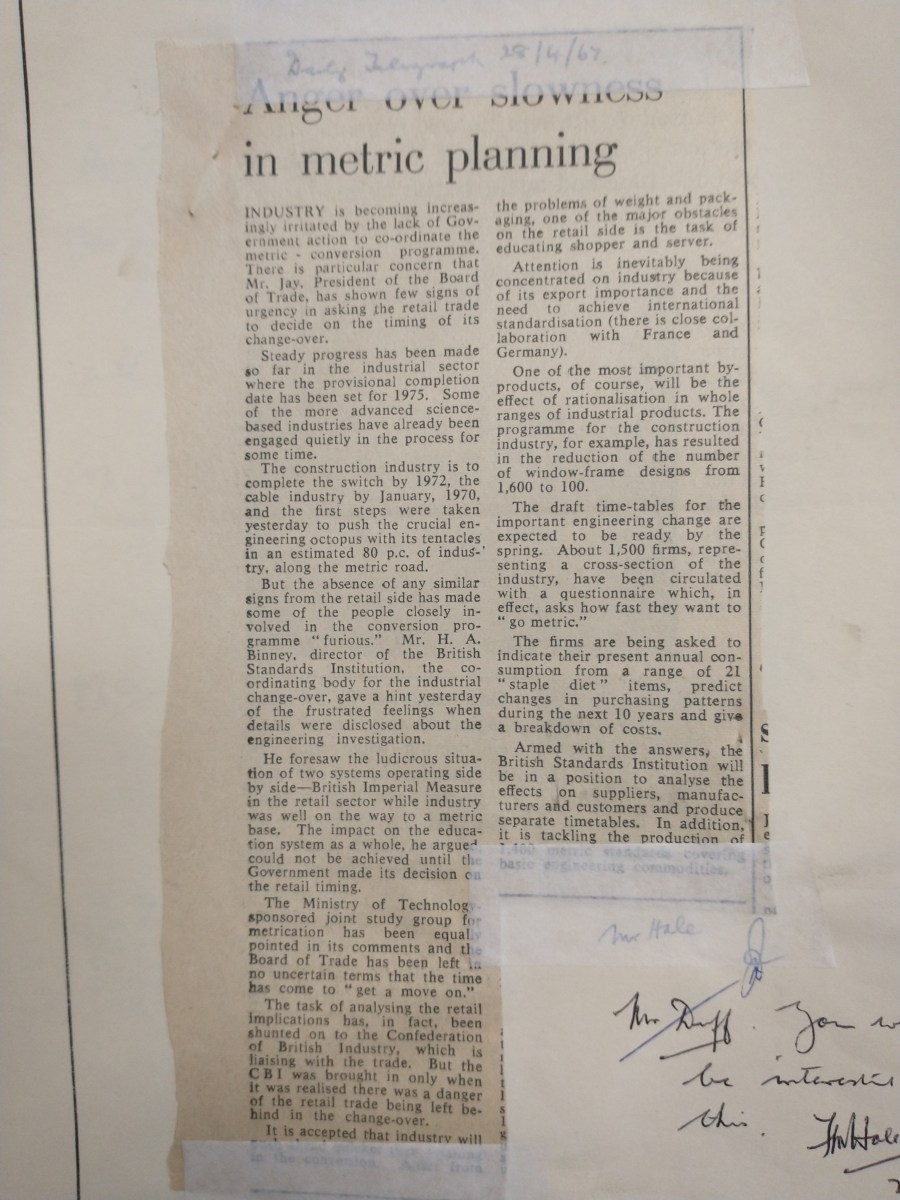
On 28 April 1967, the Daily Telegraph published an article with the headline, “Anger over slowness in metric planning”. Its opening paragraph said:
Industry is becoming increasingly irritated by the lack of Government action to co-ordinate the metric – conversion programme. There is particular concern that Mr. Jay, President of the Board of Trade, has shown few signs of urgency in asking the retail trade to decide on the timing of its change-over.
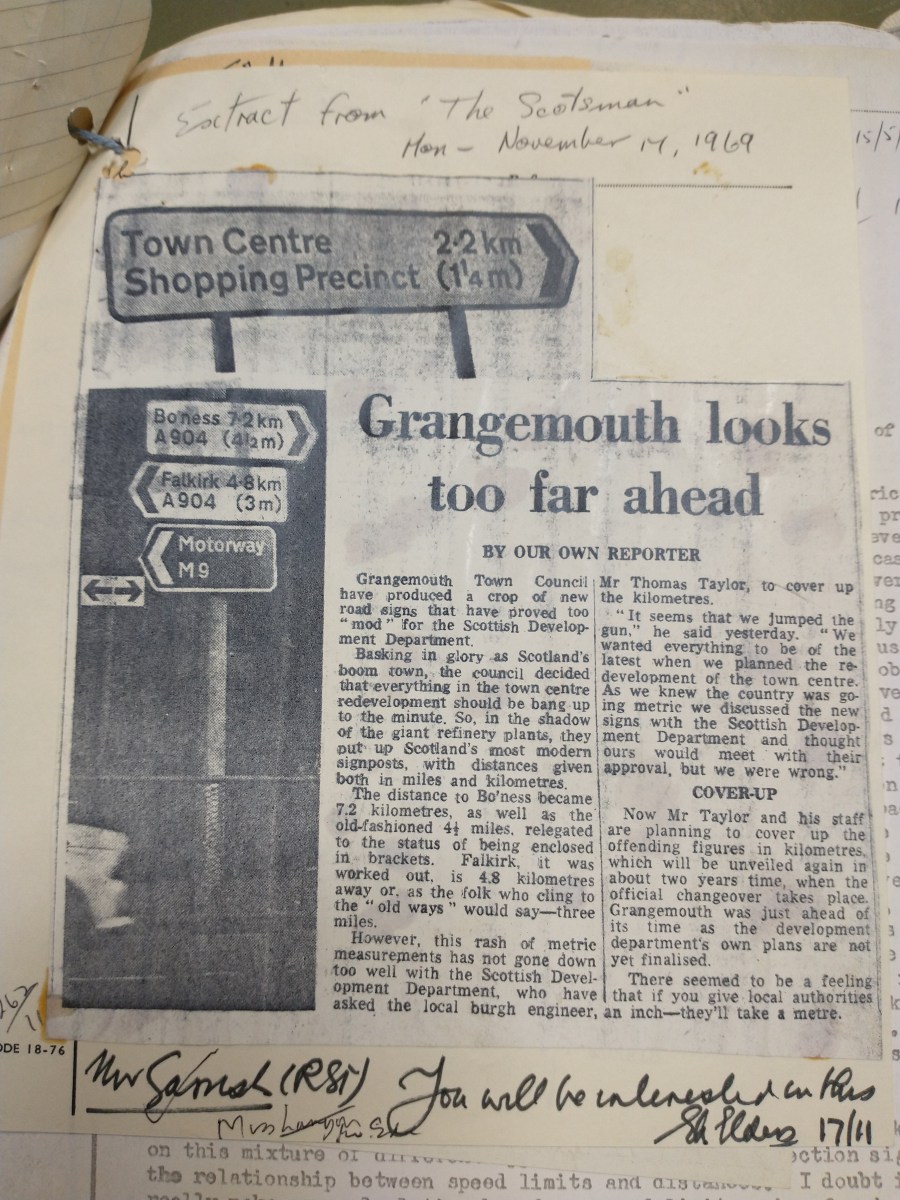
On 17 November 1969, The Scotsman reported that Grangemouth Town Council put up distance signs in kilometres ahead of the planned changeover. They proceeded two years ahead of time:
Now Mr Taylor and his staff are planning to cover up the offending figures in kilometres, which will be unveiled again in two years time, when the official changeover takes place. Grangemouth was just ahead of its time as the development department’s own plans are not yet finalised.
There seemed to be a feeling that if you give local authorities an inch – they’ll take a metre.
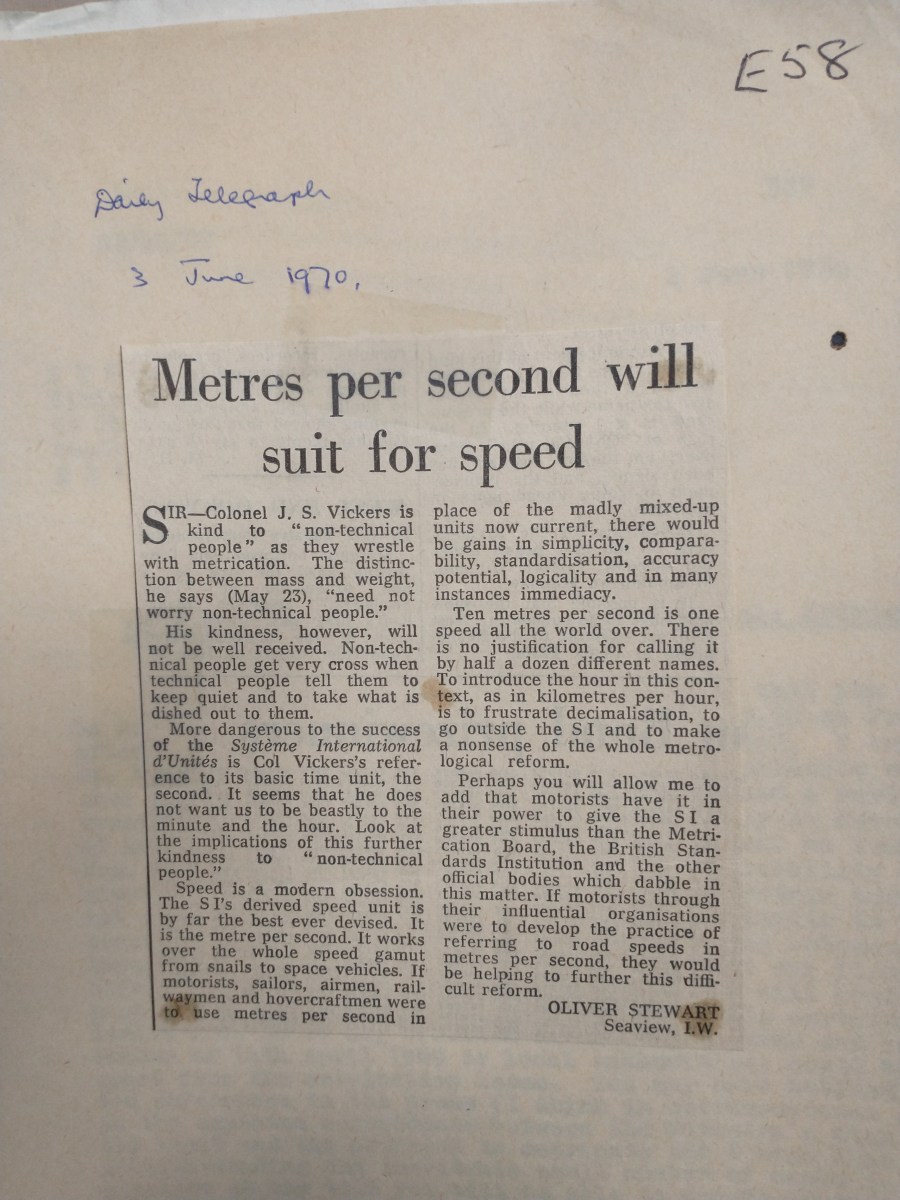
A letter by Oliver Stewart in the Daily Telegraph on 3 June 1970 made the case for describing speed in metres per second. The letter writer describes metres per second, the SI derived speed unit, as the best ever devised and argues that it is suitable for everything related to speed.
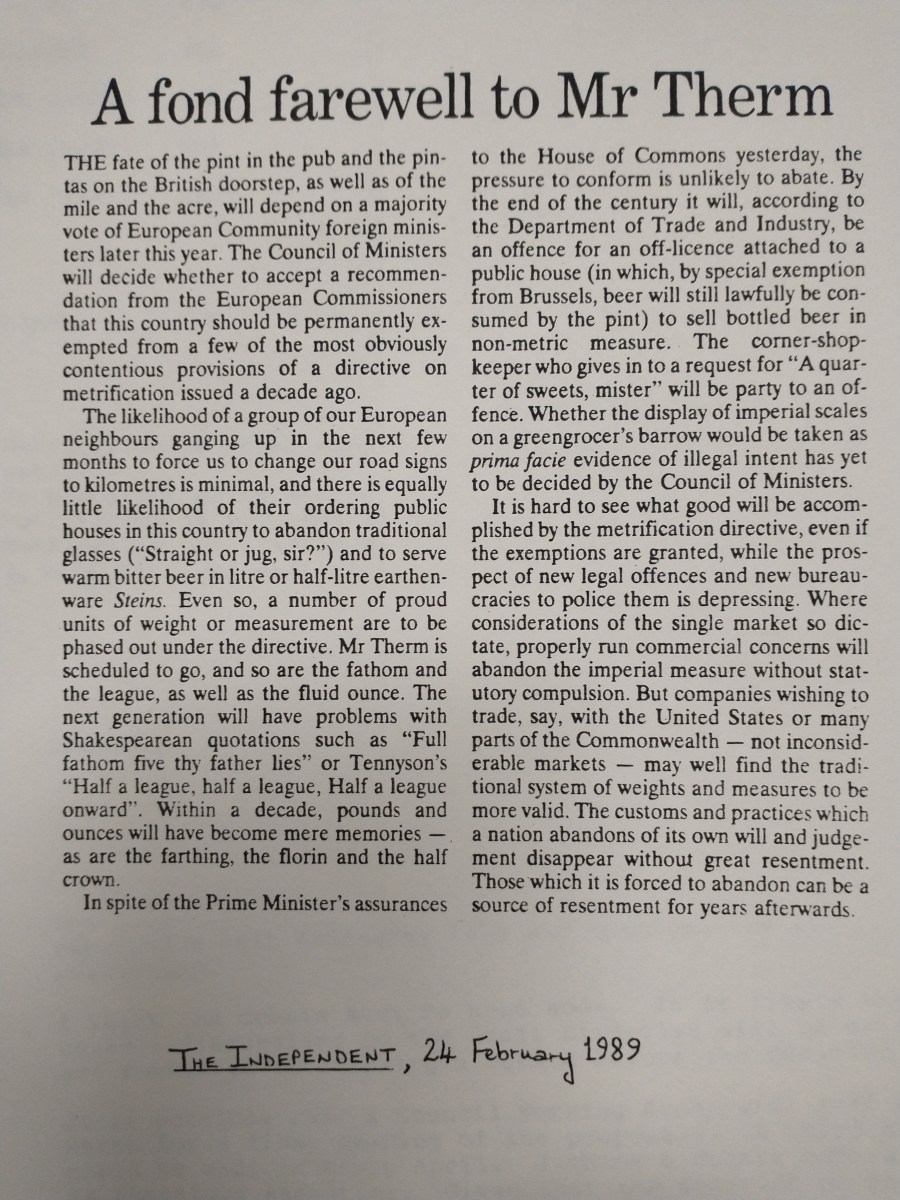
By the late 1980’s, the media became hostile towards metrication along with the political class and the general public. The consensus on metrication in the early years of the Metrication Programme was long gone. A sense of nostalgia appeared in headlines such as The Independent’s “A Fond Farewell to Mr Therm” in February 1989 and The Guardian’s “Pints, acres and therms inching towards oblivion” in February 1989.
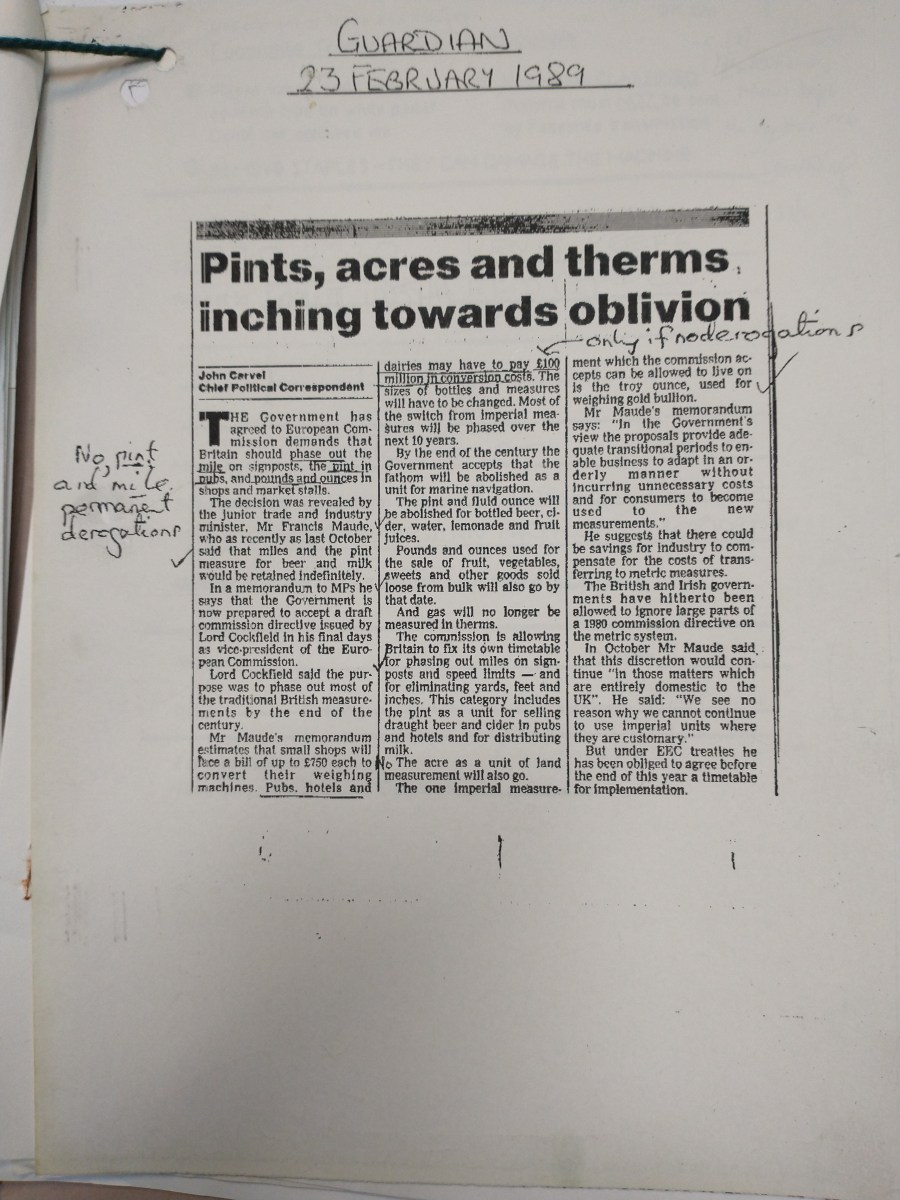
The mistakes made by British politicians have left us with an entrenched hybrid system of weights and measures and no plan to get us out of the muddle. This muddle is reflected in the media. We have borne the costs of the metric changeover without gaining the benefit of a simple, single universal system of weights and measures that are used worldwide. Hence the media rarely publish any positive articles to promote the metric system and challenge common prejudices on metrication because the metric system is perceived to be unpopular. What will it take to regain the support of the media for metrication?


Sadly, a sign of the times. It’s as if History were going backwards
LikeLike
Starmer wants to integrate with the EU on defence. This could be the thin edge of the wedge for entering the Single Market. If the government continues on this path, that could pave the way to finish the job of metrication. That is my optimistic view, at any rate. 🙂
Ezra aka punditgi
LikeLike
According to Shakespeare, Brutus said “There is a tide in the affairs of men, which, taken at the flood, leads on to fortune” (Julius Ceasar, Act IV, scene 2). In the case of metrication, the British Government spent so long trying to “get things 100% right”, that people got bored with waiting while those who had issues with metricationwere able to sway public opinion. Also, the Treasury got in the way – when things started getting more expensive than planned, they pulled the plug. This is an old Treasury trick – the costliest part is done last and it can be cancelled if they want to save money. The plug that they pulled was metrication of road signs.
Here, the Government wanted a gradual change-over – I certainly saw dual-unit speed limit signs in Mauritius in 1978 – probably the type that has been planned for the UK. Unfortunately the UK had no experience of this type of conversion. The South African conversion to decimal coinage was caried out over a period of a few months while the introduction of the D-Mark in Germany and the introduction of new guilder banknotes in the Netherlands were overnight changeovers. The change-over from driving o the left t driving on the right in Sweden was done at 05:00 on Sunday, 3 September 1967.
The Irish learnt from our mistakes and their changeover to speed limits was a weekend change, but other signs were only changed at the ends of their useful lives.
LikeLiked by 1 person
And then there was Sweden:
Sweden’s changeover from left to right-side driving, known as Dagen H (H-Day), occurred on September 3, 1967, with the actual switch taking place in a matter of minutes, although preparation took four years. Traffic was ordered to stop at 4:50 AM, switch sides, and resume driving on the right at 5:00 AM. Wikipedia +4
Key details of the transition:
So, big changes can be executed sensibly. As the saying goes, where there’s a will, there’s a way.
Ezra aka punditgi
LikeLike
punditgi:
Sweden’s changeover to driving on the right, which I remember well, has nothing to do with the metrication programme or metric signage in Britain. Nor does UKMA advocate the UK switching to driving on the right. That is a completely separate issue. I make the point so that readers do not conflate the two issues in their mind.
LikeLiked by 1 person
@metricnow
Actually, the Swedish changeover to driving on the right definitely has a connection to how a government can decide to make a big change effectively that has considerable public visibility.
Seems like a similar attitude on the part of the UK government for metrication would finally end the metric muddle.
I am confident other readers made that same connection and were not confused.
LikeLiked by 1 person
pundigti:
Closer to home in the UK, the UK’s switch to decimal currency was very much a textbook example of how to communicate with the public rationally and informatively. The fact that the base unit, the pound, remained the same, arguably helped the transition. New penny and two penny coins were completely new to the public and their values had to be learnt. The decimal five and ten pence coins could be seen as direct replacements for the one shilling and two shilling coins, so the public could relate to them, even though some people were confused by a shilling (twelve pence in the predecimal series) now being five (new) pence in the decimal series. There was some disconnect between the public information about the new currency and how people saw the values in their minds.
Thinking about how this relates to metrication, or rather the removal of the remaining imperial units in general use: there are so few imperial units left that are still legal but you cannot get away from the fact that they are some of the most important in terms of visibility, namely those left on road signs. It really wouldn’t take such a massive government information campaign to replace those signs over a period of a few years and make metric the default system in the public’s eye, quite literally.
If the government had chosen the same approach to the currency as it has to the introduction of metric as the default system, we would have had decimal and non-decimal coins in circulation alongside each, with permanent dual pricing and the ‘freedom’ to pay in the coins of your choice. The government made a deliberate choice (not that it was ever considered) not to do that, so why has it effectively allowed this to happen with the use of measurement units, leaving us with a mixture of imperial and metric and the public having to muddle its way through with no official guidance.
LikeLike
Here is another example of how confusion between metric and Imperial as long as both ways of measurement are being used can result in rather unfortunate results (Ezra aka punditgi):
LikeLike