
John Frewen-Lord tells us about his experiences of living in Cyprus and how they completed metrication successfully, unlike the UK.
If any of you watch TV’s ‘A Place in the Sun’ then no doubt you will have seen Cyprus feature fairly regularly as one of the destinations that offer lots of sunshine combined with a Mediterranean lifestyle. My wife and I, in our twilight years, decided to take the plunge, and join roughly 150 000 other British expats in moving to the Greek side of the island, doing so last year (2025). We now have official Cyprus residency. [What follows relates only to the Greek part of Cyprus, with about 80% of the total population. The island was invaded by Turkey in 1974, and the Turkish side, about one-third of the island and not officially recognised by any country except Turkey, can be a bit problematical in terms of exiting back to the Greek side, and therefore remains more-or-less ‘off-limits’ as far as non-Cypriot expats are concerned.]
Cyprus was of course owned by the British, from 1878 until 1960, when it gained its independence. The British influence is still very apparent. You drive on the left in a right-hand drive car, give way to pedestrians at Belisha-beaconed zebra crossings (or at least are supposed to – local drivers often consider that as optional), try not to park on double yellow lines, and wait at a red traffic light for it to turn red-and-amber before turning green. Your three pin British plugs work perfectly in a square-holed shuttered 240 V mains socket, and the majority of locally-born Cypriots speak English to a greater or lesser extent, albeit very much as a second language (Greek of course being their first and the only official language on the island). Today Cyprus, with an area of 9251 km², is part of the EU (even though technically it is in Asia), joining in 2004. The currency, adopted in 2008, is the Euro (€), and I have yet to see any evidence of its previous currency, the Cyprus pound.
So it comes as a very welcome surprise to find virtually no trace of non-metric measurement units! And the reason for this is very clear. Like many other countries with successful metric conversion programs, when Cyprus converted to SI, in 1986 to 1988, it did it with no messing around – no drawn-out transition periods, no exceptions, no voluntary options, no dual permissions. Today it is very hard to find any traces of its previous measurement units, even though they existed as little as 38 years ago, some of them going back hundreds of years. Let us take a brief look at how it was before 1986.
Being once British, Cyprus standardised on all the normal British imperial units as its official measurement system, implemented in 1890, and then combined that with quite a few quirky local ones, derived from Cyprus’ Ottoman and Byzantine heritage. These include the pic (equal to two imperial feet or 609.6 mm); the donum (the only official unit for area until 1986, equal to 1337.8 m² and itself divided into four evleks); and the oke, equal to exactly 2.8 pounds avoirdupois or 1.27 kg, and which itself was divided into four onjas, each of them having a mass of 100 drams. Combined with all the standard British imperial units, this was a bit of a mess!
In terms of capacity, things were even messier. There was the kilé, equal to one Imperial bushel or eight imperial gallons (36.3687 L) and which was the base unit for capacity. Other units used (for dry and liquid measures) were the oke (also used for mass – see above), equal to 1.273 L; the Cyprus litre, equal to 3.1823 L; the kartos, equal to 5.092 L; the kouza, equal to 10.23 L; and the gomari or load, equal to 163.66 L or 16 kouzas or 36 imperial gallons. The legal definition of the gallon in Cyprus was not the same as in the UK, and in fact the 1965 definition was used. (Note that most of the above conversions have been rounded to two, three or four decimal places as appropriate, while I have retained Cyprus’ use of the upper case L as the symbol for the litre.)
Starting in 1986, and completed in 1988, all of that sometimes bizarre mess of measurement units was swept away, and Cyprus converted to SI. The implementation of weights and measures in Cyprus is governed through the Weights and Measures Service (WMS). This is from its website:
Central Government exercises metrological control through the Weights and Measures Service (WMS), which is part of the Ministry of Energy, Commerce, Industry and Tourism. WMS is the competent authority for the enforcement of the Weights and Measures Legislation. Its principal aim is to ensure that accuracy of measurements is maintained, both at trade level as well as at scientific level.
The main functions / responsibilities of WMS concern the application of SI units, the custody and preservation of the national standards of units of measurement, the initial and periodic verification of measuring instruments used in trade transactions and in industrial production and the control of pre-packaged products sold by mass, volume, length, area or number. In parallel, WMS is responsible for the transposition of the relevant EU Legislation into National Legislation, the drafting of primary as well as subsidiary legislation relating to weights and measures and pre-packaged products and the implementation and enforcement of such legislation and of course the rendering of metrological services to the industry. A uniform system of weights and measures was first introduced in Cyprus in 1890 and the SI units became the legal units of measurement in 1988.
The transformation into SI, completed in 1988, was total. And it seems the local populace ‘bought’ into it. In the UK, people still use imperial units even in areas where things are otherwise completely metric. Not so in Cyprus. Ask anyone (at least those who speak English) for directions – if any distances are involved, the answer will be in metres/kilometres, even from older generations who would have grown up with the previous units of measure. Buy anything in any shop – the displayed measurements will be in metric, as will any discussions you have with shop staff. The grizzly old man in a local timber yard advised me that the wood plank I was looking to buy was 90 mm wide by 22 mm thick by 4 m long, and asked me where I wanted him to cut it so it would fit into my car – at the halfway 2-m mark or somewhere else? The only time I have come across anything non-metric was when talking to an assistant in a DIY shop. Seeing as I was from the UK, he attempted to convert things to inches (not very successfully), and I had to stop him and say centimetres are just fine! All the tape measures I have seen are metric-only.
Which brings up one interesting aspect of linear measurements in Cyprus. Like in many European countries, the centimetre is very often used in preference to the millimetre, or even whole metres. The frame on the roller shutter garage door on my house is hand-marked with the number 282.5, which I was sure related to a centimetre dimension somewhere. Sure enough, it measured 2825 mm from bottom to top. The use of centimetres in this way is very common and usually the norm in construction and DIY.
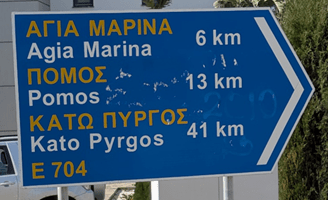
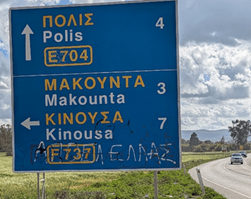
Road signs are of course entirely metric, and follow standard international (and certainly EU) practice. Distances on signposts are marked in kilometres (sometimes with, sometimes without, the km symbol – there seems to be no reason or logic for this as far as I can see), and heights of bridges, altitudes, etc, are in metres.
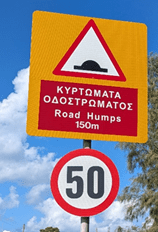
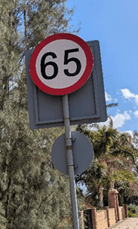
Shorter distances – e.g. to a junction – are also in metres. Speed limits are always in km/h – but with one little quirk. A limit of 65 km/h is very common on some urban or narrower rural roads. Why 65 and not either 60 or 70? Local Cypriots I have asked have no answer, and I can only assume it is a direct conversion from an old 40 mi/h limit. Otherwise limits consist of 20 km/h in some residential areas, 30 over speed bumps, 50 in towns and villages, 80 on two-lane main roads, and 100 km/h on the only motorway, between Paphos and Larnaca.
Does any imperial still exist anywhere? You can find it if you look for it. Residential plumbing used inch pipe sizes until recently, and the cast iron fittings in my 18 year old house are marked as either ½” or ¾”. I recently bought a locally-made bag of topsoil from our local garden centre, and as well as the capacity marked in litres (70 L), bizarrely the cubic feet equivalent was also labelled, albeit in very small print in parentheses. Why I have no idea, as I’ve never seen any use of this imperial measure anywhere. Other than imported dual-labelled products, it is the only example of a non-metric product label I have come across.
Why can’t we British (and Canadians for that matter) do the same as Cyprus and fully implement SI conversion? It must be a facet of the so-called British exceptionalism. I find it really annoying when my British friends and neighbours persist in using imperial units in this very metric country. One good friend, who has lived here for over 20 years (albeit with frequent visits back to the UK) still talks in miles. He claims it is because his car, which he brought with him from the UK when he moved here, is calibrated in miles, so he sees no reason to convert. My neighbour, a just-retired kitchen fitter and therefore fully conversant with using metric units in his work, describes the height of the trees in his garden in feet. Urgh!
Finally some other observations in Cyprus. The use of the comma and the full stop for decimal markers and thousands separators is completely mixed – even from the same shop! One shop we use regularly will show the comma as the decimal marker on its own receipt, while the accompanying debit card transaction receipt uses the full stop. A large real estate sign I regularly pass advertises the fact that 14.000 m² of land is available for sale.
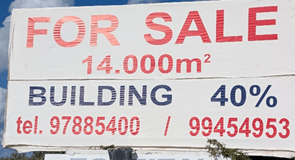
You quickly get used to this mix-up. The preferred SI use of a space as the thousands separator seems quite rare.
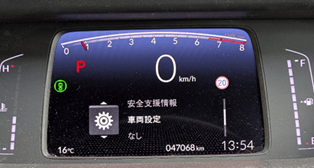
Another observation (and more relating to the EU rather than metric per se,) is Cyprus’ approach when it comes to cars. A high proportion of cars here (including mine, a 2022 Honda Fit) are direct imports that have been exported after being owned and used as home market cars in Japan (Japan of course being also a RHD country). Mine had 41 200 km on it when I bought it, having literally just arrived off the boat and still wearing its Japanese number plates when I negotiated its purchase. It fails 2022 EU specifications in a number of areas – no daytime running lights, no rear fog lights, the lighting/indicator stalk is on the right and the wiper stalk on the left (as in most RHD countries other than the UK and ROI), and the messages on the instrument display are all in Japanese. As it had to pass a safety test before it could be registered and given CY number plates, Cyprus must accept this situation. Whether the EU will allow it to continue I have no idea.
Cyprus must surely be a great example that countries, like for example Australia, CAN implement metric conversion – quickly, completely and successfully. It just takes a bit of a positive attitude and no pandering to those who try to resist because they can’t be bothered or are afraid of change.

 Metric Views