
John Frewen-Lord tells us about his experiences of living in Cyprus and how they completed metrication successfully, unlike the UK.
If any of you watch TV’s ‘A Place in the Sun’ then no doubt you will have seen Cyprus feature fairly regularly as one of the destinations that offer lots of sunshine combined with a Mediterranean lifestyle. My wife and I, in our twilight years, decided to take the plunge, and join roughly 150 000 other British expats in moving to the Greek side of the island, doing so last year (2025). We now have official Cyprus residency. [What follows relates only to the Greek part of Cyprus, with about 80% of the total population. The island was invaded by Turkey in 1974, and the Turkish side, about one-third of the island and not officially recognised by any country except Turkey, can be a bit problematical in terms of exiting back to the Greek side, and therefore remains more-or-less ‘off-limits’ as far as non-Cypriot expats are concerned.]
Cyprus was of course owned by the British, from 1878 until 1960, when it gained its independence. The British influence is still very apparent. You drive on the left in a right-hand drive car, give way to pedestrians at Belisha-beaconed zebra crossings (or at least are supposed to – local drivers often consider that as optional), try not to park on double yellow lines, and wait at a red traffic light for it to turn red-and-amber before turning green. Your three pin British plugs work perfectly in a square-holed shuttered 240 V mains socket, and the majority of locally-born Cypriots speak English to a greater or lesser extent, albeit very much as a second language (Greek of course being their first and the only official language on the island). Today Cyprus, with an area of 9251 km², is part of the EU (even though technically it is in Asia), joining in 2004. The currency, adopted in 2008, is the Euro (€), and I have yet to see any evidence of its previous currency, the Cyprus pound.
So it comes as a very welcome surprise to find virtually no trace of non-metric measurement units! And the reason for this is very clear. Like many other countries with successful metric conversion programs, when Cyprus converted to SI, in 1986 to 1988, it did it with no messing around – no drawn-out transition periods, no exceptions, no voluntary options, no dual permissions. Today it is very hard to find any traces of its previous measurement units, even though they existed as little as 38 years ago, some of them going back hundreds of years. Let us take a brief look at how it was before 1986.
Being once British, Cyprus standardised on all the normal British imperial units as its official measurement system, implemented in 1890, and then combined that with quite a few quirky local ones, derived from Cyprus’ Ottoman and Byzantine heritage. These include the pic (equal to two imperial feet or 609.6 mm); the donum (the only official unit for area until 1986, equal to 1337.8 m² and itself divided into four evleks); and the oke, equal to exactly 2.8 pounds avoirdupois or 1.27 kg, and which itself was divided into four onjas, each of them having a mass of 100 drams. Combined with all the standard British imperial units, this was a bit of a mess!
In terms of capacity, things were even messier. There was the kilé, equal to one Imperial bushel or eight imperial gallons (36.3687 L) and which was the base unit for capacity. Other units used (for dry and liquid measures) were the oke (also used for mass – see above), equal to 1.273 L; the Cyprus litre, equal to 3.1823 L; the kartos, equal to 5.092 L; the kouza, equal to 10.23 L; and the gomari or load, equal to 163.66 L or 16 kouzas or 36 imperial gallons. The legal definition of the gallon in Cyprus was not the same as in the UK, and in fact the 1965 definition was used. (Note that most of the above conversions have been rounded to two, three or four decimal places as appropriate, while I have retained Cyprus’ use of the upper case L as the symbol for the litre.)
Starting in 1986, and completed in 1988, all of that sometimes bizarre mess of measurement units was swept away, and Cyprus converted to SI. The implementation of weights and measures in Cyprus is governed through the Weights and Measures Service (WMS). This is from its website:
Central Government exercises metrological control through the Weights and Measures Service (WMS), which is part of the Ministry of Energy, Commerce, Industry and Tourism. WMS is the competent authority for the enforcement of the Weights and Measures Legislation. Its principal aim is to ensure that accuracy of measurements is maintained, both at trade level as well as at scientific level.
The main functions / responsibilities of WMS concern the application of SI units, the custody and preservation of the national standards of units of measurement, the initial and periodic verification of measuring instruments used in trade transactions and in industrial production and the control of pre-packaged products sold by mass, volume, length, area or number. In parallel, WMS is responsible for the transposition of the relevant EU Legislation into National Legislation, the drafting of primary as well as subsidiary legislation relating to weights and measures and pre-packaged products and the implementation and enforcement of such legislation and of course the rendering of metrological services to the industry. A uniform system of weights and measures was first introduced in Cyprus in 1890 and the SI units became the legal units of measurement in 1988.
The transformation into SI, completed in 1988, was total. And it seems the local populace ‘bought’ into it. In the UK, people still use imperial units even in areas where things are otherwise completely metric. Not so in Cyprus. Ask anyone (at least those who speak English) for directions – if any distances are involved, the answer will be in metres/kilometres, even from older generations who would have grown up with the previous units of measure. Buy anything in any shop – the displayed measurements will be in metric, as will any discussions you have with shop staff. The grizzly old man in a local timber yard advised me that the wood plank I was looking to buy was 90 mm wide by 22 mm thick by 4 m long, and asked me where I wanted him to cut it so it would fit into my car – at the halfway 2-m mark or somewhere else? The only time I have come across anything non-metric was when talking to an assistant in a DIY shop. Seeing as I was from the UK, he attempted to convert things to inches (not very successfully), and I had to stop him and say centimetres are just fine! All the tape measures I have seen are metric-only.
Which brings up one interesting aspect of linear measurements in Cyprus. Like in many European countries, the centimetre is very often used in preference to the millimetre, or even whole metres. The frame on the roller shutter garage door on my house is hand-marked with the number 282.5, which I was sure related to a centimetre dimension somewhere. Sure enough, it measured 2825 mm from bottom to top. The use of centimetres in this way is very common and usually the norm in construction and DIY.
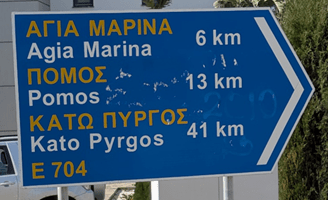
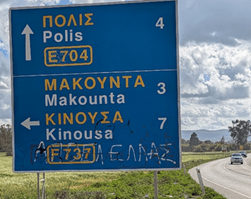
Road signs are of course entirely metric, and follow standard international (and certainly EU) practice. Distances on signposts are marked in kilometres (sometimes with, sometimes without, the km symbol – there seems to be no reason or logic for this as far as I can see), and heights of bridges, altitudes, etc, are in metres.
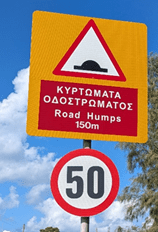

Shorter distances – e.g. to a junction – are also in metres. Speed limits are always in km/h – but with one little quirk. A limit of 65 km/h is very common on some urban or narrower rural roads. Why 65 and not either 60 or 70? Local Cypriots I have asked have no answer, and I can only assume it is a direct conversion from an old 40 mi/h limit. Otherwise limits consist of 20 km/h in some residential areas, 30 over speed bumps, 50 in towns and villages, 80 on two-lane main roads, and 100 km/h on the only motorway, between Paphos and Larnaca.
Does any imperial still exist anywhere? You can find it if you look for it. Residential plumbing used inch pipe sizes until recently, and the cast iron fittings in my 18 year old house are marked as either ½” or ¾”. I recently bought a locally-made bag of topsoil from our local garden centre, and as well as the capacity marked in litres (70 L), bizarrely the cubic feet equivalent was also labelled, albeit in very small print in parentheses. Why I have no idea, as I’ve never seen any use of this imperial measure anywhere. Other than imported dual-labelled products, it is the only example of a non-metric product label I have come across.
Why can’t we British (and Canadians for that matter) do the same as Cyprus and fully implement SI conversion? It must be a facet of the so-called British exceptionalism. I find it really annoying when my British friends and neighbours persist in using imperial units in this very metric country. One good friend, who has lived here for over 20 years (albeit with frequent visits back to the UK) still talks in miles. He claims it is because his car, which he brought with him from the UK when he moved here, is calibrated in miles, so he sees no reason to convert. My neighbour, a just-retired kitchen fitter and therefore fully conversant with using metric units in his work, describes the height of the trees in his garden in feet. Urgh!
Finally some other observations in Cyprus. The use of the comma and the full stop for decimal markers and thousands separators is completely mixed – even from the same shop! One shop we use regularly will show the comma as the decimal marker on its own receipt, while the accompanying debit card transaction receipt uses the full stop. A large real estate sign I regularly pass advertises the fact that 14.000 m² of land is available for sale.

You quickly get used to this mix-up. The preferred SI use of a space as the thousands separator seems quite rare.
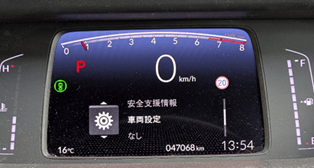
Another observation (and more relating to the EU rather than metric per se,) is Cyprus’ approach when it comes to cars. A high proportion of cars here (including mine, a 2022 Honda Fit) are direct imports that have been exported after being owned and used as home market cars in Japan (Japan of course being also a RHD country). Mine had 41 200 km on it when I bought it, having literally just arrived off the boat and still wearing its Japanese number plates when I negotiated its purchase. It fails 2022 EU specifications in a number of areas – no daytime running lights, no rear fog lights, the lighting/indicator stalk is on the right and the wiper stalk on the left (as in most RHD countries other than the UK and ROI), and the messages on the instrument display are all in Japanese. As it had to pass a safety test before it could be registered and given CY number plates, Cyprus must accept this situation. Whether the EU will allow it to continue I have no idea.
Cyprus must surely be a great example that countries, like for example Australia, CAN implement metric conversion – quickly, completely and successfully. It just takes a bit of a positive attitude and no pandering to those who try to resist because they can’t be bothered or are afraid of change.


I was talking to someone who works with me and who is from Malaysia. He used Google Earth to show me his home town of Penang and I noticed a height restriction sign that looks just like the one I have linked to below:
https://commons.wikimedia.org/wiki/File:Malaysia_road_sign_RP6.svg
Too bad the UK has not adoped metric-only height and width restriction signs yet. Maybe the next incarnation of a Labour government? Or of the Greens???
Ezra aka punditgi
LikeLike
punditgi,
The sign shown in the link is a part of the signage developed as part of the Vienna Convention. Vienna Convention signage is pretty much the standard signs used in almost every country. There are some minor variations between the Vienna Convention standard and what some use but for the most part they are all understandable by citizens of countries who use Vienna Convention signage.
https://unece.org/DAM/trans/conventn/Conv_road_signs_2006v_EN.pdf
LikeLike
I have noticed on YouTube that more and more metric is being used on English language videos whether from the UK or from the USA, sometimes even metric only videos are being made.
Too often, though, the videos from the UK reveal the metric muddle by using “miles” and even “pounds” alongside “metres”, “litres” “kilograms”., and “degrees Celsius”. Americans watching those videos would be more persuaded by the prevalence of metric over Imperial in the world if those UK videos used “kilometres”, which will happen after road signs have been converted to metric.
The British are still seen by most Americans as educated and authoritative, so the more we see British programs and videos using pure metric the more status that usage will have in our eyes (more so than our view of Australians due to their slightly odd accent). Maybe fully metric British videos, television programs, and films will finally persuade us to make the change ourselves some day.
Ezra aka punditgi
LikeLiked by 1 person
In most Commonwealth countries (plus Ireland and South Africa but excluding Canada), currency decimalisation preceded metrication by a few years, but within living memory. By its very nature, currency decimalisation had to follow a “big bang” process (1955 in Cyprus, 1957 in India and 1961 in South Africa). It affected everybody and, provided it was properly controlled, the population at large saw the benefits and were happy to live short-term inconveniences.
In the case of Britain, metrication came first and the ground rule for a gradual change-over without government help were already in place. Currency decimalisation came as metrication was gathering pace and was poorly managed (many price rises were sneaked in under the guise of decimalisation), so the British population were suspicious of this type of change.
In addition to having experience of decimalisation before metrication, many Commonwealth countries saw metrication was an expression of independence from nineteenth century British control and an adoption of twentieth century world standards.
LikeLike
I’m wondering about how easy it would be to switch over cars in the UK to metric in the event of a sign change. In the US, even cars with digital displays, some units can’t be changed. For example, my car, I have both an analog and digital speedometer. The digital speedometer and odometer can be changed back & forth from miles to kilometres, but the temperature is locked in foreignheat mode.
If one buys a new car today and these cars can last 15 years or more past metrication, FFU units can linger on for a long time after metrication if the devices can’t be changed or if the owners insist on keeping them in FFU mode long after metrication.
Cars should be made such that on the date of metrication their firmware would automatically be updated via satellite such that their displays would be fully metric. Forcing metrication of the vehicles on everyone.
LikeLike
As the UK inches (pun intended) closer to rejoining the EU, all of the deviations that the UK had before leaving will no longer be on the table. Eventually, I believe the UK will in fact rejoin and the exception the UK had to keep Imperial road signs will no longer be available. And that will be the final nail in the coffin for Imperial (except for stones, which isn’t even Imperial anyway).
LikeLiked by 1 person
@Daniel: When South Africa metricated, they did not have dual unit speedometer displays. Last year’s model had an mph display and ths year’s model had a km/h display. It did not take long for the average driver to work out that 35 mph was about 60 km/h (old and new speed limits in towns) or that 70 mph was about 120 km/h (old and new speed limits on the open road). A year or two after after metrication happened, there was an oil crisis and to save fuel, speed restrictions were dramatically reduced with heavy fines for speeding. I had an “old banger” at the time and I very quckly learnt the mph equivalents of 50, 60, 80 100 and 120 km/h. The threat of a heavy fine enhanced the learning process.
If you want a quick conversion, all you need do is remember the sequence “30-50-80” (ie 30 mph is about 50 km/h and 50 mph is about 80 km/h). You can of course go for the “luxury model” and remember the sequence “20-30-50-80-130”
LikeLiked by 1 person
punditgi,
Where are you getting information that the UK is showing interest in rejoining the EU? Who in the UK is making any comments on this? It’s been 10 years already since the UK left and the people of the EU are not feeling any pain from it. Even if the UK citizens would agree to no deviations and would not only have to accept full metrication and also agree to join the euro, it doesn’t mean that some in the UK won’t push at the EU from time to time to accept some of its differences.
In order for the citizens of the UK to see the benefit of rejoining the EU again, it would have to be completely isolated in the world. The citizens of the UK hope they could link with the US where they have at least some common history and culture. However, Donald Trump wants nothing to do with England or Europe and is looking at options to leave NATO. If the UK loses all hope of a link to the US, then its people might have no choice but to look east. Are the people of England willing to join the EU and are the people of the EU willing to also look east and link with Russia? They may need to as Russia holds all of the important cards, those being resource cards that the EU and England don’t have, With Russia’s resources and Europe’s manufacturing strength, a unified Europe-Asia super power from Lisboa on the Atlantic to Vladivostok on the Pacific would shake the world.
LikeLike
punditgi,
I did a Google search on your assertion that the UK is moving closer to rejoining the EU. This is what Google AI came up with:
Public support for rejoining the European Union has grown, with over 53% of British voters favoring re-entry ten years after the 2016 referendum, particularly driven by supporters of the Labour, Liberal Democrat, and Green parties. Despite high public support, the UK government is not pursuing full re-entry, focusing instead on a “reset” for closer ties, including rejoining the Erasmus+ student scheme.
Key Developments and Public Opinion (As of April 2026):
Challenges to Rejoining:
What I found interesting in this search is what is called “Legislative Reset”. The government is preparing legislation to align with European standards in specific sectors.
This could be good for completing metrication if that is what it is intended to mean. SI is not only a European standard but a world standard. Other than some Luddites who will always be a pain in the backside, I feel very few will find a problem completing metrication.
One area where the conversion of road signs becomes important is where I mentioned in another post the problem with automotive driver display panels. The use of displays that are different from country to country makes for a lot of issues when these vehicles are sold as second hand in countries that have a different display standard, meaning one display is in FFU and another is in SI. Once they are all in SI units only, then there will be only one type and there will be no need to have to worry about compatibility issues across border.
LikeLike
@Daniel
Recent polling in the UK shows that a majority of respondents favour rejoining the EU.
Whatever happens, it will be a long and arduous road wherever that leads.
Ezra aka punditgi
LikeLike
punditgi,
Yes, I’m aware of the recent poll findings. If you read my post clearly, you would have seen this. But, 53 % of the population is not an overwhelming majority. Also, despite the positive outcome of the polls, the UK government is not pursuing full re-entry, focusing instead on a “reset” for closer ties.
Did you read the part about the Legislative reset? This is important. If the members of the UK government are truly serious about preparing legislation to align with European standards in specific sectors, this could mean that they are looking at restarting metrication and working to complete it. There are actually very few sectors of the English economy that would be affected. The cost of metricating the road signs would be offset by the standardisation of automotive displays and a huge cost reduction not only to the automotive manufacturers but to consumers on both sides of the border who have to endure costly changes to the instrument panel if the vehicle is sold in or outside of England. No more need for manufacturers to produce one panel for England and another for everyone else.
We need to keep an eye on this Legislative “reset” to see if it is meant to include the completion of metrication and if not, why not? This is our only hope for a completion of metrication in England.
LikeLike
Canada is still in the throes of its own metric muddle as see by this data sheet for a Neptune water transmission unit. Toronto is currently switching over to new water transmission unit according to this CTV news report. It looks like the meters will use cubic meters to measure water flow. But the pipe fittings look to be Imperial. At least the meters won’t be showing gallons (US or Imperial)!
LikeLike
Sometimes we get some strange packaging here in the USA when the manufacturer or distributor of a product prints specifictions on the packaging in both English and Spanish or English and French. Very often, while the English uses US Customary units the Spanish or French uses metric units. But this is not consistent and sometimes the non-English language specs on the package will use US Customary for some things and metric for other things.
A complete mess!
Ezra aka punditgi
LikeLike