Are Imperial units based on 12s?

It is often claimed that imperial is based on 12s (duodecimal) and that this has advantages over decimal. But is this truth or myth?

Of course it makes more sense to use the same number system for measurement, money and other practical uses. But let’s look at whether imperial is duodecimal.

Consider length:
One foot = 12 inches
One yard = 3 feet
One rod = 5.5 yards
One chain = 4 rods
One furlong = 10 chains
One mile = 8 furlongs
Only the foot uses a base of 12.

Consider volume:
One pint = 20 fluid ounces
One gallon = 8 pints
No duodecimal units

Consider avoirdupois weight:
One pound = 16 ounces
One stone = 14 pounds
One hundredweight = 8 stones
One imperial ton = 20 hundredweight
Again no duodecimal units

A disadvantage of imperial is that it does not have any consistent number system but uses a hodgepodge of bases.

LACORS confirms imperial units illegal for office floorspace – Government advice misleading

LACORS (the Local Authority Co-ordinators of Regulatory Services) has confirmed its earlier advice that, where office floorspace is let per unit of floorspace, that unit must be metric. In doing so, it implicitly says that previous Government advice on this matter is wrong and/or misleading.

MetricViews has previously reported that LACORS originally gave this advice to an individual local authority as long ago as 2004. However, some trading standards officers in other local authorities were reluctant to follow this advice without full authentication from LACORS. [LACORS is funded and supported by all the local authority associations in the UK].
UKMA has now received a letter from LACORS on headed notepaper confirming the previous advice. Using this letter it will now be possible to challenge estate agents who advertise office rents “per sq ft” rather than per m2. The full text of this letter can be read here.

Previous Government advice (dating from 1995 but still available at this link) has been that “the majority of commercial transactions in goods, land and services are not regulated by the Weights and Measures Act 1985. These transactions are therefore not subject to any express sanction under provisions in UK legislation that regulate the use of units of measurement”. While this statement is literally true, it is misleading since it omits the important fact that where a transaction in goods, land and services is by reference to quantity, the measurement units used must be metric. This is explained more fully by LACORS.
The key passage of the LACORS letter reads as follows:

“If a transaction relating to land or floor space is a transaction by reference to quantity, such that the units of measurement are in use for trade (as opposed to a transaction by specification) it is LACORS view that the transaction is regulated by the Weights and Measures Act 1985.

As stated in our Guidance issued in August 2004:-

‘The relevant section of the Weights & Measures Act 1985 reads as follows:

“Section 8. Units of measurement, weights and measures lawful for use for trade.

(1) No person shall-
(a) use for trade any unit of measurement which is not included in Parts I to V of Schedule 1 to this Act…”

It can be clearly seen from Schedule 1 that imperial units including the foot, square foot etc may NOT be used for trade, since they do not appear in Parts I to V of that Schedule.

The definition of ‘use for trade’ is found in Section 7:

“7. Meaning of ‘use for trade’.

(1) In this Act ‘use for trade’ means, subject to subsection (3) below, use in Great Britain in connection with, or with a view to, a transaction falling within subsection (2) below where-
(a) the transaction is by reference to quantity or is a transaction for the purposes of which there is made or implied a statement of the quantity of goods to which the transaction relates, and
(b) the use is for the purpose of the determination or statement of that quantity.

(2) A transaction falls within this subsection if it is a transaction for-
(a) the transferring or rendering of money or money’s worth in consideration of money or money’s worth, or
(b) the making of a payment in respect of any toll or duty.

A unit of measurement may, therefore, be deemed to be in ‘use for trade’ if it is used in connection with a transaction involving the rendering of money, where the transaction is by reference to quantity.

Since 7(1)(a) can be split into two separate clauses (that is to say ‘the transaction is by reference to quantity’ or ‘is a transaction for the purposes of which there is made or implied a statement of the quantity of goods to which the transaction relates’). In the former case, there is no requirement for the transaction to involve a quantity of ‘goods’.

LACORS interpretation of the legislation is that transactions where units of measurement are used for trade, including the sale, rental and leasing of property, floor space, land, ete. are covered by this legislation. Therefore, any reference to quantity whether voluntary or otherwise, must be made in metric units.’

In summary of the above, LACORS considers that any ‘transaction by reference to quantity’ , as opposed to a transaction by reference to a description, falls within the scope of the Weights & Measures Act 1985 Part 7(1)(a), and there is no requirement for the transaction to be for ‘goods’.

…….

It is LACORS view that a transaction for the provision of a service could be a transaction by reference to quantity and therefore could fall within the scope of the Weights & Measures Act 1985 Part 7(1)(a). Your example of carpet fitting by ‘price per square metre’ would appear to be an example of this type of transaction.”

This advice seems definitive and authoritative, and effectively settles the argument over whether letting office space per sq ft is legal. Local authorities should therefore be enforcing these rules, and where TSOs are reluctant to act, they should be referred to the LACORS advice in this article and at the above link.

First Emperor showed the way – 2000 years ago

I recently had the pleasure of visiting the splendid (Chinese) First Emperor exhibition at the British Museum. Apart from the terracotta warriors, what impressed me the most was the way that Qin Shihuangdi imposed standardisation on his vast empire – including, of course, weights and measures.

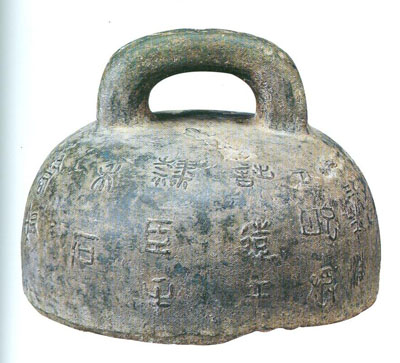
Qin Shihuangdi unified China by conquest in 221 BC. One of his first acts was to decree that only standard weights and measures were to be used throughout the empire. The bronze weight illustrated below is inscribed as follows: “In the 26th year [of his reign the king of Qin] united the princes of the [individual] states; the people enjoyed peace, and he was proclaimed emperor [huangdi]. He issued an edict that all weights are to be standardised. Where they are not uniform, or where there are any doubts, let them be standardised and classified.”


(Acknowledgements to the Trustees of the British Museum)

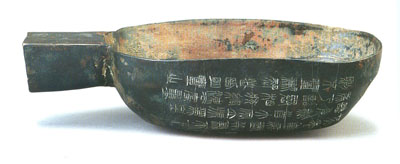
Also of interest is the measuring cup illustrated below. Its capacity is a “half dou”, which was the most popular size in use. Strangely enough, it is almost exactly equivalent to one litre. Obviously, this must be sheer coincidence, but it does give the lie to the British imperialists’ claim that the pint is “natural”, whereas the litre is not.


(Acknowledgements to the Trustees of the British Museum)

Here in Britain the first recorded attempt to standardise weights and measures can be found in Magna Carta (1215), but it was not until 1824 that imperial measures were standardised by the first Weights and Measures Act. Unfortunately, our current crop of politicians lack the perception or the political courage (or both) to acknowledge that a single system of weights and measures is a basic requirement of a modern society. Hence we have, to quote another Chinese leader*, “one country, two systems”.

————————————————————————–
*the late Deng Xiaoping, referring to the Hong Kong Special Administrative Region

TSI cops out

The Trading Standards Institute (whose members are responsible for enforcing weights and measures law) has declined to support the UK Metric Association’s campaign for a single, rational system of measurement that everybody understands and uses for all purposes. In response, UKMA has accused the TSI of “an abdication of professional responsibility”.

Continue reading “TSI cops out”

Delia goes metric

Delia Smith’s new book, “How to cheat at cooking”, was published on 15 February, and it is ALL METRIC! Not an ounce, pint, cup or Fahrenheit is to be found between the covers of this latest volume, targeted as it is at busy people who like cooking but don’t have time for elaborate preparation.

It is 5 years since the doyenne of tv cooks last published, and in the intervening period, Delia (or more probably her publisher) appears to have accepted that imperial conversions of every metric ingredient are no longer necessary or desirable. The only arguably non-metric measures given are teaspoons and tablespoons, but as these are now standardised at 5 ml and 15 ml respectively, this is perhaps forgivable. So, well done, Delia! (Examples of her recipes can be seen at this link).

Whether to give recipes in dual metric/imperial units (and if so, which should be primary) has been a difficult issue for publishers for many years. The argument used to be that older cooks would not understand grams and millilitres (obviously, anybody over 50 is unable to learn anything new) and in any case their kitchen scales would be imperial. Then it was argued that even younger people, despite doing “home economics” exclusively in metric at school, really prefer to use the same traditional units as their parents and grandparents. Neither argument proved to be valid – but there was a potentially more weighty argument: the American market.

As the British and the Americans (not to mention Australians, Irish and others) share a common language, it is convenient for publishers if they can produce a single edition of a book for sale in all English-speaking markets. Thus even though publishers find it economic to produce cookery books in minority languages like Danish or Slovak (population ca. 5 million in each case), they have used this argument to resist producing metric-only editions for the British/Australian market and US customary editions for the American market. (This is rather like the threadbare arguments used in the recent controversy about separate metric and US customary packaging for the EU and USA markets).

In reality the argument was always somewhat shaky. Leaving aside the separate culinary tastes and traditions of the national populations, European recipes tend to measure liquid ingredients by volume (in ml) but dry ingredients by weight (in grams) whereas American recipes tend to measure both liquid and dry ingredients by volume (hence “cups” of flour). The American pint (473 ml) is of course smaller than the imperial pint (568 ml).
Problems also arise over how to convert. If the starting point is a traditional imperial recipe, do you convert 1 lb to 450 g or round it up to 500 g? Similarly, should a pint be converted to 570 ml, or rounded up to 600 ml – or down to 500 ml? Note that too much rounding can throw out the relative proportions of ingredients – e.g. if you round dry ingredients up and liquid ingredients down, your cake may dry out and burn.

Undoubtedly, the best answer is to forget about imperial/US customary units, re-measure your recipe in the correct proportions and publish it exclusively in metric units. This appears to be what Delia has done. Congratulations!

Many celebrity cooks, women’s magazines and cookery sections of newspapers have actually preceded Delia in going metric-only. Let us hope that, with Delia’s splendid example in mind, the remaining imperial holdouts will also soon fall into line.

Spain to wreck European clothing sizes initiative?

According to a BBC report the Spanish government is proposing a new clothing sizes initiative which conflicts with the European Committee for Standardisation (CEN) proposal described in Metric Views last year. If this report is true it threatens to undermine the progress that had been made toward a Europe-wide sizing system for clothes.

The BBC report can be accessed from this link. And the CEN proposal was described in Metric Views here.

According to the report, the reasoning behind the Spanish proposal appears to be that mannequins and models are too thin and as a result women risk their health by striving to lose weight in order to be able to wear the clothes seen on the catwalk and in the shop window. This may well be a serious problem, but it is difficult to see how changing the sizing system will solve it.

The European Committee for Standardisation (CEN) is a private sector body independent of the European Union. The great advantage of its proposal (known as EN 13402) is that it is based on the dimensions of the customer â?? not on an ideal model that the clothes are designed to fit. So provided that the customer knows her bust, waist and hip sizes, she should be able to find the â??best fitâ?? garments. This contrasts with the current systems in which a size 12 in one shop will be a size 14 in another shop and will not necessarily have the same relationship between bust and hip.

Much of the problem stems from the obvious fact that people vary in shape as well as in size. Consequently, a single number cannot adequately describe the person a garment is intended to fit. EN 13402 allows for this by giving two or more dimensions in the form of a pictogram, whereas (if the BBC report is correct) the proposed new Spanish system will simply repeat the same mistake. Ironically, the Spanish proposal appears to be duplicating a survey carried out by the British Standards Institution and other European standards organisations that was the basis for EN 13402.

The relevance of all this for UK metrication is that EN 13402 is based on dimensions in centimetres. It would be a great advance if British consumers could be persuaded to remember their dimensions in cm, but it was feared that the British retail industry and clothing importers might resist it precisely because it would require women to remember, say, 96-82-100 rather than 38-32-40.

If Spain really does go it alone, it will be even more difficult to achieve a common system throughout Europe.

Imperial scales may give short measure says metric group

The following news release was issued by UKMA at 02:00 on 18 January:

news release … news release … news release … news release … news release …

For immediate release

“Imperial scales may give short measure” says metric group

The general public would be well advised to avoid buying from traders who use illegal scales that only weigh in pounds and ounces – so says the UK Metric Association (UKMA). Imperial-only scales have not been checked by Trading Standards Officers for over eight years, and it is quite possible that they are no longer accurate. There is therefore a significant chance that when you buy from shop or market stall that uses illegal scales you will get less than you are paying for.

Responding to reports that a market stall-holder in Hackney is being prosecuted on Friday, 18 January for Weights and Measures offences, UKMA Chairman, Robin Paice, said; “Obviously, I can’t comment on this particular case as we don’t know the full facts. However, the publicity surrounding the case suggests that, like the so-called ‘metric martyrs’ in Sunderland and elsewhere, this is really a political stunt. People are entitled to campaign to change the law, but they are not entitled to break laws just because they disagree with them. They don’t deserve any sympathy.”

Background

Since 2000, UK law has required that all shops and markets in the UK must weigh and measure at the point of sale (checkout) in grams and kilograms. Traders’ scales are periodically tested by Trading Standards Officers (TSOs) to ensure they are accurate. However, traders can still give an equivalent price in pounds and ounces if they wish. Customers can also order in pounds and ounces if they wish, and the shopkeeper or trader simply has to weigh out an equivalent amount in grams and kilograms.

Originally, it was intended that the option to show equivalent imperial prices would be phased out after 2009, but the European Commission has now proposed that this option should be retained indefinitely. However, increasingly, supermarkets are dropping the imperial equivalents, and customers are ordering at the deli counter in grams rather than obsolete ounces.

Unfortunately, egged on by populist, Eurosceptic politicians, some traders decided in 2000 to try to defy the law and continue weighing in pounds and ounces. The so-called “metric martyrs” (more accurately, they were “imperial luddites”) were found guilty of various offences under the Weights and Measures Act and fined. All their appeals to the UK courts and even the European Court of Human Rights were rejected in 2001/2.

The current issue in Hackney appears to be an attempt to re-run the same political stunt. It is unlikely to work, as it is now obvious that the law is home-grown UK law and not dictated by Brussels. People are getting rather bored by the antics of fringe politicians seeking bogus martyrdom.

UKMA Chairman, Robin Paice added:
“The purpose of the UK law is to ensure that consumers can compare goods in the supermarket and the street market on the same basis, using the same measurement units. How can you compare tomatoes at £2.09 per kilogram in the supermarket with tomatoes at 99p per pound in the market – unless you know the conversion factors and have a pocket calculator with you? It is fundamental to consumer protection that every body uses the same measurement units.

My advice to shoppers is this:

  • Avoid traders who use illegal imperial scales. You don’t know whether you are getting short measure.
  • Don’t waste your sympathy on traders who deliberately broke the law in order to seek bogus martyrdom. The vast majority of traders operate legally and cope perfectly well with metric measures.

Every country needs a single system of weights and measures that everybody understands and uses for all purposes. Nobody needs two systems.”

Notes for editors

(a) The UK Metric Association (UKMA) is an independent, non-party political, single issue organisation which advocates the full adoption of the international metric system (“Système International” – SI) for all official, trade, legal, contractual and other purposes in the United Kingdom as soon as practicable. UKMA is financed entirely by membership subscriptions and personal donations.

(b)Further extensive background information can be found generally on UKMA’s website at www.ukma.org.uk.

(c) The following are available for interviews:

Robin Paice (Chairman of UKMA) on 023 9275 5268 or for radio/TV interviews in Portsmouth or Southampton

Derek Pollard (Secretary) on 020 8374 6997 for radio/TV interviews in London

Are imperial feet “natural” units?

With the slow transition to metric in the UK, a lot of myths have emerged regarding metric and imperial. With a New Year it is an appropriate time to examine some of these myths starting with the claim that imperial feet are ‘natural’ units.

Despite the end of the British Empire and the demise of the pith helmet, quite a few British people are nostalgic about imperial units. However, many people are not really proficient in using them and often are ignorant about their history and usage. For example, many people do not know how many yards are in a mile. When the Times carried out a straw poll in early 2006 answers given for yards in a mile ranged from 52 to 10 000. The vast majority of people – even elderly – cannot explain how an acre is defined.

It has been often claimed in the British news media and by imperial supporters that imperial units are ‘natural’. Yet no evidence is offered to support this. What part of the body weighs a pound? What volume naturally corresponds to a pint? Maybe the obvious example is to say that the imperial foot is a “natural unit”.

However, a little thought shows that this is an empty claim. A unit needs to have a standard size otherwise there would be complete chaos. Human feet are not a standard size and so there is no natural size for the unit. The fact that human feet vary led to many different standard feet in Europe in the past; a key reason why an international system (metric) was needed.

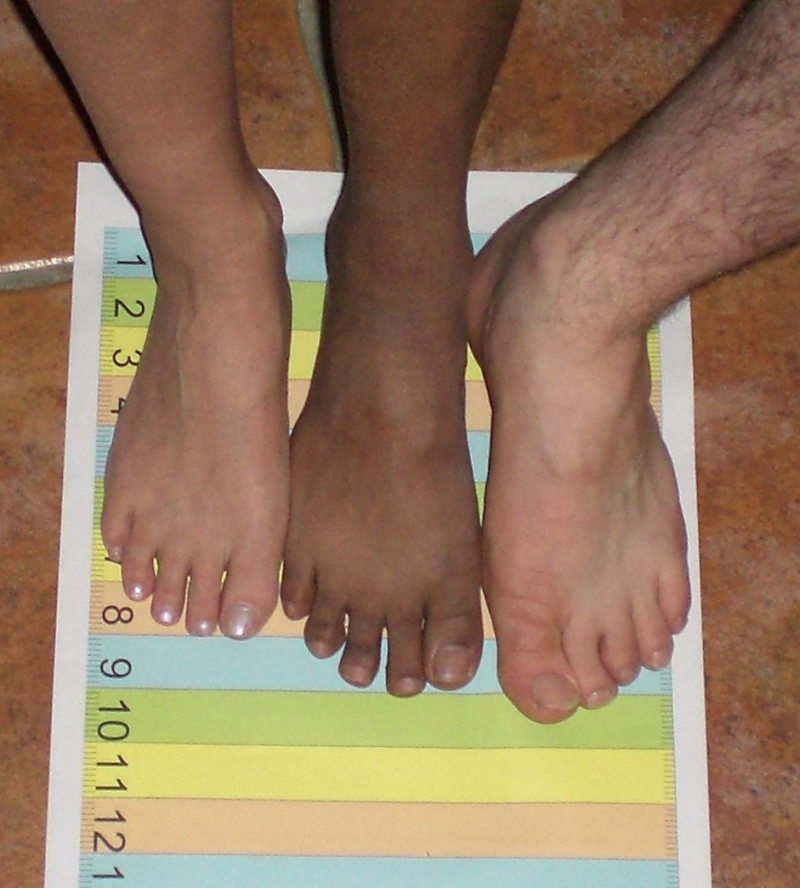
In fact very few people have feet that are as large as the imperial foot; you would need a British “shoe size 12 ½” foot! The vast majority of people have smaller feet (the photo above shows 3 people measuring their feet against a scale in inches). The average human foot is 24 cm versus 30.48 cm for the imperial foot. If an imperial foot is “natural” then by implication most people have unnaturally small feet! If in doubt try measuring your own feet and those of your friends and family.

A much stronger argument is that decimal numbers are “natural” since all able-bodied people have ten digits. It is nonsensical to justify keeping imperial on the basis that the units are “natural”; parts of the body are non-standard and so quite unsuitable as the basis of modern measures. Far better to use the accurately determined and easy-to-use metric units.

[See also related article at http://www.metricviews.uk/2007/10/28/imperial-units-natural/ – Ed]

Guyana shows the way

Metric Views has come across an interesting letter in a newspaper published in Georgetown, Guyana.
Extracts are reprinted below (acknowledgements to Stabroek News http://www.stabroeknews.com/index.pl/article_letters?id=56535420). The UK authorities could learn from the determined approach to metric conversion adopted by this former British colony.

The entire world is moving in the metric direction, Guyana needs to catch up
Thursday, December 20th 2007

“Dear Editor,

I take this opportunity to thank the many writers of letters in the letter columns of the three daily newspapers for their interest in the subject of metrication and the lively debate on the question of accuracy, margin of error etc.
………….

Let me take this opportunity also to enlighten the various writers that since the re-launching of the National Metrication programme by the GNBS in 1996, the approach taken was one of education and sensitization and the following strategies have been used to get the metric message across to the Guyanese consumer:

* Think Metric Training programmes and practical exercises for all sectors including the education sector.

* The conduct of surveillance exercises countrywide at municipal markets, shops, supermarkets etc. where proprietors are shown how to price and label in metric.

* One to one education visits conducted at all commercial entities.

* Sector visits at Government Ministries, public and private sector organizations including Non-Governmental Organizations to determine training needs and carry out training when necessary.

* Distribution of ‘fact sheets, brochures, conversion tables etc.

* Live television programmes done in workshop style.

* Issuing letters of misuse to defaulters.

* Providing answers to consumers who request information via telephone.

* Setting up of a National Metrication Committee to assist the national metrication drive.

* Publication of articles and advertisements in the newspapers and other periodicals.

* Scheduled verification and calibration of all devices in metric units.

In conclusion, the GNBS wishes to inform consumers that 98% of the world’s trade is conducted in metric units and even the United States which is taking steps to change over, though it uses the imperial system of domestic commerce, uses the metric system for all its scientific work and for international trade.

The entire world is moving in the metric direction, so Guyana needs to move ahead and stop delaying the change over of the process by hanging on to the imperial system.

Yours faithfully,

Evadnie Benfield

Head, Information Services

For Executive Director

Guyana National Bureau of Standards”

Doesn’t it sound familiar?

Enjoy a healthy Christmas turkey! Roast for 40 minutes per kg at 190 °C

Many families in the UK will roast a turkey on Christmas day. Preparing a traditional Christmas dinner challenges most people as they are cooking much larger quantities of food than normal. As a result thawing and cooking times are much longer than normally experienced. Failure to thaw or roast properly may lead to food poisoning which is one of the worst things that could happen at Christmas.

Food Poisoning Risk

It is a frightening prospect that 20% of food poisoning cases are poultry related and an estimated 10 million turkeys will be prepared for Christmas in the UK. Although most incidences of food poisoning are not reported, 4 000 Britons reported food poisoning in December 2002. Preparing a traditional Christmas dinner challenges most people as they are cooking much larger quantities of food than normal. As a result thawing and cooking times are much longer than normally experienced. Food poisoning is caused by bacteria and may arise from:

  • Inadequately cooked meat due to not thawing the turkey correctly
  • Inadequately cooked meat due to not roasting sufficiently
  • Cross contamination of bacteria from raw meat
  • Failing to chill leftovers that are retained for later use.

Use kg-based Thawing and Roasting Times

The first two problems can be solved by proper calculation of thawing and roasting times. Now that turkeys in the UK are sold in kilograms, the UK Metric Association says it makes sense to give thawing and cooking times in hours and minutes per kilogram respectively. Unfortunately many products and cookery books give guidelines in minutes per lb/450g. Since turkey weights are labelled in kilos, this means that a cook either has to convert with a calculator or re-weigh the turkey in pounds. As turkeys are often too heavy for kitchen scales it is difficult for consumers to reweigh birds unless they use bathroom scales – which is hardly hygienic! Kilogram-based thawing and cooking times are easily worked out from the turkey’s label.

Thawing Times

Thawing times depend on the temperature of the place used to thaw the bird. Thawing in a refrigerator (usually around 4 °C) is recommended, however many fridges are already full around Christmas time. Alternatives are to thaw in a cool room or even room temperature.

  • For thawing in a fridge at 4 °C, UKMA recommends allowing 12 hours per kilo. Thus to thaw an 8 kg turkey allow 4 days.
  • For thawing in a cool room at 15 °C, UKMA recommends 7 hours per kilo; so 56 hours for an 8 kg turkey.
  • For thawing at room temperature at 20 °C, UKMA recommends 2 hours per kilo; so 16 hours for an 8 kg bird.

Obviously your fridge or room may have a different temperature to those listed so you may need to allow more or less time than quoted.

Turkey Hygiene

Other tips for preparing the turkey:

  • Do not wash the turkey – that risks spreading bacteria! – roasting not washing will kill the bacteria.
  • Check the inside cavity for ice crystals at the end of thawing. If ice is still there, you need more time for thawing.
  • Avoid cross-contamination by keeping the raw turkey separate from other foods and dishes.
  • Avoid cross-contamination by carefully washing hands, knives, boards and utensils that have been in contact with the raw bird.

Roasting Times

For roasting, UKMA recommends roasting for 40 minutes per kg at 190 °C, Gas 5 – thus an 8 kg bird will take 320 minutes (5 hours 20 minutes). Fractions of kilos are also easy to calculate by allowing 10 minutes for each additional ¼ kg, so an 8.25 kg requires 5 hours 30 minutes. Check the meat is cooked by parting the skin between the leg and breast. If it is still a little pink then allow an extra 20 minutes on top of your calculated time. Juices should run clear not pink.

More Tips

Other useful tips for a perfect roast turkey on Christmas Day:

  • Check your oven is large enough if you intend cooking a big bird, and buy a special turkey roasting pan.
  • Turkeys are heavy so take care when lifting in and out of the oven.
  • Smear the breasts with olive oil or softened butter and protect the breast with butter papers or foil. Or, work your hands between the skin and flesh of the breasts and slide in large wedges of soft Brie.
  • For a tasty attractive finish sprinkle the turkey with ground paprika and crushed thyme before cooking.
  • For hygiene reasons, don’t stuff the body cavity. Instead lift the neck flap and press your stuffing up against the wishbone.
  • Never carve a bird straight from the oven. Allow it to stand for at least 20 minutes. It won’t lose heat if you cover it loosely with a foil “tent”. This also allows you to get your roast potatoes nice and crisp.
  • Chill leftover turkey as soon as it is cold and serve within 3 days. If serving hot in a sauce or as a curry, then reheat until piping hot.