
How others see us – an Australian view

UKMA occasionally receives letters from visitors to the UK expressing amazement at our dysfunctional muddle of measurement units. The following is typical (with thanks to JP for allowing us to use it):

Hi Robin,

I’ve just arrived back in Australia after a three and a half week visit to England. My wife was born in England and so we were visiting her parents and had some delightful weather. The trip included an eight day motor home trip around the north visiting York, Hadrian’s Wall, the Lake District and various other beautiful locations. It was a thoroughly enjoyable trip.

I’m just writing to express my amazement (I can’t think of a better word) at the mixture of measurement systems used in your country. Whilst driving, most road distances and speed were in miles and mph, some distances were expressed in metres, heights were sometimes in metres, feet and inches, or both. All weights were by the kilo, petrol by the litre, temperature in Celsius. What a mixed up muddled up world!

The thing I found most fascinating was the Ordinance Survey of Great Britain. An absolutely excellent mapping grid system designed in the mid 30’s I believe. Your road atlases use it, all your maps use it and most people (that I spoke to anyway) seem to understand it. For example, “TQ 03485 96849″. This system is entirely metric based – but no one is aware of the fact! For example the AA road atlas has each OSGB grid of 10 km square showing as exactly 5 cm by 5 cm on the page but the atlas never mentions this important fact. Instead it goes to great pains to explain the scale as 3 miles and 826.7 feet per inch!

Also fascinating, at a local fire station in Chatteris there was an old map of the local town. It was at least 70 years old and had many old features including a rail line that are no longer present. The really interesting thing was the coordinate system on this map was in metres. It was based on the OSGB.

Now, the reason I’m writing to you is that I read your quote:

The Chairman of the UK Metric Association (UKMA), Robin Paice, commented: The Irish changeover demonstrates that the British Government’s reasons for delaying the conversion of British road signs are simply a flimsy excuse for doing nothing. Frankly, they are rubbish. Irish drivers are no more likely to be familiar with speeds in km/h than are British drivers.
Familiarity with metric measures comes from use – not from education. The British Government should just get on with it.

I’m 42 years old and conversion happened when I was young (around 9) and so I have experience and what works and what doesn’t. From our experience here, your statement “Familiarity with metric measures comes from use – not from education” is the most important statement of all. I was speaking to mum (who is 65 and has pretty much embraced the entire metric system) about the change over to decimal currency in 1966. Australia moved from pounds, shillings and pence to dollars and cents – and it was overnight. I asked her how long it took to get used to the system and she said “a day”.

So I’m really just wishing you good luck in your journey and hope to see your road signs done soon. I think that will be a tipping point for England and it should be helped by the recent Irish conversion and the 2012 Olympics will provide an excellent target date.

Keep up the good work,

Regards,

*Jixx Pxxxxxx*

*Hobart, Tasmania, Australia.*

This letter also reminded me of Neil Kinnock’s comment (in a foreword to UKMA’s report “Metric signs ahead“) that, when the all-metric Olympic Games are hosted in London in 2012, “our imperial road signs … contradict the image – and the reality – of our country as a modern, multi-cultural, dynamic place where the past is valued and respected and the future is approached with creativity and confidence.”

Demonstrating their own ignorance and insularity, Government ministers (including Alistair Darling, then Transport Secretary) tried unconvincingly to dismiss and ridicule these comments. However, the truth is that JP’s letter is typical of the view from abroad.
A critic writes – and a response

UKMA’s Chairman received the following critical letter from a thoughtful correspondent (a student or teacher of physics). As it is better argued than most efforts from defenders of imperial measures, it was thought that it was worth publishing (slightly edited to conceal his identity) – together with Robin’s reply.

This was the original letter:
Dear Robin,

I must say, I’m suprised by the somewhat draconian arguments on the UKMA website that imperial units should be abolished altogether, especially when imperial units have not even been taught in schools for about 30 years. I write as somebody who grew up under the metric system (though exposed to imperial units at home), who used to think everything should be SI, and through experience now realises that the imperial system has a lot to offer.

Fundamentally, there is no reason to adopt any one unit over another, by virtue of the definitions, e.g. the metre is determined by the ratio of 1/(speed of light in m/s) – it could equally be defined in feet (speed of light feet/s). The choice is ultimately for consistency in scientific publications and engineering (and international trading), but there is no reason not to keep it in existence for everyday usage for a number of reasons (and in the same way most foreign people speak English as a second language, but still have their own mother tongue – thus exposed to 2 different ways of thinking). Indeed some of the arguments against imperial actually suggest the very reason why imperial should not be scrapped, but perhaps, with the exception of the Farenheit scale, be re-introduced! Metric units are not even rigidly adhered to in physics, where we revert to units that most conveniently relate to the scales of observation, for example energy in units of eV (the electron-volt) when talking about atomic energy structure, mass in terms of “atomic mass unit” for atoms, or “solar masses” in astronomy (yes there was the classic metric-imperial mistake at NASA on the Mars orbiter, which could have been avoided with a standard international unit, but that is not the argument here).

1) As your site mentions, many people use imperial units in describing length and height: it is precisely because the very origin of imperial units of length – derived from everyday objects – that it is so much more intuitive to use. What’s easier – describing somebody’s height in feet and inches, or in m / cm?

2) Numeracy skills in this country are at an all time low – now why could that be? Imperial measures, by virtue of not being very simple to use, force people to think about numbers and fractions. All units are ratios in one form or another, thus by maintaining the presence of fractions in the notation, we are reinforcing the fundamental nature of measurement; that what quantity you are specifying is not really an absolute number, but a ratio with respect to some pre-defined unit – the basis of which is arbitrary (and on this point, the foot is clearly an easier unit to estimate without a ruler than a metre). The specific ratios also being arbitrary – yes 10 makes it easier, but is no more correct than divisions of a foot by 12, 24 (half an inch) 48 (quarter of an inch) 96 (eigth of an inch) and so on (and here we can see the nice power of 2 relationship) – it is purely convenience, a convenience which encourages laziness in thinking and loses sight of the fundamentals, and consequently a severe dumbing down in science at schools, so that now the only bit of real maths a pupil is given, in the advanced GCSE science questions, is the “equation” for speed, which they are actually given – something which even when I did GCSEs in the 1980’s was expected to be known by heart even by the 2nd year, and was certainly not worthy of “advanced GCSE” status. What next – decimalise the byte?

3) Base 12 is more flexible than base 10, as with 16 ounces in a pound 12 is divisible by 1,2,3,4,6.
10 is divisible by 1,2,5.
5ths are less useful than 4ths and 3rds. And mathematically, base 12 is much nicer than base 10, you are less likely to end up with recurring reciprocals like 3.33333~ if wanting to divide a given length of something into an integer number of sections.

I think that to say everyday measurements in this country are in a muddle is slightly misleading – most of us know what these units mean, having grown up with both – it is only pedantism over having a consistent set of units, where in everyday situations this is not so important. The only circumstance where I can think that the imperial system is a muddle is in the vagueness of plumbing fittings, where for e.g. thread fitting diametres are not actually based on the thread diameters, but on the inner-section of pipe that might pass through them. Ultimately, I feel let down by this country and our declining education system for not having taught both imperial and metric units, irrespective of the need to have one international standard.

Cheers
[name withheld]

—————————————————————————————————————-

and this was the reply:

Dear zxzxzxzx

Thank you for your comments, which I read with interest. I am not able to reply in full detail but would make one or two brief points.

As you say, because the Government started the metrication process in 1965 and then lost its nerve and has effectively abandoned the whole project, we are now in a situation where both the metric system and imperial units are in widespread use. The problem with this is that most people do not have a secure grasp of either system – let alone both. This does create genuine problems of incomprehension, conversion errors, mistakes and accidents – and in some cases actual costs of having to run both systems – one for internal transactions and another for the public interface. Take a look at our blog article http://www.metricviews.uk/2007/10/15/whats-wrong-2-systems/ for further comment. (You are welcome to contribute yourself).

It is quite untrue that imperial units are “intuitive” or natural. How long is your foot? What I think you mean is that imperial units are familiar – just as it is “natural” to speak English. People brought up in metric countries do not think imperial units are “intuitive”. See also blog article http://www.metricviews.uk/2007/10/28/imperial-units-natural/ which includes comments from a German and a Dane on this point.

The argument about the advantages of base 12 are academic rather than practical. There is no prospect of converting the world’s counting system from decimal to duodecimal, and it is obviously sensible that the measurement system should be aligned as far as possible with the counting system. In any case imperial units are mostly not to base 12: 16 oz in 1 lb, 14 lbs in a stone, 8 stones in a cwt, 8 pints in a gallon, 3 ft in a yard, 1760 yds in a mile, 43 560 sq ft in an acre. How would you divide a lb or a mile by 3?

The evidence on numeracy skills is patchy, and even if it were true that numeracy skills have declined, this would be more likely to be due to other factors such as flaws in the national curriculum, poor maths teaching and the prevalence of pocket calculators and computers and the general dumbing down of mental processes – e.g. “satnavs” replacing map-reading and navigation skills.

UKMA’s proposals are not particularly draconian. Indeed, they are the method by which Australia, New Zealand and many other countries successfully made the change. Unfortunately, UK governments have adopted policies that are the opposite of those proved to be successful – which is why we are in the present muddle.

At least I think we can agree that successive UK governments have let us down.

Best wishes
Robin Paice

Would lined beer glasses solve the pint problem?

It is sometimes claimed by opponents of the metric system that any interference with “the British working man’s pint” would spell political death for any party that dared to touch it. Leaving aside the sexist assumptions behind the claim, let us examine whether there is a practical solution that need not be controversial.

Continue reading “Would lined beer glasses solve the pint problem?”

No return to pounds and ounces

Today’s announcement by the European Commission that it is to propose that “supplementary indications” (such as lbs and oz) should be allowed indefinitely does NOT mean that traders can go back to weighing and pricing in imperial measures – so says the UK Metric Association (UKMA). [Press release issued on 11 September.]

Continue reading “No return to pounds and ounces”

UKMA slates EU climb down on metrication

The UK Metric Association has accused the European Commission of “political cowardice” because it has caved in to American and European exporters – supported by the UK Government – and effectively abandoned the objective of a single, rational system of measurement throughout Europe.

The Commission has just published its response to the recent consultation on revising the Units of Measurement Directive. It is a badly written and illogical document, and UKMA has commented on it in the following press release:

The following press release was issued on Wednesday, 27 June:
“Pro-metric group slates EU climb-down
London, 27 June 2007.
The UK Metric Association (UKMA) today accused the European Commission of caving in to pressure from European and American exporters – supported by the UK Government – to be allowed to carry on using imperial and American weights and measures in packaging and product manuals. In its response to the recent consultation the Commission proposes that “supplementary indications” should be allowed indefinitely and that the obligation of the UK to “fix a date” for converting road signs to metric units should be removed.

See http://ec.europa.eu/enterprise/prepack/unitmeas/uni_ms_en.htm

UKMA Chairman, Robin Paice, commented: “This has all the signs of a stitch-up between the UK’s Department of Trade and Industry and the European Commission. The DTI has made it clear that they are implacably opposed to further metrication in the UK, and rather than challenge them, the Commission has bottled out and is proposing to abandon the objective of a single, rational system of measurement used and understood throughout the European Union.”

In its own submission to the Commission*, UKMA had argued that there is a simple solution to the problems allegedly encountered by transatlantic traders in coping with two conflicting labelling regimes (the USA mostly requires dual American/metric units on packages, whereas the EU had intended to require metric-only). All that is needed, said UKMA, is a reciprocal arrangement to accept each other’s labelling for imports and exports. Until such an agreement is reached the EU could unilaterally accept dual-labelling on American imports. Or if that is too difficult, dual labelling could be allowed on all packages and product manuals etc – but not on loose goods priced and weighed out by the trader.

The Commission’s report ignores this last point and attempts to justify its rejection of the mutual recognition argument by suggesting that third countries might complain that it also affected their exports and would be a non-tariff barrier to trade. This argument is clearly disingenuous since it would obviously be possible to devise wording that would accommodate this very minor problem. They thus appear (or pretend) to believe that two systems are cheaper than one.

The Commission has also agreed to support a UK proposal that it should not have to name a date for converting road signs to metric units. Citing both the UKMA cost estimate of £80 million and the Transport Department’s grossly inflated estimate of £800 million, the Commission’s paper comments that imperial road signs have “cultural significance and do not give rise to discomfort which can be considered a major benefit”. They have thus failed completely to understand the benefits of a single system as well as the hidden costs of continuing to muddle through with two systems. They have also ignored UKMA’s argument that the continued existence of imperial road signs is the biggest obstacle to the acceptance of metric measures in the UK in everyday life. “As long as we have miles, yards, feet and inches on the road signs, many people will not adapt to measuring up for curtains and carpets in metres and square metres.”, said Robin Paice.

He added: “Why should the refusal of the Americans to accept the world system condemn the British to endure indefinitely the misery and muddle of incompatible weights and measures in shops and markets. It undermines consumer protection (one of the Commission’s claimed new stated objectives) wastes our children’s education, and just prolongs this “very British mess**.It is a piece of political cowardice.”

ENDS

*This can be seen at http://ec.europa.eu/enterprise/prepack/unitmeas/depot_anwers/c-non-gov-organis/R205.pdf

** “A very British mess”, with foreword by Lord Howe, is published by the UK Metric Association and can be obtained via UKMA’s website at http://www.ukma.org.uk/books/index.htm

Notes for editors:

(a) The UK Metric Association (UKMA) is an independent, non-party political, single issue pressure group which advocates the full adoption of the international metric system (“Système International” – SI) for all official, trade, legal, contractual and other purposes in the United Kingdom as soon as practicable. UKMA is financed entirely by membership subscriptions and personal donations.

(b) Further extensive background information can be found generally on UKMA’s website at www.ukma.org.uk .

(c) The following are available for interview or comment:

  • Robin Paice (Chairman) on 023 9275 5268 for telephone interviews
  • Roz Denny (Press Officer) on 020 7736 5383 or 0777 039 1581 for interviews in London or by telephone
  • Derek Pollard (Secretary) on 020 83746997 or 01304 375854″

—————————————————————
Further comment:

Despite this deeply depressing cave-in by the Commission, there are perhaps two consolations that can be drawn:

  • The Commission has at least not accepted the demands of the extreme imperialists (the so-called “metric martyrs”) to go back to selling in pounds and ounces, nor is the UK Government supporting this.
  • If these proposals are actually enacted. The EU will effectively cease to have any say in UK weights and measures. It will then be possible to separate the metrication issue from the European issue, and it will be possible to make the case for completing metrication on its merits without having to refute silly arguments about Brussels bureaucrats.

Barrels of oil

The media always report statistics of oil production, reserves etc in “barrels”. But how many people know how big a “barrel” is?* Indeed is it an appropriate unit of measurement to use in the context of world energy policy?

The oil industry used to be dominated by American companies, and as with aviation and computers, American units have largely been adopted as the industry standard.

This might not matter since the only people who trade in oil are industry insiders, and arguably the general public do not need to know how big a “barrel” is. They will understand that if OPEC reduces output by x million barrels per day, that’s a lot of oil, and price rises can therefore be expected. In any case, outside the USA, they will still buy the end product in litres.

Yet although it is not a consumer protection issue, there is a problem. Any departure from the International System of Units should be discouraged, as it results in dual labelling, conversion errors, the need to know two systems when one will suffice – and of course general incomprehension.
More particularly, the “barrel of oil equivalent” is used as a
measure of global energy production and consumption. For this, all energy sources (m3 of gas, tonnes of coal, etc.) are converted by energy content into the equivalent energy available in a barrel of crude oil.

BP produces an annual report of world energy consumption and has just produced this year’s. See www.bp.com/statisticalreview
I notice that they are now using the tonne of oil equivalent alongside, or sometimes in place of the barrel. Whilst this is clearly an improvement, it doesn’t really give you what you’re looking for. If you’re talking about world energy consumption, rather than just oil, then surely joules (or gigajoules – GJ) are the unit they should be working with? I can see some logic in using a quantity of oil to measure reserves, and refinery throughput, but if you’re comparing nuclear and gas, for example, what has oil got to do with it? The joule only gets a mention in the conversion tables – 1 tonne oil equivalent ~= 42 GJ.

*A “barrel” is 42 US gallons (equivalent to approximately 159 litres)

“Office rents per sq ft not legal” – says LACORS

Metric Views has received confirmation – from an impeccable authority – of what it has long suspected: that the widespread practice of pricing and advertising office rents “per square foot” is illegal under UK law.

The full story, which has only recently come to light, seems to be as follows. Upon receipt of a complaint from a member of the public about giving business grants “per square foot”, a northern local authority Trading Standards Department initially responded that “services” are not covered by the Price Marking Order (PMO), and as this grant was considered to be a “service”, pricing “per square foot” was legal. It appears that this interpretation was frequently given by other Councils, and it was even supported by Consumer Direct, a national online helpline.

However, this interpretation was challenged by the member of the public, and LACORS (the Local Authority Co-ordinating body for Regulation) was asked to look again at the issue. In August 2004 they issued new guidance which reversed their previous opinion. Specifically, they rejected the previously quoted view that the PMO only applies to the pricing of goods for sale, and that prices “per sq ft” for or a fixed area are legal because they are merely for ‘guidance’.

The opinion is reproduced in full below, but briefly it confirms that Section 8 of the Weights and Measures Act 1985 prohibits the use of imperial units “for trade” (as they are not included in the list of permitted units in the relevant Schedule to the Act). Moreover, “use for trade” includes any “transaction involving the rendering of money, where the transaction is by reference to quantity.” The opinion goes on to argue that, since office space, boat moorings, allotments etc must be priced per metre or square metre, it would be obviously sensible for them to be advertised inthe same way.

Trading Standards Departments which hitherto have relied on the earlier interpretation will now have to review their policy, and we can look forward to the gradual disappearance of imperial pricing of shop and office rents, storage space, allotments etc as Trading Standards Departments advise estate agents of the correct legal position.

The full text of the LACORS advice is given below. We have emboldened some of the more significant passages:

————————————————————————————–

Metrication

Advice on the use of imperial units

(Specifically, transactions (sale, rental, lease, grants) relating to floor
space, areas of land, length of boat moorings, length of archiving space,
etc.)

LACORS has received a number of enquiries regarding the use of imperial
units relating to transactions such as:

Sales, rental or lease of floor space (commercial or domestic
property) by reference to floor area
Rental of boat moorings by reference to length
Lease of archiving space by reference to length
Award of development grants by reference to floor area
Rental of allotments by reference to length and/or area of land

LACORS previously issued advice that “it is unlikely that room space is ‘goods’ for the purposes of either the Weights & Measures Act 1985 or the Price Marking Order 1991″. There was, therefore, no recommendation to use only metric units.

The LACORS Metrology Focus Group has revisited the question, and now finds this advice to be out-of-date. The following advice replaces that given
previously.

The legislation

The relevant section of the Weights & Measures Act 1985 reads as follows:

Section 8. Units of measurement, weights and measures lawful for use for
trade.
(1) No person shall-
(a) use for trade any unit of measurement which is not included in Parts I
to V of Schedule 1 to this Act.

It can be clearly seen from Schedule 1 that imperial units including the
foot, square foot etc. may NOT be used for trade, since they do not appear
in Parts I to V of that Schedule.

The definition of ‘use for trade’ is found in Section 7:
7. Meaning of ‘use for trade’.
(1) In this Act ‘use for trade’ means, subject to subsection (3) below, use
in Great Britain in connection with, or with a view to, a transaction
falling within subsection (2) below where-
(a) the transaction is by reference to quantity or is a transaction
for the purposes of which there is made or implied a statement of the
quantity of goods to which the transaction relates, and
(b) the use is for the purpose of the determination or statement of
that quantity.
(2) A transaction falls within this subsection if it is a transaction for-
(a) the transferring or rendering of money or money’s worth in
consideration of money or money’s worth, or
(b) the making of a payment in respect of any toll or duty.

A unit of measurement may, therefore, be deemed to be in ‘use for trade’ if
it is used in connection with a transaction involving the rendering of
money, where the transaction is by reference to
 quantity.

Since 7(1)(a) can be split into two separate clauses (that is to say ‘the
transaction is by reference to quantity’ or ‘is a transaction for the
purposes of which there is made or implied a statement of the quantity of
goods to which the transaction relates’). In the former case, there is no
requirement for the transaction to involve a quantity of ‘goods’.

Therefore, any reference to quantity, whether voluntary or otherwise, must
be made in metric units.

For clarification, it is also necessary to establish what constitutes a
‘transaction by reference to quantity’. Consider the two examples below:
1. Offices for rent
First floor offices, fully serviced, available now, 3,500 sq ft
£35,000 per annum
2. Offices for rent
First floor offices, fully serviced, £10 per sq ft per annum
3,500 sq ft unit available now

Clearly, the same office space is being offered at the same annual rental
price in each case; however, in example 1, the reference to area may be
considered to be a description – the rental price is a total sum for the
offices as described – and therefore the use of imperial units is
acceptable. In example 2, there is a clear relation between the floor space
and the calculation of the total rental price (“£10 per sq ft”), which
renders it a transaction by reference to quantity and therefore subject to
the requirements of the Weights & Measures Act 1985 requiring the use of
metric units.

When a transaction is by reference to quantity, as described above, this is
a legal requirement; where the quantity forms part of a description only,
metric units should be indicated for the sake of clarity and consistency.

Improving Numeracy – Why joined-up government is needed

Yesterday, Gordon Brown stressed the importance of improving numeracy skills when talking to the news media and the CBI. A modern, competitive UK clearly requires a numerate workforce. Numeracy is a life skill that everybody needs whether for managing your bank account, understanding your body weight or retiling the bathroom.

However, focusing just on schools is not enough. A child in Finland, Singapore or New Zealand will learn decimal arithmetic, decimal currency and metric units – and immediately be able to apply them outside the classroom. In Britain, a child’s numeracy skills are hobbled because it is harder for them to use their skills practically. As soon as children leave the classroom they face a hodgepodge of incompatible units: metric units (with which they can calculate) and imperial units (for which they have not been taught calculation skills).  If Mr Brown is serious about numeracy he needs to give British children the same chance as those in most other countries.

Numeracy is vital for everyday life and work, yet British proficiency is quite woeful. The DfES Skills for Life Survey showed that 15 million adults in England failed to achieve the basic level 1 proficiency in numeracy. In the workplace it is mainly applied to measurement or money but a Department of Education study in 2002 showed that one in three adults could not calculate the floor area of a room in either metric or imperial!

When I went to junior school in the mid 1960s we learned arithmetic not just with numbers but with pounds, shillings & pence; yards, feet and inches; stones, pounds & ounces – not forgetting fractions thereof. Some of my worst memories of that period were of doing long division and multiplication using “old money” and “old” imperial units. Working with a hodgepodge of bases including 3, 8, 10, 12, 14 & 20 was complex and confusing. Much time was lost in teaching us unnecessarily complex calculation, delaying the teaching of more interesting topics such as algebra, geometry and data analysis.

The educational benefits of using the metric system have long been recognised. In 1862 the Report from the Select Committee on Weights and Measures stated “Economy of time in education is one of the beneficial results of the Metric system. While the study of English weights and measures is laborious and repulsive to both teacher and pupil, any one can easily master the Metric system. The time which the use of a decimal system would save in education has been stated to be at least a year“. The report went on to unanimously recommend that Britain adopt the metric system.

Roughly 40 years ago my junior school teacher announced that everything would soon “go decimal”. He outlined the basics of decimal currency and metric measurement for us. The decision to adopt the metric system in the UK was announced in Parliament on 24 May 1965 on the merits of its simplicity, modernity and international usage. This was nothing to do with EEC pressure; after all President de Gaulle had vetoed our entry earlier.

Around 1970 we were told that then Education Secretary, Margaret Thatcher, was requiring us to change our textbooks and the new ones were all decimal. After improving my maths skills in secondary school, thanks to using metric units and decimal currency, it was hard to use any of it in everyday life. In 1975, when buying food for the first time I was faced again with wretched pounds, ounces and ugly fractions. My metric education was betrayed and I faced the schizophrenic world of easy calculation in metric, but imperial in most practical situations.

Today – 42 years after starting with metric – we have a “very British mess” of metric and imperial. Fuel is sold by the litre (rather than the gallon) but road signs are still based on miles (rather than kilometres); making fuel consumption calculations very difficult. Do you use metric, imperial or simply give up because it is too messy?

As a parent I have now seen how my children fail to apply their calculating skills because it is not “cool” to talk in metric units and they do not really understand imperial. One day my youngest son asked “Dad, how many metres are there in a mile?”. When I told him “1,609” he was very baffled, but would have been equally confused if I had said “well 1,760 yards”. He is not alone, last year Times straw poll yielded answers of 52 to 10,000 for the number of yards in a mile. We have now taught a second generation to calculate in metric units but prevent them from applying it.

Numeracy is not just for abstract manipulation of numbers but is a practical life skill. In almost every case it is applied either using measurement units or money or both. However, most politicians want to do nothing to change. For example, a year ago Alistair Darling rejected a call to modernise our road signs to use metric units. The Government continues to ban the metric units taught for the last 30 years from distance signs and spends millions on new signage using imperial units that have not been taught since the early 1970s. So much for “joined-up” government!

The decimal number system is the foundation of modern numeracy. Most calculations today will be done with a calculator or a spreadsheet; but they both only work with decimal numbers. It is time to acknowledge the important link between decimal numeracy skills and applying them using metric measurement. Parents can help by measuring and weighing their offspring using metres and kilograms. Teachers can help their pupils understand their classroom exercises by giving real examples of metric quantities like a kilometre, a tonne, a hectare, etc without imperial conversion.

If Britain really wants good basic skills in the workplace and the home, urgent and decisive action is needed. Just as “old money” was taken out of circulation in 1971, “old units” must be withdrawn as soon as practicable. It cannot be that difficult – after all Australia and New Zealand managed it in the 1970s. Let’s stop undermining of our children’s numeracy and complete the metric conversion once and for all.

If Gordon Brown really wants better numeracy he needs to look beyond schools and fix our shops, adverts and road signs too. This requires a ‘joined-up’ government approach to measurement; something that has been missing in the UK for four decades.

[Roddy Urquhart]

“Metric martyrs” – what was the fuss about?

On Wednesday, 9 May, the air waves and the prints were full of fanciful stories about Brussels caving in and allowing Britain to carry on using lbs, oz and other imperial units. The so-called “metric martyrs” * (Oh no, not them again!) declared a victory for their campaign. So what has really happened?

It appears that at a recent Committee meeting of the European Parliament, one of the 27 Commissioners, Günter Verheugen, indicated that, in response to lobbying from European and American exporters, he intended to propose to fellow Commissioners that the current authorisation of “supplementary indications” alongside metric units should be extended beyond its current deadline of 2009. If the Commission approves this proposal it will then have to go through the decision-making machinery of the EU before the current Units of Measurement Directive can be revised.

This has been claimed by a spokesman for the “metric martyrs” as a victory for their campaign to be allowed to weigh and price in lbs and oz. The reality is quite different.

No difference

If Mr Verheugen’s proposal were eventually to be agreed as reported (big “if”), it would make absolutely no difference to the current situation. Traders will still have to price and weigh goods at the point of sale in metric units, with the option of an accompanying supplementary indication, which must be no more prominent than the legal metric unit. Most shops and supermarkets now comply with the law, and many have given up on showing lbs, oz, pints, sq yds, etc. Only a handful of recalcitrant market traders and small shopkeepers still hold out against the law, and their numbers are dwindling.

A special exemption for US imports and exports?

However, this is by no means the end of the story. The reason given for authorising supplementary indications is that the USA requires dual labelling (metric and “US customary” – not the same as imperial, by the way) on packaged goods. Thus, if the EU insists on metric-only labelling, exporters will require separate packaging for the two markets. It is difficult to see why putting an extra sticky label on a package is a significant business cost, but even if it is, there is a simple solution which need not affect the great majority of transactions within the EU. All that is required to solve the exporters’ alleged problem is a special exemption for imports of packaged goods from and exports to the USA. This is exactly what was proposed by the UK Metric Association (UKMA) in its submission to the EU consultation on revising the Directive, which can be seen at
http://ec.europa.eu/enterprise/prepack/unitmeas/depot_anwers/c-non-gov-organis/R205.pdf
It remains to be seen whether the Commission will accept the obvious logic and common sense of our proposal.

Pints and miles

Contrary to many media reports, Mr Verheugen’s proposal would not affect the status of the pint for draught beer and cider and for milk in returnable containers, nor would it affect the mile, yard, foot and inch for road signs, distance and speed measurement. The UK Government will still be required to name a date for phasing out these measures. As far as road signs are concerned, UKMA has proposed that a new deadline of 2014 should be set.

* Footnote:

The suggestion that the original so-called “metric martyrs” have been exonerated is absurd. They were properly prosecuted and convicted under the current law for using illegal scales and other offences, and all their appeals to various UK and European (!) courts were dismissed. Even if the Directive were to be amended as suggested, they would still be breaking the law. They were guilty as charged and remain so.

Imperialist ‘victory’ or checkout muddle?

Today’s (9/5/2007) news media have widely reported a story that imperial measures may continue to be displayed alongside metric ones in this country for an indefinite period. (http://news.bbc.co.uk/1/hi/uk/6637587.stm) This is being trumpeted by some as a “monumental victory”. It is ironic that in the very year when we are celebrating the bicentenary of the abolition of slavery, clinging on to our imperial past is so widely embraced. However, this news just means ‘business as usual’ in the UK. Weighing machines will not be changed back to imperial. We shall continue to see some unnecessarily complex price labels and, for those who stick to using imperial, a muddle at the supermarket checkout.

What most reports fail to state is that at the greengrocer, butcher and supermarket still legally need to weigh and measure using metric. So if your trader uses imperial scales, they have not been tested recently. But what is the value of labelling in imperial? If you read a price in imperial you cannot check if you have been charged correctly without using a calculator.

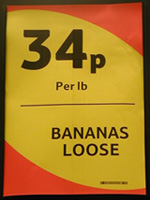
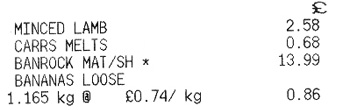
Take this real example of a supermarket advert for bananas above. A customer reading “34p/lb” may have the impression that it is a lower price compared with the shop down the road offering bananas a price of say 69p/kg. The equivalent price is actually 74p/kg.

At the checkout, however, the customer cannot check whether he or she has been charged correctly. The weighing machine uses kilograms and the receipt shows the kilogram price 74p/kg.

Common sense would suggest that the most sensible thing would be to display the price using the units of the weighing machine and receipt. Adding the imperial supplementary price adds nothing and can be confusing. Seven years after changing to metric for loose goods, we have all had enough time to change over.

What a pity that some of our politicians and news media despise consumer protection and see a victory in perpetuating an obsolete unit. It is high time that the British Government – without any pressure from the EU – finishes off the metric conversion in the interests of the consumer.