
The Four Thirds system

In response to a misconception voiced in another article, https://metricviews.uk/2007/08/28/photo-paper-sizes/#comment-312, it may surprise some readers to learn that the image sensors in Four Thirds digital cameras do not have a diagonal size of four thirds of an inch.

[Article by Martin Ward]

The naming of the Four Thirds camera system is a good example of a practice that is often used when a manufacturer wants to hide the true size of a product from the consumer. Namely, an obscure or deceptive imperial measuring convention is used instead of the original metric design size. The image sensors in Four Thirds cameras are actually 18 mm x 13.5 mm (22.5 mm diagonal), with an imaging area of 17.3 mm x 13.0 mm (21.6 mm diagonal) – quite a lot smaller than a diagonal size of four-thirds of an inch (33.9 mm), and significantly smaller than the 22.5 x 15.0 mm and 23.6 mm x 15.8 mm sensors used in the equivalent cameras of competitors Canon and Nikon.

The practice of describing image sensors in this deceptive manner continues from the days when all image sensors consisted of vacuum tubes and were described by the physical diameter of the glass tube, which was always larger than the “diameter” of the image sensor inside. Thus the imaging area of a Four Thirds camera sensor (17.3 mm x 13 mm) is the same as the imaging area of a hypothetical vacuum image-sensing tube of 4/3 inch diameter.

As with LCD and plasma TVs, technology has changed beyond the point where it makes any sense to continue using the old measuring conventions. It would be far more useful to modern consumers to describe the sizes of TV screens and camera image sensors in terms of width x height in standard metric units, than in terms of the diameters of hypothetical vacuum tubes, especially when these products now come in different aspect ratios. But, as is often the case, the needs of consumers do not always coincide with those of the marketing departments of manufacturers.

Further information on the Four Thirds system can be found at https://www.four-thirds.org/en/
Is the Moon still metric?

According to a BBC story, Dennis Hope, the self-proclaimed (imperialist?) owner of the moon, is selling plots of lunar real estate by the acre.

http://news.bbc.co.uk/2/hi/science/nature/6533169.stm

BBC2 – Horizon – 2007-04-10 21:00

This story comes just weeks after a decision by NASA that all future manned moon missions, and permanent lunar bases, will use metric measurements exclusively.

http://www.metricviews.uk/2007/01/13/metric-moon-says-nasa/

So just how will future lunar landowners measure out their 1 chain by 1 furrow long on the moon?

Degrees of confusion

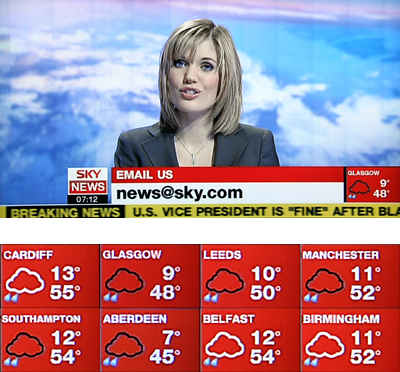
Sky News are currently giving weather forecasts for individual cities on their morning show in the form of icons in the corner of the screen.

On seeing two temperatures for each city, you might expect that they are minimum and maximum temperatures, as is conventional for city forecasts. But these temperatures are more reminiscent of those found in the Middle East.

Even after using the international standard Celsius system for 40 years, it seems that we are expected to realise that the pairs of figures shown are actually both maximum temperatures, but using two different systems.

When will the media make it easier for us all, and stick to one standard temperature scale?

Polish language signs highlight signage mess

Highway authorities have provided metric and Polish language signage for Polish motorists but continue to ban metric signs for the rest of us.

A report in yesterday’s news media describes how Cheshire highway authorities have erected Polish language signage http://www.thisislondon.co.uk/news/article-23385653-details/Road+signs+in+Polish+-+bonkers+says+Tory+MP/article.do. The reason for this is the large number of Polish motorists who have been getting lost. The pictures in the article even show that the authorities have thoughtfully provided distances in metres.

It is astonishing that Polish signage has been erected when any vehicles driving in Britain from abroad face the challenge of miles per hour speed limits and distances marked in miles and yards. It is not easy to follow speed restrictions when your speedometer is marked only in km/h. Department for Transport estimates that typical day there are 12,000 foreign lorries and 95,000 British ones on the country’s roads; 11% of the lorries.

While having nothing against Polish visitors, have the highway authorities thought about those metric-educated drivers in this country? Education has been all-metric since 1974 yet over a generation of young adults have been forbidden from using it by DfT’s imperial signage policy. British roads are designed, surveyed and built using metric but anachronistic traffic sign rules continue to ban the metre and kilometre (http://www.ukma.org.uk/Transport/index.htm).

Suffolk bird flu outbreak illustrates Government mess on measurement

The news that bird flu has broken out at a turkey farm near Holton, Suffolk  illustrates once again the difficulty that the Government has in trying to run with an “official”  system of weights and measures while doing nothing to encourage its use.

The news that bird flu has broken out at a turkey farm near Holton, Suffolk http://news.bbc.co.uk/1/hi/england/suffolk/6327193.stm means that Defra’s containment policy comes into action. Accordingly a 3 km protection zone and 10 km surveillance zone has been established around the farm.

Any user familiar with an Ordnance Survey map will be familiar with the kilometre grid system used for map references. Any OS map user will be able to understand what the protection zone and surveillance zone mean.

Although our roads are designed in metric and regulations for traffic signs are metric (see http://www.ukma.org.uk/Campaign/RoadContractors.htm), Department for Transport continues to forbid the use of metric distances on traffic signs (scroll down the BBC story to see the map).

It is ludicrous for one part of government to use metric on a health & safety issue and another part to forbid its use! It is no wonder so many people in this country are not proficient in any system of units.

A call to legalise distance signage in metres on UK roads

Road signs in Britain closely follow international norms as laid out in the Vienna Convention on Road Signs and Signals. Where possible, language-independent symbolic signs are used so as to be as universally understood as possible. (Article contributed by Martin Ward).

Continue reading “A call to legalise distance signage in metres on UK roads”