
In these uncertain times, the spending power of the pound in our pockets seems to be decreasing by the day, making it high time, in my view, to end the Great Imperial Rip-Off, and save British consumers from the cost of maintaining imperial weights and measures.
Category: Consumer affairs
Twother or twaddle?
One area where metric units have been banned in the UK is draught beer and cider. This is despite the fact that bottled or canned beer and cider is mainly available in round metric quantities. Compared with most countries the restriction of draught beer measures to pints, half pints and third of a pint is very narrow. Recently it was reported that the National Weights and Measures Laboratory has included a proposal for a two thirds of a pint beer measure – the twother – to be introduced. Continue reading “Twother or twaddle?”
Mystery shopper exposes imperial media stunt
UKMA has received evidence that the recent media hullabaloo about the prosecution of a market trader in Hackney was a deliberate setup, designed to reawaken interest in the flagging campaign to preserve obsolete imperial measures.
This is the report from UKMA’s mystery shopper:
“I managed to get away early today (instead of tomorrow) with plenty time to get off at Dalston for the Ridley Rd Market.
In brief..it is one of the most metric markets I’ve seen in the UK! It is even more kg-only than last time I went through.
All the meat and fish stalls and shops are either predominantly kg-only.. with some having per lb, usually underneath (but that would be about 3 out of approximately 10 shops).  All the fruit and veg stalls showed both kg and lb, varying in kg first or lb first…but well signed and all scales set to kg/g. There were NO lb only stands. A couple of stands seemed empty so may have been where Devers (not to be seen) had/has her stall…
Finally, I walked a good 3/4 of the way through this very long market before I heard ANYONE speaking English! (Absolutely true).
Having done a lot of shopping there (as the prices are like a step back in time after Notting Hill) I did get a lot of chats with the traders. Mostly they were Asian, Middle Eastern, African (I overheard other shoppers all asking for kilos) and they said no-one has ever shown a sign of confusion there.
The English “barra boy” types, who had (like everyone else) scales set to metric, sold me my purchases without fault weighing up exactly in kilos. They were quite jokey, so I got to ask them where the “Ridley Road media star” was? They pointed further down where I’d been and told me it was all a set-up, as the so-called customers had been asked on camera “how many POUNDS do you think this weighs”. Then (God knows where they found these “confused Caribbean” people) they replied for the cameras an amount in pounds while filming next to Devers and her stand. Now that’s outrageous!!! (But typical of the media trying to create a story out of nothing.. Seems one big storm in an imperial teacup!)”
So now we know. Or rather our suspicions are confirmed. The great majority of both traders and customers in Ridley Road are perfectly happy with using metric scales and measurements, and there is little local sympathy for the antics of Ms Devers and the bogus “metric martyrs.” Some elements of the media have been complicit in trying to create the opposite impression. None of this is very surprising, but it is disappointing that senior politicians, who ought to know better, appear (or pretend) to have been taken in by it. Sad.
Imaginative media spin on a non-event?
Supporters of consumer protection have been alarmed at reports suggesting that the Government is to tell local councils not to enforce aspects of weights and measures law. Can this really be true?
Various newspapers and broadcasters have reported alleged comments by Secretary of State John Denham that he intends to “introduce new guidelines within months that would prevent local authorities from taking traders to court” (for offences connected with using illegal scales, and weighing and pricing in illegal measures). See for example BBC report http://news.bbc.co.uk/1/hi/uk/7677438.stm.
In fact this report makes little sense. Mr Denham cannot change a law that has been passed by the UK Parliament, nor can he require Trading Standards Authorities (TSAs) not to enforce it. Indeed the existing guidance to TSAs, which is issued by the Local Authorities Co-ordinators of Regulatory Services (LACORS) in consultation with the Mr Denham’s Department (which can be downloaded from http://www.lacors.gov.uk/lacors/ContentDetails.aspx?id=17089), already recommends that enforcement action should be “proportionate”. See for example, paragraph 3.1:
“3.1 Local Authorities must continue to demonstrate their commitment to consistent, proportionate action to ensure that those remaining traders who continue to trade in imperial units through ignorance of the law or misleading media coverage, do convert to selling in metric units, and to ensure that cohesive action is taken over any remaining high profile traders who refuse as a point of principle to comply.”
The debate, of course, is about what constitutes “proportionate” action, and the LACORS guidance makes it clear that prosecution should be a seldom used last resort. It is difficult to see how any new advice (whether from LACORS or the Government itself) could go any further in discouraging prosecution without actually telling them not to enforce the law.
With regard to the legality of non-enforcement, the LACORS guidance continues:
“3.6 Authorities are advised to have regard to the provisions of Counsel’s Opinion in relation to the duty to enforce. The relevant points provide that Local Authorities may not decline to perform their statutory duties under the Act, thus, whilst they enjoy discretion whether or not to prosecute in an individual case, that discretion may not be used to justify a general policy of non-prosecution and must be exercised reasonably. The Code for Crown Prosecutors advises that prosecutors must not be affected by improper or undue pressure from any source and Counsel advises that the exercise of the discretion not to prosecute, principally in order to avoid potential political difficulties, might well amount to “improper” or “undue” pressure.”
So local Councils may not have a policy of non-enforcement, and the Secretary of State cannot legally encourage Councils not to enforce the law.
Perhaps the most charitable interpretation is that Mr Denham was caught off guard and made some ill thought-out, populist remarks, leaving his civil servants to try to limit the damage.
UKMA will be writing to Mr Denham seeking clarification of his alleged comments and inviting him to confirm that he does not condone law-breaking or failure to enforce the law.
Hackney Council gets it right
Local Councils get a lot of stick, often undeserved, so when they do something right, we should congratulate them. So hats off to the London Borough of Hackney for striking a blow for genuine consumer protection – that is, for upholding that most basic consumer right – a fair and transparent system of weights and measures that enables consumers to compare quantities and prices on a “like for like” basis.
Sainsbury’s chooses non-metric jug system
In an attempt to reduce packaging waste, Sainsbury’s has begun selling milk in 2-pint plastic bags. It is claimed that the bags will reduce milk packaging waste by 75%.
Continue reading “Sainsbury’s chooses non-metric jug system”
LACORS confirms imperial units illegal for office floorspace – Government advice misleading
LACORS (the Local Authority Co-ordinators of Regulatory Services) has confirmed its earlier advice that, where office floorspace is let per unit of floorspace, that unit must be metric. In doing so, it implicitly says that previous Government advice on this matter is wrong and/or misleading.
MetricViews has previously reported that LACORS originally gave this advice to an individual local authority as long ago as 2004. However, some trading standards officers in other local authorities were reluctant to follow this advice without full authentication from LACORS. [LACORS is funded and supported by all the local authority associations in the UK].
UKMA has now received a letter from LACORS on headed notepaper confirming the previous advice. Using this letter it will now be possible to challenge estate agents who advertise office rents “per sq ft” rather than per m2. The full text of this letter can be read here.
Previous Government advice (dating from 1995 but still available at this link) has been that “the majority of commercial transactions in goods, land and services are not regulated by the Weights and Measures Act 1985. These transactions are therefore not subject to any express sanction under provisions in UK legislation that regulate the use of units of measurement”. While this statement is literally true, it is misleading since it omits the important fact that where a transaction in goods, land and services is by reference to quantity, the measurement units used must be metric. This is explained more fully by LACORS.
The key passage of the LACORS letter reads as follows:
“If a transaction relating to land or floor space is a transaction by reference to quantity, such that the units of measurement are in use for trade (as opposed to a transaction by specification) it is LACORS view that the transaction is regulated by the Weights and Measures Act 1985.
As stated in our Guidance issued in August 2004:-
‘The relevant section of the Weights & Measures Act 1985 reads as follows:
“Section 8. Units of measurement, weights and measures lawful for use for trade.
(1) No person shall-
(a) use for trade any unit of measurement which is not included in Parts I to V of Schedule 1 to this Act…”It can be clearly seen from Schedule 1 that imperial units including the foot, square foot etc may NOT be used for trade, since they do not appear in Parts I to V of that Schedule.
The definition of ‘use for trade’ is found in Section 7:
“7. Meaning of ‘use for trade’.
(1) In this Act ‘use for trade’ means, subject to subsection (3) below, use in Great Britain in connection with, or with a view to, a transaction falling within subsection (2) below where-
(a) the transaction is by reference to quantity or is a transaction for the purposes of which there is made or implied a statement of the quantity of goods to which the transaction relates, and
(b) the use is for the purpose of the determination or statement of that quantity.(2) A transaction falls within this subsection if it is a transaction for-
(a) the transferring or rendering of money or money’s worth in consideration of money or money’s worth, or
(b) the making of a payment in respect of any toll or duty.A unit of measurement may, therefore, be deemed to be in ‘use for trade’ if it is used in connection with a transaction involving the rendering of money, where the transaction is by reference to quantity.
Since 7(1)(a) can be split into two separate clauses (that is to say ‘the transaction is by reference to quantity’ or ‘is a transaction for the purposes of which there is made or implied a statement of the quantity of goods to which the transaction relates’). In the former case, there is no requirement for the transaction to involve a quantity of ‘goods’.
LACORS interpretation of the legislation is that transactions where units of measurement are used for trade, including the sale, rental and leasing of property, floor space, land, ete. are covered by this legislation. Therefore, any reference to quantity whether voluntary or otherwise, must be made in metric units.’
In summary of the above, LACORS considers that any ‘transaction by reference to quantity’ , as opposed to a transaction by reference to a description, falls within the scope of the Weights & Measures Act 1985 Part 7(1)(a), and there is no requirement for the transaction to be for ‘goods’.
…….
It is LACORS view that a transaction for the provision of a service could be a transaction by reference to quantity and therefore could fall within the scope of the Weights & Measures Act 1985 Part 7(1)(a). Your example of carpet fitting by ‘price per square metre’ would appear to be an example of this type of transaction.”
This advice seems definitive and authoritative, and effectively settles the argument over whether letting office space per sq ft is legal. Local authorities should therefore be enforcing these rules, and where TSOs are reluctant to act, they should be referred to the LACORS advice in this article and at the above link.
First Emperor showed the way – 2000 years ago
I recently had the pleasure of visiting the splendid (Chinese) First Emperor exhibition at the British Museum. Apart from the terracotta warriors, what impressed me the most was the way that Qin Shihuangdi imposed standardisation on his vast empire – including, of course, weights and measures.
Qin Shihuangdi unified China by conquest in 221 BC. One of his first acts was to decree that only standard weights and measures were to be used throughout the empire. The bronze weight illustrated below is inscribed as follows: “In the 26th year [of his reign the king of Qin] united the princes of the [individual] states; the people enjoyed peace, and he was proclaimed emperor [huangdi]. He issued an edict that all weights are to be standardised. Where they are not uniform, or where there are any doubts, let them be standardised and classified.”
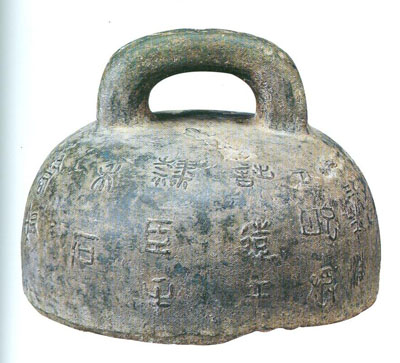
(Acknowledgements to the Trustees of the British Museum)
Also of interest is the measuring cup illustrated below. Its capacity is a “half dou”, which was the most popular size in use. Strangely enough, it is almost exactly equivalent to one litre. Obviously, this must be sheer coincidence, but it does give the lie to the British imperialists’ claim that the pint is “natural”, whereas the litre is not.
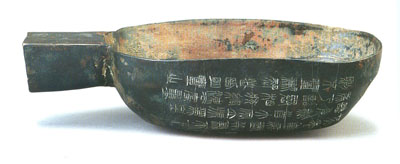
(Acknowledgements to the Trustees of the British Museum)
Here in Britain the first recorded attempt to standardise weights and measures can be found in Magna Carta (1215), but it was not until 1824 that imperial measures were standardised by the first Weights and Measures Act. Unfortunately, our current crop of politicians lack the perception or the political courage (or both) to acknowledge that a single system of weights and measures is a basic requirement of a modern society. Hence we have, to quote another Chinese leader*, “one country, two systems”.
————————————————————————–
*the late Deng Xiaoping, referring to the Hong Kong Special Administrative Region
TSI cops out
The Trading Standards Institute (whose members are responsible for enforcing weights and measures law) has declined to support the UK Metric Association’s campaign for a single, rational system of measurement that everybody understands and uses for all purposes. In response, UKMA has accused the TSI of “an abdication of professional responsibility”.
“Best bananas. Two pounds for a pound!”
An item on a BBC Radio 4 programme today included some interviews in a Tyneside market. A market trader was heard selling his wares with the cry, “Best bananas. Two pounds for a pound!”
 Metric Views