Imperialist ‘victory’ or checkout muddle?

Today’s (9/5/2007) news media have widely reported a story that imperial measures may continue to be displayed alongside metric ones in this country for an indefinite period. (http://news.bbc.co.uk/1/hi/uk/6637587.stm) This is being trumpeted by some as a “monumental victory”. It is ironic that in the very year when we are celebrating the bicentenary of the abolition of slavery, clinging on to our imperial past is so widely embraced. However, this news just means ‘business as usual’ in the UK. Weighing machines will not be changed back to imperial. We shall continue to see some unnecessarily complex price labels and, for those who stick to using imperial, a muddle at the supermarket checkout.

What most reports fail to state is that at the greengrocer, butcher and supermarket still legally need to weigh and measure using metric. So if your trader uses imperial scales, they have not been tested recently. But what is the value of labelling in imperial? If you read a price in imperial you cannot check if you have been charged correctly without using a calculator.

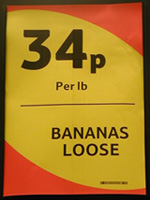
Take this real example of a supermarket advert for bananas above. A customer reading “34p/lb” may have the impression that it is a lower price compared with the shop down the road offering bananas a price of say 69p/kg. The equivalent price is actually 74p/kg.

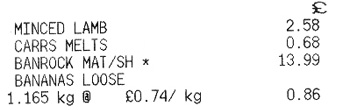
At the checkout, however, the customer cannot check whether he or she has been charged correctly. The weighing machine uses kilograms and the receipt shows the kilogram price 74p/kg.

Common sense would suggest that the most sensible thing would be to display the price using the units of the weighing machine and receipt. Adding the imperial supplementary price adds nothing and can be confusing. Seven years after changing to metric for loose goods, we have all had enough time to change over.

What a pity that some of our politicians and news media despise consumer protection and see a victory in perpetuating an obsolete unit. It is high time that the British Government – without any pressure from the EU – finishes off the metric conversion in the interests of the consumer.

DTI claim that removing supplementary indications will be a barrier to trade

Britain’s department for trade and industry (DTI) has recently published a letter advocating continued derogation on using supplementary indications.

[Article by Roddy Urquhart]

Continue reading “DTI claim that removing supplementary indications will be a barrier to trade”

Will the new metric clothing standard work?

A new international standard for sizing clothes would overcome many of the problems of incompatible size labelling. But will it be undermined by the British retail and clothing industries because it is metric? – article based on contribution by M-V.

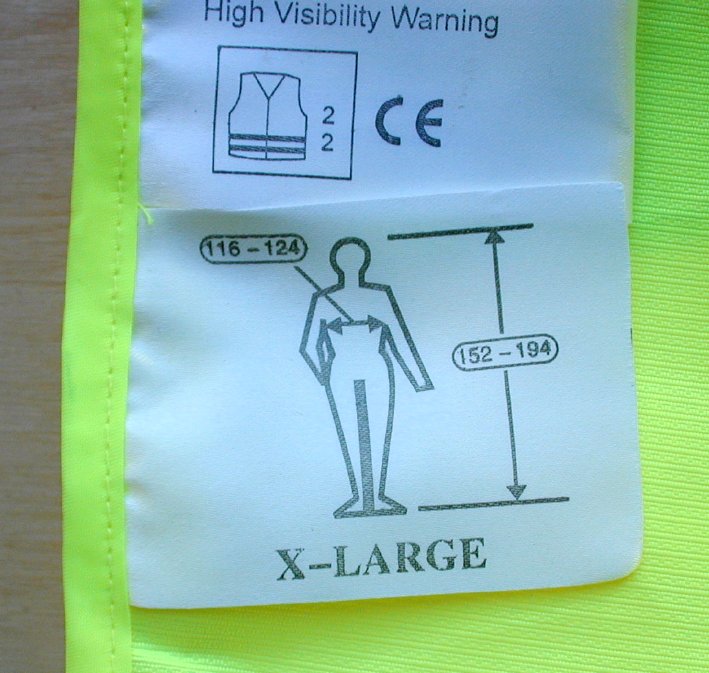
During the last few days there have been various newspaper articles describing proposed new labelling for clothing. This labelling is in fact the EN 13402 European standard for labelling clothing sizes and is expected to come into widespread use by the end of 2007. The work was sponsored by CEN (European Standards Organisation – an organisation that draws its membership from various European bodies), while much of the fieldwork was done by the BSI (British Standards Institute). The photograph below (by Markus Kuhn and downloaded from the Wikipedia site) shows an actual label used for a high-visibility jacket.

This example shows that the garment is designed to fit a man with a chest measurement of 118 to 124 cm and a height of up to 1.94 m.

The standard works as follows.
(Wikipedia http://en.wikipedia.org/wiki/EN_13402
has a full description – also written by Markus Kuhn). Firstly, it should be remembered that measurements on the garments refers to the wearer, not to the garment itself. Thus the chest measurement on a vest label and on an overcoat label for a particular person have the same value.

The standard comes in four parts:

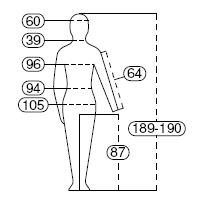
  • EN 13402-1 defines how the body should be measured (using centimetres and kilograms where appropriate). For example, the length of the hand girth is measured “maximum girth measured over the knuckles (metacarpals) of the open right hand, fingers together and thumb excluded”. This results in a pictogram (diagrammatic picture) of the individual customer – as illustrated below:

Ideally, everybody should have a little card bearing this pictogram, and they can use this whenever they go shopping for clothes (or borrow their partner’s if they are shopping for them!) Enterprising clothing retailers might offer a free measurement and card-issuing service.

  • EN 13402-2 defines the primary and optional secondary measurements for various garments. For example, the primary measurement for men’s trousers is the waist girth, while the wearer’s height and inside leg length are optional additional measurements. The author has spotted one omission is the list of garments â?? there is nothing about men’s kilts, though manufacturers might use the same parameters as are used for women’s skirts.
  • EN 13402-3 defines the standard interval sizes for various measurements. For example men’s chest sizes will be in 4 cm intervals and a 100 cm chest would be suitable for men with chests between 98 cm and 102 cm.
  • EN 13402-4 defines a five character manufactures coding system.

If UK retailers adopt the system (it is optional), then there will be a big change – conversion of the sizes of existing clothing lines will be difficult because the traditional British interval for men’s chests (for example) is 2 in, not 4 cm. This will mean that manufacturers will have to offer the public a wider range of measurements to accommodate the smaller interval. Unless there is some coordination, one can see chaos on the high street if one retailer or manufacturer uses the EN 13402 while another sticks to traditional sizing.

Fixed package sizes to remain for 5 years – EU compromise

The European Commission has proposed a compromise which would effectively retain fixed sizes for a limited number of prepackaged goods until 2013 or 2014. [article originally drafted by Robin Paice for UKMA News]

In 2005 the European Commission published a proposal which would have deregulated package sizes (aka “prescribed quantities” or “PQs”) for most goods, with the exception of wine and spirits, sugar and instant coffee. This proposal would have ended the nonsense whereby jam packed in the UK must be sold in the UK in multiples of 57 g (e.g. jars of 454 g), whereas jam imported from France may be sold in jars of 400 g or 500 g.

However, in February 2006, led by Conservative MEPs, and egged on by British tabloid newspapers, the European Parliament proposed a series of amendments which would have retained a range of fixed sizes for a variety of goods – notably the venerable “pint” of milk. The same newspapers portrayed this vote as a defeat for the Brussels Bureaucrats’ attempts to abolish the good old British pint – although actually the Commission’s proposals posed no threat to the pint.

Following a series of negotiations involving the Commission, the Council of Ministers and the European Parliament, a compromise has emerged which would achieve the Commission’s original intention of general deregulation (with limited exceptions) but with a delay of 5 years for milk, butter, pasta and coffee, and six years for sugar. It now appears that this revised proposal will be adopted by the three legislative institutions of the EU. For full details see http://eur-lex.europa.eu/LexUriServ/site/en/com/2006/com2006_0811en01.pdf

One of the Commission’s arguments for abolishing fixed sizes was that “unit pricing” (per kg, L, etc) enables consumers to compare value for money, and therefore fixed sizes are unnecessary. Unfortunately, neither the Commission nor the UK Government has attempted to explain or popularise the little understood concept of unit pricing – the small print which appears at the bottom of price labels. So whether the consumer will be well served by this decision is debatable.

In the meantime, the UK Government is now faced with a dilemma. In 2005 it proposed that the various Food Orders (as they are called), which regulate the sizes of packages which may be manufactured and sold in the UK, should be consolidated into a single Order – albeit without changing the content of the Orders. (These are the Orders which determine that, for example, jam must be sold in multiples of 57 g but instant coffee in multiples of 50 g).

Assuming that the Commission’s proposals come into force in 2008, and that the Food Orders also could not be revised until the same year, the revised Orders would only be in force for a maximum of five years – and only for the limited range of products listed above. This may not be enough to warrant the expense of churning out the necessary secondary legislation and occupying scarce Parliamentary time.

What about the pint of beer?

There remains, however, one minor but iconically important issue raised by the DTI in its consultation paper but not covered by the Commission’s proposal: the pint of beer. UKMA had proposed that draught beer and cider should be permitted (not required) to be dispensed in metric quantities, as long as the price per litre was displayed. As this would be an additional option and not a new and onerous regulation, there should be no problem about introducing this measure immediately.

In its response in September 2005, the DTI simply commented: “We will consider the options for revision of specified quantities for alcoholic drinks …., taking into account comments received.”