First Emperor showed the way – 2000 years ago

I recently had the pleasure of visiting the splendid (Chinese) First Emperor exhibition at the British Museum. Apart from the terracotta warriors, what impressed me the most was the way that Qin Shihuangdi imposed standardisation on his vast empire – including, of course, weights and measures.

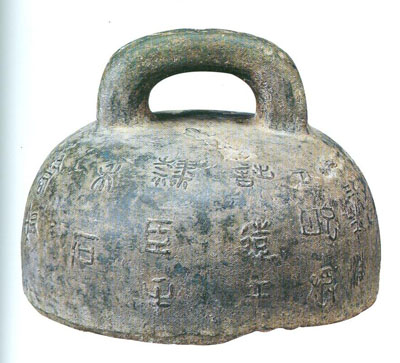
Qin Shihuangdi unified China by conquest in 221 BC. One of his first acts was to decree that only standard weights and measures were to be used throughout the empire. The bronze weight illustrated below is inscribed as follows: “In the 26th year [of his reign the king of Qin] united the princes of the [individual] states; the people enjoyed peace, and he was proclaimed emperor [huangdi]. He issued an edict that all weights are to be standardised. Where they are not uniform, or where there are any doubts, let them be standardised and classified.”


(Acknowledgements to the Trustees of the British Museum)

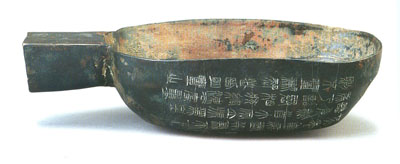
Also of interest is the measuring cup illustrated below. Its capacity is a “half dou”, which was the most popular size in use. Strangely enough, it is almost exactly equivalent to one litre. Obviously, this must be sheer coincidence, but it does give the lie to the British imperialists’ claim that the pint is “natural”, whereas the litre is not.


(Acknowledgements to the Trustees of the British Museum)

Here in Britain the first recorded attempt to standardise weights and measures can be found in Magna Carta (1215), but it was not until 1824 that imperial measures were standardised by the first Weights and Measures Act. Unfortunately, our current crop of politicians lack the perception or the political courage (or both) to acknowledge that a single system of weights and measures is a basic requirement of a modern society. Hence we have, to quote another Chinese leader*, “one country, two systems”.

————————————————————————–
*the late Deng Xiaoping, referring to the Hong Kong Special Administrative Region

Decimal measures to oust inches and miles

But seriously folks. The article below was an April fool joke but the decimal tape measure is real. In Britain surveyors did use the decimalised foot before going metric. Clearly they recognised the advantages of a decimal system but realised that the metric system proper had much more to offer. The tape featured in the article is in fact American where they still use old fashioned units of measurement. They too clearly see the advantages of decimal in measurement, so the next step is …

Continue reading “Decimal measures to oust inches and miles”

TSI cops out

The Trading Standards Institute (whose members are responsible for enforcing weights and measures law) has declined to support the UK Metric Association’s campaign for a single, rational system of measurement that everybody understands and uses for all purposes. In response, UKMA has accused the TSI of “an abdication of professional responsibility”.

Continue reading “TSI cops out”

An echo of the past, but no pointer to the future

The Sunday Telegraph and the Daily Mail have followed the far-right British National Party in drawing attention to the case of a market trader in Dalston, East London, who prefers to sell fruit and veg by the bowl (see previous posting in Metric Views). This may come as no surprise to some readers, but we wonder where it is leading.

Continue reading “An echo of the past, but no pointer to the future”

Imperial scales may give short measure says metric group

The following news release was issued by UKMA at 02:00 on 18 January:

news release … news release … news release … news release … news release …

For immediate release

“Imperial scales may give short measure” says metric group

The general public would be well advised to avoid buying from traders who use illegal scales that only weigh in pounds and ounces – so says the UK Metric Association (UKMA). Imperial-only scales have not been checked by Trading Standards Officers for over eight years, and it is quite possible that they are no longer accurate. There is therefore a significant chance that when you buy from shop or market stall that uses illegal scales you will get less than you are paying for.

Responding to reports that a market stall-holder in Hackney is being prosecuted on Friday, 18 January for Weights and Measures offences, UKMA Chairman, Robin Paice, said; “Obviously, I can’t comment on this particular case as we don’t know the full facts. However, the publicity surrounding the case suggests that, like the so-called ‘metric martyrs’ in Sunderland and elsewhere, this is really a political stunt. People are entitled to campaign to change the law, but they are not entitled to break laws just because they disagree with them. They don’t deserve any sympathy.”

Background

Since 2000, UK law has required that all shops and markets in the UK must weigh and measure at the point of sale (checkout) in grams and kilograms. Traders’ scales are periodically tested by Trading Standards Officers (TSOs) to ensure they are accurate. However, traders can still give an equivalent price in pounds and ounces if they wish. Customers can also order in pounds and ounces if they wish, and the shopkeeper or trader simply has to weigh out an equivalent amount in grams and kilograms.

Originally, it was intended that the option to show equivalent imperial prices would be phased out after 2009, but the European Commission has now proposed that this option should be retained indefinitely. However, increasingly, supermarkets are dropping the imperial equivalents, and customers are ordering at the deli counter in grams rather than obsolete ounces.

Unfortunately, egged on by populist, Eurosceptic politicians, some traders decided in 2000 to try to defy the law and continue weighing in pounds and ounces. The so-called “metric martyrs” (more accurately, they were “imperial luddites”) were found guilty of various offences under the Weights and Measures Act and fined. All their appeals to the UK courts and even the European Court of Human Rights were rejected in 2001/2.

The current issue in Hackney appears to be an attempt to re-run the same political stunt. It is unlikely to work, as it is now obvious that the law is home-grown UK law and not dictated by Brussels. People are getting rather bored by the antics of fringe politicians seeking bogus martyrdom.

UKMA Chairman, Robin Paice added:
“The purpose of the UK law is to ensure that consumers can compare goods in the supermarket and the street market on the same basis, using the same measurement units. How can you compare tomatoes at £2.09 per kilogram in the supermarket with tomatoes at 99p per pound in the market – unless you know the conversion factors and have a pocket calculator with you? It is fundamental to consumer protection that every body uses the same measurement units.

My advice to shoppers is this:

  • Avoid traders who use illegal imperial scales. You don’t know whether you are getting short measure.
  • Don’t waste your sympathy on traders who deliberately broke the law in order to seek bogus martyrdom. The vast majority of traders operate legally and cope perfectly well with metric measures.

Every country needs a single system of weights and measures that everybody understands and uses for all purposes. Nobody needs two systems.”

Notes for editors

(a) The UK Metric Association (UKMA) is an independent, non-party political, single issue organisation which advocates the full adoption of the international metric system (“Système International” – SI) for all official, trade, legal, contractual and other purposes in the United Kingdom as soon as practicable. UKMA is financed entirely by membership subscriptions and personal donations.

(b)Further extensive background information can be found generally on UKMA’s website at www.ukma.org.uk.

(c) The following are available for interviews:

Robin Paice (Chairman of UKMA) on 023 9275 5268 or for radio/TV interviews in Portsmouth or Southampton

Derek Pollard (Secretary) on 020 8374 6997 for radio/TV interviews in London

No return to pounds and ounces

Today’s announcement by the European Commission that it is to propose that “supplementary indications” (such as lbs and oz) should be allowed indefinitely does NOT mean that traders can go back to weighing and pricing in imperial measures – so says the UK Metric Association (UKMA). [Press release issued on 11 September.]

Continue reading “No return to pounds and ounces”

UKMA slates EU climb down on metrication

The UK Metric Association has accused the European Commission of “political cowardice” because it has caved in to American and European exporters – supported by the UK Government – and effectively abandoned the objective of a single, rational system of measurement throughout Europe.

The Commission has just published its response to the recent consultation on revising the Units of Measurement Directive. It is a badly written and illogical document, and UKMA has commented on it in the following press release:

The following press release was issued on Wednesday, 27 June:
“Pro-metric group slates EU climb-down
London, 27 June 2007.
The UK Metric Association (UKMA) today accused the European Commission of caving in to pressure from European and American exporters – supported by the UK Government – to be allowed to carry on using imperial and American weights and measures in packaging and product manuals. In its response to the recent consultation the Commission proposes that “supplementary indications” should be allowed indefinitely and that the obligation of the UK to “fix a date” for converting road signs to metric units should be removed.

See http://ec.europa.eu/enterprise/prepack/unitmeas/uni_ms_en.htm

UKMA Chairman, Robin Paice, commented: “This has all the signs of a stitch-up between the UK’s Department of Trade and Industry and the European Commission. The DTI has made it clear that they are implacably opposed to further metrication in the UK, and rather than challenge them, the Commission has bottled out and is proposing to abandon the objective of a single, rational system of measurement used and understood throughout the European Union.”

In its own submission to the Commission*, UKMA had argued that there is a simple solution to the problems allegedly encountered by transatlantic traders in coping with two conflicting labelling regimes (the USA mostly requires dual American/metric units on packages, whereas the EU had intended to require metric-only). All that is needed, said UKMA, is a reciprocal arrangement to accept each other’s labelling for imports and exports. Until such an agreement is reached the EU could unilaterally accept dual-labelling on American imports. Or if that is too difficult, dual labelling could be allowed on all packages and product manuals etc – but not on loose goods priced and weighed out by the trader.

The Commission’s report ignores this last point and attempts to justify its rejection of the mutual recognition argument by suggesting that third countries might complain that it also affected their exports and would be a non-tariff barrier to trade. This argument is clearly disingenuous since it would obviously be possible to devise wording that would accommodate this very minor problem. They thus appear (or pretend) to believe that two systems are cheaper than one.

The Commission has also agreed to support a UK proposal that it should not have to name a date for converting road signs to metric units. Citing both the UKMA cost estimate of £80 million and the Transport Department’s grossly inflated estimate of £800 million, the Commission’s paper comments that imperial road signs have “cultural significance and do not give rise to discomfort which can be considered a major benefit”. They have thus failed completely to understand the benefits of a single system as well as the hidden costs of continuing to muddle through with two systems. They have also ignored UKMA’s argument that the continued existence of imperial road signs is the biggest obstacle to the acceptance of metric measures in the UK in everyday life. “As long as we have miles, yards, feet and inches on the road signs, many people will not adapt to measuring up for curtains and carpets in metres and square metres.”, said Robin Paice.

He added: “Why should the refusal of the Americans to accept the world system condemn the British to endure indefinitely the misery and muddle of incompatible weights and measures in shops and markets. It undermines consumer protection (one of the Commission’s claimed new stated objectives) wastes our children’s education, and just prolongs this “very British mess**.It is a piece of political cowardice.”

ENDS

*This can be seen at http://ec.europa.eu/enterprise/prepack/unitmeas/depot_anwers/c-non-gov-organis/R205.pdf

** “A very British mess”, with foreword by Lord Howe, is published by the UK Metric Association and can be obtained via UKMA’s website at http://www.ukma.org.uk/books/index.htm

Notes for editors:

(a) The UK Metric Association (UKMA) is an independent, non-party political, single issue pressure group which advocates the full adoption of the international metric system (“Système International” – SI) for all official, trade, legal, contractual and other purposes in the United Kingdom as soon as practicable. UKMA is financed entirely by membership subscriptions and personal donations.

(b) Further extensive background information can be found generally on UKMA’s website at www.ukma.org.uk .

(c) The following are available for interview or comment:

  • Robin Paice (Chairman) on 023 9275 5268 for telephone interviews
  • Roz Denny (Press Officer) on 020 7736 5383 or 0777 039 1581 for interviews in London or by telephone
  • Derek Pollard (Secretary) on 020 83746997 or 01304 375854″

—————————————————————
Further comment:

Despite this deeply depressing cave-in by the Commission, there are perhaps two consolations that can be drawn:

  • The Commission has at least not accepted the demands of the extreme imperialists (the so-called “metric martyrs”) to go back to selling in pounds and ounces, nor is the UK Government supporting this.
  • If these proposals are actually enacted. The EU will effectively cease to have any say in UK weights and measures. It will then be possible to separate the metrication issue from the European issue, and it will be possible to make the case for completing metrication on its merits without having to refute silly arguments about Brussels bureaucrats.

“Office rents per sq ft not legal” – says LACORS

Metric Views has received confirmation – from an impeccable authority – of what it has long suspected: that the widespread practice of pricing and advertising office rents “per square foot” is illegal under UK law.

The full story, which has only recently come to light, seems to be as follows. Upon receipt of a complaint from a member of the public about giving business grants “per square foot”, a northern local authority Trading Standards Department initially responded that “services” are not covered by the Price Marking Order (PMO), and as this grant was considered to be a “service”, pricing “per square foot” was legal. It appears that this interpretation was frequently given by other Councils, and it was even supported by Consumer Direct, a national online helpline.

However, this interpretation was challenged by the member of the public, and LACORS (the Local Authority Co-ordinating body for Regulation) was asked to look again at the issue. In August 2004 they issued new guidance which reversed their previous opinion. Specifically, they rejected the previously quoted view that the PMO only applies to the pricing of goods for sale, and that prices “per sq ft” for or a fixed area are legal because they are merely for ‘guidance’.

The opinion is reproduced in full below, but briefly it confirms that Section 8 of the Weights and Measures Act 1985 prohibits the use of imperial units “for trade” (as they are not included in the list of permitted units in the relevant Schedule to the Act). Moreover, “use for trade” includes any “transaction involving the rendering of money, where the transaction is by reference to quantity.” The opinion goes on to argue that, since office space, boat moorings, allotments etc must be priced per metre or square metre, it would be obviously sensible for them to be advertised inthe same way.

Trading Standards Departments which hitherto have relied on the earlier interpretation will now have to review their policy, and we can look forward to the gradual disappearance of imperial pricing of shop and office rents, storage space, allotments etc as Trading Standards Departments advise estate agents of the correct legal position.

The full text of the LACORS advice is given below. We have emboldened some of the more significant passages:

————————————————————————————–

Metrication

Advice on the use of imperial units

(Specifically, transactions (sale, rental, lease, grants) relating to floor
space, areas of land, length of boat moorings, length of archiving space,
etc.)

LACORS has received a number of enquiries regarding the use of imperial
units relating to transactions such as:

Sales, rental or lease of floor space (commercial or domestic
property) by reference to floor area
Rental of boat moorings by reference to length
Lease of archiving space by reference to length
Award of development grants by reference to floor area
Rental of allotments by reference to length and/or area of land

LACORS previously issued advice that “it is unlikely that room space is ‘goods’ for the purposes of either the Weights & Measures Act 1985 or the Price Marking Order 1991″. There was, therefore, no recommendation to use only metric units.

The LACORS Metrology Focus Group has revisited the question, and now finds this advice to be out-of-date. The following advice replaces that given
previously.

The legislation

The relevant section of the Weights & Measures Act 1985 reads as follows:

Section 8. Units of measurement, weights and measures lawful for use for
trade.
(1) No person shall-
(a) use for trade any unit of measurement which is not included in Parts I
to V of Schedule 1 to this Act.

It can be clearly seen from Schedule 1 that imperial units including the
foot, square foot etc. may NOT be used for trade, since they do not appear
in Parts I to V of that Schedule.

The definition of ‘use for trade’ is found in Section 7:
7. Meaning of ‘use for trade’.
(1) In this Act ‘use for trade’ means, subject to subsection (3) below, use
in Great Britain in connection with, or with a view to, a transaction
falling within subsection (2) below where-
(a) the transaction is by reference to quantity or is a transaction
for the purposes of which there is made or implied a statement of the
quantity of goods to which the transaction relates, and
(b) the use is for the purpose of the determination or statement of
that quantity.
(2) A transaction falls within this subsection if it is a transaction for-
(a) the transferring or rendering of money or money’s worth in
consideration of money or money’s worth, or
(b) the making of a payment in respect of any toll or duty.

A unit of measurement may, therefore, be deemed to be in ‘use for trade’ if
it is used in connection with a transaction involving the rendering of
money, where the transaction is by reference to
 quantity.

Since 7(1)(a) can be split into two separate clauses (that is to say ‘the
transaction is by reference to quantity’ or ‘is a transaction for the
purposes of which there is made or implied a statement of the quantity of
goods to which the transaction relates’). In the former case, there is no
requirement for the transaction to involve a quantity of ‘goods’.

Therefore, any reference to quantity, whether voluntary or otherwise, must
be made in metric units.

For clarification, it is also necessary to establish what constitutes a
‘transaction by reference to quantity’. Consider the two examples below:
1. Offices for rent
First floor offices, fully serviced, available now, 3,500 sq ft
£35,000 per annum
2. Offices for rent
First floor offices, fully serviced, £10 per sq ft per annum
3,500 sq ft unit available now

Clearly, the same office space is being offered at the same annual rental
price in each case; however, in example 1, the reference to area may be
considered to be a description – the rental price is a total sum for the
offices as described – and therefore the use of imperial units is
acceptable. In example 2, there is a clear relation between the floor space
and the calculation of the total rental price (“£10 per sq ft”), which
renders it a transaction by reference to quantity and therefore subject to
the requirements of the Weights & Measures Act 1985 requiring the use of
metric units.

When a transaction is by reference to quantity, as described above, this is
a legal requirement; where the quantity forms part of a description only,
metric units should be indicated for the sake of clarity and consistency.

“Metric martyrs” – what was the fuss about?

On Wednesday, 9 May, the air waves and the prints were full of fanciful stories about Brussels caving in and allowing Britain to carry on using lbs, oz and other imperial units. The so-called “metric martyrs” * (Oh no, not them again!) declared a victory for their campaign. So what has really happened?

It appears that at a recent Committee meeting of the European Parliament, one of the 27 Commissioners, Günter Verheugen, indicated that, in response to lobbying from European and American exporters, he intended to propose to fellow Commissioners that the current authorisation of “supplementary indications” alongside metric units should be extended beyond its current deadline of 2009. If the Commission approves this proposal it will then have to go through the decision-making machinery of the EU before the current Units of Measurement Directive can be revised.

This has been claimed by a spokesman for the “metric martyrs” as a victory for their campaign to be allowed to weigh and price in lbs and oz. The reality is quite different.

No difference

If Mr Verheugen’s proposal were eventually to be agreed as reported (big “if”), it would make absolutely no difference to the current situation. Traders will still have to price and weigh goods at the point of sale in metric units, with the option of an accompanying supplementary indication, which must be no more prominent than the legal metric unit. Most shops and supermarkets now comply with the law, and many have given up on showing lbs, oz, pints, sq yds, etc. Only a handful of recalcitrant market traders and small shopkeepers still hold out against the law, and their numbers are dwindling.

A special exemption for US imports and exports?

However, this is by no means the end of the story. The reason given for authorising supplementary indications is that the USA requires dual labelling (metric and “US customary” – not the same as imperial, by the way) on packaged goods. Thus, if the EU insists on metric-only labelling, exporters will require separate packaging for the two markets. It is difficult to see why putting an extra sticky label on a package is a significant business cost, but even if it is, there is a simple solution which need not affect the great majority of transactions within the EU. All that is required to solve the exporters’ alleged problem is a special exemption for imports of packaged goods from and exports to the USA. This is exactly what was proposed by the UK Metric Association (UKMA) in its submission to the EU consultation on revising the Directive, which can be seen at
http://ec.europa.eu/enterprise/prepack/unitmeas/depot_anwers/c-non-gov-organis/R205.pdf
It remains to be seen whether the Commission will accept the obvious logic and common sense of our proposal.

Pints and miles

Contrary to many media reports, Mr Verheugen’s proposal would not affect the status of the pint for draught beer and cider and for milk in returnable containers, nor would it affect the mile, yard, foot and inch for road signs, distance and speed measurement. The UK Government will still be required to name a date for phasing out these measures. As far as road signs are concerned, UKMA has proposed that a new deadline of 2014 should be set.

* Footnote:

The suggestion that the original so-called “metric martyrs” have been exonerated is absurd. They were properly prosecuted and convicted under the current law for using illegal scales and other offences, and all their appeals to various UK and European (!) courts were dismissed. Even if the Directive were to be amended as suggested, they would still be breaking the law. They were guilty as charged and remain so.