
UKMA slates EU climb down on metrication

The UK Metric Association has accused the European Commission of “political cowardice” because it has caved in to American and European exporters – supported by the UK Government – and effectively abandoned the objective of a single, rational system of measurement throughout Europe.

The Commission has just published its response to the recent consultation on revising the Units of Measurement Directive. It is a badly written and illogical document, and UKMA has commented on it in the following press release:

The following press release was issued on Wednesday, 27 June:
“Pro-metric group slates EU climb-down
London, 27 June 2007.
The UK Metric Association (UKMA) today accused the European Commission of caving in to pressure from European and American exporters – supported by the UK Government – to be allowed to carry on using imperial and American weights and measures in packaging and product manuals. In its response to the recent consultation the Commission proposes that “supplementary indications” should be allowed indefinitely and that the obligation of the UK to “fix a date” for converting road signs to metric units should be removed.

See http://ec.europa.eu/enterprise/prepack/unitmeas/uni_ms_en.htm

UKMA Chairman, Robin Paice, commented: “This has all the signs of a stitch-up between the UK’s Department of Trade and Industry and the European Commission. The DTI has made it clear that they are implacably opposed to further metrication in the UK, and rather than challenge them, the Commission has bottled out and is proposing to abandon the objective of a single, rational system of measurement used and understood throughout the European Union.”

In its own submission to the Commission*, UKMA had argued that there is a simple solution to the problems allegedly encountered by transatlantic traders in coping with two conflicting labelling regimes (the USA mostly requires dual American/metric units on packages, whereas the EU had intended to require metric-only). All that is needed, said UKMA, is a reciprocal arrangement to accept each other’s labelling for imports and exports. Until such an agreement is reached the EU could unilaterally accept dual-labelling on American imports. Or if that is too difficult, dual labelling could be allowed on all packages and product manuals etc – but not on loose goods priced and weighed out by the trader.

The Commission’s report ignores this last point and attempts to justify its rejection of the mutual recognition argument by suggesting that third countries might complain that it also affected their exports and would be a non-tariff barrier to trade. This argument is clearly disingenuous since it would obviously be possible to devise wording that would accommodate this very minor problem. They thus appear (or pretend) to believe that two systems are cheaper than one.

The Commission has also agreed to support a UK proposal that it should not have to name a date for converting road signs to metric units. Citing both the UKMA cost estimate of £80 million and the Transport Department’s grossly inflated estimate of £800 million, the Commission’s paper comments that imperial road signs have “cultural significance and do not give rise to discomfort which can be considered a major benefit”. They have thus failed completely to understand the benefits of a single system as well as the hidden costs of continuing to muddle through with two systems. They have also ignored UKMA’s argument that the continued existence of imperial road signs is the biggest obstacle to the acceptance of metric measures in the UK in everyday life. “As long as we have miles, yards, feet and inches on the road signs, many people will not adapt to measuring up for curtains and carpets in metres and square metres.”, said Robin Paice.

He added: “Why should the refusal of the Americans to accept the world system condemn the British to endure indefinitely the misery and muddle of incompatible weights and measures in shops and markets. It undermines consumer protection (one of the Commission’s claimed new stated objectives) wastes our children’s education, and just prolongs this “very British mess**.It is a piece of political cowardice.”

ENDS

*This can be seen at http://ec.europa.eu/enterprise/prepack/unitmeas/depot_anwers/c-non-gov-organis/R205.pdf

** “A very British mess”, with foreword by Lord Howe, is published by the UK Metric Association and can be obtained via UKMA’s website at http://www.ukma.org.uk/books/index.htm

Notes for editors:

(a) The UK Metric Association (UKMA) is an independent, non-party political, single issue pressure group which advocates the full adoption of the international metric system (“Système International” – SI) for all official, trade, legal, contractual and other purposes in the United Kingdom as soon as practicable. UKMA is financed entirely by membership subscriptions and personal donations.

(b) Further extensive background information can be found generally on UKMA’s website at www.ukma.org.uk .

(c) The following are available for interview or comment:

  • Robin Paice (Chairman) on 023 9275 5268 for telephone interviews
  • Roz Denny (Press Officer) on 020 7736 5383 or 0777 039 1581 for interviews in London or by telephone
  • Derek Pollard (Secretary) on 020 83746997 or 01304 375854″

—————————————————————
Further comment:

Despite this deeply depressing cave-in by the Commission, there are perhaps two consolations that can be drawn:

  • The Commission has at least not accepted the demands of the extreme imperialists (the so-called “metric martyrs”) to go back to selling in pounds and ounces, nor is the UK Government supporting this.
  • If these proposals are actually enacted. The EU will effectively cease to have any say in UK weights and measures. It will then be possible to separate the metrication issue from the European issue, and it will be possible to make the case for completing metrication on its merits without having to refute silly arguments about Brussels bureaucrats.
“Metric martyrs” – what was the fuss about?

On Wednesday, 9 May, the air waves and the prints were full of fanciful stories about Brussels caving in and allowing Britain to carry on using lbs, oz and other imperial units. The so-called “metric martyrs” * (Oh no, not them again!) declared a victory for their campaign. So what has really happened?

It appears that at a recent Committee meeting of the European Parliament, one of the 27 Commissioners, Günter Verheugen, indicated that, in response to lobbying from European and American exporters, he intended to propose to fellow Commissioners that the current authorisation of “supplementary indications” alongside metric units should be extended beyond its current deadline of 2009. If the Commission approves this proposal it will then have to go through the decision-making machinery of the EU before the current Units of Measurement Directive can be revised.

This has been claimed by a spokesman for the “metric martyrs” as a victory for their campaign to be allowed to weigh and price in lbs and oz. The reality is quite different.

No difference

If Mr Verheugen’s proposal were eventually to be agreed as reported (big “if”), it would make absolutely no difference to the current situation. Traders will still have to price and weigh goods at the point of sale in metric units, with the option of an accompanying supplementary indication, which must be no more prominent than the legal metric unit. Most shops and supermarkets now comply with the law, and many have given up on showing lbs, oz, pints, sq yds, etc. Only a handful of recalcitrant market traders and small shopkeepers still hold out against the law, and their numbers are dwindling.

A special exemption for US imports and exports?

However, this is by no means the end of the story. The reason given for authorising supplementary indications is that the USA requires dual labelling (metric and “US customary” – not the same as imperial, by the way) on packaged goods. Thus, if the EU insists on metric-only labelling, exporters will require separate packaging for the two markets. It is difficult to see why putting an extra sticky label on a package is a significant business cost, but even if it is, there is a simple solution which need not affect the great majority of transactions within the EU. All that is required to solve the exporters’ alleged problem is a special exemption for imports of packaged goods from and exports to the USA. This is exactly what was proposed by the UK Metric Association (UKMA) in its submission to the EU consultation on revising the Directive, which can be seen at
http://ec.europa.eu/enterprise/prepack/unitmeas/depot_anwers/c-non-gov-organis/R205.pdf
It remains to be seen whether the Commission will accept the obvious logic and common sense of our proposal.

Pints and miles

Contrary to many media reports, Mr Verheugen’s proposal would not affect the status of the pint for draught beer and cider and for milk in returnable containers, nor would it affect the mile, yard, foot and inch for road signs, distance and speed measurement. The UK Government will still be required to name a date for phasing out these measures. As far as road signs are concerned, UKMA has proposed that a new deadline of 2014 should be set.

* Footnote:

The suggestion that the original so-called “metric martyrs” have been exonerated is absurd. They were properly prosecuted and convicted under the current law for using illegal scales and other offences, and all their appeals to various UK and European (!) courts were dismissed. Even if the Directive were to be amended as suggested, they would still be breaking the law. They were guilty as charged and remain so.

BBC pundit supports going metric

Mention ‘k’ to this economist, and it’s not only the size of investment capital that he’s thinking of..

BBC News economics editor and presenter of “Dragons’ Den”, Evan Davis, speaks out in favour of the simplicity of the metric system in an article on his BBC blog. Normally associated in the public eye for financial figures in the thousands of pounds, Evan Davis compares the elegance and simplicity of the metre and kilometre and of decimal currency against the confusion of inches, feet, yards and miles, pounds, shillings and pence.

Is the Moon still metric?

According to a BBC story, Dennis Hope, the self-proclaimed (imperialist?) owner of the moon, is selling plots of lunar real estate by the acre.

http://news.bbc.co.uk/2/hi/science/nature/6533169.stm

BBC2 – Horizon – 2007-04-10 21:00

This story comes just weeks after a decision by NASA that all future manned moon missions, and permanent lunar bases, will use metric measurements exclusively.

http://www.metricviews.uk/2007/01/13/metric-moon-says-nasa/

So just how will future lunar landowners measure out their 1 chain by 1 furrow long on the moon?

Degrees of confusion

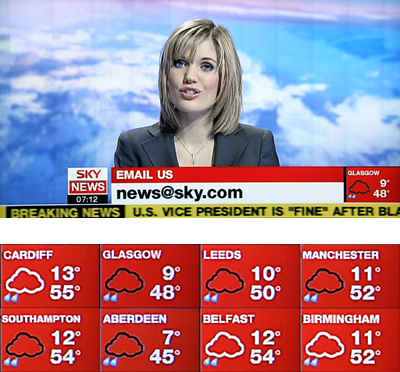
Sky News are currently giving weather forecasts for individual cities on their morning show in the form of icons in the corner of the screen.

On seeing two temperatures for each city, you might expect that they are minimum and maximum temperatures, as is conventional for city forecasts. But these temperatures are more reminiscent of those found in the Middle East.

Even after using the international standard Celsius system for 40 years, it seems that we are expected to realise that the pairs of figures shown are actually both maximum temperatures, but using two different systems.

When will the media make it easier for us all, and stick to one standard temperature scale?

Metric howlers – Times hat-trick

When converting metric units into imperial units, journalists (or more likely sub-editors) are apt to make mistakes, especially if they are dealing with subjects with which they are not very familiar. On the 9th December 2006, The Times managed a hat-trick of blunders. [article contributed by MV]

Page 8 – Airlines should pay full cost of their pollution

The penultimate paragraph contained the text “[Boeing and Airbus] Aircraft use an average of four litres of fuel per 100 km”. This sentence should have raised the alarm bells – a consumption of 4 L/100 km is what one would expect of an economical car such as the Smart Car. (The imperial equivalent is 70 mpg!). If the writer used metric units when driving they would have spotted this howler.

Page 43 – Why the Dead Sea is dying

The fifth paragraph contains the phrase “to suck 1,900 million cubic metres (2.1 million cubic yards) of water”. This phrase contains two howlers. Firstly, a factor of 1000 seems to have gone missing. Secondly, the writer appears to have used a factor of 1.1 to convert cubic metres to cubic yards when the correct factor is 1.1 x 1.1 x 1.1 (which is equal to 1.331).

Page 44 – Spend a penny, but it make you think of a tenor

The third paragraph contains the sentence “The block, in Calcutta, is spread over 3,000 square metres (3,300 square yards) and is “. Here, the writer used a factor of 1.1 to convert square metres to square yards. The correct factor is 1.1 x 1.1 (which is equal to 1.21).

Football going metric?

Viewers of “Match of the Day” on 9 December had the unusual experience of hearing football commentary in metric. Was this an aberration or a straw in the wind? (asks Robin Paice)

There was an interesting exchange on “Match of the Day”
recently.

Three football pundits (Ray Stubbs, Alan Shearer and Mark Lawrenson) are discussing the “goal of the season” scored by Matthew Taylor for Portsmouth against Everton. Lawrenson is describing the volley, voice over an action replay: “straight as an arrow, like a rocket, dipping – here’s the measurement [screen shows 42 metres]. Similar thing at Sunderland last season, like an arrow, goalkeeper on his six yard box [sic] didn’t stand a chance [screen shows 39 metres], not quite so far but still a very good goal. He won’t score many better than that. 42 metres …

AS: By the way, I work in yards.

ML: [slightly condescending] It’s 42 lots of 39 inches.

AS: [to RS] Carry on then.

ML: It’s about 45 and a half yards, give or take.

RS: Have you just worked it out that quickly?

ML: No, I’ve been practising all day.

[All fall about laughing].

Football tends to be militantly imperial despite the fact that as the sport is relatively unknown in the USA, and despite the prominence of foreign players and managers in English and Scottish football, Britain and Ireland are the only countries in the world which still cling to expressions such as the “eighteen yard box” (meaning the penalty area). So it was encouraging, and perhaps we should thank Mark Lawrenson for introducing the footballing masses to the novelty of metric measurements – albeit it was treated somewhat light-heartedly – as though metres are not real measurements.

I would guess that the explanation for this unexpected foray into the world system was that the software used by the BBC in this instance was probably metric. It was easier to use it than try to amend it.

Anyway, thanks to Mark Lawrenson.

“Animals in the womb: Mammals” – pioneering TV from Channel 4

This programme used a combination of computer graphics, physical modelling, and actual ultra-sound images to create stunning pictures of the foetus of a dolphin, an elephant and a golden retriever developing in the womb. There was a commentary, but for much of the time the amazing images spoke for themselves. [Article contributed by Derek Pollard]

Continue reading ““Animals in the womb: Mammals” – pioneering TV from Channel 4″