
Whitworth is famous for the eponymous screw thread, and for his promotion of standard measures and interchangeability that brought about an engineering revolution. Less well known are his enthusiasm for decimal measurement and his opposition to the introduction of the metric system in Britain.
When I started secondary school in 1954, the curriculum included carpentry. Measurement in the school workshop was by inches and fractions. I never got the hang of this, my carpentry was characterised by wonky joints, and my completed projects were fit only for firewood. This would have disappointed my grandfather, for I grew up in a home with several fine items of oak furniture that he had made.
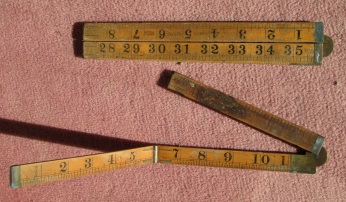
This is an illustration of folding rulers that would have been used by carpenters in the late nineteenth and the first half of the twentieth centuries.
Ten years after my introduction to carpentry, I started work setting out foundations and the like on construction sites. Measurements involving inches and fractions continued to be a challenge, but now included feet to complicate even further the arithmetic.
So if carpentry and construction were still in a medieval world of halves and quarters of inches in 1964, how could British manufacturing industry be thriving at the same time? Step forward the ghost of Joseph Whitworth.
Sir Joseph Whitworth (1803 – 1887) was an English engineer, entrepreneur, inventor and philanthropist. In 1841, he created a widely accepted accepted standard for screw threads. His contribution to the promotion of decimal measures is illustrated by this extract from an article in Wikipedia:
“The introduction of the thousandth of an inch as a sensible base unit in engineering and machining is generally attributed to Joseph Whitworth who wrote:
…instead of our engineers and machinists thinking in eighths, sixteenths and thirty-seconds of an inch, it is desirable that they should think and speak in tenths, hundredths, and thousandths…
Up until this era, workers such as millwrights, boiler makers, and machinists measured only in traditional fractions of an inch, divided as far as 64ths. Each 64th is about 15 thou (sandth of an inch). Communication about sizes smaller than a 64th of an inch was subjective and hampered by a degree of ineffability—while phrases such as “scant 64th” or “heavy 64th” were used, their communicative ability was limited by subjectivity. Dimensions and geometry could be controlled to high accuracy, but this was done by comparative methods: comparison against templates or other gauges, feeling the degree of drag of calipers, or simply repeatably cutting, relying on the positioning consistency of jigs, fixtures, and machine slides. Such work could only be done in craft fashion: on-site, by feel, rather than at a distance working from drawings and written notes. Although measurement was certainly a part of the daily routine, the highest-precision aspects of the work were achieved by feel or by gauge, not by measuring (as in determining counts of units). This in turn limited the kinds of process designs that could work, because they limited the degree of separation of concerns that could occur.
The introduction of thou as a base unit for machining work required the dissemination of vernier calipers and screw micrometers throughout the trade, as the unit is too small to be measured with practical repeatability using rules alone (most rule-markings were far too wide to mark a single mil). During the following half century, such measuring instruments went from expensive rarities to widespread, everyday use among machinists. Bringing more metrology into machining increased the separation of concerns to make possible, for example, designing an assembly to the point of an engineering drawing, then having the mating parts made at different firms who did not have any contact with (or even awareness of) each other—yet still knowing with certainty that their products would have the desired fit.”
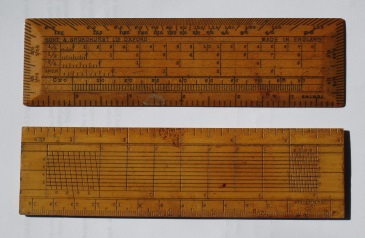
By the early twentieth century, many in Britain had become familiar with measuring both in fractions and in decimals of an inch. The illustration below shows a boxwood protractor from the 1930s, marked with fractions and decimals of an inch together with millimetres. I remember too that my school ruler had decimals of an inch and centimetres on the two front edges and fractions of an inch on the back.
So, you might say, this should have made the metric changeover easier. Certainly in construction this was the case. Imperial measures using fractions were scarcely fit for purpose. The changeover began in 1968 and was largely completed in 1975 as planned.
However, many in manufacturing saw little benefit from metrication. The industry was already decimal, thanks in part to Whitworth’s foresight. Overseas demand for Imperial products was declining, but, thanks to the home market, there was enough work for many companies to make a living. As a result, the industry programme for the changeover was often ignored. Targets were frequently missed. By 1975, when the metric changeover should have been completed, there was still much work to be done. Thereafter, into the 1980s, export markets for inch products collapsed and a sharp decline in manufacturing occurred.
We can only guess what Whitworth would have made of this had he been alive. We do know that he opposed the introduction of the metric system, and suggested that if the French had to have a metre then they should make it forty English (sic) inches!
And what about the Whitworth thread, arguably the best ever created?
Paradoxically, problems with lack of interchangeability among American, Canadian, and British parts during World War 2 led to an effort to unify their inch-based standards, and the Unified Thread Standard was adopted in 1949 by the Screw Thread Standardization Committees of Canada, the United Kingdom and the United States, with the hope that it would be adopted universally. However, internationally, the metric system was eclipsing inch-based units. With continental Europe and much of the rest of the world turning to SI and the ISO metric screw thread, the UK gradually leaned in the same direction. In 1965, the British Standards Institution strongly recommended in a statement that British industry should adopt the ISO metric screw thread system. Today, fifty years on, the Whitworth thread is history, and the inch unified thread is generally found only in products manufactured in North America or for American companies.
Again, we can only guess what Whitworth would have made of the disappearance of his thread system, of the almost universal adoption of metric measures, and of an ‘English’ inch defined as exactly 25.4 mm giving a metre of 39.370 inches. However, we can be sure he would be pleased that decimals now rule nearly everywhere.
 Metric Views
@derekp:
“When I started secondary school in 1954, the curriculum included carpentry. Measurement in the school workshop was by inches and fractions. I never got the hang of this, my carpentry was characterised by wonky joints, and my completed projects were fit only for firewood.”
I too started secondary school the same year. And my carpentry skills were about on a par with yours! It wasn’t until later in life that I (at the time, reluctantly) turned to using mm instead of inches and bits thereof that they improved – not by much, but enough that some of my efforts actually merited retention.
My father, an electronics engineer, but with great mechanical skills as well, was a Whitworth devotee. I cannot remember him saying anything against the metric system, but given a choice I’m sure he would have chosen Whitworth every time.
But time marches on. SI is (almost) universal. As my father might have said, “Whitworth is dead. Long live Whitworth!”
LikeLike
I have no idea what Whitworth would have made of the situation today but if he was sensible he would have at least regarded the mish-mash of different threads that are still around, (or were until recently) such as Whitworth, BSF, BA, UN, metric and so on, as appauling.
I don’t think his opposition to metric during his time is a reliable indicator of what he would think of it today given just how profoundly different the world is, from an international perspective, compared to the nineteenth century.
One thing is certain though- there is no going back now.
LikeLike
your observations on metric versus Imperial sized threads, has missed out one very important fitting, that being the water pipe thread BSP, which is almost universal in europe and many other parts of the world( except usa) for the basic reason that many countries imported their original water supply equipment from the uk and change would be very costly….. in other fields imperial was well established, a few years ago in Spain I remember buying what were supposed to be 10 mm bolts from an Ironmongers, only to find they were 3/8″ BSW!
LikeLike
This is an interesting article, with some perspicacious replies. Thanks Andrew for reviving it.
Whitworth was not the first to come up with the idea of decimalising imperial values. That dates back to the surveyor Gunter in the early 17th century. To measure large areas of land, etc., multiplication of quantities was desirable, and quantities with non-decimal sub-units did not lend themselves well to that. Gunter took the chain and divided it into 100 links. Ten chains made one furlong and ten square chains were an acre. Multiplication of quantities then became easy.
Whitworth’s idea of dividing the inch into thousandths was basically a good one, provided it was used for small measurements. The Americans have also favoured the idea of decimal inches on electronic circuit board design. The “thou” worked very well for metal turning; the lathe operator would check diameter with a caliper gauge or micrometer and decide, “It needs another couple of thou off.” However, there were limitations. These operations were carried out in the same environment as drilling, and twist drill bits came in fractions of an inch, not thousandths. So the fitter would be presented with mental arithmetic challenges like “What size drill is one sixty-fourth greater than nine thirty-seconds?” Also, Whitworth’s thousandths for small measurements did not relate well to Gunter’s links for larger measurements. Hence the success in due course of the metric system, devised from scratch and not from any existing units, and embracing microscopic measurements to astronomical ones on a continuous decimal relationship.
I should mention that the Whitworth thread has a particular form, based on an profile of included angle of 55 degrees. This form is used across British Standard Whitworth, British Standard Fine, British Association (which is based on a metric standard but employs this profile) and British Standard Pipe, which is still widely used in many countries. Unified and isometric threads use a 60 degree included angle. Hence the Whitworth form is a deeper thread, and does not relate well to other standards, even though diameter and thread pitch may appear identical in some cases. Since the Pipe Thread standard is still so widely used it is to be expected that it will continue.
I am surprised that Andrew Brown was able to buy a Whitworth bolt (as opposed to a pipe or accessory) in Spain. I think it would be very difficult to procure one now in the UK.
LikeLike