
How can you tell a hard-boiled egg from a fresh egg? The answer is simple – you spin them. The fresh egg will come to rest a lot quicker than the hard-boiled egg. The reason? When spinning a fresh egg, the friction between the yolk and the shell causes a loss of rotational energy within the egg thus slowing it down. In the same way, friction between the earth’s core and the earth’s mantle and the friction between the tides and the seabed causes the earth to slow down, albeit slowly.
It has been estimated that during the Jurassic period, the earth’s day was about 23 hours rather than 24 hours as at the current time. Currently, each day is about 1.7 ms longer than it was 100 years ago. Over the course of one year, this amounts to an extra 620 ms a year. Since the invention of the atomic clock, this slowing down can be measured. In 1955, the International Astronomical Union defined the second by back calculating the speeds of the earth’s rotation and its revolution around the sun for the year 1900. This was found to be inadequate, so in 1967 the CGPM defined the second in terms of the frequency of a particular wavelength of light emitted by an excited cadmium atom. This definition, which is both more realisable and more stable than the 1955 definition is in use today.
In 1958 the International Astronomical Union (IAU) introduced the concept of International Atomic Time (IAT) which was defined in terms of the 1955 definition of the second without any compensation for the earth slowing down. In 1960 the concept of Coordinated Universal Time (UTC, formerly known as GMT) was formalised and it too used the same definition of the second as did the IAU. In 1967, the definitions of both IAT and UTC were to change to accommodate the new definition of the second.
One of the consequences of the 1955 and subsequent definitions of the second was that sunrise and sunset appeared to be getting later, on average, by 1.7 ms per year. In 1972, a formal move was made to resynchronise IAT and UTC by adding 10 seconds to UTC. Provision was made to resynchronise UTC and IAT in the future by adding or subtracting extra seconds to UTC on 31 December or 30 June of any year as needed so as to keep UTC and IAT within one second of each other. In layman’s terms, this meant that the clocks would be adjusted at regular intervals so that the sun would continue pass over the Greenwich Observatory at the correct time.
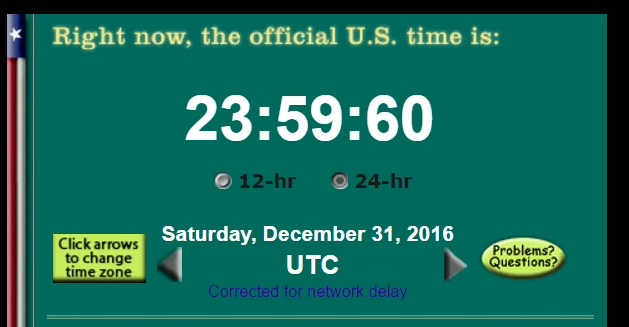
When an extra second was needed, it would be added by making the final minute of the day 61 seconds in length. Since then, 27 extra seconds, known as leap seconds, have been added but none have been subtracted. The last leap second was added in 2016 and since then, the earth appears to have been speeding up rather than slowing down which some scientists attribute to the melting of the ice caps. This means that soon it will be necessary to subtract one second from UTC, something that has not happened before. Doubts have been raised in many quarters about the feasibility of doing this safely as now there are literally hundreds of systems that rely on GPS-synchronised clocks. The effects of subtracting one second from many of these systems are unknown. (Y2K scenario all over again!)
This was discussed at the 28th CGPM which ended on Thursday 15 October 2026. The meeting decided that the risks of removing a second from UTC were so great that rather than adding or subtracting a second from UTC in order to bring it into synch with IAT, they would add (or subtract) an hour from UTC only when the difference between the two exceeded one hour rather than one second as at present. Such a change is unlikely to occur in the next thousand years. What we (or our descendants) will notice is that in 100 years’ time, the sun will rise and set at a slightly different time than it does now. This time might be of the order of tens of seconds or maybe a few minutes. Other people who will benefit are developers of time-critical IT systems who no longer need to accommodate leap seconds in their products.
References
Text of CGPM motion: https://www.bipm.org/en/cgpm-2026/
Earth’s Rotational Speed: https://en.wikipedia.org/wiki/Earth%27s_rotation
Leap second: https://en.wikipedia.org/wiki/Leap_second
UTC: https://en.wikipedia.org/wiki/Coordinated_Universal_Time
Image: https://commons.wikimedia.org/wiki/File:LeapSecond.png

