
Seven years ago, mistakes arose after energy firms mixed up imperial and metric gas meters. At least 8000 customers were affected by these administrative errors. In response to these errors, the Office of Gas and Electricity Markets (OFGEM) wrote to all gas suppliers and other interested parties after a large gas supplier informed OFGEM about this issue. This issue should serve as a warning about the serious errors that can arise from the use of two rival systems of measurement.
The billing errors because some customers were registered by their energy supplier with an imperial gas meter when they had a metric gas meter. EON was the only company to provide numbers of affected customers. They said that 600 were affected; 350 overpaid and 250 underpaid.
OFGEM wrote an open letter to raise awareness of this issue across the energy industry. 1 This is the letter from OFGEM:
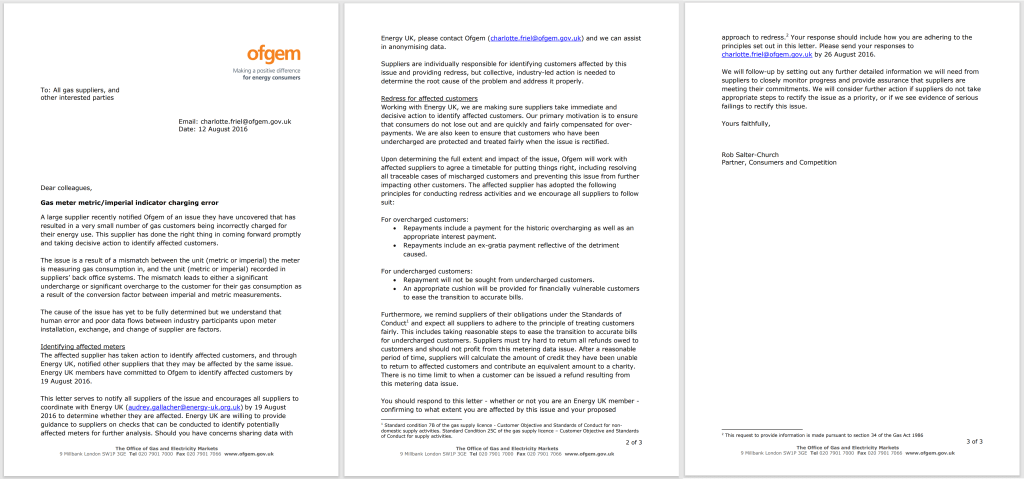
In the letter, OFGEM writes:
“The issue is a result of a mismatch between the unit (metric or imperial) the meter is measuring gas consumption in, and the unit (metric or imperial) recorded in suppliers’ back office systems. The mismatch leads to either a significant undercharge or significant overcharge to the customer for their gas consumption as a result of the conversion factor between imperial and metric measurements.
The cause of the issue has yet to be fully determined but we understand that human error and poor data flows between industry participants upon meter installation, exchange, and change of supplier are factors.”
The This is Money article about this issue says:
“The problem occurred because gas is recorded differently depending on the kind of meter installed.
Older meters measure energy in cubic feet while the newer metric meters measure energy in cubic meters. Therefore if the wrong kind of meter is registered on an account, the customer will be billed incorrectly.” 2
Old imperial gas meters measure in units of 100 cubic feet, equivalent to 2.83 cubic metres. Modern metric gas meters measure usage by the cubic metre. Billing customers by the wrong unit could lead to serious financial losses for one of the parties. Mixing up units could lead to an overcharge of almost three times the expected bill or an undercharge of approximately 35% of the expected bill. In either case, the customer loses out or the energy supplier loses out.
The fact that some meters record gas usage in cubic feet and others in cubic metres was taken as a given. Why wasn’t the phasing out of all imperial gas meters and of cubic feet in all back-office systems considered? If the whole industry records usage in cubic metres and all meters are metric (i.e. they measure gas usage in cubic metres), this problem would not arise. It would eliminate the source of this problem once and for all.
Sources:
- https://www.ofgem.gov.uk/sites/default/files/docs/2016/08/open_letter_to_gas_suppliers_on_metricimperial_indicator_charging_error.pdf (OFGEM open letter, 12 August 2016)
- https://www.thisismoney.co.uk/money/bills/article-3741205/Thousands-customers-money-energy-firms-mix-imperial-metric-gas-meters-affected.html (“Thousands of customers are due money back after energy firms mix up imperial and metric gas meters: Could you be affected?” by Rebecca Rutt, ThisIsMoney.co.uk, 15 August 2016)
 Metric Views
Old imperial gas meters measure in units of 100 cubic feet. To calculate the number of cubic metres used, gas suppliers multiply imperial meter readings by 2.83.
Overcharging errors can occur if a gas supplier’s records aren’t updated correctly after a customer’s meter is replaced with a metric meter (multiplying a metric meter reading by 2.83 will result in a bill nearly 3 times what it should be – NOT “over 35 times” as stated in the article).
See my comment in this article: https://metricviews.uk/2023/10/26/why-progress-uses-dual-measurements-in-their-sample-applications/#comments
[The article has been corrected to reflect the billing in units of 100 cubic feet for imperial gas meters. – Editor]
LikeLike
It’s amazing that after 50 years there are still imperial gas meters in existence. Even though it may have cost a fortune to convert all of the meters in a short amount of time, a plan should have been put into effect to change out so many per year so that all would have been changed out by the turn of the century.
Now, a few years back, my meter was changed out for two reasons, one, it was too old and two the measuring part was analog and they replaced it with an electronic digital sensing unit that can broadcast the reading to a receiver that is remote. No person needs to walk house to house on a monthly basis.
The metering unit can be removed if it breaks down and replaced, without the need to replace the whole unit.
Can someone tell me if it is possible in England to change out the metering unit without having to replace the entire gas-meter? If this is possible, then why don’t the gas companies in England change out the metering portion en-masse? If they switch from an analog type to a more modern digital type that is already set up for cubic metres, then there is no cost to complete the metrication and the entire cost is borne onto the switching from analog to digital. The savings of not having to hire a person to walk from house to house to read the meters would pay for the changeover in a short amount of time.
LikeLike
Daniel said, “The metering unit can be removed if it breaks down and replaced, without the need to replace the whole unit.”
This may apply to a modern meter, especially a smart meter. It is doubtful whether it applies to a meter registering cubic feet; such a meter would be of substantial age. Of course, if this meter should be replaced by a smart meter, the problem is solved. However there is some consumer resistance to upgrading to smart meters, no thanks to some scaremongering by the tabloid press. If an energy company wants to replace a meter in serviceable condition, it wants to replace it with a smart meter. To replace it with a metric “non-smart” meter is money spent on something less progressive.
LikeLiked by 1 person
How do you know if this is an issue with you meter?
LikeLike