
In Matt Groening’s The Simpsons, Grampa Simpson famously decries the metric system as being “the tool of the Devil”.
In Russell T Davies’ latest Doctor Who spin-off science-fiction mini-series, it seems the metric system is the tool of the Sea Devil too.
In Episode 2 of The War Between the Land and the Sea, when the Sea Devils (now known as Homo aqua) meet with a United Nations assembly in London, they give the coordinates of their underwater location to the UN representatives. The scientific experts at U.N.I.T. are bewildered by the depth coordinate, which is given to them in metres.
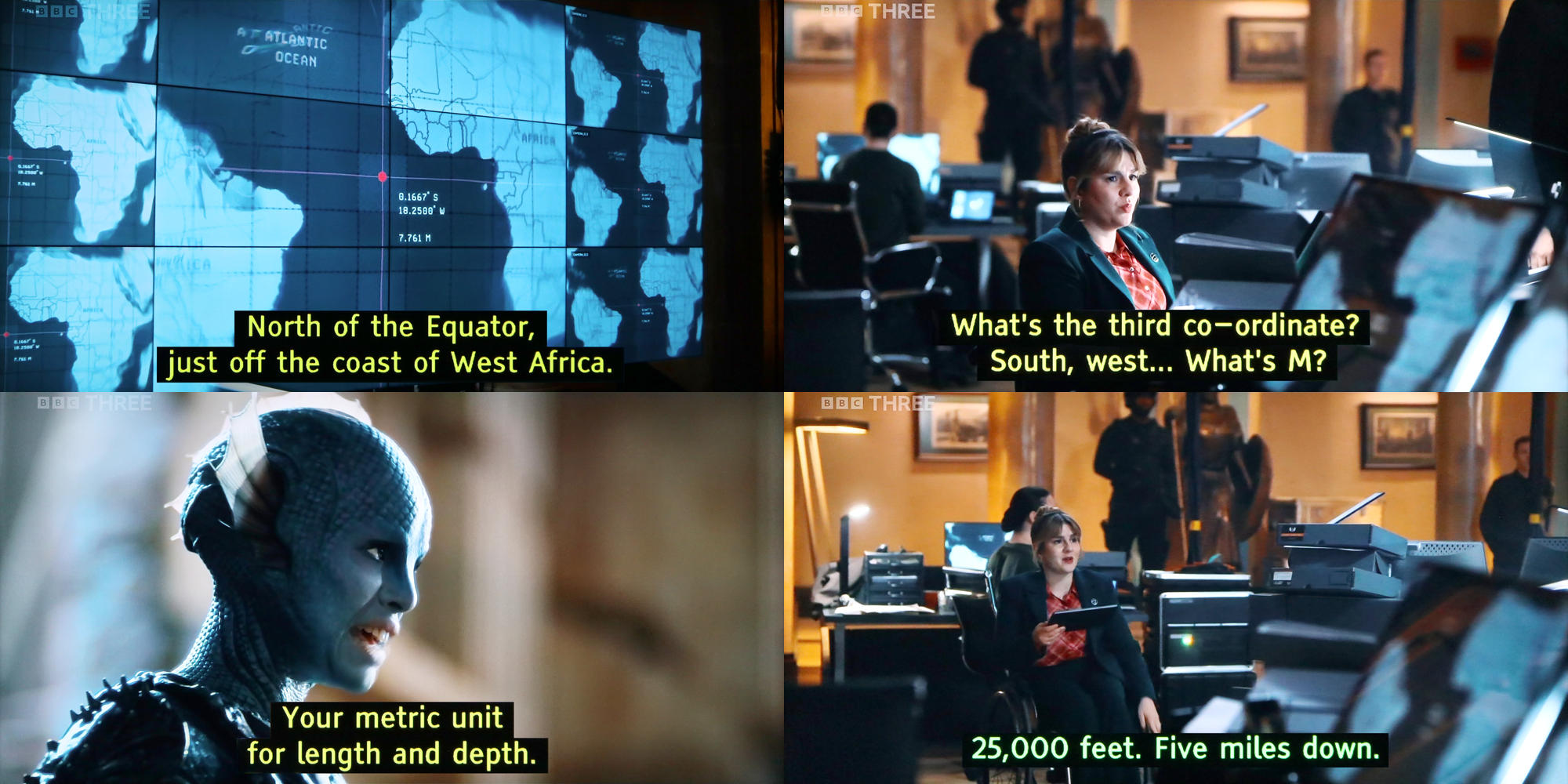
“What’s m?” asks the scientific adviser. The Sea Devil, named Salt, explains that it is “Your metric unit for length and depth”. Seemingly none the wiser, the U.N.I.T. expert hurriedly consults her computer for clarification, declaring in triumph that the location is the Romanche Trench and is “25,000 feet. Five miles down”. The actual metric value remains unspoken.
As if this dialog wasn’t unbelievable enough, the U.N.I.T. experts also manage to mistake a latitude of “0.1667° S” as being “North of the Equator”.
The (Sea) Devil is in the detail
When it comes to measurement units, the programmes’s script is not the only thing lacking credibility; the various computer displays appearing in the episode are also riddled with measurement unit errors.
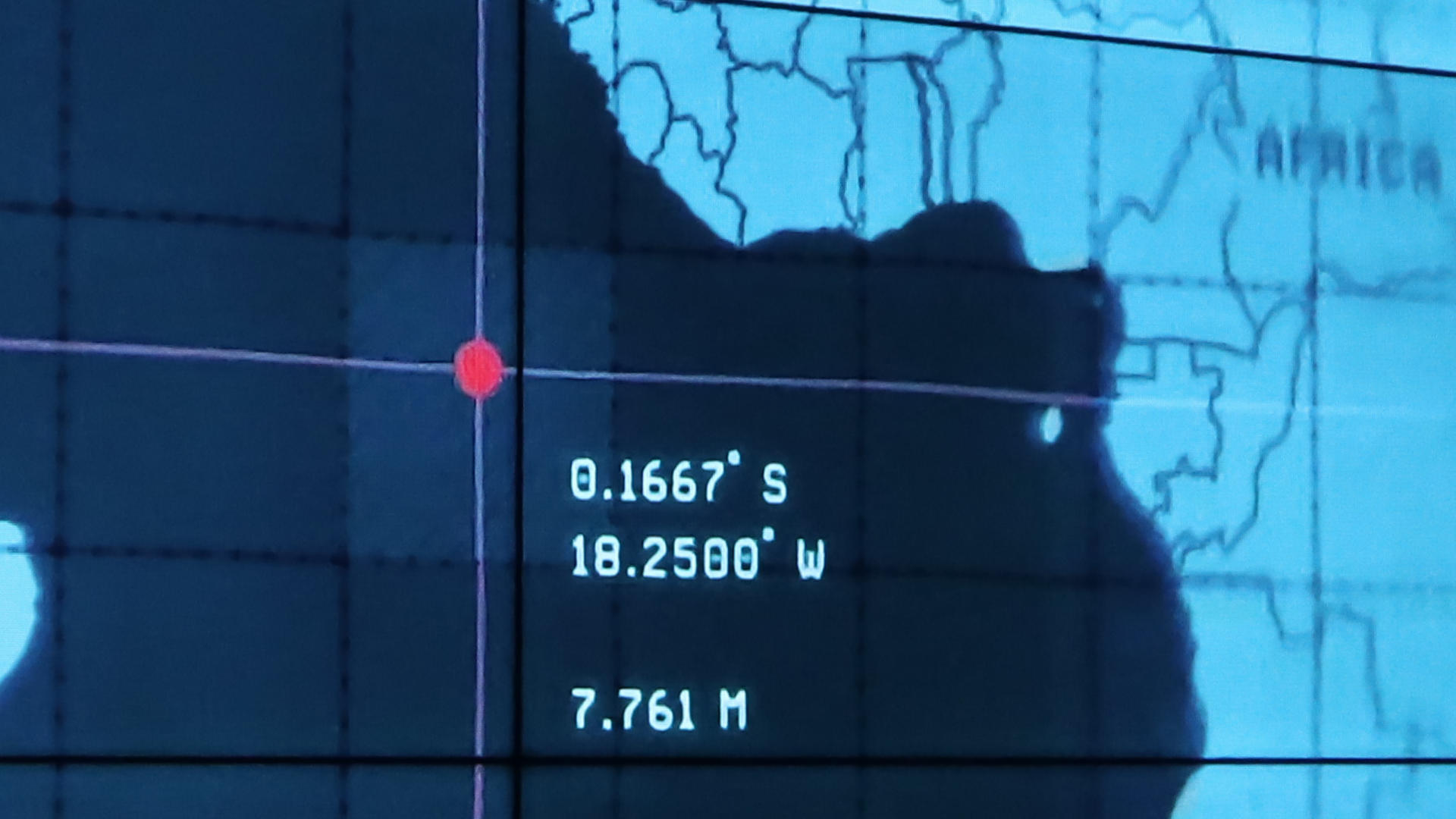
The depth coordinate is shown as “7.761 M”. The “M” should of course be a lower case “m”, and there should be no decimal point, unless the symbol “M” was intended to be “km”.
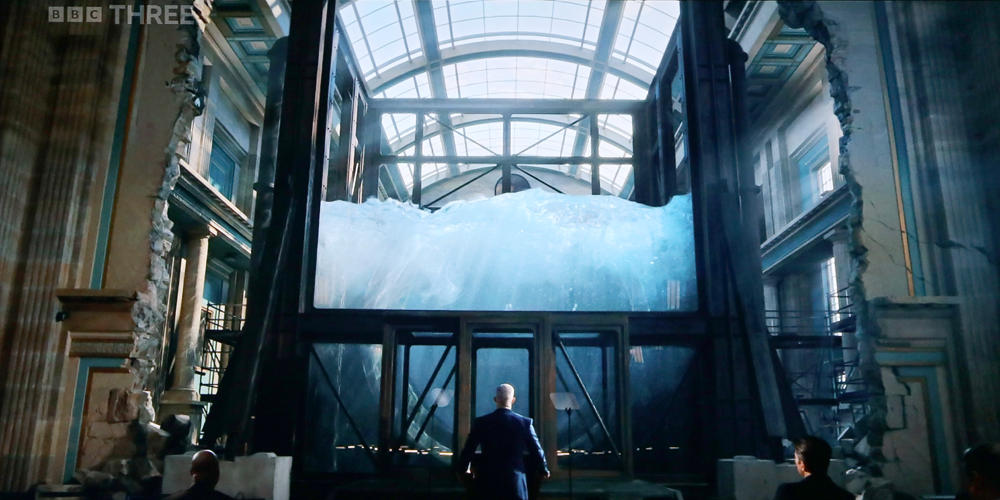
Earlier in the story, we also see a giant glass tank being filled with water in preparation for the reception of the sea dwellers, together with a meter displaying water pressure.
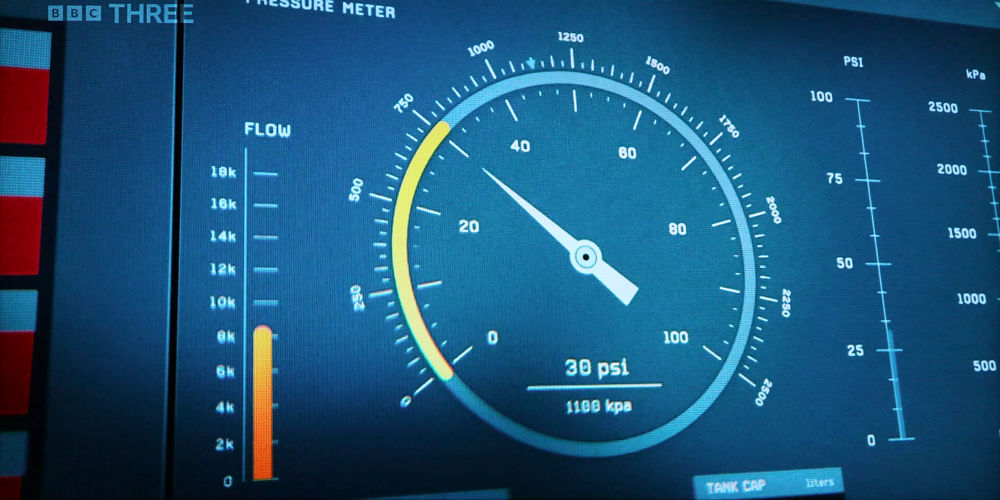
The dual-unit pressure dial has many of the errors that might be found in a poor generative-AI image, and is not befitting of a TV production with a multi-million-pound budget at its disposal.
It has scales for kPa and psi. There are superfluous linear scales at the right of the screen too. However, as if to demonstrate the dangers of using dual-units, the two scales don’t correspond to the same pressure – the conversion used is wrong. A pressure of 750 kPa does not correspond to 30 psi. The true value would be 108.8 psi. The secondary digital display is also wrong. It shows 30 psi being equal to 1100 kpa (sic).
On closer inspection, the dial’s graduations are very strange. Labelled graduations occur at intervals of 250 kPa. Each of these intervals are divided into eight subdivisions, giving intervals of 31.25 kPa. The psi scale suffers the same issue with major graduations every 10 psi, and subdivisions every 2.5 psi.
The linear scales are worse. The psi scale has graduations labelled every 25 psi, with subdivisions every 8⅓ psi.
Any normal decimal scale would be subdivided into 2, 5, or 10 subdivisions, not 3, 4 or 8.
Measurement units in science-fiction
Sadly, this programme is only one example of how the use of measurement units in science fiction is all-too-often overlooked. A single instance of an anachronistic use of measurement units can destroy the believability of even the best of science-fiction stories.
Readers may have their own examples of where the poor use of measurement units irreparably harms a science-fiction story’s credibilty.
References
The War Between the Land and the Sea, Episode 2, 7 December 2025
https://www.bbc.co.uk/iplayer/episode/m002nc7n/the-war-between-the-land-and-the-sea-series-1-2-plastic-apocalypse


No science fiction production should ever use anything other than correct SI units. Same goes for nature documentaries. So sad that the USA is so far behind when it comes to metrication given the outsized influence of American companies on television programs seen around the world. The American ignorance and sloppiness when it comes to the metric system is all too obvious even in the (now) 21st century.
Gene Rodenberry was ahead of his time using metric on Star Trek. Too bad that did not catch on mostly due to the election of Ronald Reagan as President and his many retrograde ideas.
Ezra aka punditgi
LikeLike
I have now had the opportunity to watch the first two episodes, which are amusing enough. Regarding the depth information 7.761 M is clear. This is how many Europeans would write the depth with a decimal instead of a comma. So the depth is 7,761 m in our notation, and indeed converts to 25,462 ft. The upper case letter for m is only too common. Other criticisms are valid and I have another to add. Homo Aqua is referred to as this in the subtitles instead of Homo aqua. Overall, I agree that the lack of proper scientific oversight is a disappointment. And indeed why is U.N.I.T. wedded in the past in terms of units? [ironic, really].
LikeLike
I just watched an ITV short show about how meteorologists are processing and describing significant weather changes and extreme weather events due to climate change.
What stuck me was that the report was done entirely in metric (Celsius, metres, millimetres, etc.) except for one glaring omission: wind speed in miles per hour.
High time Department for Transport helped close that hole and changed road signs to metric. That would fix the problem once and for all.
Ezra aka punditgi
LikeLike
I just came across this fun and informative video by an American woodworker who gives a very nice history of how America failed to metricate and towards the end even visited England to explore the metric muddle. Definitely worth watching! 🙂
https://www.youtube.com/watch?v=bKMEDZp7ZZs
Ezra aka punditgi
LikeLike
Now it turns out that Trump’s tariffs on softwood products from Canada might be pushing them to convert that industry and the container and pallets that accompany them to metric:
Oh, irony of ironies! But at least there is that possible silver lining to the whole tariff fiasco.
Ezra aka punditgi
LikeLike
Punditgi,
These mills have been operating internally in metric for some decades now. They use cutting machines that have a low limit of 5 mm, so the cut sizes will be increments of 5 mm. A “4 x 8” piece of plywood would be cut to 1220 mm x 2440 mm, a rounded metric size, but not a size used in the countries that they want to sell to. The standard in the metric world is 1200 mm x 2400 mm. So, if Canadian mills want to sell to these countries, they need to be able to produce the more standard sizes.
LikeLike
One small victory to report. I watch a lot of channels on YouTube on my phone, many of which are science channels of one kind or another. Even though many sound like they are produced in the USA, I always ask in the comments for metric units if I hear only Imperial in the video.
Yesterday I made such a comment on one of those channels and actually got a reply from the originator of the videos saying he would add metric units from now on.
One small step for a man; one giant leap for mankind! 🙂
Ezra aka punditgi
LikeLike
Punditgi,
Adding metric (SI) units is great and hopefully he keeps his word. But, in reality, we see SI units as the original units and FFU as an afterthought. I hope when he does show SI units he does so in the primary position and the SI units are shown as normal round numbers. I’d hate to think he would take original SI values, convert them to FFU and back convert them to SI loaded with decimal dust. In other words, creating new values instead of using the original ones. Can you provide the link to the video in question?
LikeLike
@Daniel
I totally agree with you. Alas, I don’t have the link handy to that video. I’ll pass it along if I get notified of a new video on that channel.
LikeLike
Here is the latest (2026) view of the state of metrication in the world. What do folks here think?
https://worldpopulationreview.com/country-rankings/countries-that-dont-use-the-metric-system
Ezra aka punditgi
LikeLike
I have a few comments to make about this assessment.
The terms “Almost complete”, “partially complete” are subjective and need to be better defined.
It would also have helped if the authors added paragraphs about the progress of metrication in Canada and the United Kingdom. I would also like to know what units are retained in Sweden and Brazil retain. I would also like to know the difference in degrees of metrication between Ireland and the United Kingdom. As far as I am aware, the only difference is in road signs.
Birth and rise of the metric system
The metre did not “yield 39,37008 inches”, but rather “in 1960 the imperial/customary unit of length and the metric unit of length were aligned with each other by defining the yard to be exactly 0.9144 metres”.
The phase “… an International Bureau of Weights and Measures met in Paris to sign the Treaty of the Meter. Forty countries, including the United States but excluding Britain, signed the treaty, establishing the International Bureau of Weights and Measures.” does not make sense. It would be more accurate if it read ” … the Treaty of the Metre was signed by representatives of seventeen governments in including the Government of the United States by excluding the Government of the United Kingdom”.
LikeLike
@punditgi
That map implies that all countries coloured in grey are fully metric, whereas in reality it probably just means that the authors have not researched them. If they had, they would have found, for example, that Belize, like the UK, still uses miles and mph on its road signs.
https://wiki.aaroads.com/wiki/Road_signs_in_Belize
LikeLike
@m Good point about Belize. Here is the AI overview from Google:
Belize has not fully adopted the metric system and predominantly uses the imperial system (miles, pounds, gallons) for daily life, similar to the United States. While some metric units may appear in international trade or specific products, the country relies on imperial units for road signs, speed limits, and retail, making it one of the few nations worldwide that have not adopted the metric system as their primary standard.
Key details regarding measurement in Belize:
I also saw a Reddit post saying that petrol is sold in gallons (most likely the US kind). Since the AI overview mentions retail sales being done in Imperial / USC, I suspect that includes things like milk, soda, and local food items.
Ezra aka punditgi
LikeLike
One small step forward in the USA to report: The medical provider I now see has posted on their physical bulletin board a notice that they are now recording a person’s weight (mass) in kilograms for patient safety when prescribing now much of a drug to take. Good news!
Alas, the notice read “Kilograms (Kg)” instead of “kilograms (kg)”. I pointed this out to one of the medical assistants who said she would pass the info along to the powers that be. I hope they really do make the change.
This makes me wonder if the NHS and private providers in the UK always measure patient mass in kilograms (and height in meters or centimeters).
LikeLike
@punditgi – In the UK, the NHS and its sister organisations in Scotland, Wales and Northern Ireland are required to use weighing devices that only measure in metric units. I have not seen any explicit statements concerning heights, but but at both my sergery and at the lcal hospital the measuring devices that I have seen only record centimetres. Links to the childrens growth charts (0-4 years) that are used in the UK can be found at https://www.rcpch.ac.uk/resources/uk-who-growth-charts-0-4-years.
Every baby in the UK is issued with a “red book” in which the child’s progress is recorded. A typical blank red book is shown at https://www.scribd.com/document/13995961/NHS-My-Personal-Child-Health-Record. You will notice that on most pages, only metric units are used, though there are a few where both metric and imperial can be recorded.
LikeLike