
Just after midnight on 27 December 2023, the government published the response to its imperial units consultation. On the same day, the BBC initially reported it under the headline “Metric measurement rules to stay after Brexit review”. Later that day, the BBC changed its headline to “Pint-sized bottles of wine to be sold after Brexit review” and buried the main story at the bottom of the rewritten article. The new pint size for wine bottles was not the main news item but a side issue. The BBC news report was changed to cover up the overwhelming public rejection of government plans to revive imperial units. Did the BBC bow to political pressure to cover up bad news for the government?
Here are the versions of the same BBC news report before 1 and after 2 the change:
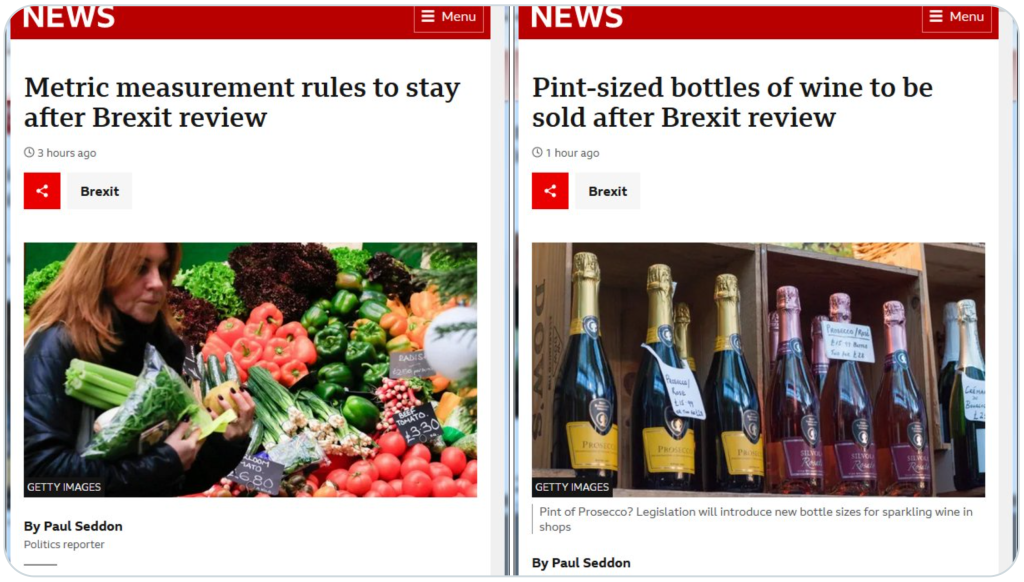
UKMA tweeted “Why did BBC News change the slant on this story? With 99% of 100 000 respondents rejecting Government plans to row back on metrication, the original headline was clearly the most pertinent one.”. The tweet has had over 31 000 views.
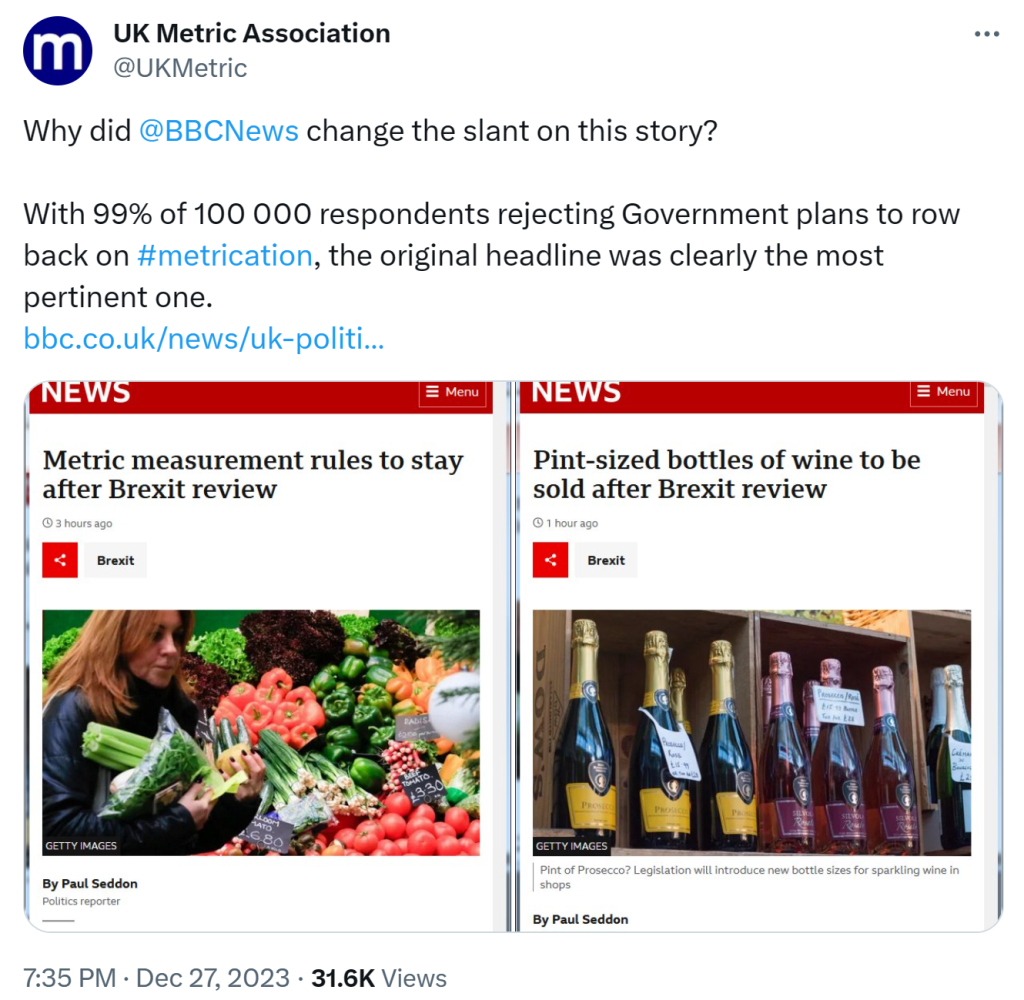
UKMA Chair Peter Burke has complained to the BBC about the suppression of this important story, saying:
I wish to complain about a serious lack of balance in the BBC’s reporting of the outcome of the government consultation on weights and measures, which was made public on 27th December. On that morning, the BBC News website published an article factually reporting the results of the consultation, including the fact that only 1.3% of respondents were in favour of any movement towards greater use of imperial units.
In the course of the morning, that news item was replaced by another, in which the focus shifted to the government allowing champagne to be sold in 568 mL (1 pint) bottles. As almost all commentators have stated, this is a complete irrelevance. Champagne is already available in standard 750 mL and 500 mL bottles, and the additional size will add little to consumer choice; furthermore in practice hardly any champagne bottlers, most of whom are outside the UK, will have any interest in making that size available, as doing so will carry additional costs. In contrast, the evidence on public opinion is highly significant, particularly as the survey was done by the government itself and was, as has often been pointed out, highly biased in favour of a pro-imperial result. This much more important story was buried at the end of the replacement article, and may well have been overlooked by many readers. It must be asked why the BBC made this change. It is very difficult to resist the conclusion that the BBC was bowing once again to political pressure. Occurrences such as this can only bring the BBC into even further disrepute and should at all costs be avoided. Could I request an explanation and, if applicable, an apology?
Sources:
- https://web.archive.org/web/20231227040109/https://www.bbc.co.uk/news/uk-politics-67795075
- https://web.archive.org/web/20231227112040/https://www.bbc.co.uk/news/uk-politics-67795075
Further reading:
- https://westenglandbylines.co.uk/business/metric-is-here-to-stay/
- https://www.dailymail.co.uk/news/article-12903773/Government-scraps-Brexit-dividend-imperial-measurements-shops-voters-prefer-metric.html
- https://www.gov.uk/government/consultations/choice-on-units-of-measurement-markings-and-sales
- https://metricviews.uk/2023/12/27/government-confirms-metric-measurement-rules-to-stay-as-99-reject-greater-use-of-imperial-units/


If we look at the last part of the two URLs that Peter accessed, we notice that they are both end in “67795075” – in other words, the same story. While I appreciate that once published electronically, it is acceptable that changes reflecting typographical errors, minor factual errors and the like are made, but the changes in this case that were actually, as Peter says, a rewrite.
LikeLiked by 1 person
I totally agree this looks like a cover up in line with many issues these days.
It is not unusual (my comments elsewhere on these pages) for the BBC to change an article from fact to fiction during the course of a morning (from metric to some some obscure units of measure not from the originator).
As an octogenarian myself I find this objectionable, irritating and quite honestly confusing. I have spent 60 years trying to empty my brain of this useless information especially as conversions are more often than not USC, or a form of imperial that was never in use in UK anyway (high values of lbs, horizontal feet and inches).
In fact the usage of imperial is so stupid I wonder why anyone ever wanted to keep it going, I guess many here agree.
We are where we are, maybe at least someone somewhere in the media or in the commons may just notice many of us are at least a little educated and can probably work a few things out. The added burden of duplicated and often wrong information makes for difficult understanding.
Maybe, just maybe this could be a wake-up call to a few influencers, to use a modern term.
LikeLiked by 1 person
Many people were circulating the link to the BBC story that morning on social media, only for the story to be re-written before others had chance to read it with, what I thought, was the key point still intact, namely:
“nearly 99% of respondents to an official consultation said they were happy with kilos and litres.”
In future, for any BBC article, I will circulate a screen shot, or the relevant web archived version, if available. The BBC can no longer be regarded as a reliable source.
LikeLiked by 2 people
The “pints of wine” story was always intended as a distraction. It was the proverbial “dead cat” that we have come to expect when almost any political story breaks these days.
Any good journalist would have realised this if they had only asked the wine producers:
https://www.theguardian.com/food/2023/dec/29/english-wine-producers-unlikely-to-adopt-redundant-pint-option
To further add to this fiasco, having added 500 mL and 568 mL ‘pint’ sizes to the range of permissable sparkling wine bottle sizes, it seems that the Government might have not included the actual size favoured by Churchill, namely the “Champagne imperial pint” equal to 600 mL.
https://www.vinovest.co/blog/champagne-bottle-sizes#link-3
Of course none of these sizes would be described as a ‘pint’ in the USA.
LikeLiked by 1 person
Yes, very strange that someone in the government pushed out a 568 mL (Actual fill 570 mL) size that the industry claims they never asked for.
““We don’t understand why the government has introduced a pint measure for wine after consulting the industry and being told that no one seems to favour going back to imperial measures,” Mark Driver, a co-owner of the estate, told the Guardian.”
Then got to media to claim this size is the one they will encounter next year despite Rathfinny producing 800 bottles of the 500 mL size. I’d be curious to know who in the government and media went out out of their way to claim this and why.
LikeLike
An American who moved to the UK years ago and married a Brit has this amusing take on the government fiasco of trying to revive Imperial units of measure:
This really hits the nail on the head!
(punditgi aka Ezra thanks to the latest WordPress weirdness)
LikeLiked by 1 person
@punditgi
Brilliant, my biggest laugh in years.
A great pity this was not 1st April, it would be an impossible task to convince the world this was actually true!
LikeLiked by 1 person
There always seem to be some that resist change and do whatever they can to hark back to old times, in spite of public opinion.
This reminds me of the “Save the sixpence” campaign.
Let’s go back to 1971. The UK was due to switch to decimal currency in mid-February. Copper coins were not compatible with decimal, and were due to be withdrawn and replaced with decimal copper coins of value ½p, 1p and 2p. The old sixpenny piece was worth 2½p by Shoppers’ Table conversion. The official feeling was that though this was compatible with decimal currency it would not sit well. Campaigners though otherwise, and the government bowed to pressure and allowed 6d pieces to be retained in circulation among decimal coins. Banks would continue to issue them upon request.
As it happened, at the time I was a frequent user of a photocopier in the college library. This photocopier took sixpenny pieces. Accordingly, when I drew cash from the bank I would often ask for a pound’s worth of sixpenny pieces. These were always issued without any trouble.
In due course, I ceased to use the photocopier, and had no further need to ask the bank for sixpenny pieces, which gradually disappeared from circulation, because indeed they did not fit well with decimal currency.
It was as though the government gave in to the campaigners, knowing that sixpences would die out naturally anyway. It was absolving itself from blame for their withdrawal.
I wonder if there are parallels with “pints of champagne”. Is this a way in which the imperial die-hards appease those of the public of like mind? Common sense dictates that they are unlikely to happen but the government could always say it did not prohibit them. Did the government in fact issue a fresh news release, soon after the original one reporting widespread support of metrication in the consultation results? The BBC can respond to an updated news release more rapidly than the newspapers can.
LikeLiked by 1 person
Champagne is a protected product name under EU law and is made in France. The UK has accepted to comply with protected product names in its trade agreement following its departure from the EU. How is it then that the British Government is mandating a change to the size of bottles used for this product? It does not have the power to do this, even if it wanted to.
LikeLike
https://bernard-magrez.com/en/actualites/why-a-wine-bottle-measures-75cl/?fbclid=IwAR2lMWU1vJ4iIbWZ2JvZ0FuDzcQ00q_mxi2vcjYVARKE2Ov732oaY6qhQOE
If this is true then 75 cl bottles are Imperial by definition anyway!
Standard 19th century UK 50 gallon shipping containers divided into 300 bottles of 75 cl.
A case of 6 bottles = 4.5 l = 1 gallon (minus 46.09 ml a little for sampling, wastage and overfill).
One standard UK shipping container = 50 cases = 50 gallons.
.
LikeLike
A disappointing move from the BBC. In this day and age, I would expect a public service broadcaster to be metric by default in any use of measurements.
LikeLiked by 1 person
@metricnow: Two points, firstly the proposed government regulations speak of “sparkling wine”, not “Champagne”, so that would obviously include Prosecco and any other sparkling wines.
Secondly, nothing in the proposed legislation will prohibit any product that tis currently legal in the EU from being sold in the United Kingdom. From a UKMA point of view, a 500 ml bottle is sufficiently different from a 375 ml bottle and from a 750 ml bottle as to give the customer a genuine choice and as such the UKMA is justified in not opposing such an action.
However the reintroduction of an imperial unit of measure alongside metric units of measure for a particular commodity after more than forty years have lapsed is a retrograde step to which the UKMA is fully justified in opposing. Furthermore, one of the secondary aims of the UKMA is the promotion of consumer protections. Having two products on the shelf that differ by less than 3.5% does not really give the consumer more choice but rather gives the retailer scope for hoodwinking the public. This again is something that UKMA has every right to oppose.
LikeLiked by 1 person
Martin Vliestra:
I am aware that the legislation speaks of ‘sparkling wine’ and not ‘champagne’. However, that is not how it was reported in the press.
https://www.dailymail.co.uk/news/article-12902647/Brits-soon-buy-pints-champagne-wine-supermarket-post-Brexit-freedoms.html
LikeLike
BrianAC raised an interesting point about wine bottles. A full bottle of whisky or other spirit, used to be 26 2/3 fluid ounces. So six such bottles would contain a gallon, and 50 bottles would contain 30 gallons. Same size as bottles of wine, apparently.
A sixth of a gallon is 75.77 centilitres. Very close indeed to the present standard for bottles of wine.
It is not clear why spirits are now sold in 70 cl bottles – a deviation from the original size.
Other than that, there are other examples of goods now sold in metric sizes that are very close to former imperial sizes. One example is the standard loaf of bread, formerly 28 oz, now 800 g.
LikeLike
@metricnow: I have looked at the Daily Mail’s article. As usual, nothing in the article is untrue, but a considerable amount of detail has been left out of the article.
“And pint bottles of wine and sparkling wine will soon be stocked on supermarket shelves thanks to Brexit freedoms, the Government has announced.” A half-truth. Firstly, how soon is “soon”? Secondly, the legislation has not yet been passed and until it is passed, no winemaker is going to commit themselves to taking advantage of the legislation. Thirdly, how does the Daily Mail know that the producers of wine (still or sparkling) will take advantage of the proposed legislation.
“Yet before the ban around 60 per cent of champagne sold in the UK was by the pint.” How much champagne was drunk in the UK before the UK joined the EEC? Before the UK joined the EEC, wine (still or sparkling) was heavily taxed in relation to other alcoholic drinks which meant that there was pressure on champagne producers to sell their product on the UK market in smaller bottles. The article also fails to note that since the UK joined the EEX, wine consumption in the UK has increase by 10-fold whereas beer consumption has remained steady.
“British makers produce around 12.2 million bottles of still or sparkling wine a year”. Unless we have something against which this figure can be compared, it means nothing. According to Statistica, the UK produces 80,000 hL wine per annum, but consumes 12,500,000 hL per annum – ie domestic production is less than 1% of domestic consumption.
LikeLiked by 2 people
I would submit that one reason the UK has been so slow to wean itself off imperial measures is not the units of the SI themselves, but the terminology. When talking in daily life about distance for example, would you rather use a word of one syllable or a word of four? Would you rather say “I went for a 5 mile walk” or “I enjoyed a perambulation that extended to 8 kilometers”?
“Give us 2 pounds of apples” or ” I would wish to purchase a kilogram of the fruits of the apple tree”? Also, again in ordinary daily life the system of prefixes to the primary unit are redundant. “Kilo-” just means a thousand. So why not just say a thousand grams or meters. Or a thousandth, as appropriate.
I am going to stick my neck out and start talking about “metric miles” (kilometers) – especially as the original meaning of “mile” was “1000” as it still is in Irish. Then after an interval, drop the “metric”, and if I am misunderstood, so be it.
In short, the problem is not the units but the names of the units, in daily use.
LikeLike
“Kilogram” is not a properly formed metric name, it should be renamed to something else, grave, klug or something else. Grave and klug also have the advantage of being one syllable. Klug has advantage of having same abbreviation as current kilogram. Also with the current name it makes it sound like the base unit is gram which is not correct.
On “Kilometers”, American Military uses “klick” instead of “kilometer” to make it one syllable and easier to say.
LikeLike
@Colin
Australians, New Zealanders,Canadians and the Irish are using standard metric units with no problems.
I don’t think the units are the issue for the English, Welsh, Scots, and Northern Irish.
LikeLike
Colin,
I don’t know if what you are saying is a real concern or just a convenient excuse not to use metric by some. If you use the metric units as they are, you will in time get use to their length and won’t have a craving for smaller words. I’m sure that in metric countries where metric units have been used long enough that everyone living today knows no other, the metric words don’t sound to long and flow easily from the mouth. The only way to know is to inquire of people living in countries metric for a long time as to how they feel about this.
If smaller words are an absolute must, then maybe the BIPM or whoever has the authority can come up with a list of short-hands for the more common unit names. Maybe the reason they never did was because it has never been a complaint, except in possibly England and the US. So where does the problem really lie, in the metric unit names or in the English and American people?
LikeLike
@Colin – I think that the phase “5k fun-run” answers your question. Furthermore, when I took our dog to the vet a few weeks ago, the vert told me that the dog weighed “8.9 kilos”, though she recorded it as “8.9 kg”.
LikeLiked by 1 person
Very succinctly put, Martin. In fact, some people find even single-syllable words too long. We hear people referring to a price, e.g. fifty pence, as fifty pee. It is a practice that I personally dislike, but it abounds.
The reason for the UK to take so long to convert to metric is plain enough to me – resistance to change on the part of governments. It is not surprising that people do not think in terms of kilometres, when our roads are still emblazoned with signs showing miles. The “pints of champagne” story indicates how this resistance to change still exists in government, unfortunately.
LikeLiked by 1 person
In Aus they say k’s for km, I have also heard people say kees for kg in the UK, so yeah, shortening abounds – no doubt if the UK did manage change to metric road signs (may be before the centennial of the decision to not do so, that would be nice), the bête noire of this forum would soon also abound – kph – much to purists annoyance.
LikeLiked by 1 person
Metricmac,
Is it “the government”? 50 years ago “the government” was pro-metric and worked with industry & business albeit some exceptions to bring about metrication. So, what has changed in “the government” that is causing it to be at fault?
LikeLike
Yes Daniel, it is “The Government”.
I lived in South Africa when that country adopted the metric system. There were three major differences between the British and South Africa metrication programs – the South Africans introduced a rigid price control system while the British Post Office led the way in profiteering by increasing postage rates by 40%, thereby earning the nation’s mistrust. Secondly, the South Africans prohibited the sale of measuring devices such as tape measures that had imperial units on them while in Britain dual unit measuring devices are the norm. Thirdly, the South African compensated traders who had to change their weighing devices to metric whereas in Britain such traders were expected to bear the cost themselves.
These differences encouraged the South African public to adopt the metric system, whereas the British Government’s approach did little to encourage change.
LikeLike
Martin Vliestra wrote. “South Africa compensated traders who had to change their weighing devices to metric whereas in Britain such traders were expected to bear the cost themselves”
I would be surprised if British traders were not able to set the cost of new metric weighing devices off against tax. I’m sure they would have been able to do that with other devices in the past too as part of their operational expenses.
LikeLike
Martin & Metricnow,
It might not have been as expensive for the English shopkeepers as in South Africa. South Africa changed in the 1970s pre-digital. So they went from analogue imperial to analogue metric. However, England didn’t change until 2000, already into the digital age. I’m sure in most cases, those who had digital scales prior to 2000 had metric capability already installed in the software and all they needed to do was flip a switch or change a code to have it display metric. If they didn’t know how to do it, possibly the technician doing certifying or service technician doing any repairs or firmware upgrades could do the change.
Those who still had analogue scales would be the ones required to endure a larger cost, but the cost would be offset by the purchase of a modern digital scale already set-up in metric mode. This would have the advantage of removing old technology from usage and when over every balance would be digital and metric. Thus killing two birds with one stone.
Then the last possibility is if the scales are leased. Leased are based on time and when the lease is up the renewal would usually mean a swap out of scales. The leasing party gets a new scale with all of the updates, including metric capability and the old scale is taken back and if still in good condition upgraded/updated and back into service. If there is no exchange of scales then the scale company could update the machine as needed.
England, by waiting until the end of the century avoided a large cost to the industry and users.
LikeLiked by 1 person
I am almost certain that British traders could set the new metric weighing devices against tax – that would be normal accounting practice. Assume that the device costs £1000, that its standard amortisation period is 10 years and that the marginal tax rate (Income tax plus NI) is 30%. This means that you can write off £100 against your profits every year (one tenth of £1000). This will result in a tax saving of £30 every year for ten years (30% of £100)
Now assume that you had owned your device for five years when metrication took place. Its book value would be £500. If you received compensation for scrapping it, you would be given £500 (or a voucher for £500 against the purchase of a new device). If on the other hand you received nothing, you could scrap it yourself and post a loss of £500 against your profit which would means an actual reduction in tax of £150. (30% of £500).
LikeLiked by 1 person
The BBC article is factually wrong as it states that ‘pints of wine ARE TO BE SOLD after the Brexit review’ (my emphasis). As others have pointed out, no winemakers have said that they are about to launch a 568 or 570 ml bottle of wine onto the market. The BBC article should have pointed out that the Government consultation on units of measurement specifically excluded units of measure for the drinks trade. Why, then, following the overwhelming rejection of a return to imperial units by the general public, does the Government see fit to propose a new imperial unit for wine? That is what the author of the article should have been asking. The BBC articles are a textbook example of sloppy journalism.
LikeLike
I cannot even recall the “public” consultation even being announced
LikeLike