
1 July 2024 marks the 50th anniversary of the switch to metric road signs in Australia.
For about a year before the change, car manufacturers fitted dual speedometers to their vehicles and, after 1974 all new cars were fitted with metric-only speedometers. Several kinds of speedometer conversion kits were available. As a result of all these changes, conversion on the roads occurred without incident.
The UK’s switch to metric speed limits had already been announced 5 years earlier, in 1969, and was originally scheduled to take place in 1973 – one year before Australia.
50 years later, with practically all UK vehicles already fitted with dual unit speedometers, we are still waiting for the UK to catch up.
A Panel for Publicity on Road Travel, representing the various motoring organisations, regulatory authorities and the media, planned a campaign to publicise the change, believing that public education, not the confusion that would result from dual sign posts, would be the most effective way of ensuring public safety. The resulting publicity campaign cost $200 000 and was paid for by the Australian Government Department of Transport.
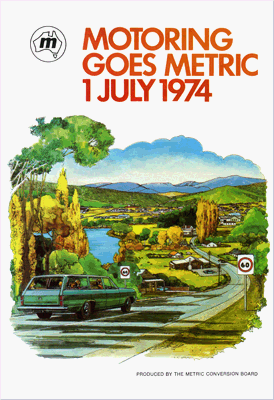
In addition, the Australian Metric Conversion Board produced 2.5 million copies of a pamphlet, “Motoring Goes Metric”, which was distributed through post offices, police stations and motor registry offices.
The following is an extract from an official government report (Wilks, K.J., 1992: Metrication in Australia, Department of Industry, Technology and Commerce (DITAC), Commonwealth of Australia, ISBN 0-644-24860-2)
“One of the most important and publicly visible of the metric changes was the change in road speed and distance signs and the accompanying change in road traffic regulations. M-day for this change was 1 July 1974 and, by virtue of careful planning, practically every road sign in Australia was converted within one month. This involved installation of covered metric signs alongside the imperial sign prior to the change and then removal of the imperial sign and the cover from the metric during the month of conversion.”
Except on bridge-clearance and flood-depth signs, dual marking was avoided. Despite suggestions by people opposed to metrication that ignorance of the meaning of metric speeds would lead to slaughter on the roads, such slaughter did not occur.
The failure of successive UK Governments to carry out the metrication of UK road signs, and their continued resistance to any idea of doing so, has sent the worst possible signal to the public about metrication in general. It arguably helped to grow the idea within public opinion that metrication was something that should be resisted.
References
https://ukma.org.uk/road-signage/international-experience/#australia
https://api.parliament.uk/historic-hansard/commons/1969/mar/05/roads-speed-limits
 Metric Views
I wonder whom Labour will choose to run the Department for Transport. Maybe someone who can be persuaded to convert road signs even if it is in stages? Only time will tell, of course.
Ezra (aka punditgi)
LikeLiked by 1 person
Ezra,
How many Labour governments has the UK had in the past 50 years and during their reign was the UK any closer to having metric road signs? So, what makes you think a future Labour government would be any different? Do you know something the rest of us don’t?
The only way for this to happen is for the DfT leadership to be replaced by a person or persons that are metric supporters and use their position to put their personal preference into action. Do we know of anyone who fits the description?
LikeLike
I don’t think the DFT has a strong ideological opposition to metrication; after all, they are more than happy to converse in metric internally. Rather, they don’t want to spend time, money, and effort doing something when there is very little pressure for them to do so, and as a government department, they are accountable to the whims of the government.
Unfortunately, as a consequence of delaying the process, political apathy has truly set in, and people have gotten really comfortable with the status quo. I know that when this subject gets brought up, there seem to be people just assuming that it would cost billions or coming up with some short-term problems that didn’t even factor into any other countries switching over. With there being a downright refusal to acknowledge the benefits of the metric system and why it is ridiculous to use such antiquated, illogical, and inconsistent measurement units in such an egregious manner.
There just isn’t a political appetite for change; it isn’t something that is on the serious political agenda, and politicians don’t want to be seen to do something that is at least controversial in the short term. It shows how detrimental the decision to postpone it truly was, rather than getting it done and dusted then and there.
LikeLiked by 1 person
Alex M wrote:
“I don’t think the DFT has a strong ideological opposition to metrication; after all, they are more than happy to converse in metric internally. Rather, they….”
The reason for all of this is because the DfT is not a single sentient entity, but an organisation composed of possibly thousands of individuals with different feelings towards the metric system. Metric is used internally within the organisation due to the presence of technical staff who prefer to operate in metric. A leader among this segment decided a long time ago to make any and all work under their command to be in metric and so it is to this day.
However the person or persons who had the authority to present the metric system externally to the DfT organisation were opposed to metrication and saw to it that it didn’t happen. Thus that decision also is with us to the present day.
If I remember correctly, one of the more recent directors (the name Hammond comes to mind) of the DfT made an edict some years back insisting that all communications, reports to him or within the organisation would be in imperial units. If this is true, then we know that it was due to a personal preference of the director of the DfT at that time and I’m sure that “directive” still stands.
I’m sure if the right person were put in charge of the DfT and has strong feelings towards completing metrication, he or she will make it happen.
LikeLiked by 1 person
An interesting note about the pamphlet shown at the top of the article. On the last page, the last of the conversion scales shown is for kilopascals to psi. It should be noted that tyre pressure never went over to pascals. Gauges and the like a still in psi or at least that is what they default to. I wonder how this was missed.
LikeLike
A new Government, a new opportunity to complete the metrication of road signs in the UK. Time for us to catch up with countries like Australia at last.
LikeLiked by 1 person
I had already asked my new MP the day before she was elected to GET THE JOB DONE, I do hope it happens.
At least we have got rid of a few tenacious obstacles which is probably more important.
LikeLiked by 2 people
OK, so it seems the Labour Party has won an overwhelming victory with a massive majority in the Parliament. This could be an opportunity to complete the metrication process, but can we count on the Labour MPs to make it happen? Who among the Labour MPs has spoken out positively in recent times concerning the completion of metrication? Who can be counted on to make metrication an issue again? Do we have names?
LikeLike
Daniel,
Do not expect miracles. There will quite rightly be far more important issues for the first year probably.
However, strike while the iron is hot may be a good policy. My take would be that metrication comes part and parcel with the need for industrial growth, we cannot grow from an 18th century root system.
For as long as we are hobbled with duplicity and confusion at just about every level of domestic society, the domestic workforce will not have the dedicated expertise needed for an efficient and effective work force. This has been a drag on industry for so many years now.
From a political angle, we have lost the drag force, it remains to be seen if we get any additional driving force.
In answer to your four questions, so far it is no, none, none and no.
LikeLiked by 2 people
Another reason to get on with the job of switching to metric speed limits:
“Mandatory speed limiters come to the EU and NI”
https://www.theguardian.com/technology/article/2024/jul/05/hard-to-argue-against-mandatory-speed-limiters-come-to-the-eu-and-ni
“Combining satnav maps with a forward camera to read the road signs, they will automatically sound an alarm if driven too fast for the zone they are in.“
It will be interesting to see how this system copes when cars are driven on roads that cross to and fro over the Irish km/h / mph border.
LikeLiked by 2 people
Daniel, I am well aware that the DFT isn’t a single sentient entity, but it is still an organisation with policies and procedures. Various ministers for transportation have the power to permit metric units but have been resisting doing so for decades, with little progress. It was even an uphill battle to have metres required on hight restrictions and even then still have needlessly cluttered signs by requiring feet and inches, with that being after many bridge strikes.
Unfortunately, neither government has had a good track record when it comes to this and has been putting off something that countries like Australia did decades ago without any real issue. I would like to think that it would be different now that there is a new Labour government, but I am not optimistic. The previous Labour government was very dismissive of it, and not much changed while they were in power.
Overcoming people’s general hostility to change remains a massive stumbling block for those who want to see the completion of the metrication process, one that is easy for politicians from all parties to pander to. It is easier to just dismiss it with some feeble excuse, like it costs too much, it might confuse motorists, there is no safety reason, etc., than engage with it seriously.
LikeLike
@m You raise a good point about the speed limiters and drivers crossing back and forth between Ireland and Northern Ireland. Let’s see what the fallout is from that.
I do note with some chagrin that at the end of the article the author refers to “miles per gallon”. Does that make any sense? I thought fuel economy is given as litres per 100 km. What ever happened to that?
Maybe some small quick steps for road sign metrication would be to replace signs with “yards” to say “metres” or “m” instead and to make all height, width, and length restriction signs metric only. Maybe also start replacing distance signs with metric only signs.
Another step forward would be to make it legal to post metric only signs anywhere (other than speed limit signs for now). The toughest change will in fact be speed limit signs. Ireland has shown how to do that although they had fewer roads and signs during the changeover but the basic idea is still the same.
Others will think of other steps that can be taken.
Ezra (aka punditgi)
LikeLiked by 1 person
As posted by punditgi on another post:
https://www.theautopian.com/how-australia-managed-to-convert-to-metric-speed-limits-without-everyone-losing-their-minds/
LikeLiked by 1 person
While I don’t have a link to the Buzzfeed poll source, a member of the USMA posted this info to the USMA mailing list:
In a 09/24/24 Buzzfeed poll, Canadians who lived in the U.S. for anextended period of time mentioned the Metric System as one of the reasonsteit’s better to live in Canada. Said one interviewee: “For the life of meI could not grasp Fahrenheit. Then there were weird things like ‘fluidounces’? Isn’t an ounce a unit of weight? Shouldn’t liquids be measured inanother unit like pints or such?”
More evidence that switching to metric completely can help preserve our sanity. 🙂
As it happens the bit about Fahrenheit being a puzzler for folks used to degrees Celsius is not a one-off. I remember a Canadian calling into an American talk show on the radio saying how she could not fathom Fahrenheit. And a Canadian I worked with a lot near Seattle and who had lived in the USA for many years confessed that he was still totally clueless when it came to temperature in Fahrenheit.
Apologies btw for the weird date format in the post. Per ISO it should say 2024-09-24.
Ezra aka punditgi
LikeLike
Posted today by a member of the USMA to its mailing list:
In a 09/24/24 Buzzfeed poll Canadians who lived in the U.S.A. for an
extended period of time mentioned the Metric System as one of the reasons
it’s better to live in Canada. Said one interviewee: “For the life of me
I could not grasp Fahrenheit. Then there were weird things like ‘fluid
ounces’? Isn’t an ounce a unit of weight? Shouldn’t liquids be measured in
another unit like pints or such?”
Best for all holdout and half-converted countries to switch 100% to metric.
LikeLiked by 1 person
btw, I have my own evidence that Canadians don’t understand Fahrenheit even after living over here for a time.
One lady from New Brunswick called into an American radio talk show saying how she had no idea what Fahrenheit meant whenever she heard it. And a co-worker of mine in Seattle who grew up in Canada confessed he still had no clue about Fahrenheit even after many years of living and working in the USA.
We should be all in with the SI! 🙂
LikeLike
NBN News, Australia: “50 years ago this month road users saw the introduction of the metric system of measurement, July 1 was known as M-Day.”
https://www.nbnnews.com.au/2024/07/21/rewind-series-4-episode-2-metrification-in-1974/
LikeLiked by 2 people