
Dual units have been mandatory on restriction signs since TSRGD 2016. For height restrictions, the imperial and metric units normally appear on a single sign though they can appear on separate adjacent signs. Most height restriction traffic signs for bridges now show dual units. If your vehicle complies with both values, you can drive under the bridge. If your vehicle does not comply with either value, you cannot drive under the bridge. But what if your vehicle complies with only one of the values? Can you drive under the bridge in this case?
After I read about this case on the https://metrication.uk website, I decided to make a FOI request to the Department for Transport to clarify the legal position for vehicles that comply with only one of the values. I got a disappointing reply from the DfT to my FOI request. They told me that they cannot interpret the law and that I should seek legal advice. Then I emailed my local MP Mike Freer in late 2022 to ask the Secretary of State for Transport to clarify the legal position. In my email to Mike Freer, I wrote:
“Dear Mike Freer
Please can you ask the Secretary of State for Transport if a driver can use a vehicle that complies with only one value in a dual restriction sign.
I would like the SoS to clarify the legal ambiguity of vehicles that comply with only one of the values on a dual unit restriction sign. Can a vehicle be driven under a bridge when it only complies with one of the values on a dual unit sign? Or does it have to comply with both values?
The metric and imperial values shown on a dual unit height restriction sign are each calculated separately according to their own rules. One is not a conversion of the other. The Department for Transport’s Traffic Signs Manual – Chapter 4 describes these rules. Both values include safety margins:
To obtain the imperial figure shown on signs, the bridge height is measured in feet and inches, rounding down to the nearest inch.
3 inches is subtracted from the measured value.
The remaining value is then rounded down to the nearest multiple of 3 inches.
The bridge is signed with the rounded down value in feet and inches.
To obtain the metric figure shown on signs, the bridge height is measured in metres to two decimal places, rounding down to the nearest 0.01 m.
If the second decimal digit is 8 or 9, it is deleted.
If the second decimal digit is 7 or less, it is deleted and the remaining number is reduced by 0.1.
The bridge is signed with the remaining whole number and the first decimal digit.
If dual units are used for trade, the metric unit is the legal unit, and the imperial unit acts only as an optional supplementary indication. However, the TSRGD makes no such distinction when it comes to dual unit restriction signs. It must therefore be assumed that the imperial restriction is as legally valid as the metric restriction.
Having two different, but equally valid, restrictions on one sign creates legal ambiguity. It is not clear whether a vehicle must comply with both values, or whether compliance with one value is sufficient.
This issue is not insignificant. The difference between the metric and imperial values on the same sign can be greater than 8 cm. A vehicle might appear to be compliant with a dual unit sign when a driver uses an imperial tape measure, but not when a metric tape measure is used.
For example, in the case of a bridge with a measured height of 3.97 m, the two values on the resultant sign differ by 8.6 cm.
A measured height of 3.97 m would be signed as 3.8 m in metric.
The same height measured in imperial would be 13′ 0 3⁄10″, which would be signed as 12′-9″ (equal to 3.886 m).
Any vehicle with a measured imperial height of 12′ 6″, 12′ 7″, 12′ 8″ or 12′ 9″ would have a height greater than the 3.8 m maximum height limit, but would still not exceed the imperial maximum height of 12′ 9″.
Can such a vehicle be driven legally under a bridge signed 3.8 m in metric and 12′-9″ in imperial?
Owners of vehicles need to know if they can use a bridge if their vehicles comply with only one value in a dual restriction sign.
Please can you get clarification on this issue from the Secretary of State for Transport.
Ronnie Cohen”
I received the following reply from my MP referring to the following attached correspondence:
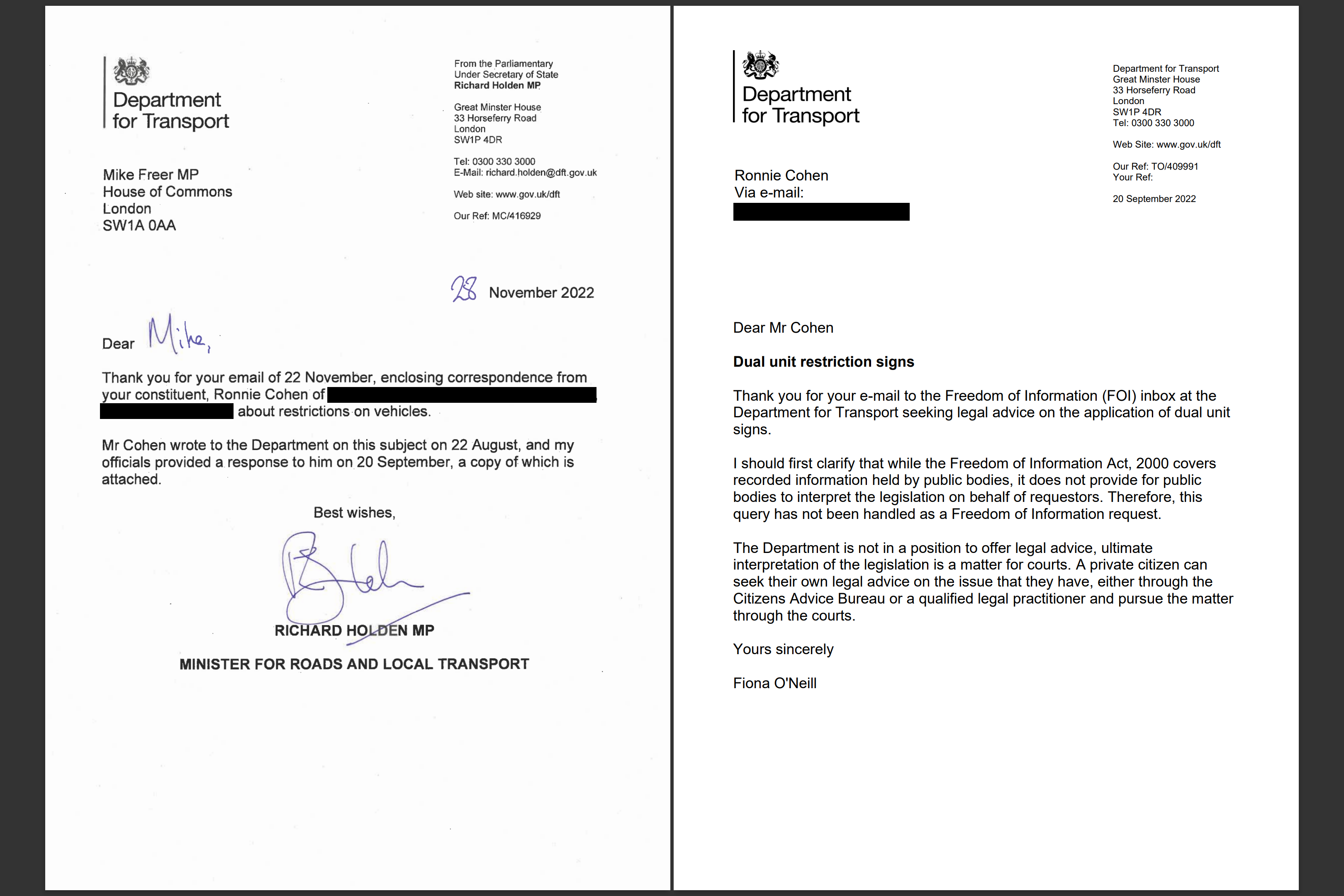
Richard Holden, Minister for Roads and Local Transport, gave me the same answer as the DfT. So, the legal ambiguity remains. It is still unclear whether drivers can drive under a bridge when their vehicle complies with only one value of a dual height sign.
The most rational way to remove this legal ambiguity is to use only metric units on traffic signs showing height, width and length limits. This would align official traffic signs with height signs at petrol stations and private car parks, which are predominantly metric. It would also align these signs with vehicle manuals, which show vehicle dimensions in metres. Then drivers will only need to know their vehicle dimensions in metres.
For more information, see:
https://metrication.uk/transport/roads/vehicle-restriction-signs/


American here so I don’t know my opinion carries any weight. It is pretty shocking that the agency that passed the rule doesn’t know and can’t interpret what their own rule means. It is certainly perilous to use dual units in a legal dispute. However, my interpretation would be that the bridge must be safe for a vehicle meeting either claimed legal maximum. If it isn’t safe, you shouldn’t claim it would be. Actually DfT’s rounding rules seem to yield a sufficient margin in both cases.
If I correctly interpret the rules, the Imperial limit provides a clearance of 3 – 6″ (7.62 – 15.24 cm) to the maximum legal Imperial vehicle. The posted metric value provides a clearance of 8 – 18 cm for the maximum legal metric vehicle. as the metric resolution 0f 0.1 m is greater than 3″, the metric limit is frequently the more restrictive, but there are values for which the Imperial limit is the more restrictive.
Perhaps a driver should carry both an Imperial-only and a metric-only tape measure and offer the correct one for the limit he intends to claim. I also suspect as long as there is no bridge strike, no officer is going to measure.
Certainly American lawyers love to argue how many angels can stand on the end of a pin and would enjoy eating DfT in court for inability to explain what their own law means and/or prosecuting a driver for a vehicle only meeting one of the two claimed safe maximums.
LikeLiked by 1 person
@Ronnie: I checked the regulations from the driver’s point of view. They can be found at https://mhf.uk.com/about-us/news-blog/hgv-height-limits/ and state that any HGV must have its height displayed to the driver in feet and inches (boo, hiss). The displayed value must be in characters that are at least 40 mm in height and at least 150 mm greater than the true value, thereby giving a clearance of at least 15 cm. If we add the additional clearance provided by the way in which the bridge height restriction is calculated, there should always be a clearance of at least 20 cm. According to the website, the driver of an HGV is personally responsible for making the measurement and if there is no height measurement stick in the cab, he can personally be fined £30. If we assume that the police will only prosecute if there is a bridge strike, then there is enough leeway in the definitions that the choice of units does not matter – one party (or both parties) got their measurements wrong regardless of whether they used metric or imperial units.
From what I can recall when I read the actual regulation, this applies to any vehicle that is over 3 metres in height, but the carrying of a measuring stick is not necessary for vehicles whose height is fixed and who have the values permanently displayed in the cab (eg busses).
Furthermore, Vehicles that are not registered in the UK are exempt from these regulations unless they are over 4 metres in height (as a result, I assume, of the Vienna Convention on Road Traffic). If the UK were to fully metricate all height warning and prohibition signs, then we would have leverage within the UNECE to have the Vienna Convention updated to include all vehicles anywhere in Europe that are over 3 metres in height.
LikeLiked by 1 person
Since, at present, there are still some height signs in imperial only, my guess is that road haulage contractors go mainly by imperial height, so that they are covered if they encounter an imperial-only sign. They may well check load heights in metric as well – particularly if they venture over the channel – or the Irish Sea, even.
As jmsteele9027 states, there is margin for safety built into both measurements. If a driver complies with either measurement, there should not be a problem. If a bridge strike should occur, the driver has not complied with either measurement, and the haulage company would be liable for any damage caused.
LikeLike
Clearly, the issue isn’t about whether a vehicle would actually strike a bridge or not. Complying with either value should be enough to avoid this.
The issue is whether a vehicle is deemed to comply with a dual unit prohibitory sign if it only complies with one of its values.
Failure to comply with a prohibitory sign is a serious matter. e.g. Would a driver’s insurance be valid after failing to comply with one of the values on the sign, and his vehicle was subsequently involved in an incident (unrelated to the actual bridge)?
LikeLiked by 1 person
@Martin
I read the article on HGV height limits and the height can include metres but only alongside feet and inches. Bummer.
Once again, standardizing on just metric signage and concomitant changes in the law is the sensible way to go.
Ezra aka punditgi
LikeLike
I would think that in order to overcome the ambiguity, the law needs to specifically state that in the event of a discrepancy between the two unit descriptions, the metric value takes precedence.
The regulation stated by Martin that the driver must have a sign in his vehicle stating the height of the vehicle in feet and inches may increase the chance of a bridge strike. This presents an even greater problem than any discrepancy of units on the signs. The person responsible for the regulation is assuming that the driver will understand what the gibberish on the sign he/she is forced to have in the vehicle means.
I’m sure most foreign drivers and possibly some English drivers don’t know what the sign means and also don’t know how to determine from the sign if the vehicle exceeds the limit of the bridge. Metric values can be understood without delay of time compared to imperial values. A vehicle height of 4 m is obviously safe to pass under a bridge with a height restriction is 4.10 m. Attempting to determine the clearance height in imperial units between the height on the sign by the road and the sign in a vehicle may provide some difficulty costing time and thus a bridge strike.
LikeLike
so apparently only legal metric signs are width/height restriction signs (and they still need to be accompanied by imperial sign). But I’ve seen a couple of distance signs in metres (as opposed to yards). There is one near where I live in Bath, warning that 30mph speed limit applies in 220 metres! I’ve checked the google street view and it seems like it’s been there for at least a couple of years. I wonder who put it there and how apparently illegal metric sign survived for so long.
LikeLike
Krzysztof,
All signs are in metres, even if it states yards. It’s a ridiculous situation. If they changed the sign, all that would change is the name metres to yards thus it would say 220 yards. But it will still be 220 m. So, what is gained by erecting signs with distances in metres that say yards?
The only people who change these signs are metric haters from a group called ARM (Active Resistance to Metrication). I don’t know how active this group is now as most of their membership is literally dying out.
LikeLike
I had a related discussion with a manager at my place of work during lockdown as our company provided signage instructing people to distance at 2m – or – 6 feet. I told him that 6 feet was not the same as 2 metres and wasn’t taken seriously by him, he made some humorous remark about a famously-tall footballer. What I did not say is that it would make it harder to discipline people who weren’t social distancing, given that I am a union rep and it’s not my job to help management bring better cases against my members. Not even if they are “bang to rights” – I had no respect for the people not distancing.
LikeLiked by 1 person
Matt Parker has made a video about the UK’s ridiculous dual-unit height restriction signs:
https://www.youtube.com/watch?v=kH_bSvf7EVA
LikeLike
And this madness is exactly how I discovered this site and Metrication UK.
LikeLike
@0 Dogs Remaining: My understanding is that where ambiguity exists, the benefit of the discrepancy will always be given to the motorist. Thus, if there is a width prohibition of «2 m/6’6″», the motorist is guaranteed that there will be a 2.0 metre clearance and that the motorist will not be prosecuted for breaking the «6’6″» limit (which is approximately 1.98 m). (Note – I have used the French notation for quotes because the single and double apostrophe are both used within the quote).
LikeLike
And so the madness goes round and round with no exit. I never know what we can ever achieve after over 60 years of pain.
We could re-visit every post on this site and still get nowhere but the same place. Nothing is going to change any time soon. What we need is some sort of break through plan of action, someone in government prepared to tackle this wasteful money sump of duplicity across every part of our society.
Whilst roads and transport is one of the most visible and probably influential sectors, the ministers, MP’s and wannabe elected of all flavours show no inclination whatsoever to change anything ever.
I still think retail is where we could inject some sort of pressure, shopping is still a 1960’s battle of confusion and affects pretty much everyone equally, even if most do not recognise the problem exists. Therein is the problem!
LikeLiked by 1 person
As a bit of a diversion in the realm of madness that goes round and round I submit this entertaining video on the strangeness of units out there in the world:
In the end I would hope that eventually we will end up with rational units in most cases all of which are directly based on the SI. Cheers! 🙂
Ezra aka punitgi
LikeLike