
If like me, you are a fan of the Olympic Games, over the last 16 days you have probably enjoyed seeing the metric system used almost exclusively in TV coverage of the Games. It seems that the tendency, all too common in the 1970s, for British TV commentators to convert heights jumped, and distances thrown, into feet and inches, is definitely a thing of the past.
However, whilst most of the events, such as athletics, swimming and cycling, could be said to be exclusively metric, a few events still made use of non-metric measurement units.
Now that the Paris 2024 Olympic Games have come to a close, we take a look at some of the last hold-outs of non-metric units.
Golf
In golf, outside of the Olympic Games, the use of yards for hole distances generally depends on which country the golf course is in. For example, it seems that Australia, New Zealand and most European countries use metres, but that the UK, USA and some Middle-Eastern countries use yards.
In the Paris 2024 Olympics, hole distances were shown in dual units – metres and yards, on both the courses themselves and on TV graphics.
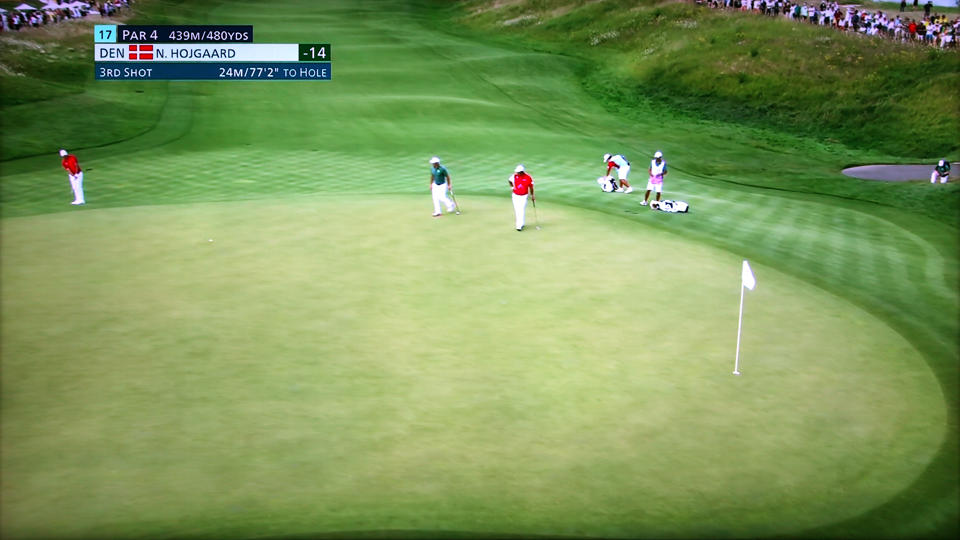
Men’s golf – Paris 2024
It is not apparent why there was any need for dual units – after all, dual units were not used for athletics 100 years ago, when many other nations were still using yards for track events.
e.g. When Britain’s Eric Liddell famously won the 400 metres at the Paris 1924 Olympics, newspaper headlines didn’t see any need for dual units in their articles about the event.
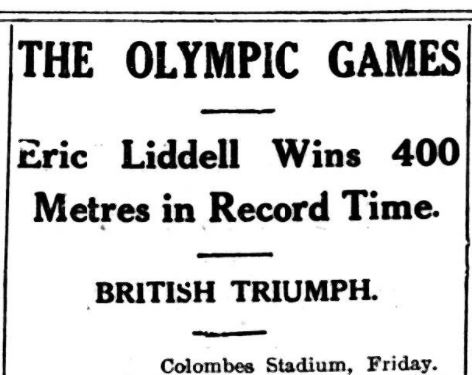
Shields Daily News – 12 July 1924
The graphics overlays on the TV coverage of the golf events did not restrict the use of dual units to hole distances.
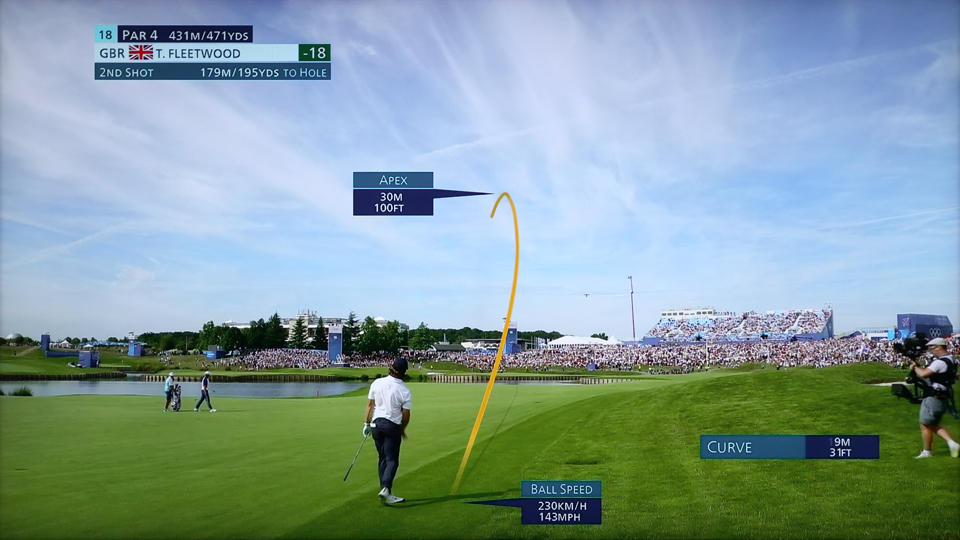
Men’s golf – Paris 2024
Every sort of measurable statistic was shown in dual units – speeds in km/h and mph, ball trajectory apex heights in metres and feet, and ball trajectory curves in metres and feet.
As is customary in imperial, vertical distances are not measured in yards, so for the golf events, all vertical distances were shown in feet, with horizontal distances shown in yards, except on greens where horizontal distances were shown in feet and inches.
In contrast, all distances in metric were shown in metres, regardless of whether they were vertical or horizontal.
If ever there was a case for Golf’s governing bodies to bring their sport up-to-date internationally, it was this muddled use of units seen on TV coverage shown all round the world.
The BBC TV golf commentary made no use of the metric units shown, choosing to stick exclusively with imperial units.
As a side issue, it is curious why ball speeds in sports are not given in metres per second. Being able to visualise how many metres a ball travels in one second is easier, and seems more relevant to sport, than being able to visualise how many kilometres it would travel in one hour.
Sailing
For all sailing events, wind speeds were shown in knots, symbol “kn”. The knot is a non-SI unit that is not accepted for use with SI.
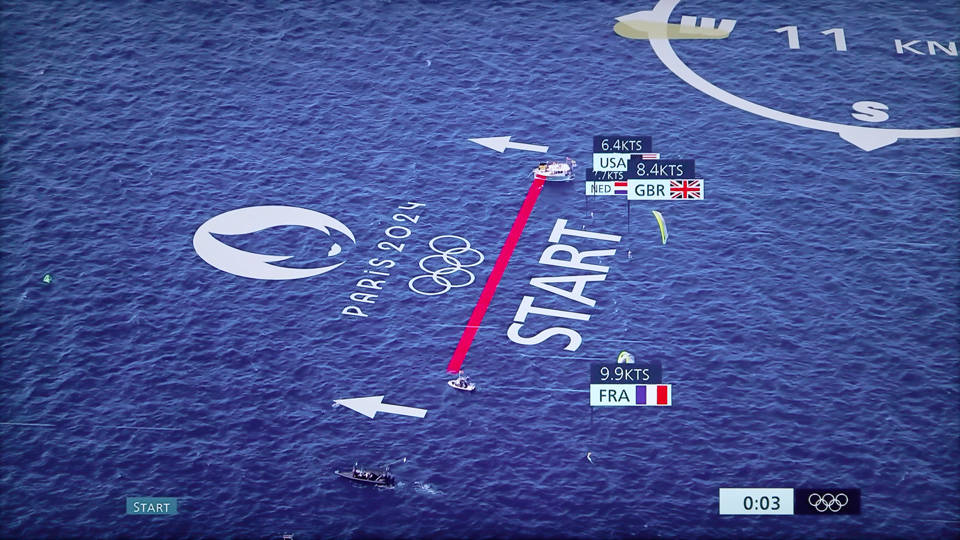
Wind speed 11 kn – Women’s kite – Paris 2024
Boat speeds were also shown in knots, but for some unknown reason a different abbreviation was used, “kts”.
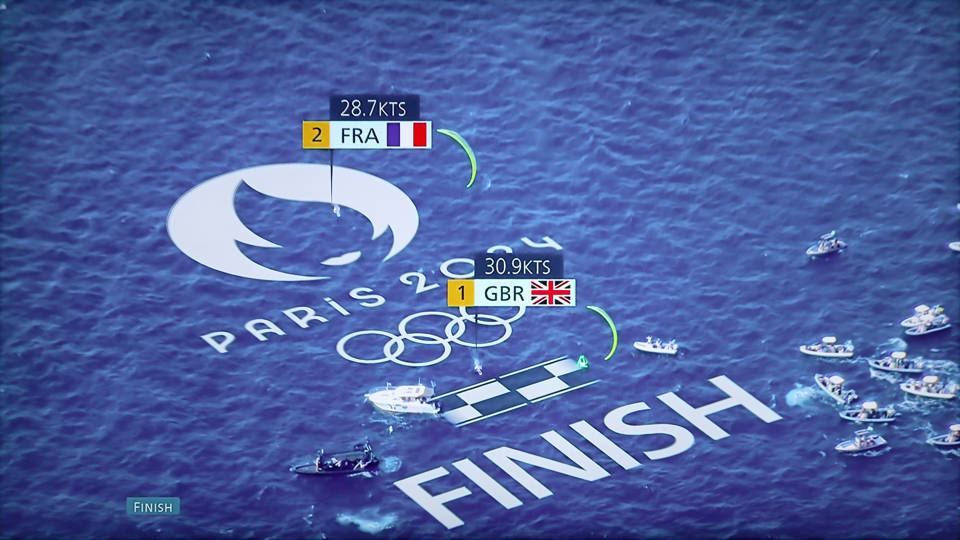
GBR speed 30.9 kts – Women’s kite – Paris 2024
Computer overlay graphics showed distances to destination marks in metres.
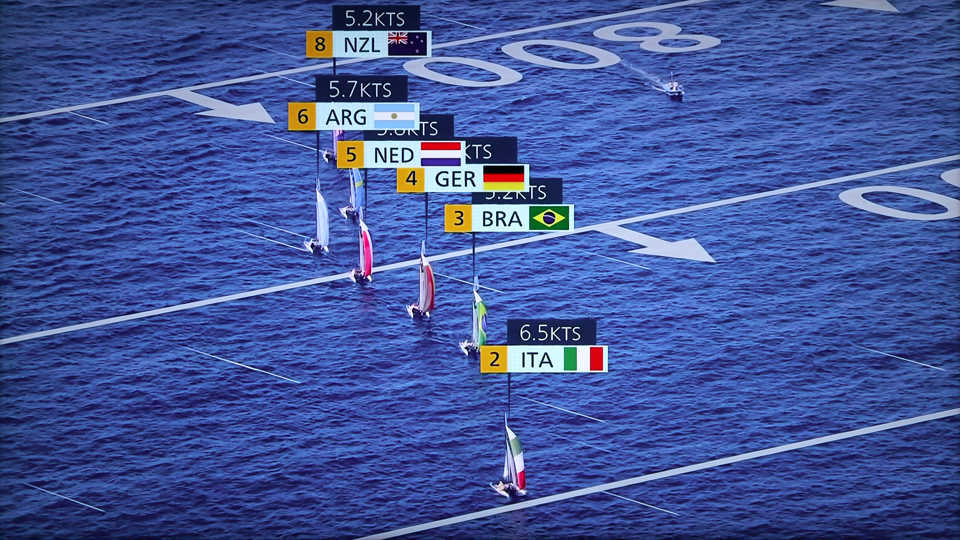
Mixed multi-hulls – Paris 2024
Again, it is not immediately obvious why the computer graphics for sailing events could not have used km/h for speeds, or better still m/s. Wind speeds in athletics events, such as the long jump and sprints, are shown in metres per second.
The marathon
Often mistaken for an imperial race, the marathon is exactly 42 195 metres, with progress markers at every kilometre. 2024 is the 100th anniversary of the marathon being standardised at this length.
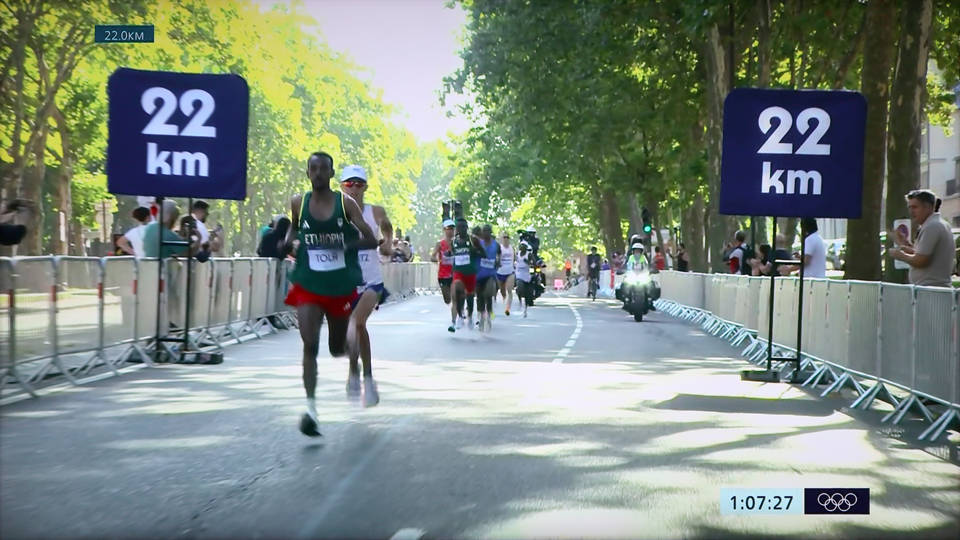
Men’s marathon – Paris 2024
The BBC TV commentary team are to be congratulated for barely mentioning miles in either the men’s or women’s marathon. As with cycle road races, any mention of miles can lead to confusion. The omnipresent computer graphics showing the race’s progress in kilometres to one decimal place, are all that is needed for any viewers unfamiliar with kilometres.
In the men’s marathon, as the runners were approaching a particularly steep section of the course, commentator Paula Radcliffe noted the muddled units that she was about to quote describing the gradient.
Paula Radcliffe:
“I’m not sure why I’ve got it mixed up in terms of metric and imperial, but between 14 k and 20 k it climbs 511 feet.”
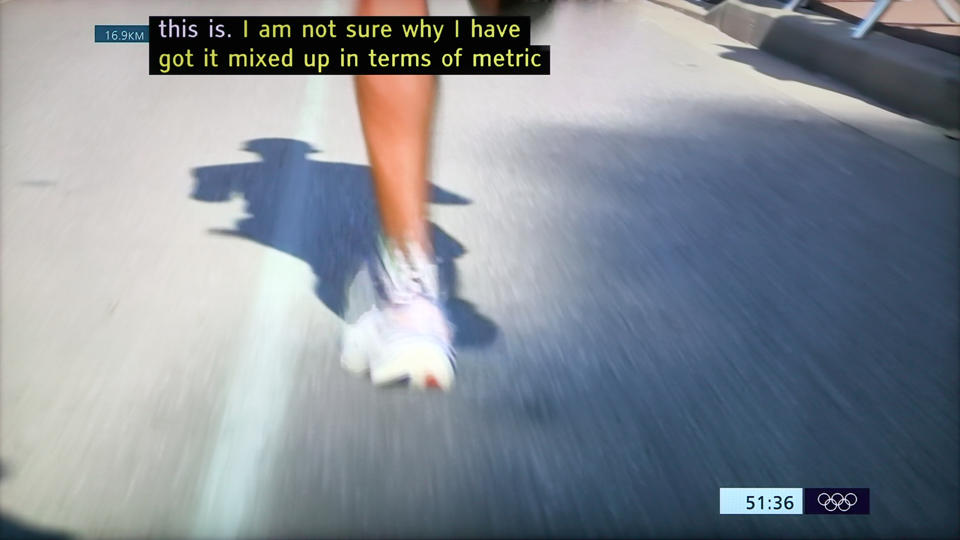
Men’s marathon – Paris 2024
We will leave it to readers to calculate for themselves the average gradient percentage over that 6-kilometre stretch of the course.
Absolute distances in metres, relative distances in yards?
Olympic silver medalist, and former 1500 m world record holder, Steve Cram is a much-admired and valued member of today’s BBC athletics commentary team. He is an excellent commentator and quite naturally describes distances along an athletics track in terms of metres. However, I hope he won’t mind us pointing out his rather odd quirk, unique amongst the BBC commentary team it seems, where he tends to describe the distances between runners in terms of yards and fractions, rather than metres:
Steve Cram:
“Look at the start of Seville. He’s a yard-and-a-half … certainly a big yard behind.”
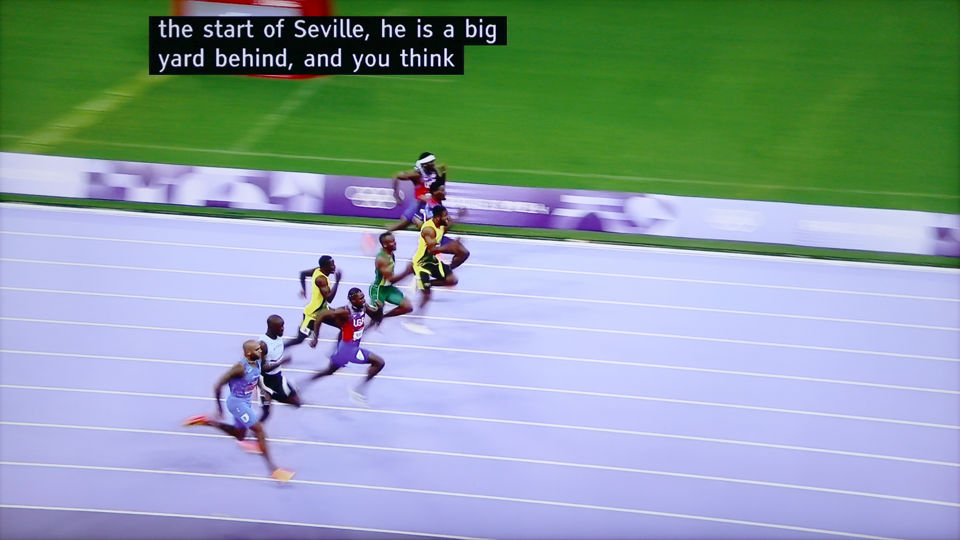
Men’s 100 m final – 1st replay – Paris 2024
[Editor: “a big yard” – could that be a metre?]
Steve Cram:
“Battocletti of Italy is close here. Can Chebet hold her off?
Battocletti a yard away, half a yard away. Can she get there?”
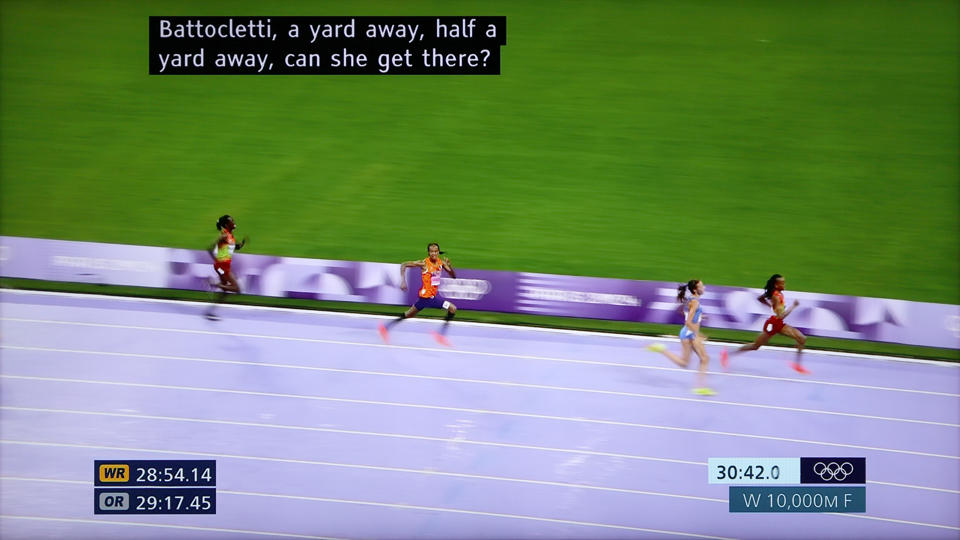
Women’s 10 000 m – Paris 2024
Paris 2024 – upper and lower case characters
The style of font used for all Olympic Games text at the 2024 Games was such that lower case letters were represented by small block capitals. This made the distinction between upper and lower case letters less obvious. This in turn made it less easy to discern whether the correct case was being used in the SI symbols shown in TV graphics.
Los Angeles – 2028
The Olympic Games move next to Los Angeles, USA in 2028. Dare we hope for a greater use of metric units in events like sailing and golf in the next Games?
 Metric Views
Now that we’ve had 100 years of the nonsensical ‘imperial’ marathon, surely now would be a good time to lobby (the IOC?) to revert back to the original Olympic marathon distance of 40 km in time for the 2028 games?
LikeLike
The most “heinous” mix of units is the way in which the apex of the golf ball’s trajectory is quoted in different units to the speed with which it is hit and, when using imperial units, the distance before it lands. “A Level” physics students are expected to understand projectile motion using the SUVAT equations. I did a calculation and found that the distance a projectile can travel is maximised if the projectile is launched at an angle of 45° to the horizontal (assuming that there is no air resistance). Furthermore, the maximum height that it will attain is given by v²/4g where v is the velocity with which it is launched and the distance before it hits the ground is v²/g. (For purposes of SUVAT, one should resolve v into its x and y components.)
I decided to apply these figures to the golfing image in the posting. I know that g is about 9.8 m/s², the apex is given as 30 m, but 230 km/h has to be converted to m/s (63.9 m/s). From this I can calculate that the theoretical distance that the ball will travel before hitting the ground is 416 m and that it will attain a height of 104 m. I could have done the same calculations using imperial units, but again I would have had to convert mph to ft/s, but since the tee distance is given in yards, a second conversion would have been needed. These figures are in excess of the expected distance as quoted on the screen, so I deduce that air resistance plays a big part in the trajectory that the golf ball takes.
Finally, I agree with Isaac that km/h for the speed of the ball is ridiculous – I have seen a golf ball travel for one kilometre, let alone 100 km in a single hit, not have I seen it continuing in motion for an hour.
LikeLike
Rules of golf sometimes contain metric units as a secondary unit:
The rules states:
Sail
LikeLike
I am hoping that someone very familiar with navigation (on the high seas or in the air) can explain why nautical miles and knots are preferred. It seems to have something to do with navigation and the kind of grid that gets used on the this oblate spheroid we call “Earth”?
Ezra aka punditgi
LikeLike
@punditgi: The nautical mile was originally designed to be the distance of one minute of arc of latitude. If we assume the earth to be perfectly spherical and the distance from the pole to the equator to be 10,000 km (the original definition of the kilomere), then one degree of latitude is 10,000/90 = 111.1 km and one minute of latitude is 111.1/60 = 1.8518 km. According to the SI brochure, the nautical mile is 1852 metres exactly.
As you rightly say, the earth is not perfectly spherical, but is ellipsoidal. According to Wikipedia (https://en.wikipedia.org/wiki/Latitude ), one degree of latitude at the equator is 110.574 km making one minute of arc 1843 metres while at the poles, one degree of latitude is 111.694 km making one minute of arc 1861 metres. At 45° one degree is 111.132 km making one minute of arc 1852.2 metres.
From these figures, defining a nautical mile as 1852 metres is a reasonable compromise.
Your other question – one knot is one nautical mile per hour.
LikeLiked by 1 person
@Martin
Many thanks for the info on nautical miles and knots.
I thought I read somewhere that using nautical miles and knots made calculating your location and where you will end up when given a certain heading easier given the latitude and longitude grid used for navigation and before automated devices were around and such things were calculated manually.
Is that still an issue nowadays? What would be the impact of switching all of that to SI?
Ezra aka punditgi
LikeLike
@Modernman: I think that trying to convince the IAAF to reduce the length of the marathon to 40 km is highly optimistic. Perhaps a better strategy would be to convince the British public that a half-marathon is rally two “10k runs plus a little”.
LikeLiked by 1 person
It may be possible that those who supplied the graphics for those particular sporting events used software already in existence for when the sport is performed outside the Olympics. In the case of golf, the presenters may have been required to show metric and decided to just add it in, or possibly this version of software is used in metric countries.
As for knots, they can be considered “old metric”, like calories. They are not really imperial or USC/FFU as they are defined exactly as 1852 m and this value when translated to pre-metric units is a non-ending number. People may be confused and think it is FFU because of the inclusion of the word mile, but change the name to something else and their assumed connection to FFU disappears.
LikeLike
Thank you, Isaac, for your interesting, well researched and well illustrated report. There are a number of points to consider here.
Ball speed and height
In most ball games, e.g. golf, tennis, the score is determined by where the ball goes. Measurements such as ball speed, height, etc. are of interest only and do not affect the score. Therefore the game is the same, whether or not we use metric for these measurements. I have seen dual units used in other places on odd occasions. This is probably because of the persistent usage of miles for road distances in the UK and USA – it is considered to be more helpful. If Wimbledon could show ball speeds in km/h as well as mph, it would be a step in the right direction.
In track events, e.g. running, cycling, the distance round the track is critical to record the achievement of the athletes, hence these have been standardized on metric for many years. It is odd that a commentator chooses to describe distance between runners in yards, considering that a former world class athlete would be expected to be well familiar with metric distances.
Summing up, so far, all official Olympics results are in metric, in the interests of international conformity. Additional information is not restricted thus.
Kilometres per hour or metres per second?
The general public is familiar with car speedometers and the way in which they are calibrated. The public is not familiar with devices calibrated in metres per second. I have been an engineer in my working life but am struggling to remember, even in my undergraduate days, a device in a laboratory reading in metres per second.
I recognize the reasoning of the argument that a tennis ball will not travel many miles or kilometres, and will not take an hour in flight. But this is not the point of concern. If police wish to check a car suspected of speeding, they do not time it over a period of one hour. Let me bring in a comparison with rotational velocity.
Why do car “rev counters” take a whole minute to count revs, and then use dividers on the scale, e.g. “x 100” or “x 1000” to get the resulting large figure down to a manageable size? Would it not be sufficient to count the revs per second? Counting revs for a whole minutes seems more appropriate to James Watt’s early steam engines. It seems even more bizarre when applied to aircraft jet engines, where rpm can run to five figures.
I once worked in power stations. Charts were available for generator speed trials, converting between rotor speeds in revs per minute and mains frequency in cycles per second (hertz nowadays). Generator speeds, indeed almost any rotating machinery, is not measured in revs per second and alternating current frequency is not measured in cycles per minute. One thing I do remember from my student days is a laboratory device with a dual-scale speed indicator calibrated in both revs per minute and radians per second. I would record my readings in radians per second, which made calculations easier. Power is torque multiplied by absolute rotational velocity. No need to faff on with a “60” or a “π” in the formula. Not many of my colleagues did the same.
My point is that if we think that km/h is not a suitable measurement of speed of a tennis ball, I can find parallel cases that seem to be widely accepted.
LikeLiked by 1 person
Modernman,
there is no chance of changing the marathon distance to 40 km! There is nothing wrong with 42195 m, and those 2195 m can make or break a person!
LikeLike