
There is a new board game, about measurement, called “How Many What?!”. Or rather it is about describing the size of things without the benefit of a universal measurement system.
The game’s blurb says, “Some people will use anything but the metric system to measure things! How Many What?! is the ridiculous party game of absurd comparisons.”
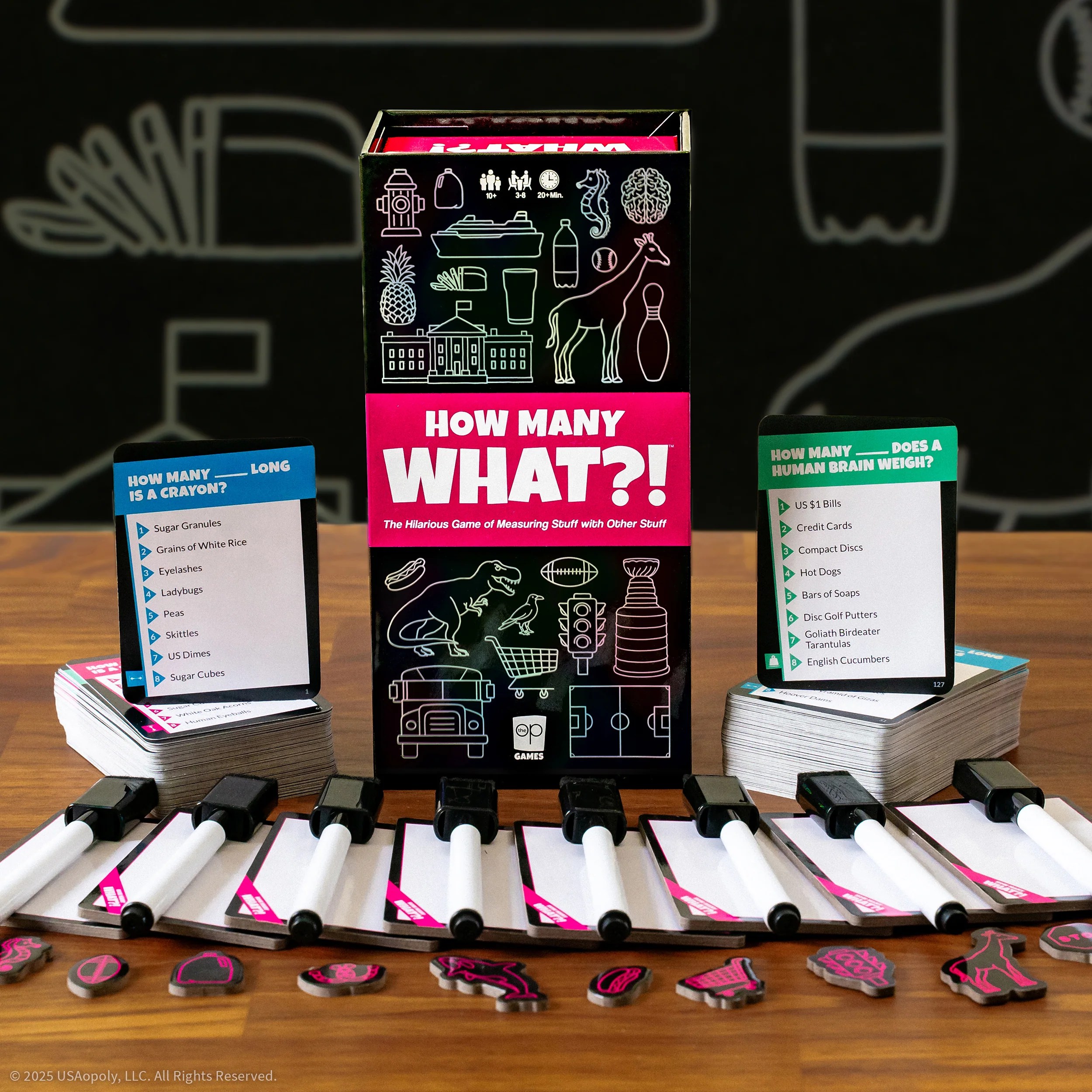 image courtesy of The Op Games
The object of the game is to estimate how many of a named object are equal to the length, or weight, of another named object.
Examples given on the manufacturer’s website include, “Did you know that a giraffe is 19 gallons of milk tall”, and that “a blue whale weighs as much as 21 school buses”. Of course the assumption is that the player is familiar with the objects in question – in this case “a school bus” and “a gallon of milk”.
The time needed to play the game is given as 20+ minutes (or should that be 5 boiled eggs).
The concept of the game would be amusing, if it didn’t reflect the seemingly growing incidence of journalists dumbing down, or avoiding completely, the use of even the most universally-understood measurement units in news stories. The most well-known example is probably the story involving a road obstruction, which was reported as “a large boulder the size of a small boulder” (in this case the report was meant to have said “small car”).
Some common comparisons that readers have probably seen many times already include, “London bus”, “Olympic swimming pool”, and “size of Wales”. The size of Wales, being equal to about 20 000 km², would give the Moon an approximate surface area of 2 kiloWales.
Physics World recently highlighted the absurd practice of describing the size of meteors in terms of the sizes of animals, e.g. “Corgi-sized meteor as heavy as 4 baby elephants hit Texas”, when they announced a new standard animal-based size scale for meteoroids and asteroids in an April Fool spoof article.
Following a quick search, here are a few examples of news stories that have avoided using measurement units in their headlines. Perhaps readers can find equally absurd headlines:
Moorland fire was ‘size of 325 football pitches’
https://www.bbc.co.uk/news/articles/crkx3d486nxo
Farmland seven times the size of London could face flooding by 2050
https://inews.co.uk/news/environment/england-farmland-flood-risk-2050-3525976
Bigger than Texas: the true size of Australia’s devastating floods
https://www.theguardian.com/australia-news/2025/apr/05/bigger-than-texas-the-true-size-of-australias-devastating-floods
How a flood basin the size of 310 Olympic swimming pools saved south Manchester
https://manchestermill.co.uk/how-a-flood-basin-the-size-of-310
Asteroid half the size of a giraffe strikes the Earth off the coast of Iceland – just two HOURS after it was discovered by astronomers
https://www.dailymail.co.uk/sciencetech/article-10610491/Asteroid-half-size-giraffe-strikes-Earth-coast-Iceland.html
Astronomers launch new asteroid-classification system based on animal sizes (1 April 2022)
https://physicsworld.com/a/astronomers-launch-new-asteroid-classification-system-based-on-animal-sizes/
Bendy camera the width of a human hair can take accurate 3D images
https://www.newscientist.com/article/2285625-bendy-camera-the-width-of-a-human-hair-can-take-accurate-3d-images/
Galway-sized object in space ‘may be alien spacecraft coming to attack’
https://www.dublinlive.ie/news/galway-sized-object-space-may-32142362
Enormous asteroid the size of 59 Bonos racing towards Earth could ‘wipe Ireland off the map’
https://www.irishmirror.ie/news/irish-news/enormous-asteroid-size-59-bonos-34626814
Corgi-sized meteor as heavy as 4 baby elephants hit Texas
https://www.jpost.com/science/article-732223
Asteroid the size of 18 walruses to pass Earth on Sunday
https://www.jpost.com/science/article-743268
Author of viral ‘large boulder the size of small boulder’ tweet explains what happened
https://denvergazette.com/outtherecolorado/news/5-years-later-heres-what-the-large-boulder-the-size-of-a-small-boulder-writer/article_cfb33e88-dcd3-11ef-93aa-371afebdf315.html
“As Long As 13 London Buses”: The Curious, Spurious Comparisons We Find In The Media
https://londonist.com/london/secret/london-comparisons
References
How Many What?!
https://theop.games/products/how-many-what
How Many What?! Game Review


Wiki gives many different sizes/volumes of ‘Olympic Swimming Pools’
LikeLike
I checked the Wikipedia article https://en.wikipedia.org/wiki/Olympic-size_swimming_pool. It states that an Olympic swimming pool must have a length of 50 metres, a width of 25 metres and a depth of at least 2 metres, with greater depths for certain events such as diving. Its volume is therefore at least 2.5 ML, not 1.0 ML as stated. They got their incorrect information from NIST, so I have written to NIST, pointing out their error.
LikeLike
Martin,
Why not just say 2500 m^3 ? Litres should be restricted to volumes under 1 m^3 .
LikeLike
I find it difficult to make rational comment.
My opinions of the media on this topic are best not put into writing! The game blurb says it all.
Many years ago I was recording a ‘technical’ series from the BBC, the irritation of ‘stupid units’ was outweighed by the subject interest until one topic on F1 cars. Fully engrossed I was confronted with the phrase ‘the pressure of seven elephants’. Such was my ire that I left the room and asked my wife to delete the whole set of recordings for me, and the reservations.
I have not watched a BBC science programme since.
LikeLike
Unfortunately Brian, the media only presents fake or neutered science. It’s meant to provide the most basic of information to the uninterested of media followers. If for example someone watched these programs and it did tweak an interest, these people would be put off when the move to more specific information presented in metric units.
As you were turned off from having to encounter FFU, they would be equally turned off in reverse for having to encounter metric. All science information should be expressed in SI only and if it does turn anyone off, better to be turned off at the first encounter than to move on to step two and be turned off there.
But, this will never happen as there are those of limited mental capacity who think science works just fine in FFU when it doesn’t. FFU enthusiasts have yet to agree as to whether the pound is a unit of force/weight or mass, and have declared it is both. It irks me to no end when there are those who should know better and treat the kilogram the same way.
LikeLike
I think measuring with walruses, corgis, giraffes, school buses and elephants is more a case of FFS than FFU.
LikeLiked by 1 person
There’s a lively comments section on a Hackaday blog article titled, METRIC, IMPERIAL, AND FLEXIBILITY – currently 81 comments.
https://hackaday.com/2025/08/16/metric-imperial-and-flexibility/
LikeLike
I am glad that someone has introduced the game to take the mickey out of the media. I confess I have sometimes used such comparisons myself, if in a jocular manner.
E.g.:
– Rwanda has approximately the same area as Wales.
– Majorca is about the same size as County Durham.
– An acre is the size of a rectangle of one cricket pitch by one racecourse section.
These comparisons are less bizarre if they compare similar things; in these examples – areas.
An Olympic swimming pool is not a familiar item to most people, and as has been pointed out it is not even of fixed depth. Broadcasters using this for size comparison are more interested in sensation than accurate size description.
Regarding buses, why the London bus? There are some variations in bus size, e.g. double-decker buses come in standard height and low height (to get under low bridges), but most of us have a good idea of the size of a standard double-decker. This is standard throughout the UK, even though it may appear incongruous in places like the Isle of Wight, where the standard-sized double-deckers lumber their way through a street scene resembling more Fairyland than London.
How many of us have actually been in a football field? Probably not as many of us as we may think. Football is actually a minority interest, even we might not think so judging by the way it dominates the headlines every weekend.
But even land areas are not always clearly defined. Does County Durham include areas of places like Gateshead or Stockton on Tees, which are unitary authorities, not under county governance?
I liked reading, with much amusement, the Londonist article, “As Long as 13 London Buses”. At least the media can take a laugh at themselves, sometimes.
@BrianAC @Daniel
There is an American flavour to your comments. The position in the USA at present can be compared with the position in the UK in the 1960s – predominance of imperial units but metric used for certain things.
In the 1970 the BBC ran a programme called “Tomorrow’s World”. However the presenter of the day did not have a “Tomorrow-like” usage of units and this, together with his dumbing-down and condescending manner put me off the programme, even though I was interested in scientific matters. In the 1990s the programme re-appeared with new presenters with a more up-to-date approach and I was more interested.
LikeLike
The spirit of this post is a good match with this entertaining video by a Brit who recounts many of the bizarre units in the Imperial non-system of units compared to the metric system: Enjoy! 🙂
LikeLike
The Guardian have outdone themselves today with the headline “Revealed: Europe losing 600 football pitches of nature and crop land a day”
https://www.theguardian.com/environment/2025/oct/01/revealed-europe-losing-600-football-pitches-of-nature-and-crop-land-a-day
LikeLike
@Free Thinker
I will say that the article in The Guardian is mostly metric with certain mentions of metric units followed by Imperial in parentheses, but many mentions of metric values were left alone with no Imperial, which I was glad to see.
LikeLike
In the US & Canada where metric usage is weak among the population, < 8 % of the population work in any form of industry where measurements are a critical part of the business. In the UK and EU it is higher about 18 %. In China it is about 30 % and Korea and Japan its about 23 %.
It seems the higher the usage of metric the more industrial and associated jobs exist. The lower the metric usage the less likely you will find people working in industry? Is there a correlation between metric usage in a country and how many people are employed in industrial jobs?
Industrial based jobs seem to be more stable, higher paying and in the US at least the best source of benefits like medical care and vacations. Those working outside of industry struggle to make ends meet and are often living on the edge of bankruptcy. A lot of industrial jobs have vanished due to technical advances and automation, but I’m sure this these things occurred sooner rather than later due to the metrication of lot of industries and the working population at the time in industry resisting metrication. Industry in the English speaking world that experienced worker resistance had to find a solution to the effects of workers not being able to function in metric and that was to either export jobs from these countries to metric countries as well as developing automation.
When I see younger looking people spending their time making videos that on the surface may appear that they are just presenting an historical perspective but expressed a sort of pride in areas where metrication was successfully resisted, like road signs and UK pubs, makes me wonder if they could have been working in higher paying long term industrial jobs instead of struggling in an over competitive video producing industry that eventually people will tire of them and they will disappear.
LikeLike
I thought I would share this link showing a map of the countries that have tried to make the transition to metric.
https://worldpopulationreview.com/country-rankings/countries-that-dont-use-the-metric-system
My main objection is that the USA should be categorized as mostly non-metric. Saying the USA’s conversion to metric is “partially complete but stalled” is too generous. 😦
Ezra (aka punditgi)
LikeLike
Here in the U.S., the “football field” is used often enough that it’s practically an official unit equal to 100 yards.
LikeLike