
If, like me, you are a regular viewer and fan of QI, the BBC’s long-running “Quite Interesting” trivia game show, you are probably frustrated by the seemingly random choice of measurement units that the programme uses to convey the sizes of things. Viewers are expected to be familiar with a whole host of units that haven’t been taught in schools for more than 50 years.
A prime example of this was Episode 4 of the current series, first broadcast on 11 November 2025, where the theme of the show was waves.
The episode related an amusing story of how microwaves were used in an experiment to revive cold hamsters. The story used a plethora of units; inches, feet, millimetres, metres and kilograms. On this occasion kilograms were used for weight, but on another day it might have been pounds, ounces or stones.
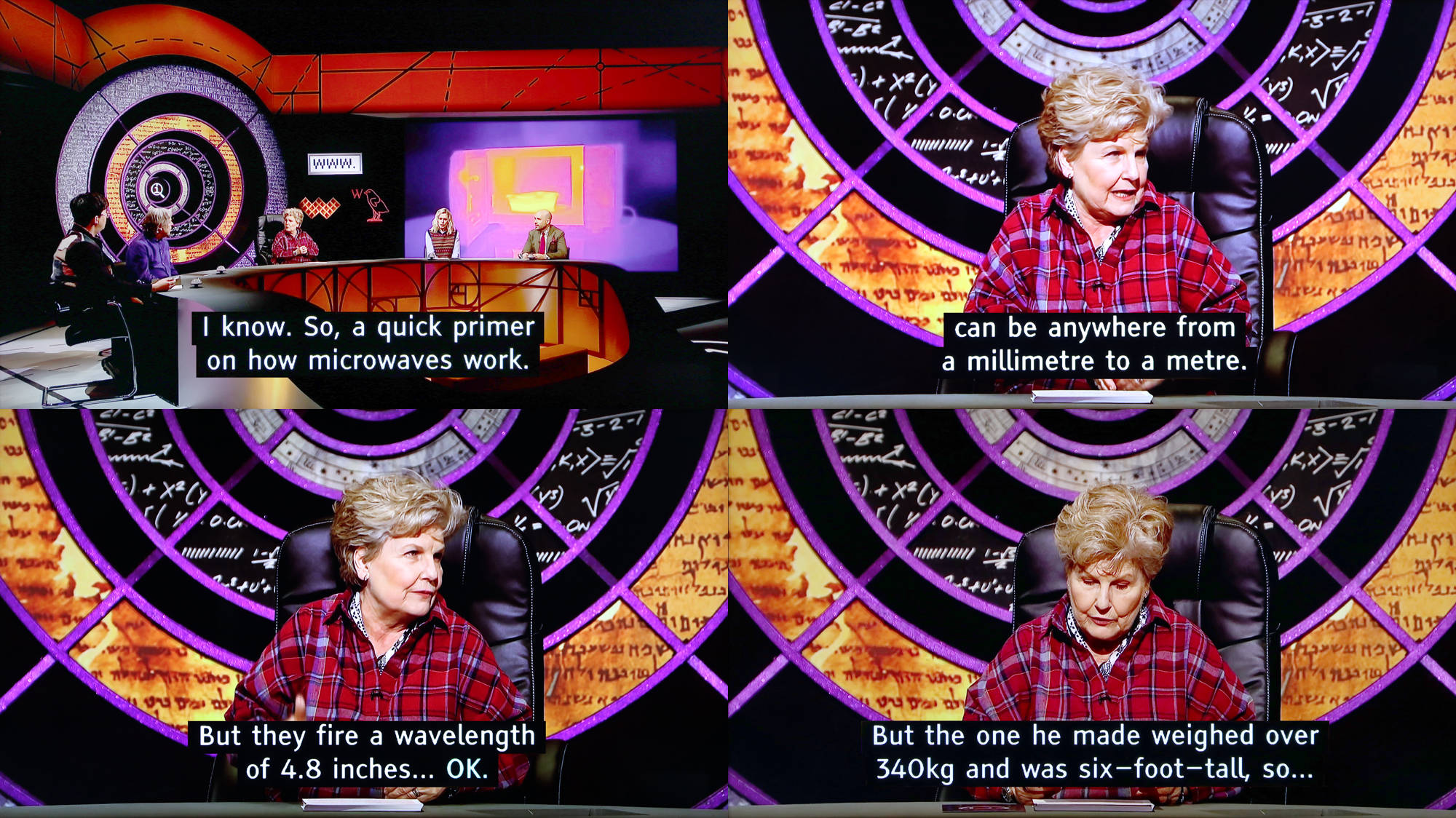
Microwaves can be thought of as radio waves with very short wavelengths (and correspondingly high frequencies). The presenter informed us that microwaves are electromagnetic radiation with wavelengths ranging from “a millimetre to a metre”. When we were told that the electromagnetic radiation used in the experiment had “a wavelength of 4.8 inches”, we were expected to know that was within the given range.
The use of inches for wavelengths was particularly jarring here. I’ve never heard of imperial units being used to measure wavelengths of electromagnetic radiation before. If they ever were, it seems particularly inappropriate for a BBC programme in 2025, with its charter to educate the public, to be giving the impression that inches are a valid unit to use for science involving electromagnetic radiation. Indeed, ever since public broadcasting began in the 1920s, the wavelengths of radio stations have been given in metres – The UK’s first public broadcasting radio station, 2MT, transmitted for the first time on 14 February 1922 on a wavelength of 700 metres.
On a more general note, how are we expected to compare the sizes of things when the show keeps flipping from one measurement unit to another? A cynic might say that this is done deliberately to add to the confusion of the panelists, and viewers, that forms the source of so much of the humour generated in the show, and that not understanding something is funny, so it doesn’t matter that we are confused.
The story went on to describe an early microwave oven that weighed “over 340 kg” and was “6 foot tall”. In this context, the use of superfluous words like “over” and “more than”, when used in conjuction with an already-rounded amount, are usually a clue that a value has been converted from its original recorded unit. In this case, an approximate value of 750 pounds, would have converted to 340.2 kg, hence the words “over 340 kg”, rather than merely “340 kg”.
This would support my view that, despite its use of measurement units still being a mess, the programme does seem to me to be increasing its use of kilograms in recent years, and decreasing its use of pounds. Nevertheless, surely it would make sense to stick with metric throughout, and not expect viewers to be able to juggle a plethora of different units, most of which they haven’t learned in school.

Later in the show, we were asked to guess the identity of the largest animal that has ever lived. Some humour was had about this being where the size of a bus would ordinarily have come into the discussion. But, seemingly in defiance, we were not given the size of a whale shark, or the size of a blue whale in terms of “London buses”. Instead, the distance between two members of the audience was used to demonstrate the lengths of the animals. This of course introduces us to another novel unit of length – a “QI audience”.
Whether deliberately or not, we never got to hear the actual lengths of a blue whale, or a whale shark, in metres, or any other measurement unit. We were just told, “that is the size of a whale shark”. Any visually-impaired listeners would have been none the wiser.
References
QI XL – Series W: Episode 4: Wavey
https://www.bbc.co.uk/iplayer/episode/m002m418/qi-xl-series-w-4-wavey
Metric Views – “How many what?!”
https://metricviews.uk/2025/08/01/how-many-what/
 Metric Views
I was listening to a BBC weather forecast this morning and the announcer said there could be ‘up to 25 centimetres of snow, that’s about ten inches.’ Why have they dialled back on using metric measurements? If people want to use imperial they can convert it themselves.
LikeLike
The wavelength and frequency of electromagnetic radiation have always been quoted using metric units. The wave phenomena of electromagnetic radiation was first studied by James Clerk Maxwell over a period of years starting in 1856. His most celebrated publication of this work was in 1865. While he was doing this work, he was also a leading light (along with Kelvin) in the British Association for the Advancement of Science. At this time, the BAAS were extending the metric system to cover power, energy and other physical phenomena. Part of this extension was the laying the foundations of coherence in the metric system.
LikeLiked by 1 person
Without looking up in some kind of encyclopedia as to what the wavelength of microwaves was, I would automatically assume they were somewhere in the micrometre range. Otherwise, why bother calling them microwaves if they weren’t?
LikeLike
According to a Google search the wavelength of typical microwave over is 120 mm, corresponding to 2.45 GHz. So, I now wonder what the word micro in microwave is actually referring to.
LikeLike
https://en.wikipedia.org/wiki/Microwave
Interesting. Evidently, the “micro” in microwave just means smaller than normal radio waves.
LikeLike
Daniel
It is a case of relativity. Without taxing my brain too much ‘long waves’ are around 1500 metres, ‘medium waves’ 200 metres, short waves around 2 metres, microwaves are less than that! There are many different bands, ovens are around the 10 to 12 cm, indeed “something in inches”.
Never before in my entire 60 years of telecoms have I heard wavelength reference in inches, nor indeed yards or miles, so stupid in fact that I tried hard to not even read this article.
LikeLike
Depending on which source you read, radio engineers have defined long waves as having a wavelength in excess of 1000 m, medium between 100 m and 1000 m, short waves between 10 m and 100 me, vhf (very high frequency) a wavelength of between 1 m to 10 m and uhf (ultra-hight-frequency) a wavelength of between 30 cm ad 1 m. Some authorities classify microwaves as having a wavelength of between 1 m and 1 mm while others use the limits of 30 cm to 0.1 mm.
One of the problems in using microwaves for communication purposes is that water molecules absorb electromagnetic radiation that has a wavelength of 12 cm. However, this is put to effective use by using this absorption property to heat food – hence the microwave oven.
LikeLike