
The new version of the Met Office’s weather forecasting website no longer has the option to show wind speeds in metric units. All wind speeds are now in mph-only. Previously, users could choose from a list of different units, including metres per second and km/h.
However, even though the use of the Celsius scale is for all intents and purposes settled in the UK, users are still offered a choice of units on the website for the display of temperature.
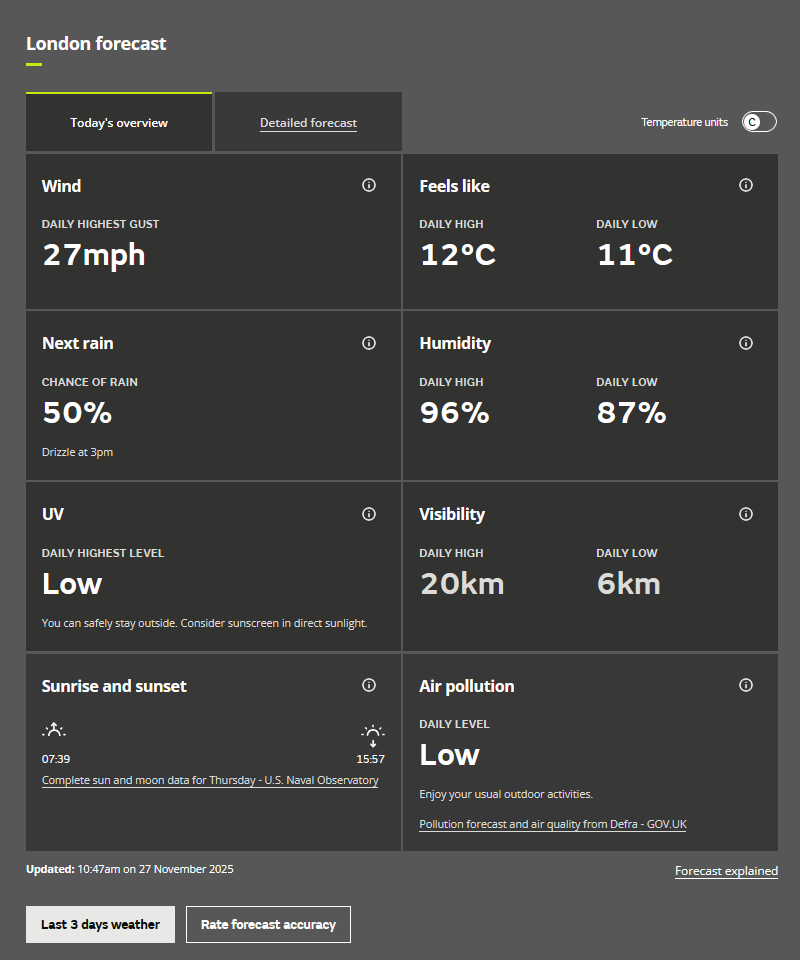
Met Office – NEW weather website, November 2025
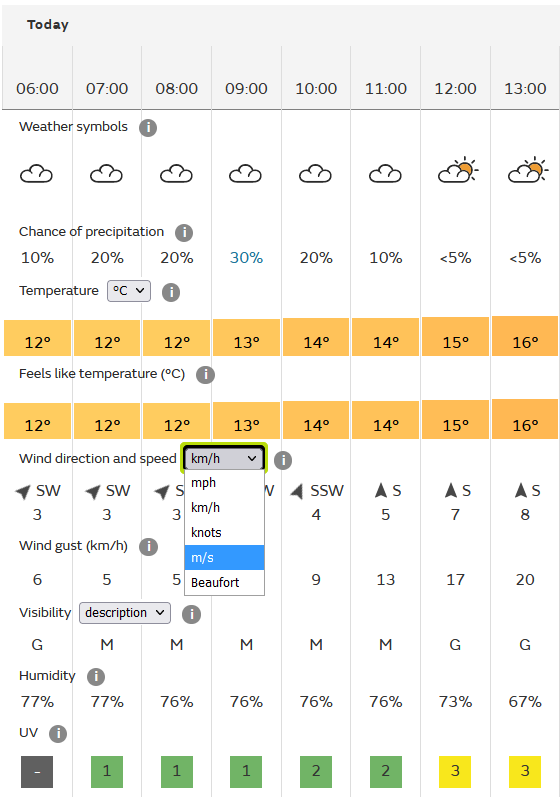
Met Office – OLD weather website, October 2025
On 21 November, a post on Bluesky asked for feedback on their new website and weather forecasting app. This post was updated on 24 November thanking users for their suggestions, citing a request for wind gust speeds to be displayed more prominently. But no mention was made of restoring an option to choose metric units for the display of wind speeds.
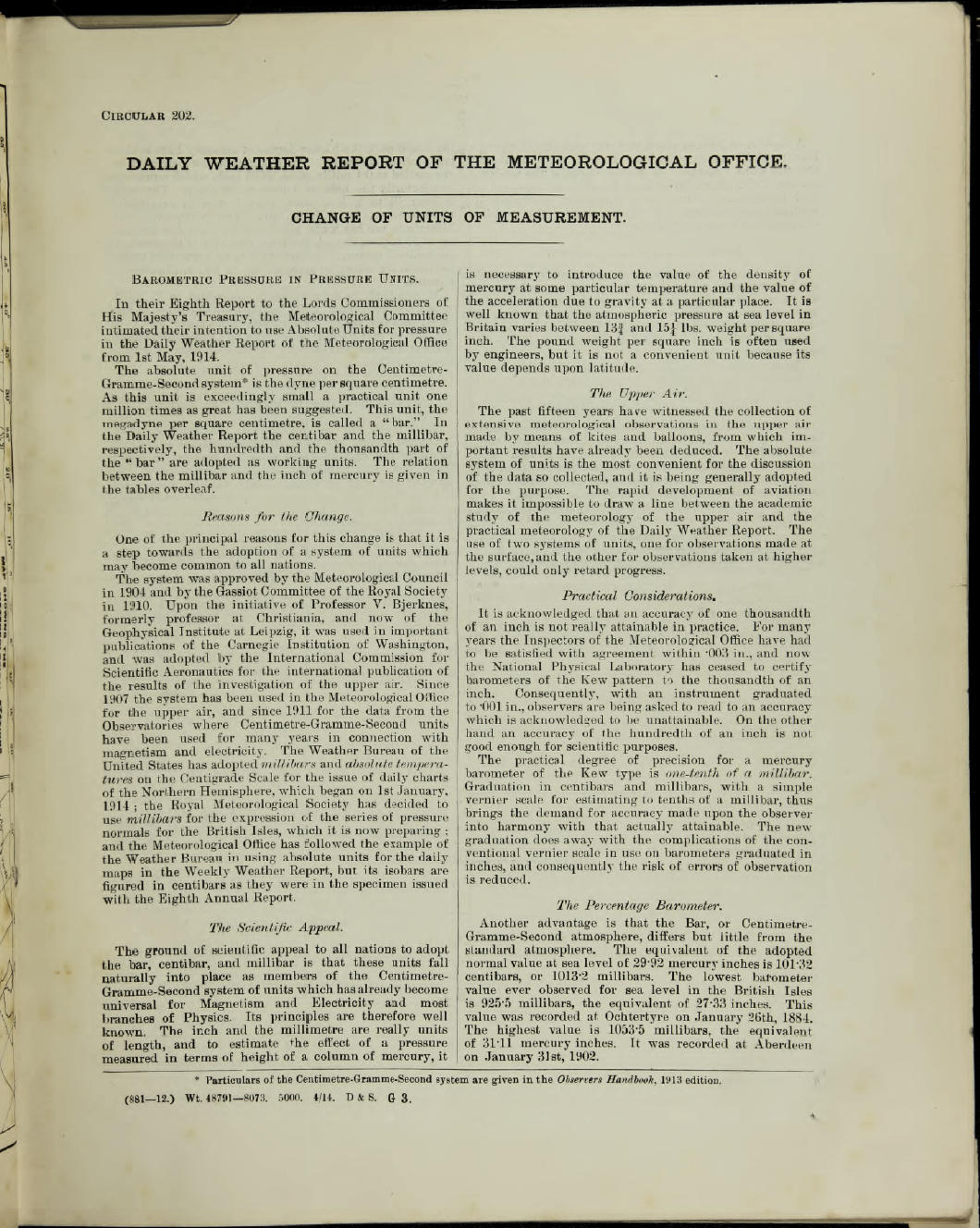
In 1914, when the Met Office originally adopted metres per second for wind speeds, one of the reasons they gave for the change was, “that it is a step towards the adoption of a system of units which may become common to all nations”. Another more obvious one is that it is a lot easier to visualise a leaf being blown a given number of metres in one second than it is to visualise how many miles it would go down the road in one hour.
The system was approved by the Meteorological Council in 1904 and by the Gassiot Committee of the Royal Society in 1910. Upon the initiative of Professor V. Bjerknes, formerly professor at Christiana, and now of the Geophysical Institute at Leipzig, it was used in important publications of the Carnegie Institution of Washington, and was adopted by the International Commission for Scientific Aeronautics for the publication of the results of the investigation of the upper air. Since 1907 the system has been used in the Meteorological Office for the upper air, and since 1911 for the data from the Observatories where Centimetre-Gramme-Second units have been used for many years in connection with magnetism and electricity. The Weather Bureau of the United States has adopted millibars and absolute temperatures on the Centigrade Scale for the issue of daily charts of the Northern Hemisphere, which began on 1st January 1914; the Royal Meteorological Society has decided to use millibars for the expression of the series of pressure normals for the British Isles, which it is now preparing; and the Meteorological Office has followed the example of the Weather Bureau in using absolute units for the daily maps in the Weekly Weather Report, but its isobars are figured in centibars as they were in the specimen issued with the Eighth Annual Report.
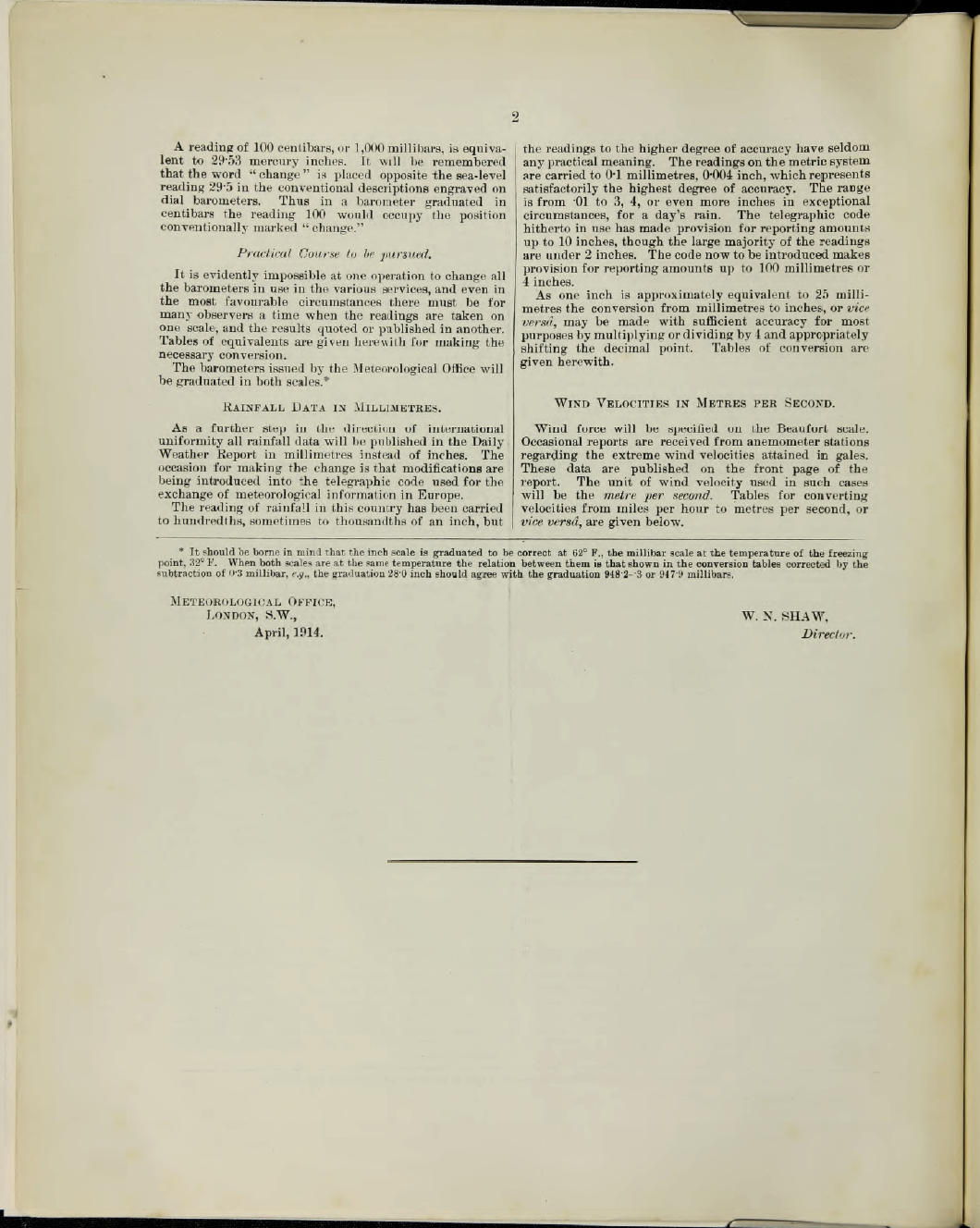
WIND VELOCITIES IN METRES PER SECOND
Wind force will be specified on the Beaufort scale. Occasional reports are received from anemometer stations regarding the extreme wind velocities attained in gales. These data are published on the front page of the report. The unit of wind velocity in such cases will be the metre per second.
Daily Weather Report Of The Meteorological Office,
Circular 202, Change Of Units Of Measurement, April 1914
Met Office – feedback form
The Met Office has a feedback form at the following link:
https://www.metoffice.gov.uk/forms/website-feedback
 Metric Views
The Settings let you choose km/h but the page still displays in mph. I suspect it’s a programming glitch rather than removing km/h. I’ll enquire further.
LikeLiked by 1 person
I have no idea whether it helps your cause. However, even the US National Weather Service (NWS) allows a user choice of Customary or SI units on point forecast pages. (One switch for all weather items.) On an hourly detail page, units can be chosen item by item, including wind speed (knots, mph, km/h, m/s). And we are supposedly less metric than the UK.
LikeLike
I checked the website a few minutes ago. It appears that the overview forecast does not provide the users with any options regarding choice of units of measure – temperatures are in °C (but are specified only as 11° – no “C” or “F”) and wind speeds in mph. The detailed forecast which is an expanded view for selected weather phenomena (temperature, precipitation, wind, UV and humidity defaults to wind speed in mph, but gives the use the option of using °C or °F. For the record, the expanded wind data gives average wind speed and maximum expected gusts).
In short, they ned to get their act together in respect of units of measure, not only from the point of view of metrication, but in general.
LikeLike
I agree. The Met office, who are a serious scientific organisation, need to grow up when it comes to consistent measurements. I am sick to death of hearing any non SI unit coming out of that organisation.
I refuse to use their newer format, instead I continue to use the previous one which enabled me to select the units I understand.
LikeLiked by 1 person
The new Met Office website has also dropped the 24-hour format for times, in favour of 12-hour am/pm times.
Travel ticket times and schedules are all 24-hour time format in the UK, so it made sense for weather forecasts to use the same format.
Breaking the functionality of websites is not unique to the UK it seems. The main Australian weather website has recently had a “makeover” too:
Australia’s beloved weather website got a makeover – and infuriated users
https://www.bbc.co.uk/news/articles/c2k4dy15nqqo.amp
LikeLike
That’s another reason why I switched back to the old format. It uses 24 hr clock times, like I do basically exclusively! Because why not? In Russian for example; a foreign language which I know well, written times default to 24h, even though Russians use 12h in speech.
LikeLiked by 1 person
I suspect part of the backsliding on the part of the Met is the fact that speed limit signs on UK roads are still shown in mph. Emulating Ireland by switching to km/h would finish that nonsense once and for all.
As an aside I am watching the Apple TV series “For All Mankind”, which provides a counterfactual story where the Russians beat the Americans to a man landing on the moon and then work together to set up a colony on Mars. The story is pretty interesting, but what caught my attention for this website is that they had a disastrous failure of a probe to Mars because the Russians provided crucial orbital and landing data in metric and NASA incorrectly converted it to Imperial.
Nifty that the writers included this kind of story based on real world history. And another lesson being taught in a subtle way that two systems of measurement is not a good idea. 😦
Ezra aka punditgi
LikeLiked by 1 person
I have been using my smart phone to watch a bunch of YouTube channels from Canada on news, politics, energy policy, etc. I continue to be struck by how consistently and spontaneously they use kilometres and degrees Celsius despite being bombarded by programs on television, radio, and online from the USA just south of their border near which most Canadians live that use US Customary units exclusively in their programming.
The only things that changed in Canada despite the American millstone around their neck is the fact that their road signs changed to metric, all their thermometers and appliances and devices switched to metric temperature (probably because of government regulation, I suspect) and all of their media agreed to stick to just metric with no conversions when it comes to distances, speed, quantities (like for rain and snowfall), volumes in litres (like for petrol), and temperature.
I just checked the government of Canada weather website and it is all in metric with no option I can find to display Imperial. The site displays barometric pressure in kPa (not even a minor fudge to use hPa instead!) and wind speed in km/h as well as temperature in Celsius. Some Canadian newspapers I checked were writing about snowfall in centimetres with no mention of inches.
If road signs in the UK were changed to metric (cf Ireland) and the government made a concerted effort to standardise on metric while cajoling media to do the same, full metrication could happen in the UK. Too bad the current Labour government does not see that as important. 😦
Ezra aka punditgi
LikeLiked by 1 person
Imagining that I were a visitor to Earth from another planet, with no preconceived ideas of how things are done here, comparing the 12-hour and 24- hour time systems I have no doubt that I would select 24-hour as the better system. Two sets of numbering from one to twelve on a single day would carry the inevitable risk of error.
In practice the vast majority of circular clock faces are based on 12-hours, and there seems to be little evidence of any attempt to change this. Clocks in railway stations, etc., usually have the figures 13 to 24 printed alongside the 1 to 12, but these are still essentially 12-hour dials. As long as this situation continues people are always going to think in terms of 12 hours for general daily matters.
If messrs m and Derevnin can work with 24-hours, without converting times after 12:00, then that is fine. We have the choice.
I do not believe that this cuts across my support for the metric system. It is an entirely different matter.
LikeLike
@MetricMac – Although the use of the 12 or 24-our clock falls outside UKMA’s ambit of interest, it is closley aligned. When I have been travelling on the Continent, I have made a point of looking at various posters and flyers to see how much the 12-hour clock is used. From my observations, the 12-hour clock might be used in everyday conversation and on clock faces, but all notices use the 24-hour clock. In fact, using the 12-hour clock ca cause some problems, especially when translations are involved. I used Google translate to see what happened when I translated “I am arriving at half past five” into French and German. The French translation returned “J’arriverai à cinq heures et demie” (literally “Five hours and a half” while the German translation returned “Ich komme um halb sechs an” (literally “half [before] six” ). When using the 24-hour clock these ptoblems do not arise. A futher advnatage of using the 24-hour clock in the written word (or rather the computer-generated word) is that the 24-hour clock requires fewer digits.
LikeLiked by 1 person
Many weather sites and apps offer a choice of units for wind speed as well as most other metrics. While I can see why people like having these options, I think it’s time for people to coalesce around common units used everywhere. This would certainly include the use of meters per second for wind speed (not kilometers or miles per hour), probably hectopascals for pressure, meters or kilometers for visibility, and millimeters for rainfall. The only option should be between Fahrenheit or Celsius for temperature.
LikeLiked by 1 person
I think “hectopascals” are a kludge to permit meteorologists to pretend they are using “millibars”. Better to stick to the rule of 1,000 and use “kilopascals” instead for barometric pressure . As for Fahrenheit, it is long past time to give it the boot forever. Long live Celsius! 🙂
Ezra aka punditgi
LikeLike
@Ezra While the use of hectopascals might be a fudge, I suspect that they have been introduced for the benefit of safety withn the aviation industry where changes to units in common use are frowned on for safety reasons. I know that most of aviation is metric – in the UK runway length, visibility, temperature and air pressure are all quoted in metric units, but distance and speed is quoted in knots and heights are quoted in “levels” with one “level” being nominally 1000 feet. From the point of view of safety, it is almost impossible to change the definition of levels – I know that in areas where there is very little air traffic ocntrol (eg over the Sahara), aircraft flying north-south flew at even numbered levels and those flying est-west at odd numbered levels (or is it the other way round?). The rationale was to prevent aircraft from colliding with each other when approaching at 90°.
LikeLiked by 1 person
The Observatory in Hong Kong uses km/h for wind speed reports (and knots for maritime reports).
LikeLiked by 1 person
The Met Office app has been refreshed
https://weather.metoffice.gov.uk/weather-app
On the website, changing wind speed units via the cog icon still has no effect on the display of wind gust speeds – which remain in mph.
The Met Office is inviting feedback on the new updates.
LikeLike
I have used the cog icon to set the unit for wind speed gusts to km/h and that is what it displays on my screen. Are these settings location-dependent?
LikeLike
On my PC’s browser, I went to the website https://www.metoffice.gov.uk/ , and chose “London” as the place.
After clicking the cog icon, I chose “Kilometres (km)” for VISIBILITY, and “Kilometres per hour (km/h)” for WIND SPEED UNITS.
The settings page says: “Please note that when changing units, only forecasts and maps will be affected.”
The following images are screen captures taken as I scrolled down the resulting weather forecast:
LikeLike
I get much the same as Isaac above, wind gusts in mph, visibility in km and wind speed in m/s as requested, (including gusts in m/s in the lower sections!)
Built in duplicity just to keep the old folk happy (other than me).
Pretty pathetic really.
LikeLike
Isaac:
I hadn’t ‘refreshed’ to use their ‘new forecast design’. The old design did indeed give me a choice of units for wind speed but, as you say, the new design doesn’t allow any change to be made for wind speed units and displays in mph.
BrianAC:
I feel you may not have ‘refreshed’ to the ‘new’ design.
LikeLike
@ metricnowsays:
Not sure what we are talking about here. I have never used the site before now, I get the same display as Issac above, except I use m/s rather than the equally meaningless km/h unit.
Always refresh after install and or updates.
More annoying to me, ensuring I will NEVER use it again, is the times in AM/PM, very American. Time spent at airports and train stations due to this ludicrous time practice (or my stupidity depending on opinion) still runs raw in my veins.
LikeLike
BrianAC:
Equally annoying are time displays in four digits with am or pm added, for example, 03:00 pm (instead of 15:00). If you use four digits, it’s the 24-hour clock and you don’t need am or pm. 03:00 is (obviously) 3am.
LikeLike