
55 years ago today, the Government announced that,
In the 55 years since that announcement, successive governments have failed to set a new date for the changeover to metric speed limits. We reproduce here an extract from UKMA’s main website:
Speed limits
By 1966, the Ministry of Transport, was already aware of the need to switch road signs to metric, and was actively preparing for the change. In December of that year a paper was produced by their Traffic Engineering Division titled “Speed Limit Signs conversion to Metric”. The paper detailed four alternative methods for changing speed limits to kilometres per hour over a prolonged transition period.
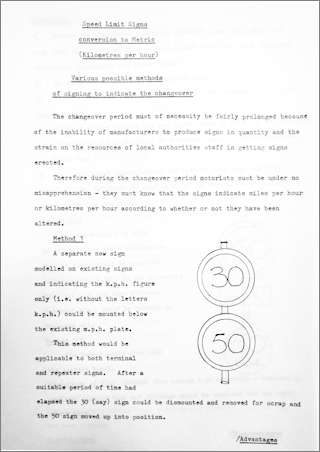
Speed Limit Signs conversion to Metric, 1966
Click image to access pdf
This document was subsequently updated in February 1969, just weeks prior to the metrication of speed limits being announced in Parliament.
Hansard, 5 March 1969
Amongst other things, the revised document questioned the confusing use of “m” for miles, given that the standard symbol for metre is also “m”.
The parliamentary announcement was widely reported in the following day’s newspapers. However, in 1970 all plans were postponed indefinitely. The Government published the following press release to accompany the announcement in Parliament:
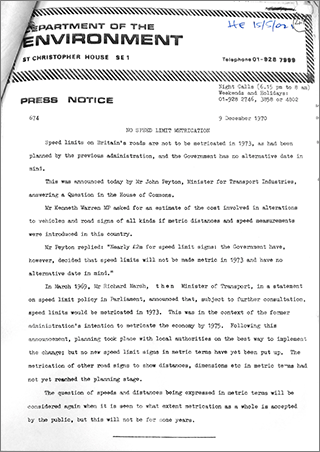
No Speed Limit Metrication, 1970
Click image to access pdf
In November 1970, the Government had promised to produce a White Paper setting out the new administration’s policy on metrication. When this was finally published in February 1972, in order to avoid the embarassment of changing policy on speed limits yet again, the White Paper included the following statement:
However, the White Paper created a rod for the Government’s own back. In subsequent discussions on metrication, for the remainder of the administration’s term, it became the main reason why the changeover of speed limits could not begin until the late 1970s at the earliest.
The White Paper created a quandary for the Government which had also helped draft the 1971 EEC Directive on Units of Measurement committing the Government to switch all road signs to metric units by 1979. Government documents from the 1970s show that considerable effort was devoted to this politically-manufactured problem rather than dealing with the real task in hand, which should have been the planning of the metric changeover of the road signs themselves:
a) to adhere to the strict interpretation of October 1976 and try to convert all our signs by then;
b) to go to the Commission and try to persuade them 1979 is a reasonable interpretation, and if we can’t try to get an amending Directive, for 1979 or later;
c) to rely on the elements of doubt and plan for conversion by October 1979.
Course a) is I think out of the question, First on practical grounds we could possibly – at substantial extra cost – convert speed limits by 1976 but not more than a small proportion of the others (unless of course we mounted a crash programme at heavy cost and to the detriment of other things in the traffic and safety field).
Secondly, on political grounds it does not accord with the re-assurance to the public given in the White Paper that road signs will be left for several years.
Course b) is a possibility. My belief however is that once we put it to the Commission they will be bound to take a strict view and that will mean a fresh Directive. I do not think the importance of the point justifies asking Ministers to pilot one through – assuming the French etc. allowed us to. I.T. Division will no doubt have views here on how it fits into our current pattern of dealings with EEC.
Course c) is the one I would at this stage recommend. It does sufficient justice to the undertaking in the White Paper. On the other hand it does also expose us to challenge by the Commission, on the grounds that we are failing to comply with the Directive (or should have secured an adaption i.e.) but I think that is a risk we should be prepared to take. Our answer would be to make as much as we can of the legal doubts, to point out that the special problems of traffic signs had clearly not been envisaged in the preparation of the Directive, to stress that we had no intention of not fulfilling our obligations, it was merely a question of being a little behind in this one specialised field and that safety considerations as well as practical ones lead inevitably to 1979 as the shortest practical timescale.”
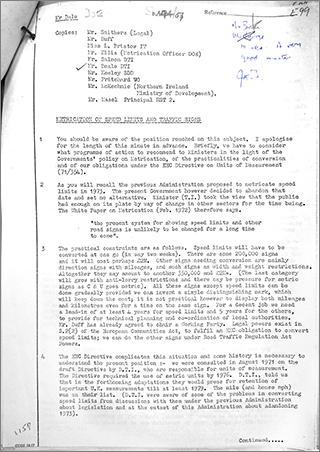
Metrication of Speed Limits and Traffic Signs, 9 January 1973
Click image to access pdf
A ministerial briefing note from the time included advice on how to answer any awkward questions that might be asked:
A. No date has yet been fixed but the Government have a completion date of 1979 in mind.
Q. Why not earlier?
A. This is a complex operation requiring several years for careful planning and efficient execution, integrated with the normal work of installing and maintaining road signs.
Q. Why not later?
A. Quite apart from EEC commitments, road signs cannot remain imperial in a metric world.
Q. Are we not committed to 1976 by EEC?
A. The Directive was not drafted with traffic control in mind; 1979 accords with its general intention and is in any event the earliest practicable date.
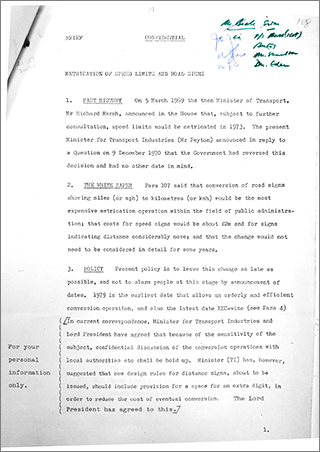
Metrication of Speed Limits and Road Signs
Click image to access pdf
Perversely, one of the reasons cited for not switching to metric units, after 1973, was the belief that many local authorities, that had previously been keen to switch to metric units, would now be hostile to the idea, following the Ministry of Transport preventing them from switching to metric units in the late 1960s, when all road signs were upgraded to Vienna Convention compliant “Warboys” signs:
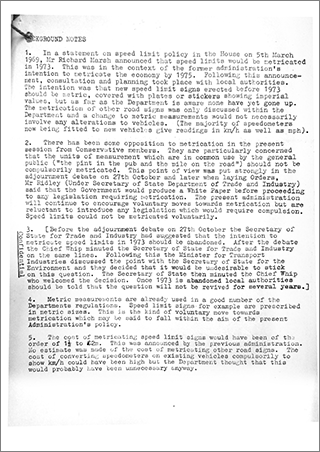
Metrication of Speed Limits – Background Notes
Click image to access pdf
Arguments for and against the Metrication of Speed Limits
Ministry of Transport, 1969
Some of the Department for Transport’s early thoughts on the subject of metrication of speed limits are recorded in a Department document from 1969 that summarises arguments for and against the metrication of speed limits:
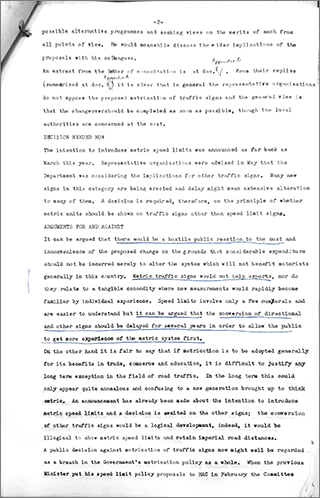
Arguments for and against the Metrication of Speed Limits, 1969
Click image to access pdf
| Ministry of Transport, 1969 | UKMA analysis |
| AGAINST | |
| “It can be argued that there would be a hostile public reaction to the cost and inconvenience of the proposed change on the grounds that considerable expenditure should not be incurred merely to alter the system which will not benefit motorists generally in this country.” | On the contrary, continuing to use a measurement system that the majority of motorists have not been taught in schools cannot possibly benefit motorists. |
| “Metric traffic signs would not help exports, nor do they relate to a tangible commodity where new measurements would rapidly become familiar by individual experience.” | Any relation of traffic signs to exports and tangible commodities is irrelevant. The argument that “new measurements would rapidly become familiar by individual experience” is actually an argument in favour of proceeding with the metrication process. |
| “Speed limits involve only a few numerals and are easier to understand but it can be argued that the conversion of directional and other signs should be delayed for several years in order to allow the public to get more experience of the metric system first.” | This argument never had any validity. Experience of the metric system comes with its use. Delaying the introduction of metric units on road signs denies any possibility of experiencing roads signed in metric units. Fifty years after the metric system became the primary system of measurement taught in schools, and fifty years after the introduction of food sold in metric packs, this argument is now completely bogus. |
| FOR | |
| “On the other hand it is fair to say that if metrication is to be adopted generally for its benefits in trade, commerce and education, it is difficult to justify any long term exception in the field of road traffic.” | More than fifty years later, there is no justification. |
| “In the long term this could only appear quite anomalous and confusing to a new generation brought up to think metric.” | This statement has proved to be prophetic. Fifty years after the metric system became the primary system of measurement taught in schools, and more than twenty years after imperial units ceased to be used for most other official purposes, the use of imperial units on road signs could not be any more anomalous and confusing. |
| “A public decision against metrication of traffic signs now might well be regarded as a breach in the Government’s metrication policy as a whole.” | The Government’s failure to metricate speed limits, and road signs in general, caused immense harm to the national metrication programme.
An early change to metric road signs, backed by an information campaign on a similar scale to that of the decimalisation of currency in 1971, would have ensured that the public were on board with the long-standing goal of having a single, rational system of measurement for all official purposes. Instead, the silence of successive governments on metrication left much of the public with the impression that metrication was in some way unpatriotic and something that the Government was only doing under pressure from foreign powers. If speed limits had switched to metric units in 1973 as originally planned, the metrication of the retail sector would most likely have been completed before 1980, rather than being dragged out until the end of the century. |
Further reading
https://ukma.org.uk/the-case-for-change/policy-areas/road-signs-policy/


What a sad commentary on the uselessness of successive UK governments.
Now the UK is outside the EU as a third country but with a land border with an EU member state (Ireland).
Britain continues to suffer from its heightened isolation and separation from its natural partners in the EU. While returning to the EU will not be easy despite its many benefits, the UK could certainly fix its metric muddle once and for all especially by metricating road signs as soon as possible to align with a single sensible system of measurement that would also signal to the EU it willingness to harmonize with EU (and world-wide outside the USA) standards.
Ezra aka punditgi
LikeLiked by 1 person
The United Kingdom was one of the last countries to decimalise its currency and only did so as the computer age was beginning to make itself felt. As one who wrote his first computer program before British decimalisation, I am fully aware of the problems that using pounds shillings and pence would have caused when writing programs in COBOL or Fortran. I suspect that industry leant on Her Majesty’s Government to implement decimalisation before having a non-decimal system of currency caused too much trouble.
We are now in a situation on our roads that cars are having an increased amount of automation, and the prospect of driverless cars is rapidly approaching. Such cars are still in the experimental stage and if our family car is anything to go by, the car makes use of images gathered from cameras to establish the current speed limit. If cars do not cross borders, there is little problem with units of measure – in the UK “30” means “30 miles per hour”, but in France it means “30 kilometres per hour”. What about Ireland? Northern Ireland uses miles per hour, and the Republic uses kilometres per hour. On many roads between the two, the only give-away that one is crossing the border is a sign stating that speeds are given in miles per hour or kilometres per hour (as the case may be). Unless the car can accurately determine which country it is in using GPS, then relying on border control signs to determine units of measure is not a sensible way to go forward.
The obvious way forward is to implement a conversion to kilometres per hour on British roads as soon as possible. Appologists might say that the converse is true – keep miles per hour. Such a proposal is ridiculous as it will be virtually impossible for Britian to convert later without the massive overhead of retrofitting the programs in many cars that have driverless capability.
LikeLike
It just takes the decision of one person to ruin it for everyone. I’m sure the person who made the decision not to metricate the roads did so with the hope that other sectors of the economy would also get the cojones to also say no and have a result similar to the US where metrication still hasn’t occurred for the most part or where metrication occurs in secret.
As for the claim that metric roads don’t have anything to do with exports, this is completely wrong. It’s a mind set. If the roads are metric, everyone learns from experience what a metre and kilometre are and that flows into other areas of the economy. It’s all connected.
If the roads had metricated 50 years ago, the resistance to metrication among some citizens and political elites would have ended not long after that. Name me one country other than England whose leaders in recent time made an effort to revert to FFU.
LikeLiked by 1 person
The ministry briefing note for stock answers to questions indicates that to convert road signs to metric would be a “complex operation”. Let us see what has happened since the 1970s.
Well I’ll pick on one thing. Satellites have been launched onto geostationary orbits. Devices called satnavs have been introduced for travellers. These devices contain digitized maps of all the roads in the UK, and lots of clever electronics which pick up satellite signals to calculate the current position, plus clever software which produces from this data real-time information that guides the traveller.
I reckon that this was a far more complex and expensive operation than changing the information born on road signs. It very probably cost much more too. Yet the money was found and the technical objectives solved.
Briefly, it is scientists and technologist that effect progress, while governments hold it back with feeble excuses and inaction.
Sad, isn’t it!
LikeLiked by 1 person
Setting speed limits in km/h is so “complex” that only 98 of the world’s 100 largest countries have managed to do it.
LikeLiked by 1 person
As an aside I just saw an episode of the Australian version of 60 minutes about the increased dangers of shark attacks at the momnt. What surprised me is this Aussie of about 60 years old (my guess) who was interviwed and who regularly paddles a shallow canoe in the area of much danger. He said (twice) that he now restricts himself to paddling away from shore in water that is no more than “a foot or a foot and a half deep”.
How is possible after all this time that an Aussie (obvious from his accent) talking to an Aussie reporter would still use Imperial units? Totally baffling!
Ezra aka punditgi
LikeLike
My car, a Nissan Qashqai, like most modern cars, has facilities to select different units for the electronic displays. I have set it to record fuel economy on journeys in litres per 100 km, rather than miles per gallon.
For the purposes of simple comparison between different cars, either method can be used. I presume that many motorists stay with miles per gallon simply because that is what they are used to, and successive governments – implementing some metric changes but not others, with no regard to the failure of this half-baked mix-up to meet our needs – have not offered helpful suggestions.
My needs go beyond comparisons or one-up-man-ship. I like to be able to estimate quantity and cost of fuel for long journeys. Fuel is no longer sold by the gallon so mpg does not serve us well. On the other hand, distance in kilometres is readily available from maps, especially the electronic ones one can access on the Internet.
A consequence to setting this is that the odometer reads in kilometres. Not a problem to me. For the annual MOT tests, if they want to record miles the garage can get that easily enough. My satnav gives distances to junctions ahead in metres – again I can cope; I find this slightly easier that yards. Longer distances are given in kilometres. This is out of step with road signage but until the government does something about that there is always going to be a disparity somewhere.
My analogue speedometer is of course calibrated in mph and km/h. The speed limit indicator still recognizes speed limits in mph, and flashes if I exceed the speed limit. So I am legal!
I imagine that if I were to take the car over to France I would need to make some further changes, but I’ll worry about that when and if the time comes.
LikeLiked by 1 person
Before starting a long distrance trip in England, I note down the driver location signs (See https://en.wikipedia.org/wiki/Driver_location_sign) that are of consequence. For example, I went to Nottingham from SE England last weekend. My log is: Leave the M25 at J21 (km 122) and join the M1 at J61 (km 33). Leave M1 at J25 (km 193) .
Values on Driver Location Signs (England only) can be found on the relevant motorway page of Wikipedia or the Roads.UK website ( https://www.roads.org.uk/motorway).
LikeLike
MPG: Do younger motorists, say, those under 40, still think in terms of ‘gallons’ of fuel? Part of the problem of mpg is that it perpetuates the idea that people are buying in gallons, albeit gallons sold in litres. I have heard older men, retirees, not so long ago chatting amiably about their cars, how many ‘gallons’ they had just put in and how much a ‘gallon’ now costs. None of them will have bought fuel in gallons for 40-50 years!
LikeLike
“America’s only metric highway could soon be no more”
LikeLike
There looks to be a new petition on this! https://petition.parliament.uk/petitions/755323
LikeLiked by 1 person
New petition on converting road signs and speeds to kilometres and km/h:
Excellent news. The message needs to be spread wide and far.
LikeLike