
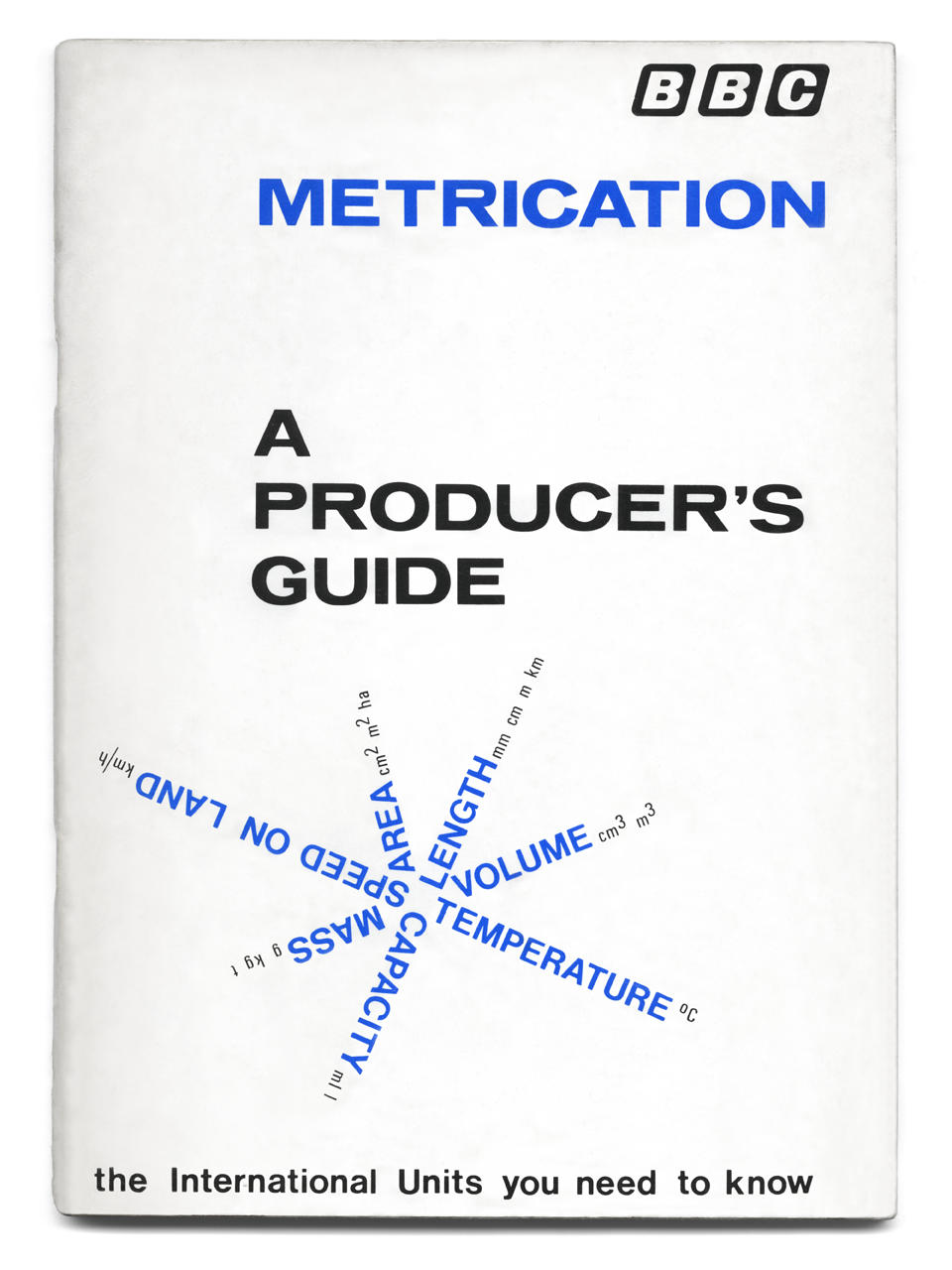
It may come as a surprise to many readers that, 50 years ago, the BBC had an Inter-divisional Metrication Committee. It’s precise remit is not clear, but in 1976 it published a 68-page booklet with the intriguing title, Metrication – A Producer’s Guide.
The booklet’s title conjures up an expectation that it would include a metrication plan with timetables for programme makers to refer to as they switched from using old imperial units to new metric units in BBC programmes. In 1976, such a plan would have been timely, bearing in mind that schools had recently finished the switch to metric education, and foodstuffs such as cereals, sugar and chocolate bars were now being sold in round metric pack sizes, with plans for all other foods to go metric by the end of the 1970s.
 |
Of course, we all know that the BBC made no such transition to the metric system in their programmes in the 1970s and, on the contrary, BBC programmes are still being made to this day which refer to measurement units, like acres, gallons and stones – units that haven’t been taught in schools for more than two generations.
Fifty years later, producers continue to show a reluctance when it comes to the use of metres and kilometres in their programmes, and rarely use the easy-to-visualise hectare for land areas, preferring instead the little-understood acre. No thought, it seems, is given to future-proofing programmes, let alone reflecting the reality that, with the exception of road signs, the metric system has been the UK’s official measurement system for over a quarter of a century.
So, what did the guide have to say about the metrication of BBC programmes 50 years ago?
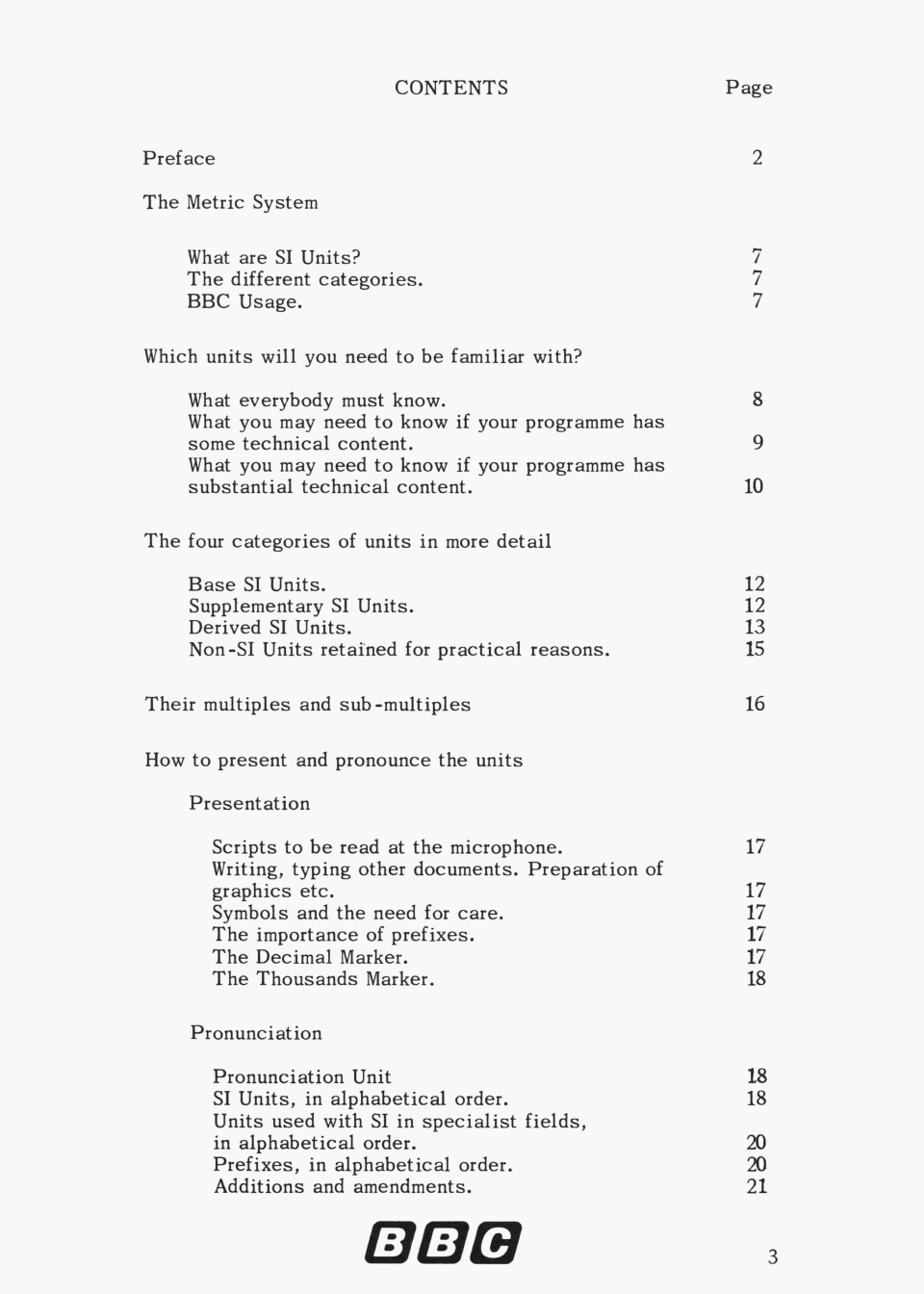
The guide gives a description of the metric system, listing the units that a producer would need to be familiar with. These are split into three categories:
- What everybody must know
- What you may need to know if your programme has some technical content
- What you may need to know if your programme has substantial technical content
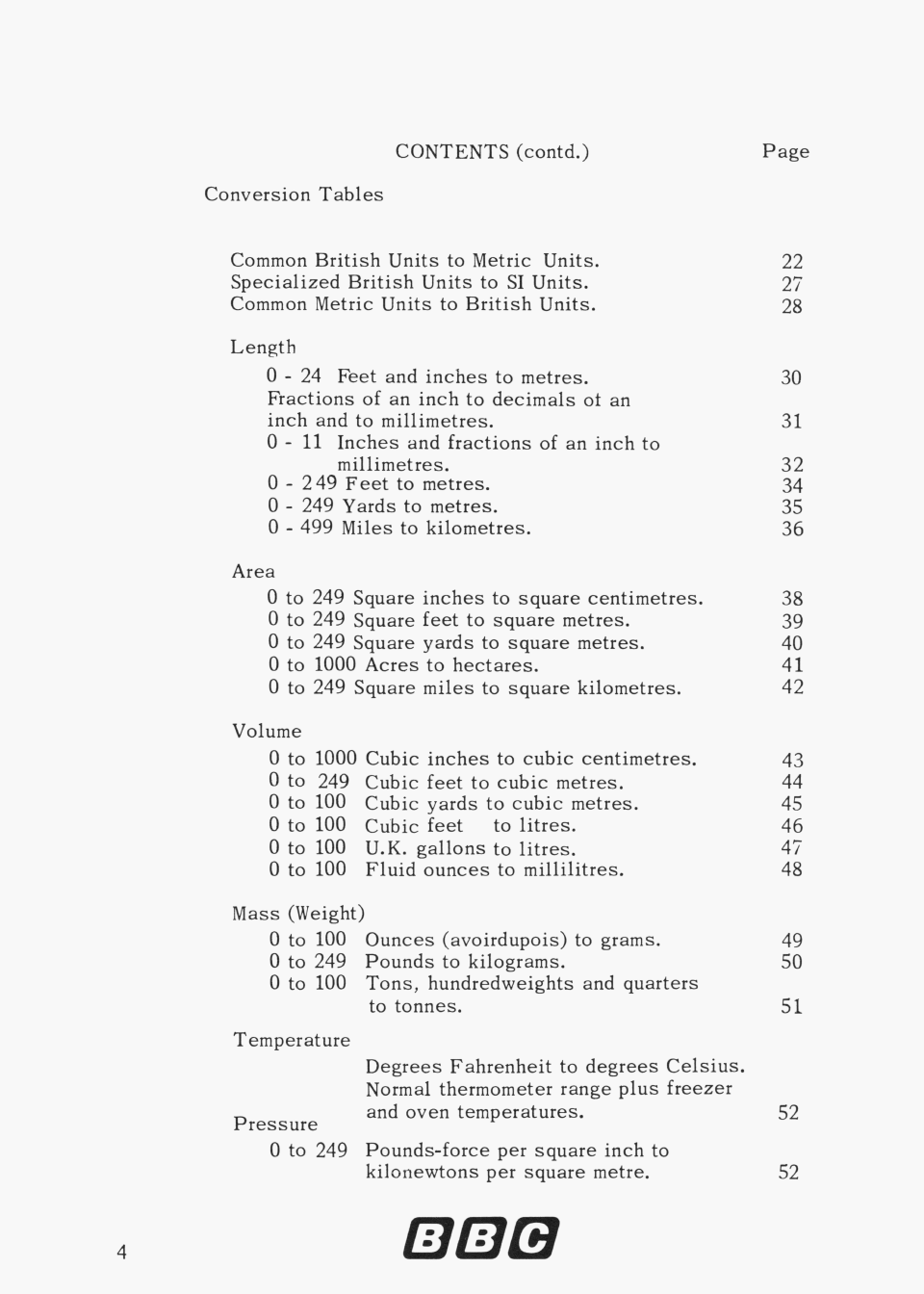
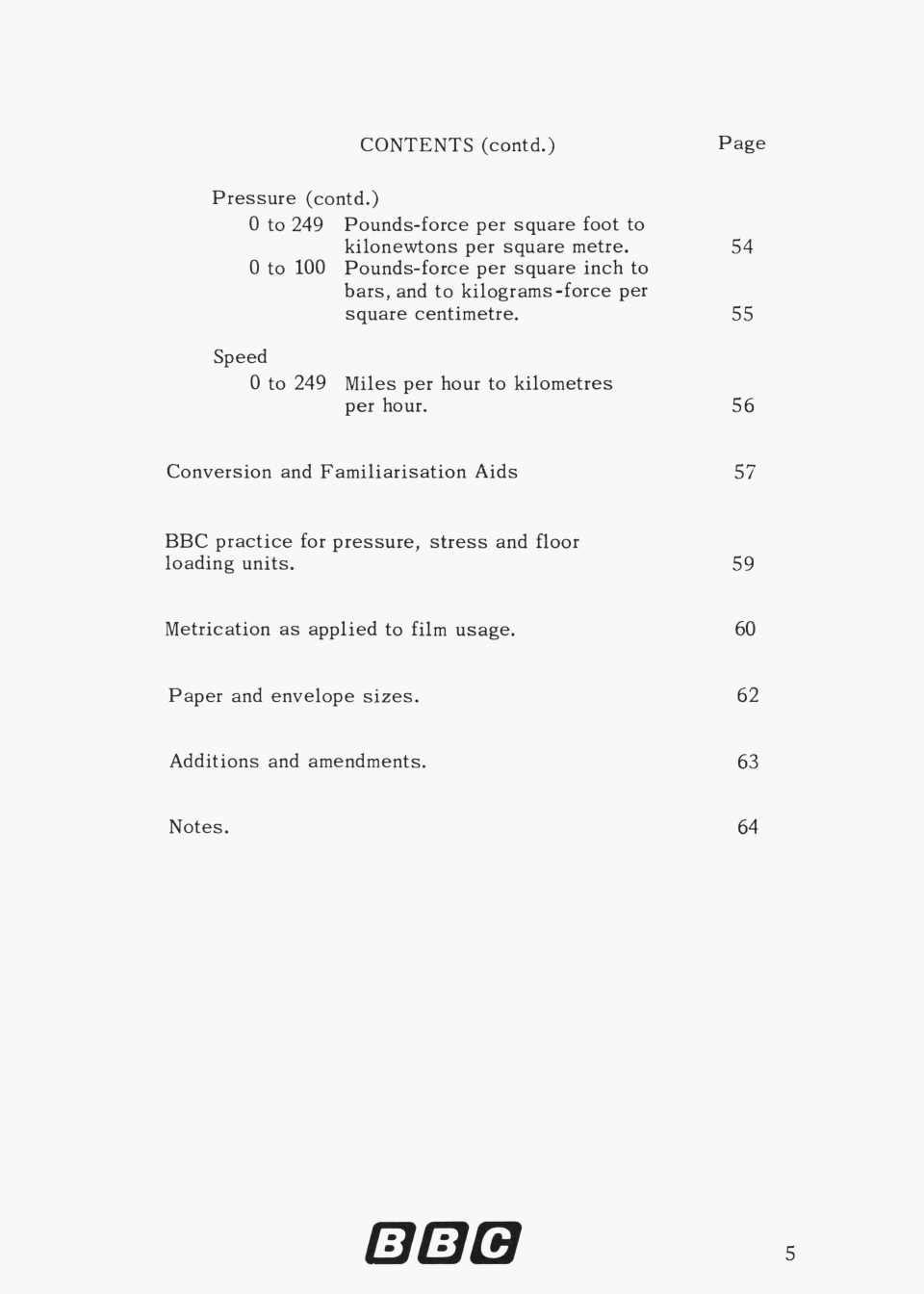
There is also a short section on the pronunciation of metric units, but most of the rest of the guide consists of extensive conversion tables between metric units and what it calls “British units”.
 |
 |
 |
There is no metrication timetable for BBC programmes.
It seems that the BBC Inter-divisional Metrication Committee, responsible for the guide, did not actually have any kind of metrication plan for BBC programmes themselves. Instead, the guide seems to have been intended for internal reference use only:
BBC metrication policy
What little reference there is to metrication, and BBC metrication policy in particular, is contained in the guide’s preface:
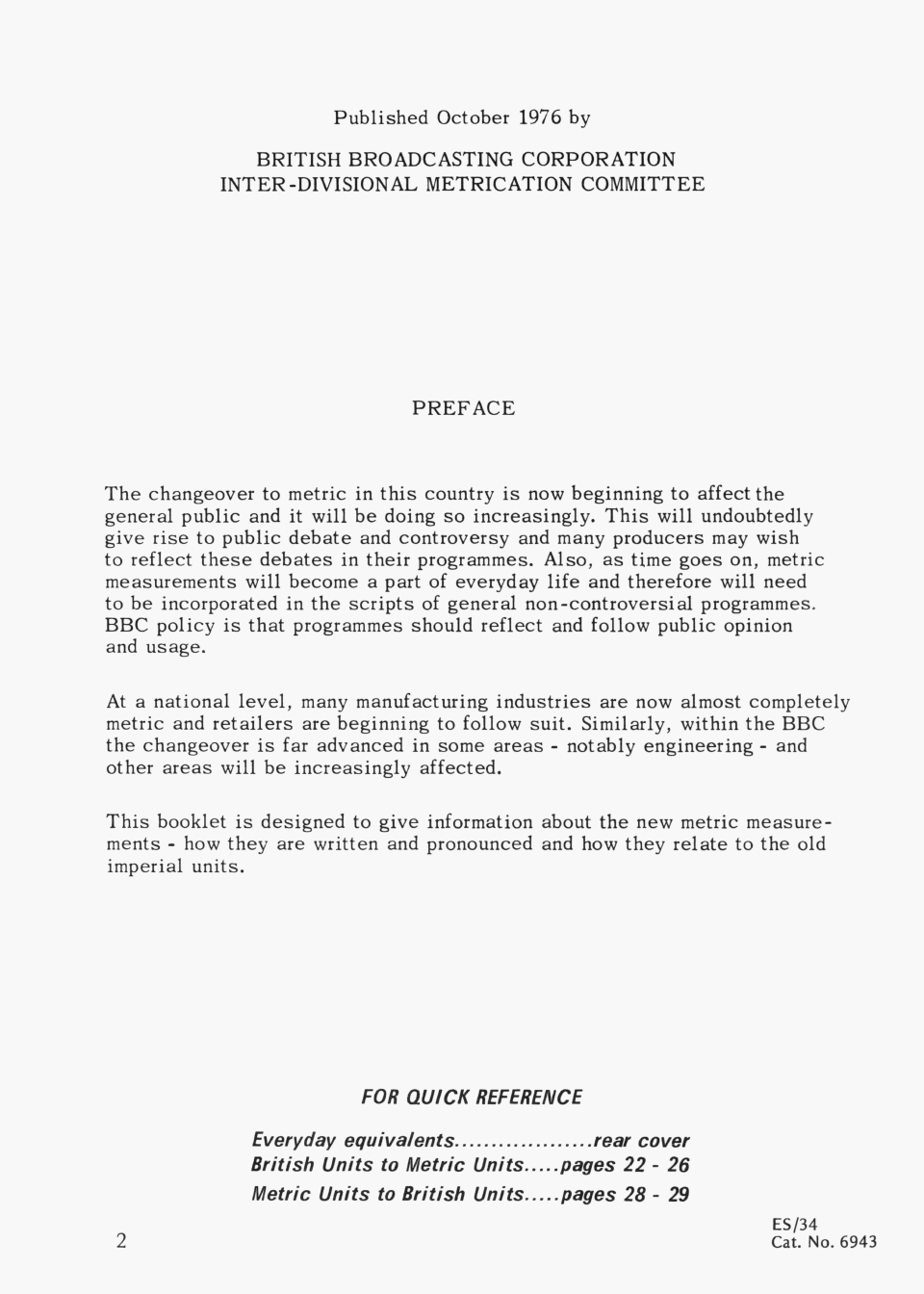 |
Even though metrication was already well under way by 1976, with the metrication programmes of the building industry and agriculture already complete, and with industry irreversibly committed to the change, it seems that the BBC decided to take the view that metrication was something that it did not need to be concerned about regarding its own programme content. The guide encapsulates the BBC’s laissez-faire approach to metrication in a single sentence:
However, the guide reveals that not only does the BBC in 1976 take a hands-off approach to metrication within its own productions, it also actively sought to undermine public confidence in official government policy by declaring:
This was quite a radical stance to have taken at the time, given that metrication had been official government policy since 1965, and had the support of both Labour and Conservative governments. Metrication had hitherto not been regarded as controversial. Switching to the use of decimal measurements was just one of a whole host of modernisations that were taking place in the 1960s and 1970s.
Even when metric units become part of everyday life, the guide says that they should only be incorporated in the scripts of what it calls “non-controversial programmes”. It doesn’t explain which programmes it considers to be controversial, or why metric should not be used in those programmes.
Most surprising is that a metrication guide aimed at producers contains no mention of the role that BBC programmes would have been expected to play in educating the public about the new units, or about how metric should be phased in. There is no requirement for all children’s programmes to use metric units, for example.
Decimalisation
The BBC’s stance on metrication is in sharp contrast to the role it took in the country’s switch to decimal currency.
At no point after the Government decided that money would go decimal, did the BBC declare that decimalisation was controversial, or up for debate.
In the run up to decimalisation, the BBC broadcast extensive coverage of the change, including a series of five TV programmes, titled Decimal Five, which were broadcast at prime time after children’s programmes, before the early evening news every day before D-Day.
It’s interesting to speculate that, without the BBC’s participation in a concerted government information campaign, there was a very real possibility that the public could have continued to refer to prices in shillings after D-Day. If just one major retailer had decided to price goods in shillings after D-Day (switching from £sd to £sp, rather than to £p – with 5 new pence to the shilling), an ambivalent BBC decimalisation policy could have helped to create a long-lasting dual unit pricing mess. After all, the old one shilling and two shillings coins weren’t withdrawn after D-Day, and remained in circulation until the 1990s, and when the 5p and 10p coins were introduced in 1968, the public had been told to treat them as one shilling and two shillings coins – which they did, for three years. In 1969, there was even a poster telling people to use the new 50p piece like a 10 shilling note.
The BBC’s Royal Charter
The BBC’s policy on metrication in the 1970s was arguably in breach of its Royal Charter duties, as laid out in its mission statement:
As with any other matter “in the public interest”, when it comes to metrication, the BBC was, and remains, obligated by their Royal Charter, to “inform” and “educate”. Reflecting and following public opinion and usage cannot be categorised as informing or educating.
BBC Style Guide
The BBC has two sets of editorial guidelines; an extensive set of BBC Editorial Guidelines – which seems to contain no guidance on measurement units at all, and a BBC News Style Guide, which includes the following on Weights and measures:
- We should use both imperial and metric measures in most stories.
- For feet and inches, use digits followed by abbreviations – eg: The hedge was exactly 9ft 4in high (2.84m).
- UK and US stories should usually use imperial first.
- In non-UK/US stories, metric should usually come first – with a bracketed conversion to imperial.
- For weights originally expressed as a precise number of stone, write out the word “stone” (never “stones”) – and follow our usual convention with any accompanying number – eg: The child weighed less than two stone (12.7kg) at the time of his death.
- For volumes, the usual approach, again, is to use both metric and imperial – eg: The tanker was carrying 30,000 gallons (136,000 litres) of petrol.
- With Sports stories, be guided by the traditions of the individual sport in deciding which system of measurement should be given prominence.
The BBC News Style Guide clearly doesn’t even pretend to reflect public opinion or usage, as per BBC metrication policy. Most people use one unit or the other, and never “both imperial and metric measures” at the same time. Describing a hedge as being “9ft 4in high, 2.84m”, cannot be considered a reflection of normal public usage.
A requirement for metric to be first only for non-UK/US stories, also implies a false assumption that the metric unit is not the one that is used in the UK.
Following the Style Guide can give some bizarre results:
- Sugar has been sold in metric pack sizes for 50 years, yet the guide requires that the contents of a 1-kg bag of sugar be described as 2.2lb (1kg), unless it is in France, for example, where it should be described as 1kg (2.2lb).
- A distance of 100 metres is required to be described as 328ft (100m), unless it refers to sport, where it can be described as 100m, unless it is in a sport like golf, where it would be described in yards, providing that it wasn’t in a country where metres are the norm for distances in golf.
Metrication Board
Given the influential role of the BBC, and the hugely beneficial effect it could have had in the early days of metrication, it would be interesting to know if the Metrication Board ever approached the BBC with a view to agreeing a plan for switching to metric units in BBC programmes. As it is, for 50 years, BBC policy has continued to act against the adoption of a single rational system of measurement for all official purposes.
References
BBC Editorial Guidelines
https://www.bbc.com/editorialguidelines
BBC News Style Guide – Weights and measures
https://www.bbc.co.uk/newsstyleguide/numbers
Further reading
Official BBC Measurement Policy
https://metricviews.uk/2020/10/01/official-bbc-measurement-policy/
BBC told to stop undermining the National Measurement System
https://metricviews.uk/2013/12/14/bbc-told-to-stop-undermining-the-national-measurement-system/
The BBC explains its position on measurement units
https://metricviews.uk/2011/09/04/the-bbc-explains-it-position-on-measurement-units/
 Metric Views
The BBC has clearly been derelict in their duty to educate the public.
I suspect that any push forced by economics to see the UK integrate more closely with the EU (such as the Customs Union and the Single Market) ending up with the UK rejoining the EU (which, if done right, would benefit both) would require the UK to harmonize their road signs with the EU by converting to metric. The knock-on effect should finally finish off the metric muddle once and for all.
LikeLike
It turns out that Channel 4 is no better. In their report today on the war in Iran they quoted a civil defence commander that Iran would not give up “one inch” of its territory.
Whaaaat???? The Iranian actually used the word “inch”? I’ll bet my bottom dollar that he said either “millimetre” or “centimetre”. How hard is it to actually quote the guy correctly?
So, where do ITV and Sky News fit iinto this picture? Any better?
LikeLike