
There is much to be learned from Australia’s highly successful 1970s metrication programme. In a previous Metric Views article, we looked at two information leaflets produced by Australia’s Metric Conversion Board; Temperature and Pressure go Metric and Motoring goes Metric. Both leaflets were part of intensive public information campaigns in the lead up to “M-days” for weather forecasting and motoring – specific days on which official measurement units switched from the old units to modern metric units.
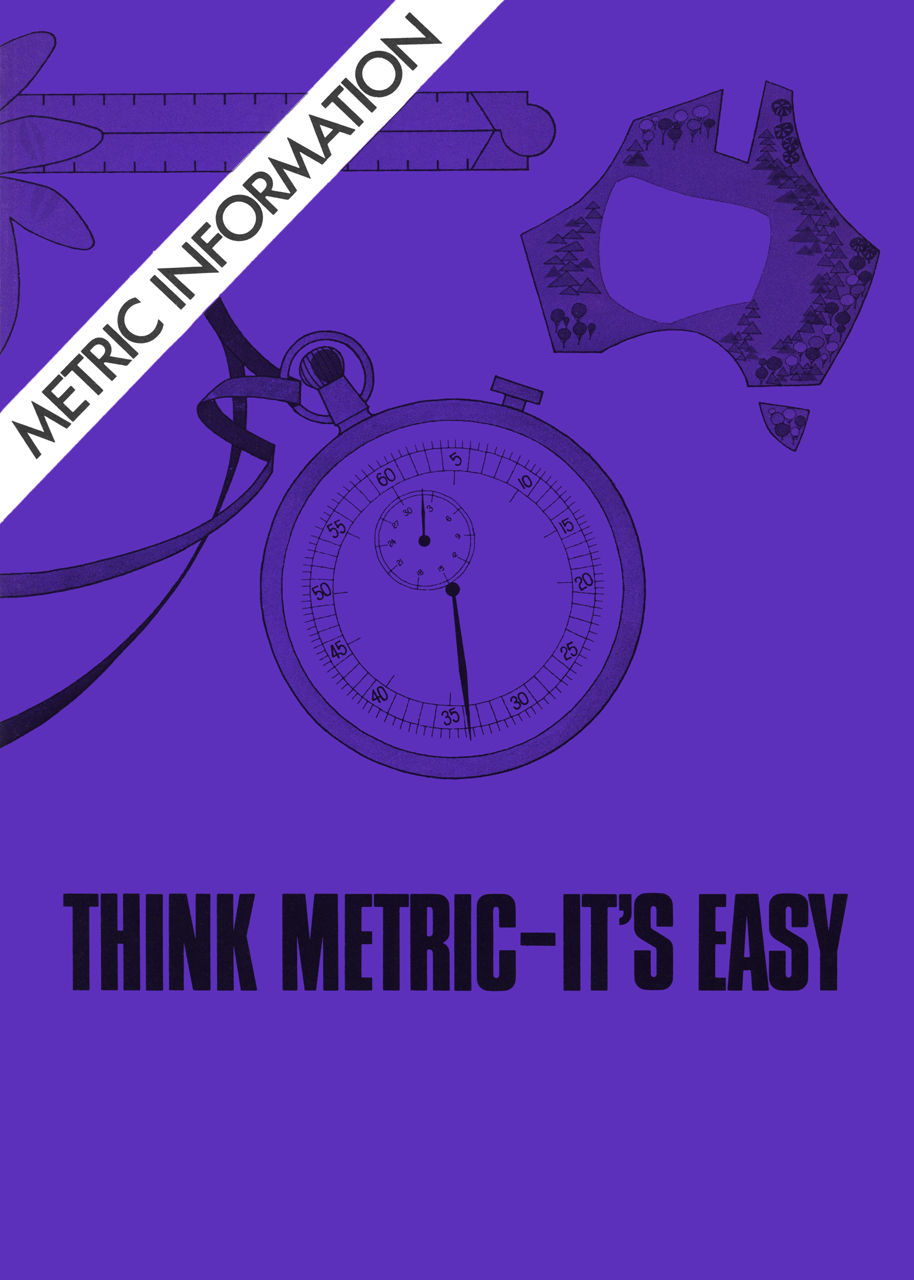
In this article, we take a look at another of their leaflets, Think Metric – It’s Easy.
 |
||
| click on the image to access the pdf | ||
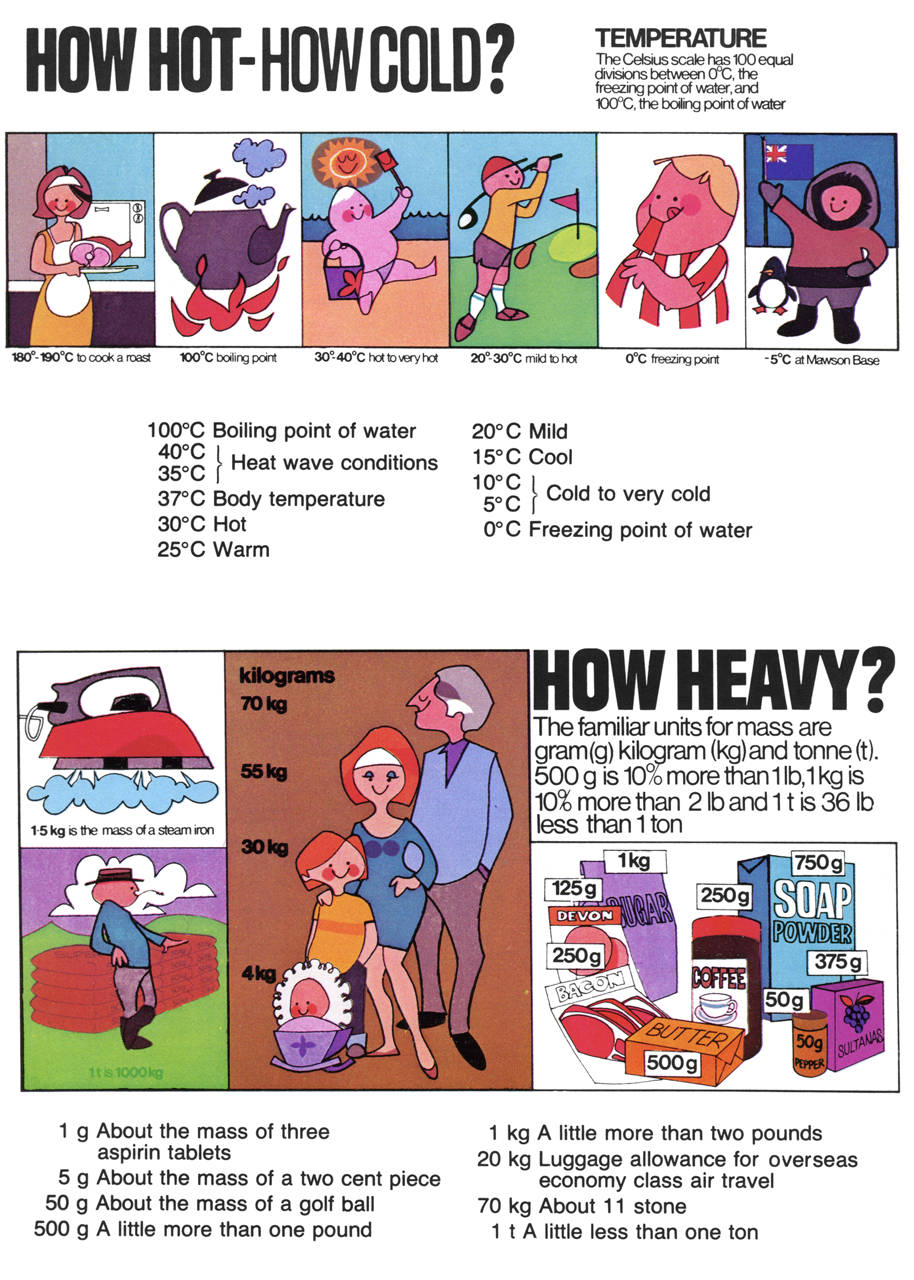
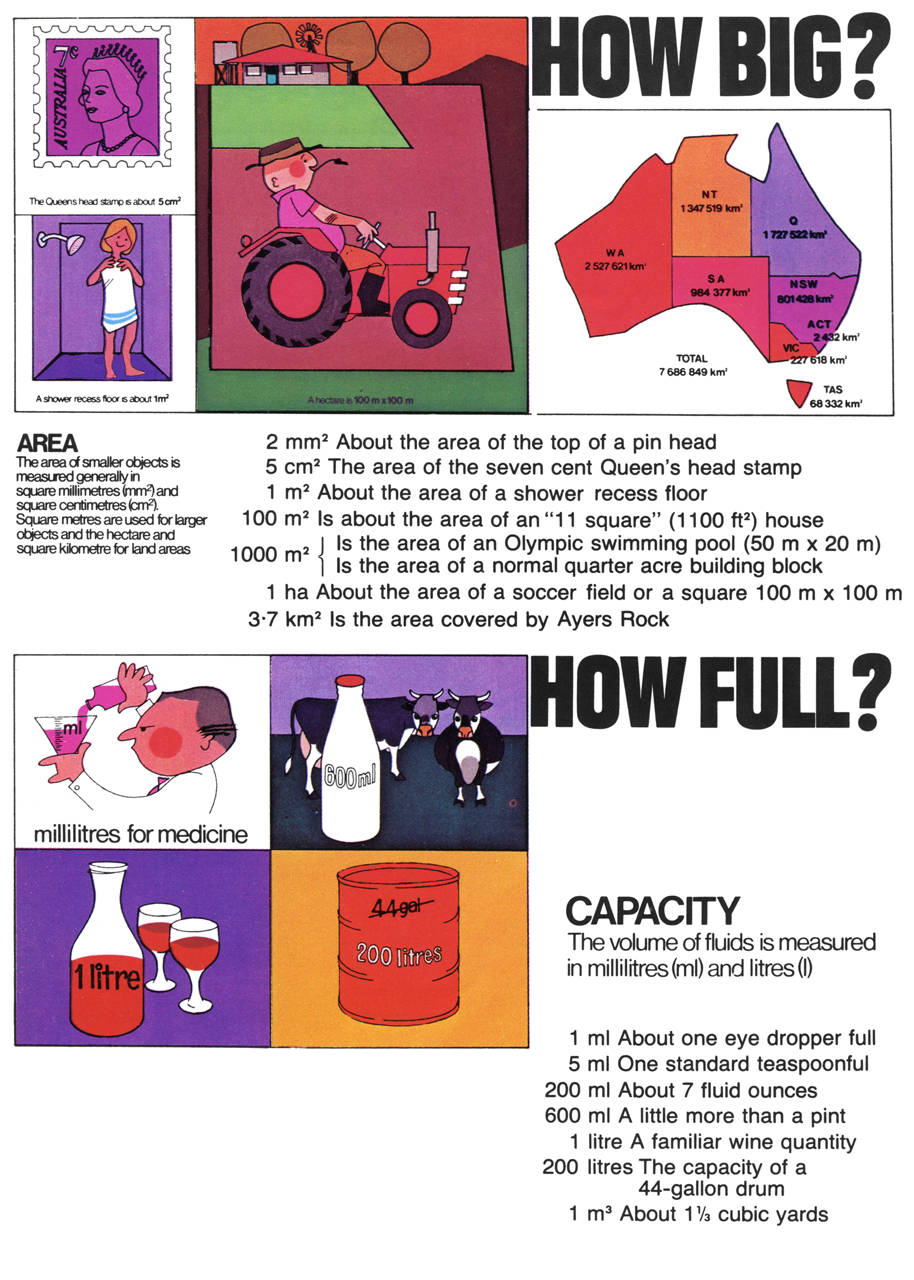
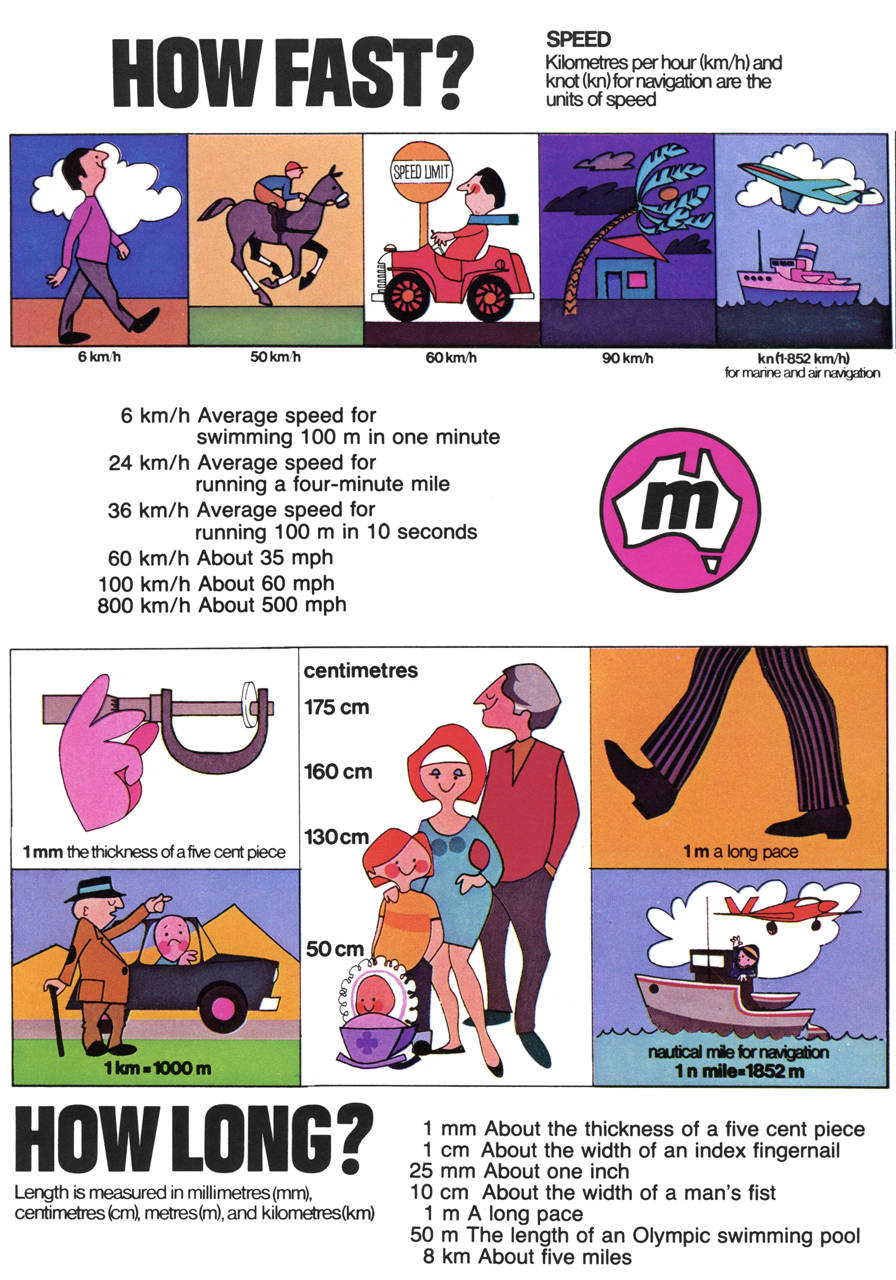
This tri-fold leaflet, produced in 1973, gives information about Australia’s metrication programme as a whole. It describes the thinking behind the conversion process, and emphasises how simple metrication can be once the “prop” of imperial conversions is abandoned. The leaflet advises readers to “forget the imperial system and, instead, associate familiar objects and situations with metric values”.
For example, converting every occurrence of Celsius temperature to degrees Fahrenheit adds an unnecessary layer of complication that discourages the switch to metric. Instead, learning typical Celsius temperatures for a handful of “recognition points” can be quick and straight forward. This strategy enabled Australia to switch from Fahrenheit to Celsius in weather forecasts in a single day. In contrast, in the UK, more than sixty years after nominally switching to Celsius, some British weather forecasters still use dual units for temperatures.
As the leaflet’s title says, “Think Metric – It’s Easy”. This is a strategy that UKMA fully endorses, and has devoted a website to.
The following is from the main body of the text in the leaflet:
About 95% of the world’s population live in metric countries, or countries which have announced an intention to convert to SI. Australia made the decision to convert in 1970. Few adults will need to learn everything about SI. It will be important, however, to gain an appreciation of “everyday” metric units – such as units of mass (weight), length, volume, area, and speed – and to think metric. For example, one should think of a man of average build as weighing about 75 kilograms and being about 175 centimetres tall.
Increasingly, we are being involved in our new metric environment. Our weather information is metric, horseracing, football, cricket and Olympic sports are metric. We buy wine and beer in metric quantities, our wool is sold in kilograms. Next year we will be reading metric road maps and road signs and measuring our speed in kilometres per hour.
Teaching in metric units began in primary schools at the beginning of this year. Secondary schools will follow suit through 1973 and 1974. By the end of 1973 it is anticipated that about half the goods available on supermarket shelves will be marked in metric units only. Already building plans are being accepted in metric units, and houses built to metric specifications.
Use of the imperial system as a “prop” to understand metric measurement will confuse rather than foster confidence in thinking metric. What we must do is forget the imperial system and, instead, associate familiar objects and situations with metric values. The “recognition points” in this pamphlet will help you feel at home with the units we are using in our metric environment.”
Further reading
M-days in Australia
https://metricviews.uk/2019/09/25/m-days-in-australia/
Think Metric! – A UKMA website
https://thinkmetric.uk


I lived in South Africa until 1978. The South African metrication program was very similar to the Australian program and like Australia, South African metrication came after decimalisation. The decimalisation program was handled in a way that caused minimum confusion with the public so the government was trusted with metrication. As Isaac said, the continued use of imperial units as a “prop” has served to confuse matters, not help matters.
Unfortunately we now have the situation in the United Kingdom where metrication has been demonised as a “sop to Brussels” and many politicians who have no real interest in units of measure are railing against metrication to score political points in order to win votes from people who have no real interest in units of mesurement.
LikeLike
A set of commemorative stamps, in the same style as the Think Metric leaflet, was also issued in 1973.
https://thedigitalphilatelist.com/australia-philately-1973-metric-conversion/
LikeLike
Martin,
So, what people are/were the politicians hoping to gain political points with? It can’t be the younger generations who are exposed to metric in the schools and in the markets and on the jobs. It has to be only the older people who have spent the last 60 years with blinders on and refused to learn despite being surrounded by metric units.
With so many of them dying off, how many of them can be left? Maybe that is why their attempts a few years ago failed. The vast majority of people are not in favour of reverting and are happy with the metric system and want it to remain. Unfortunately, they are in favour of keeping the status quo and see no benefit in completing the one major area where imperial hangs on strongly.
I hate to say it, the UK needs a leader like Trump in power for a short time who is in favour of completing metrication and will step hard on toes to do it.
LikeLike
@Daniel: The UK already has a leader somewhat like Trump – Nigel Farage. I found the following quote about Farage in Time Magazine:
“On Saturday [6 May 2015], when a reporter tells Farage of the birth of Princess Charlotte, the daughter of Prince William and Princess Kate, and that she weighs 8lbs 3oz, he is most touched by the fact the weight is given in pounds and ounces rather than kilograms. “Imperial measurements! Proper measurements – not some horrid kilograms,” he says, referring to his party’s belief that the metric system is one of the many toxic importations from the E.U. that are destroying life in the U.K.” (https://time.com/3846925/nigel-farage-uk-election/).”
The one thing that has been lacking in the various surveys on the use of the metric system is the frequency with which people actually use the measurement specified – for example how should statisticians interpret a survey which shows that 70% of the population weigh themselves once a year using stones and pounds and the remaining 30% weigh themselves weekly using kilograms? Politicians will say what the 70% prefer to hear and if in years to come the ratios change, it will no longer be their problem – they will be enjoying the pensions that come with having been elected to office.
LikeLike
Martin,
There are a lot of toxic leaders that make it into the leadership of various countries. That’s why I stated: “the UK needs a leader like Trump in power for a short time who is in favour of completing metrication and will step hard on toes to do it. It is obvious that he didn’t fit the criteria I established.
The UK doesn’t need another Nigel Farage. What it needs is someone who wants the UK to progress, not someone who wants to drag the country back into the dark ages.
LikeLike
Maybe Andy Burnham can do the job of metricating the UK. We shall see.
Ezra aka punditgi
LikeLike
Ezra aka punditgi,
Is there anything Andy Burnham said or did in the past that can be seen as a support for completing metrication?
LikeLike
@Daniel: Politicians thrive (in more ways than one) on getting votes. Pushing hard for metrication is unlikely to create many votes for any politician, so we need to adopt the “softlee softlee catchee monkey” approach.
One way is to get appropriate magazines to focus not on how much weight one can lift or carry, but to focus on the ratio of the weight that one is lifting or carrying to one’s own weight. A picture of a petite 50 kg woman pushing 40 kg in the gym will promte the metric argument. What weight should a 17 stone man be able to push if he is pushing 80% of his own weight? The weights in the gym are invariably in meric units.
LikeLike
Martin,
A politician often pursues a different agenda after they win the election from what they promised during the campaign. Trump promised to end the Russo-Ukraine war, not only is the war still raging on, he has attacked and abducted the leader of Venezuela, has threatened and continues to threaten Cuba and has attacked Iran.
If he had told the people he was going to do these things, he would never have been elected. The same can happen in the UK. A leader during his campaign can be silent about his feeling towards metrication, but once he is residing at #10 Downing Street, he could initiate a completion of the metrication process.
I don’t think there is much to change, mostly road signs. If they want to keep the pint, fine, just make sure it is officially defined as 570 mL. Pounds can be redefined to 500 g, But, even with this, these units would be illegal for trade.
LikeLike
Given that Wes Streeting has said publicly that the UK should eventually rejoin the EU, there is hope that the UK will make moves to convince the EU they should let the UK rejoin. One such move would be harmonizing road signs with the EU member states.
Ezra aka punditgi
LikeLiked by 1 person
Punditgi:
It’s not so much the road signs themselves, their design, shape or colour, that are harmonised but the units on them. Even they have not been ‘harmonised’ as such: they’ve simply been metric units since the metric system was adopted across Europe by individual countries.
It would make eminent sense for the UK to use the same metric units on its signs as the rest of Europe, including Ireland. At the moment, everything seems to operate on workarounds, lorries using metric units on odometers, the emergency services and the police using metric and of course the highways being built to metric specifications in the first place. But Joe Public still has to see and is expected to understand imperial units on the road signs themselves which haven’t been taught for over half a century. Whether one wishes to emphasise Britain’s position as an island in Europe or not, there is a continuum of roads linked by tunnels, bridges and ferries across our Continent and to the outlying islands including Britain and Ireland. It makes sense for both commercial drivers and tourists to experience the same units of measurement across these countries. It would certainly eliminate the need for systems that can be switched between metric and other units and that would surely lower costs.
LikeLike
I prefer not to speculate on what Andy Burnham may do. He is not an MP yet, He needs to win an election, where there will undoubtly be opposition.
LikeLiked by 1 person
I’ve just read a couple of stories on the BBC about the current heat wave including one about travel delays at Dover. All of the temperatures mentioned in the articles are in degrees Celsius only. Not a single mention of Fahrenheit anywhere.
The dawn of a new day at the BBC? I certainly hope so.
Ezra aka punditgi
LikeLike
This might be good opportunity to recap how temperatures are reported in the UK.
This morning, I looked at how the usual right-wing (and therefore often pro-imperial) newspapers reported the heat wave. All the news items in The Daily Telegraph were in degrees Celsius as were the reports in the Daily Mail and Daily Express. However, reports in the latter two showing maximum temperatures at selected cities around the world used both degrees Celsius and degrees Fahrenheit.
This begs the question as to why would anybody in the UK want to know the temperatures in foreign cities in degrees Fahrenheit when both the UK and the foreign country (apart from the United States) use Celsius as their default?
LikeLiked by 1 person
Martin:
I think those lists of cities in newpapers showing temperatures in degrees C and F are something that editors have not bothered to look at for decades. They date back to the 70s, at least, when degrees C was quite a new thing in Britain and many people were still converting back to ‘old money’. Michael Fish, a BBC weather presenter, even said how many degrees temperatures were in ‘old money’ for years after Britain changed to degrees Celsius. Perhaps that was the BBC’s editorial policy at the time.
LikeLike
metricnow,
I highly doubt it was BBC policy, but either the personal decision of the presenter or someone in the office behind the scenes. But as time goes on and these people retire and leave, new blood in the department don’t see the need to go through the bother of converting back and have no desire to do so, especially if the public complaints of not using “old money” diminish to such a low amount or none at all, the justification for no longer presenting it is no longer valid.
LikeLike
I love how Groundskeeper Willie on The Simpsons shows us how replacing the metric system with ancient units makes so much sense! Ezra aka punditgi
LikeLike
Should I be surprised to see more backsliding from the BBC that they have included Fahrenheit alongside Celsius in their latest article about the upcoming heat wave in the UK? Probably not. 😦
https://www.bbc.com/weather/articles/c79y35nl719o
Here is the Google AI breakdown of the. usage of Celsius vs Fahrenheit for weather reports:
Only a handful of countries routinely use degrees Fahrenheit for weather temperature. These include the United States (including its territories), Belize, the Bahamas, the Cayman Islands, and Liberia, along with some associated Pacific island nations like Palau, the Federated States of Micronesia, and the Marshall Islands.
Here is how Fahrenheit usage breaks down globally:
It is high time the BBC and all media outlets in the UK ditched Fahrenheit once and for all.
LikeLiked by 1 person
I thought I would follow up on the Google AI summary and checked on the Liberia Meteorological Service of the Ministry of Transport:
https://meteoliberia.com/
All the weather forecast data is in metric with no option I can see to switch to Imperial units or even to just Fahrenheit for temperature. So, could the Google AI summary have gotten it wrong? Looks like even fewer countries are using Fahrenheit than the AI summary led me to believe. And that’s even more shame on the BBC if Liberia can outclass that organization.
LikeLiked by 1 person
punditgi,
Despite the name, AI is not intelligent. It only has the ability to search the internet for what ever information it can find on any subject and just summarise and regurgitate it. It can’t accurately ascertain anything.
It would be somewhat interesting if Liberia had up to date modern meteorological equipment to provide weather information. More than likely a number of countries in the region share the same equipment and seeing that all of Liberia’s neighbours use the metric system, Liberia would be getting the same information they get in the same units they get.
Liberia is way to poor to insist that conversions be made for them and have to accept the metric data provided to them. Also, Liberia was the last country in 2018 to officially adopt the metric system. Due to their extreme poverty change is slow, but seeing they depend on neighbouring countries for trade and necessary commodities to sustain life, the trade is in metric. Metric goods and services are traded back and forth. Automobiles imported from neighbouring countries are going to be metric only.
As far as I know, petrol stations only exist in the capital city of Monrovia and they are still in gallons. but, in rural areas, petrol is sold from 20 L jerry cans or glass jars.
All of the rest of the countries you mention outside of the US are also dirt poor and unlike Liberia and Myanmar that rely on neighbouring metric countries for supplies, the poor Caribbean island nations rely heavily on the US and in that case, metrication will be slow.
Some years ago, there was a new push to complete metrication in some of the Caribbean islands due to it being a requirement for future Chinese investment. Whether or not some progress was made, I’m not sure.
LikeLike
@Daniel
Many thanks for your excellent post. Very informative.
Too bad the USA is such a drag on progress towards full metrication globally (as well as other goals of interest to many).
Ezra aka punditgi
LikeLiked by 1 person
Punditgi,
Further information:
Looking at the list of nations supposedly using fahrenheit, we already discovered that Liberia uses degrees Celsius. looking at the Bahamas:
https://met.gov.bs/
It appears to be dual, with Celsius primary. Precipitation is in millimetres. The only thing I saw in Fahrenheit only was a heat health bulletin. The population of the Bahamas is <405 000 people
The Cayman Islands:
https://www.weather.gov.ky/current-weather
https://www.weather.gov.ky/forecast
Fahrenheit for temperatures but millimetres for rainfall.
https://www.weather.gov.ky/climate
This page is dual, with fahrenheit prominent with celsius in parenthesis. The population of the Cayman islands is about 77 000 people.
Palau:
https://www.weather.gov/gum/palau
This link is to a US site and as expected everything is in FFU.
https://forecast.weather.gov/data/obhistory/PTRO.html
The population of Palau is <20 000 residents.
Belize:
https://nms.gov.bz
Seems to be dual with fahrenheit primary for the present weather. Forecasts are fahrenheit only. Rain is in millimetres and pressure in hectopascals. The population of Belize is <429 000
If you add up the populations of these countries, it is 931 000, not even a million people in these countries. It should also be noted that these countries are would be designated at 3-rd world countries, where significant number of people live in poverty. Not a good advertisement for the use of FFU.
LikeLike
Here is the latest BBC report just on the Continental high temperatures:
https://www.bbc.com/news/articles/cx2vdydz31no
So, the BBC is doing something a bit strange by reporting high temperatures only in degrees Celsius with no Fahrenheit for the Continent but it reports British high temperatures using both Celsius and Fahrenheit (at least at the start of those articles).
Makes no sense to me at all given how long Celsius has been used exclusively in the UK for decades. Weird?
LikeLike
punditgi,
It doesn’t surprise me. It just tells me that the author of the article, Neil Murphy, doesn’t see a reason to use Fahrenheit. What does surprise me is his use of decimal; degrees. I can’t imagine what purpose there is in any temperature not in a whole number of degrees. Most consumer grade thermometers are not accurate to anything less than a whole degree.
LikeLike
One more data point: an article today on BBC Weather that touts the intense heat coming again to the UK with nothing but degrees Celsius in the article:
https://www.bbc.com/weather/articles/c621j44jwe1o
So, those guys can do it right if they choose to. I could get picky about not seeing the space and the degree symbol after the actual numeric temperature but before the capital “C”, but I’m just glad they didn’t bother with Fahrenheit at all in their report.
LikeLike
@punditgi – I believe that the real reason that journalists write 30C rather than 30 °C is that they do not have a degree symbol on their PC keyboards. (Apple MAc users shoudl be able to use the “Compose” sequence). This was one of the reasons behind the proposal at https://metricviews.uk/2023/09/28/proposal-for-a-british-technical-keyboard/. That keyboard would also make the symbols μ and Ω available.
I have installed a Greek keyboard as an alternative to the UK English keyboard to enable me to get these symbols. It requries two clicks on the mouse to set up the Greek keyboard and two clicks to restore the English keyboard.
LikeLike