
During the late 1960s and 1970s, British industry embarked on one of the most significant technical transitions in its modern history: the move from imperial to metric units. This shift—often described simply as “going metric”—was not a sudden revolution but a carefully staged programme of industrial modernisation. The materials reproduced in the “Going Metric: Industry is changing to the metric system of Weights & Measures. How? Why? When?” report, originally issued by the Ministry of Technology and the British Standards Institution, reveal a campaign that was both practical and persuasive. It aimed to explain the logic of metrication, prepare engineers and designers for new working methods, and reassure the public that the change would be orderly, beneficial, and internationally aligned.
What emerges from the report is a clear narrative: metrication was not merely a change in units, but a strategic response to globalisation, industrial efficiency, and the need for standardisation across sectors. This report synthesises that historical material to provide a coherent account of how industry was expected to change, why the change was considered essential, and when the transition was planned to occur.

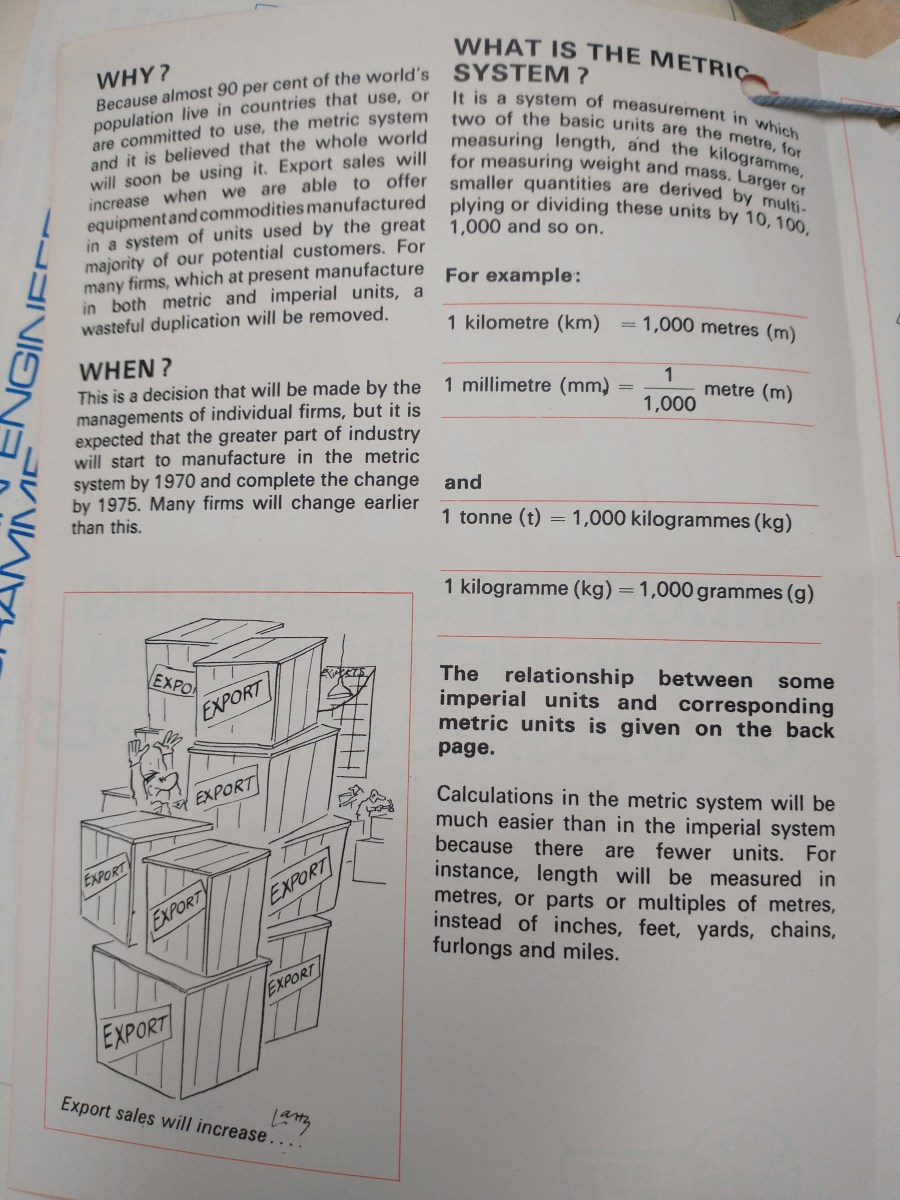
Why Industry Was Going Metric
Across the report, the rationale for metrication is presented with striking consistency:
- Global alignment: Nearly 90% of the world’s population already used the metric system. For British manufacturers, continuing to produce goods in both imperial and metric units created duplication, inefficiency, and barriers to export. The educational leaflets emphasised that overseas customers preferred products made to familiar metric standards, and that aligning with global practice would directly support export growth.
- Simplicity and rationality: The metric system is built on decimal relationships—multiplying or dividing by 10, 100, or 1000. Compared with the imperial system’s mixture of inches, feet, yards, chains, furlongs, and miles, metric units offered a streamlined, logical structure. The campaign materials repeatedly stressed that calculations would become easier, drawings more consistent, and training more straightforward.
- Industrial modernisation: The shift was framed as part of a broader programme of product rationalisation. Standardising components, tools, and materials in metric units would reduce waste, simplify production planning, and support the adoption of modern engineering methods.
The message was clear: metrication was not an ideological project but a practical necessity for a competitive industrial economy.
How Industry Would Change
The report outlines a structured, multi‑stage transformation across engineering and manufacturing. Several key themes stand out:
1. New Working Methods and Tools
Designers, draftsmen, and production staff would need to adopt metric calculations, metric drawings, and metric measuring devices. Firms were advised to provide:
- metric handbooks
- familiarisation training
- new rules and instruments
- updated production planning systems
The transition was not simply about replacing units but about embedding new habits and workflows.
2. Use of Metric Prefixes and Scales
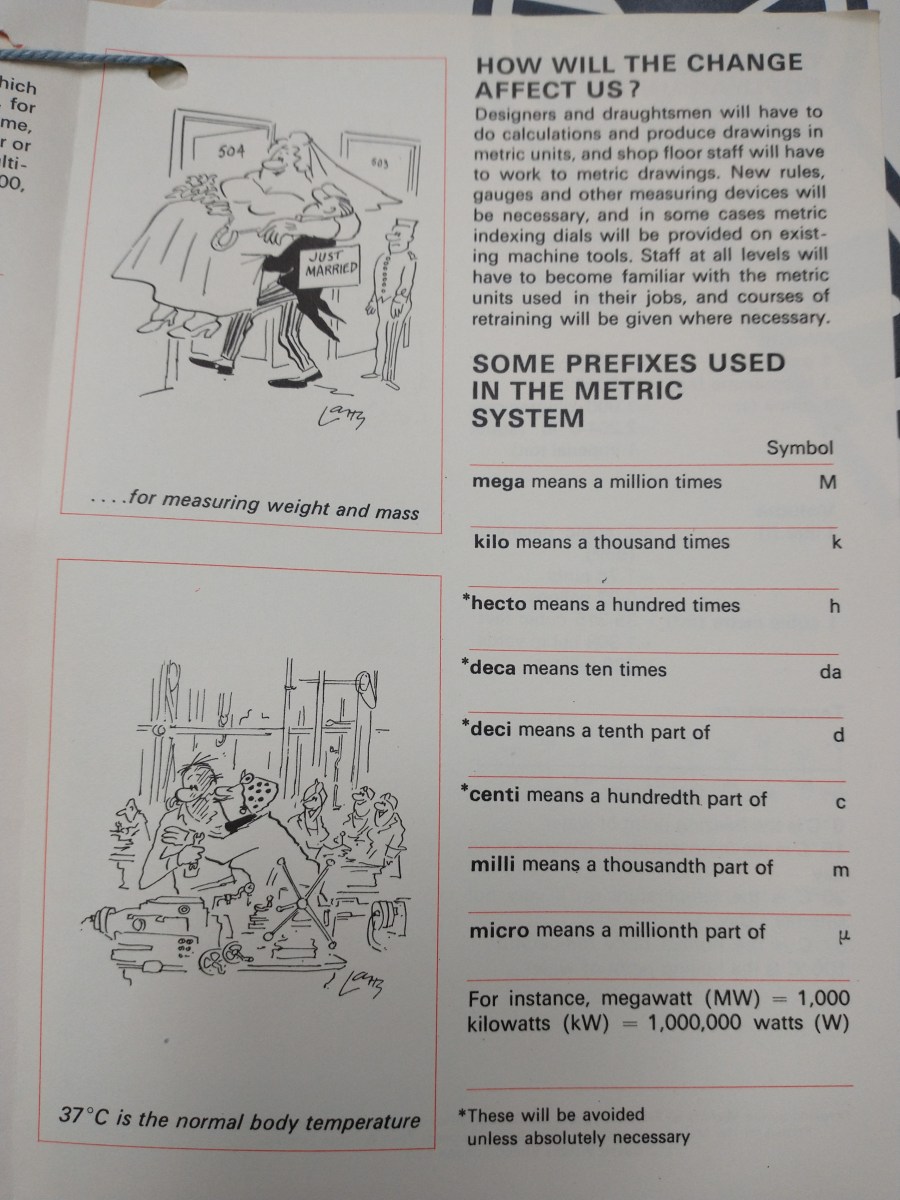
Educational materials introduced the standard metric prefixes—kilo, mega, milli, micro, and others—explaining how they scale quantities up or down. Although the report noted that some prefixes would be avoided unless necessary, the intention was to build confidence in the decimal structure of the system.
3. Product Rationalisation
The “Going Metric – Product Rationalisation” leaflet highlighted that standardising product ranges in metric units would reduce duplication. Instead of maintaining parallel imperial and metric versions of components, firms could streamline production and reduce costs.
4. Sector‑by‑Sector Transition
The BSI timeline chart shows how different industries—electric cable, paper and printing, construction, and others—were expected to progress through:
- an initial period of change (up to 25%)
- a main period of change (25–75%)
- final consolidation (over 75%)
This visualisation makes clear that metrication was planned as a coordinated, cross‑industry effort rather than a piecemeal shift.
When the Change Would Occur
The report consistently projects a transition period centred on 1970–1975:
- Most industries were expected to begin manufacturing in metric units by 1970.
- The majority of the change would be completed by 1975.
- Some firms were anticipated to convert earlier, depending on their export markets and technical readiness.
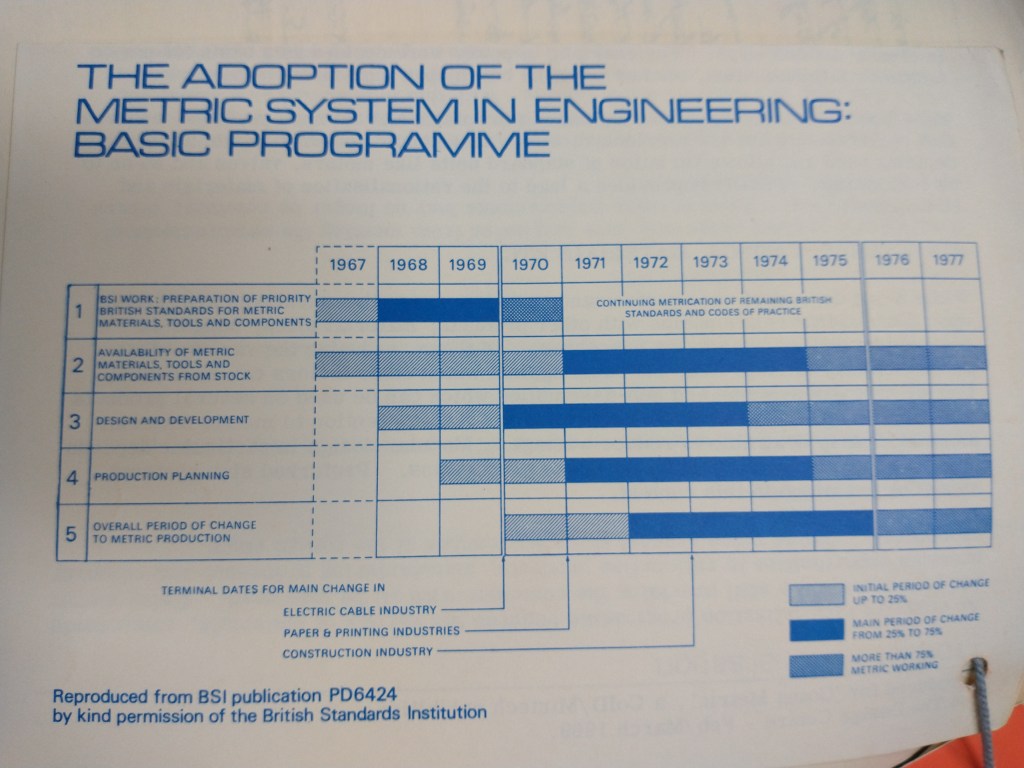
The timeline chart reinforces this, showing a decade‑long progression from 1967 to 1977, with most sectors completing the bulk of their transition in the early to mid‑1970s.
Public Communication and Cultural Reassurance
The campaign materials also reveal a softer side to the metrication effort. Cartoons, humorous captions (“It tastes the same!”), and simple comparisons between imperial and metric units were used to reassure the public that everyday life would not be disrupted. Temperature examples (0°C freezing, 15°C warm spring day, 37°C body temperature) and familiar volume conversions (litres to pints and gallons) helped demystify the new system.
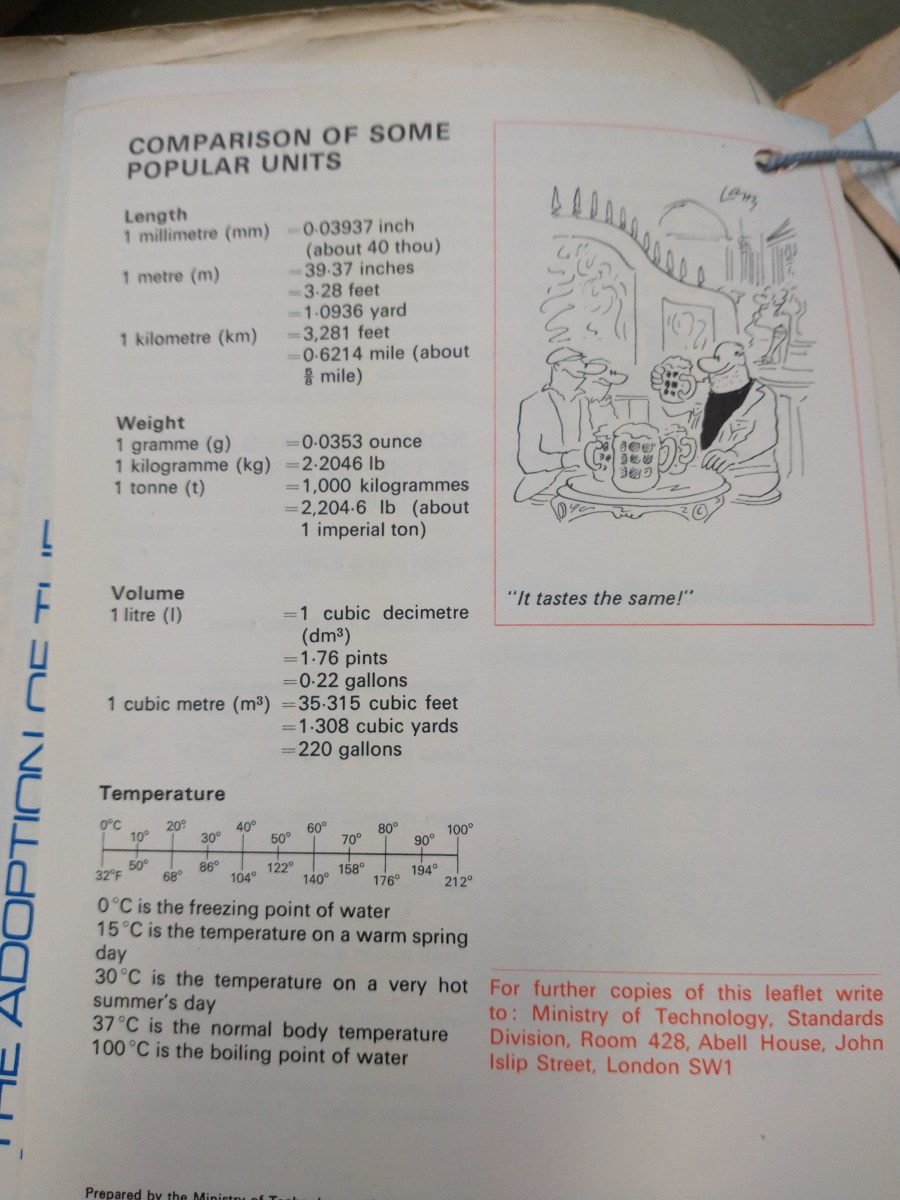
This blend of technical guidance and light‑hearted illustration shows that the government recognised the cultural dimension of metrication. Changing a national system of measurement required not only industrial planning but public confidence.
Conclusion
The “Going Metric” materials present a snapshot of a pivotal moment in British industrial history. They show a nation preparing to align itself with global standards, modernise its engineering practices, and simplify its measurement systems. The transition was framed as logical, beneficial, and inevitable—a necessary step toward efficiency and international competitiveness.
For today’s readers of Metric Views, this report offers both historical insight and a reminder of the unfinished nature of the UK’s metrication journey. The clarity of the original campaign contrasts sharply with the mixed measurement environment that persists today. Yet the underlying arguments—simplicity, standardisation, and global alignment—remain as relevant as ever.


During the 1902 Imperial Conference which took place at the time of the coronation of Edward VII, the question of metrication was raised. There was the normal political ping-pong with most of the Empire wanting metrication to be the Empire standard and in 1907 a parliamentary select committee proposed that metrication be adopted throughout the Empire. This proposal was opposed by certain sectors of British industry who wanted to tie existing customers into their product line.
By 1965 these customers were expecting specifications for these products to be in metric units which was one of the drivers of the metrication program that was launched two thirds of the way through the last century. As an example, my mother related to me that when she was working in Gundrys, one of Bridport’s principal rope and net making companies in the immediate pre-war era, they had to convert prices per pound to prices per kilogram for their Icelandic [and possibly other] customers.
Thus, the short-term advantages gained in 1907 have resulted in long-term problems in the inter-war era and even bigger problems in the post-war era.
LikeLike