First Emperor showed the way – 2000 years ago

I recently had the pleasure of visiting the splendid (Chinese) First Emperor exhibition at the British Museum. Apart from the terracotta warriors, what impressed me the most was the way that Qin Shihuangdi imposed standardisation on his vast empire – including, of course, weights and measures.

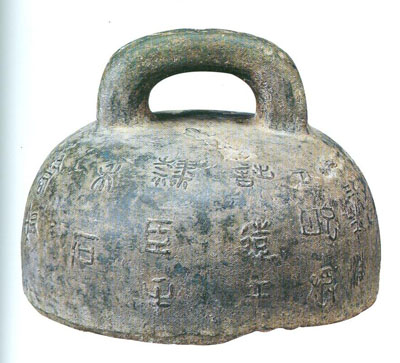
Qin Shihuangdi unified China by conquest in 221 BC. One of his first acts was to decree that only standard weights and measures were to be used throughout the empire. The bronze weight illustrated below is inscribed as follows: “In the 26th year [of his reign the king of Qin] united the princes of the [individual] states; the people enjoyed peace, and he was proclaimed emperor [huangdi]. He issued an edict that all weights are to be standardised. Where they are not uniform, or where there are any doubts, let them be standardised and classified.”


(Acknowledgements to the Trustees of the British Museum)

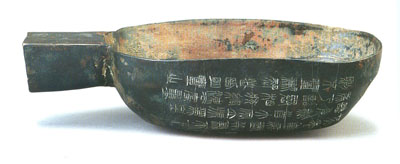
Also of interest is the measuring cup illustrated below. Its capacity is a “half dou”, which was the most popular size in use. Strangely enough, it is almost exactly equivalent to one litre. Obviously, this must be sheer coincidence, but it does give the lie to the British imperialists’ claim that the pint is “natural”, whereas the litre is not.


(Acknowledgements to the Trustees of the British Museum)

Here in Britain the first recorded attempt to standardise weights and measures can be found in Magna Carta (1215), but it was not until 1824 that imperial measures were standardised by the first Weights and Measures Act. Unfortunately, our current crop of politicians lack the perception or the political courage (or both) to acknowledge that a single system of weights and measures is a basic requirement of a modern society. Hence we have, to quote another Chinese leader*, “one country, two systems”.

————————————————————————–
*the late Deng Xiaoping, referring to the Hong Kong Special Administrative Region

The London Marathon

This weekend thousands of runners will test themselves to the full in the annual Flora London Marathon. At 42.195 km, it is a race of endurance. But why 42.195 km? That is tied up in the history of the 1908 London Olympic Games. But why does the United Kingdom press call it a 26 mile 385 yard race and does it matter? For the record, two measurements differ by 1 cm. (Article contributed by Martin Vlietstra)

Continue reading “The London Marathon”

Decimal measures to oust inches and miles

But seriously folks. The article below was an April fool joke but the decimal tape measure is real. In Britain surveyors did use the decimalised foot before going metric. Clearly they recognised the advantages of a decimal system but realised that the metric system proper had much more to offer. The tape featured in the article is in fact American where they still use old fashioned units of measurement. They too clearly see the advantages of decimal in measurement, so the next step is …

Continue reading “Decimal measures to oust inches and miles”

Visionary sci-fi writer uses metric

The late Arthur C Clarke who died this month (March 2008) wrote what may be regarded as his most memorable non-fiction article in 1945. He was the first person to propose the use of satellites in geostationary orbit to form part of a global communications network.

http://lakdiva.org/clarke/1945ww/1945ww_oct_305-308.html

It was quite fitting that his orbital calculations and other details were entirely in metric in recognition of the future as seen from early post-war England.

Continue reading “Visionary sci-fi writer uses metric”

TSI cops out

The Trading Standards Institute (whose members are responsible for enforcing weights and measures law) has declined to support the UK Metric Association’s campaign for a single, rational system of measurement that everybody understands and uses for all purposes. In response, UKMA has accused the TSI of “an abdication of professional responsibility”.

Continue reading “TSI cops out”

Delia goes metric

Delia Smith’s new book, “How to cheat at cooking”, was published on 15 February, and it is ALL METRIC! Not an ounce, pint, cup or Fahrenheit is to be found between the covers of this latest volume, targeted as it is at busy people who like cooking but don’t have time for elaborate preparation.

It is 5 years since the doyenne of tv cooks last published, and in the intervening period, Delia (or more probably her publisher) appears to have accepted that imperial conversions of every metric ingredient are no longer necessary or desirable. The only arguably non-metric measures given are teaspoons and tablespoons, but as these are now standardised at 5 ml and 15 ml respectively, this is perhaps forgivable. So, well done, Delia! (Examples of her recipes can be seen at this link).

Whether to give recipes in dual metric/imperial units (and if so, which should be primary) has been a difficult issue for publishers for many years. The argument used to be that older cooks would not understand grams and millilitres (obviously, anybody over 50 is unable to learn anything new) and in any case their kitchen scales would be imperial. Then it was argued that even younger people, despite doing “home economics” exclusively in metric at school, really prefer to use the same traditional units as their parents and grandparents. Neither argument proved to be valid – but there was a potentially more weighty argument: the American market.

As the British and the Americans (not to mention Australians, Irish and others) share a common language, it is convenient for publishers if they can produce a single edition of a book for sale in all English-speaking markets. Thus even though publishers find it economic to produce cookery books in minority languages like Danish or Slovak (population ca. 5 million in each case), they have used this argument to resist producing metric-only editions for the British/Australian market and US customary editions for the American market. (This is rather like the threadbare arguments used in the recent controversy about separate metric and US customary packaging for the EU and USA markets).

In reality the argument was always somewhat shaky. Leaving aside the separate culinary tastes and traditions of the national populations, European recipes tend to measure liquid ingredients by volume (in ml) but dry ingredients by weight (in grams) whereas American recipes tend to measure both liquid and dry ingredients by volume (hence “cups” of flour). The American pint (473 ml) is of course smaller than the imperial pint (568 ml).
Problems also arise over how to convert. If the starting point is a traditional imperial recipe, do you convert 1 lb to 450 g or round it up to 500 g? Similarly, should a pint be converted to 570 ml, or rounded up to 600 ml – or down to 500 ml? Note that too much rounding can throw out the relative proportions of ingredients – e.g. if you round dry ingredients up and liquid ingredients down, your cake may dry out and burn.

Undoubtedly, the best answer is to forget about imperial/US customary units, re-measure your recipe in the correct proportions and publish it exclusively in metric units. This appears to be what Delia has done. Congratulations!

Many celebrity cooks, women’s magazines and cookery sections of newspapers have actually preceded Delia in going metric-only. Let us hope that, with Delia’s splendid example in mind, the remaining imperial holdouts will also soon fall into line.

Spain to wreck European clothing sizes initiative?

According to a BBC report the Spanish government is proposing a new clothing sizes initiative which conflicts with the European Committee for Standardisation (CEN) proposal described in Metric Views last year. If this report is true it threatens to undermine the progress that had been made toward a Europe-wide sizing system for clothes.

The BBC report can be accessed from this link. And the CEN proposal was described in Metric Views here.

According to the report, the reasoning behind the Spanish proposal appears to be that mannequins and models are too thin and as a result women risk their health by striving to lose weight in order to be able to wear the clothes seen on the catwalk and in the shop window. This may well be a serious problem, but it is difficult to see how changing the sizing system will solve it.

The European Committee for Standardisation (CEN) is a private sector body independent of the European Union. The great advantage of its proposal (known as EN 13402) is that it is based on the dimensions of the customer â?? not on an ideal model that the clothes are designed to fit. So provided that the customer knows her bust, waist and hip sizes, she should be able to find the â??best fitâ?? garments. This contrasts with the current systems in which a size 12 in one shop will be a size 14 in another shop and will not necessarily have the same relationship between bust and hip.

Much of the problem stems from the obvious fact that people vary in shape as well as in size. Consequently, a single number cannot adequately describe the person a garment is intended to fit. EN 13402 allows for this by giving two or more dimensions in the form of a pictogram, whereas (if the BBC report is correct) the proposed new Spanish system will simply repeat the same mistake. Ironically, the Spanish proposal appears to be duplicating a survey carried out by the British Standards Institution and other European standards organisations that was the basis for EN 13402.

The relevance of all this for UK metrication is that EN 13402 is based on dimensions in centimetres. It would be a great advance if British consumers could be persuaded to remember their dimensions in cm, but it was feared that the British retail industry and clothing importers might resist it precisely because it would require women to remember, say, 96-82-100 rather than 38-32-40.

If Spain really does go it alone, it will be even more difficult to achieve a common system throughout Europe.

Language and measurement – an enduring relationship

One objection to metrication that I often hear is that the imperial system is embedded in the English language. If we were to lose the old measurement system, we would lose a lot of our language with it, they say. Just how true is that? (Article contributed by David Brown)

Continue reading “Language and measurement – an enduring relationship”

Metres and yards – now interchangeable?

A reader of Metric Views has drawn our attention to a paragraph in the DfT Traffic Signs Manual that allows distances shown as ‘yards’ on some traffic signs to be measured in metres. We wonder if this idea on interchangeability has spread beyond the DfT.

Continue reading “Metres and yards – now interchangeable?”

Imperial scales may give short measure says metric group

The following news release was issued by UKMA at 02:00 on 18 January:

news release … news release … news release … news release … news release …

For immediate release

“Imperial scales may give short measure” says metric group

The general public would be well advised to avoid buying from traders who use illegal scales that only weigh in pounds and ounces – so says the UK Metric Association (UKMA). Imperial-only scales have not been checked by Trading Standards Officers for over eight years, and it is quite possible that they are no longer accurate. There is therefore a significant chance that when you buy from shop or market stall that uses illegal scales you will get less than you are paying for.

Responding to reports that a market stall-holder in Hackney is being prosecuted on Friday, 18 January for Weights and Measures offences, UKMA Chairman, Robin Paice, said; “Obviously, I can’t comment on this particular case as we don’t know the full facts. However, the publicity surrounding the case suggests that, like the so-called ‘metric martyrs’ in Sunderland and elsewhere, this is really a political stunt. People are entitled to campaign to change the law, but they are not entitled to break laws just because they disagree with them. They don’t deserve any sympathy.”

Background

Since 2000, UK law has required that all shops and markets in the UK must weigh and measure at the point of sale (checkout) in grams and kilograms. Traders’ scales are periodically tested by Trading Standards Officers (TSOs) to ensure they are accurate. However, traders can still give an equivalent price in pounds and ounces if they wish. Customers can also order in pounds and ounces if they wish, and the shopkeeper or trader simply has to weigh out an equivalent amount in grams and kilograms.

Originally, it was intended that the option to show equivalent imperial prices would be phased out after 2009, but the European Commission has now proposed that this option should be retained indefinitely. However, increasingly, supermarkets are dropping the imperial equivalents, and customers are ordering at the deli counter in grams rather than obsolete ounces.

Unfortunately, egged on by populist, Eurosceptic politicians, some traders decided in 2000 to try to defy the law and continue weighing in pounds and ounces. The so-called “metric martyrs” (more accurately, they were “imperial luddites”) were found guilty of various offences under the Weights and Measures Act and fined. All their appeals to the UK courts and even the European Court of Human Rights were rejected in 2001/2.

The current issue in Hackney appears to be an attempt to re-run the same political stunt. It is unlikely to work, as it is now obvious that the law is home-grown UK law and not dictated by Brussels. People are getting rather bored by the antics of fringe politicians seeking bogus martyrdom.

UKMA Chairman, Robin Paice added:
“The purpose of the UK law is to ensure that consumers can compare goods in the supermarket and the street market on the same basis, using the same measurement units. How can you compare tomatoes at £2.09 per kilogram in the supermarket with tomatoes at 99p per pound in the market – unless you know the conversion factors and have a pocket calculator with you? It is fundamental to consumer protection that every body uses the same measurement units.

My advice to shoppers is this:

  • Avoid traders who use illegal imperial scales. You don’t know whether you are getting short measure.
  • Don’t waste your sympathy on traders who deliberately broke the law in order to seek bogus martyrdom. The vast majority of traders operate legally and cope perfectly well with metric measures.

Every country needs a single system of weights and measures that everybody understands and uses for all purposes. Nobody needs two systems.”

Notes for editors

(a) The UK Metric Association (UKMA) is an independent, non-party political, single issue organisation which advocates the full adoption of the international metric system (“Système International” – SI) for all official, trade, legal, contractual and other purposes in the United Kingdom as soon as practicable. UKMA is financed entirely by membership subscriptions and personal donations.

(b)Further extensive background information can be found generally on UKMA’s website at www.ukma.org.uk.

(c) The following are available for interviews:

Robin Paice (Chairman of UKMA) on 023 9275 5268 or for radio/TV interviews in Portsmouth or Southampton

Derek Pollard (Secretary) on 020 8374 6997 for radio/TV interviews in London