Are imperial feet “natural” units?

With the slow transition to metric in the UK, a lot of myths have emerged regarding metric and imperial. With a New Year it is an appropriate time to examine some of these myths starting with the claim that imperial feet are ‘natural’ units.

Despite the end of the British Empire and the demise of the pith helmet, quite a few British people are nostalgic about imperial units. However, many people are not really proficient in using them and often are ignorant about their history and usage. For example, many people do not know how many yards are in a mile. When the Times carried out a straw poll in early 2006 answers given for yards in a mile ranged from 52 to 10 000. The vast majority of people – even elderly – cannot explain how an acre is defined.

It has been often claimed in the British news media and by imperial supporters that imperial units are ‘natural’. Yet no evidence is offered to support this. What part of the body weighs a pound? What volume naturally corresponds to a pint? Maybe the obvious example is to say that the imperial foot is a “natural unit”.

However, a little thought shows that this is an empty claim. A unit needs to have a standard size otherwise there would be complete chaos. Human feet are not a standard size and so there is no natural size for the unit. The fact that human feet vary led to many different standard feet in Europe in the past; a key reason why an international system (metric) was needed.

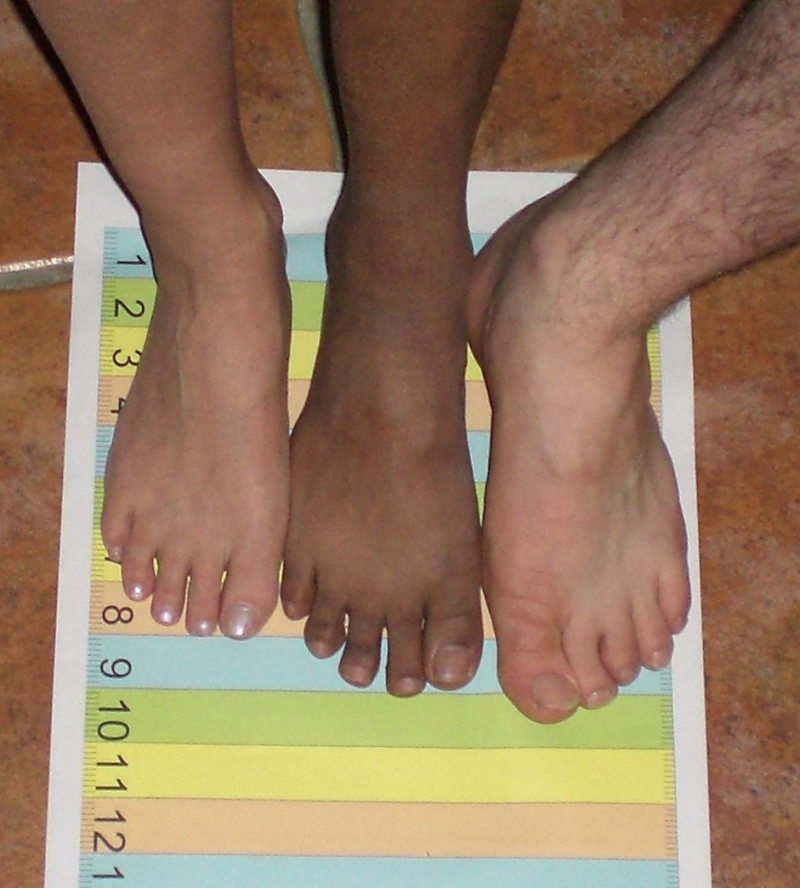
In fact very few people have feet that are as large as the imperial foot; you would need a British “shoe size 12 ½” foot! The vast majority of people have smaller feet (the photo above shows 3 people measuring their feet against a scale in inches). The average human foot is 24 cm versus 30.48 cm for the imperial foot. If an imperial foot is “natural” then by implication most people have unnaturally small feet! If in doubt try measuring your own feet and those of your friends and family.

A much stronger argument is that decimal numbers are “natural” since all able-bodied people have ten digits. It is nonsensical to justify keeping imperial on the basis that the units are “natural”; parts of the body are non-standard and so quite unsuitable as the basis of modern measures. Far better to use the accurately determined and easy-to-use metric units.

[See also related article at http://www.metricviews.uk/2007/10/28/imperial-units-natural/ – Ed]

Guyana shows the way

Metric Views has come across an interesting letter in a newspaper published in Georgetown, Guyana.
Extracts are reprinted below (acknowledgements to Stabroek News http://www.stabroeknews.com/index.pl/article_letters?id=56535420). The UK authorities could learn from the determined approach to metric conversion adopted by this former British colony.

The entire world is moving in the metric direction, Guyana needs to catch up
Thursday, December 20th 2007

“Dear Editor,

I take this opportunity to thank the many writers of letters in the letter columns of the three daily newspapers for their interest in the subject of metrication and the lively debate on the question of accuracy, margin of error etc.
………….

Let me take this opportunity also to enlighten the various writers that since the re-launching of the National Metrication programme by the GNBS in 1996, the approach taken was one of education and sensitization and the following strategies have been used to get the metric message across to the Guyanese consumer:

* Think Metric Training programmes and practical exercises for all sectors including the education sector.

* The conduct of surveillance exercises countrywide at municipal markets, shops, supermarkets etc. where proprietors are shown how to price and label in metric.

* One to one education visits conducted at all commercial entities.

* Sector visits at Government Ministries, public and private sector organizations including Non-Governmental Organizations to determine training needs and carry out training when necessary.

* Distribution of ‘fact sheets, brochures, conversion tables etc.

* Live television programmes done in workshop style.

* Issuing letters of misuse to defaulters.

* Providing answers to consumers who request information via telephone.

* Setting up of a National Metrication Committee to assist the national metrication drive.

* Publication of articles and advertisements in the newspapers and other periodicals.

* Scheduled verification and calibration of all devices in metric units.

In conclusion, the GNBS wishes to inform consumers that 98% of the world’s trade is conducted in metric units and even the United States which is taking steps to change over, though it uses the imperial system of domestic commerce, uses the metric system for all its scientific work and for international trade.

The entire world is moving in the metric direction, so Guyana needs to move ahead and stop delaying the change over of the process by hanging on to the imperial system.

Yours faithfully,

Evadnie Benfield

Head, Information Services

For Executive Director

Guyana National Bureau of Standards”

Doesn’t it sound familiar?

How others see us – an Australian view

UKMA occasionally receives letters from visitors to the UK expressing amazement at our dysfunctional muddle of measurement units. The following is typical (with thanks to JP for allowing us to use it):

Hi Robin,

I’ve just arrived back in Australia after a three and a half week visit to England. My wife was born in England and so we were visiting her parents and had some delightful weather. The trip included an eight day motor home trip around the north visiting York, Hadrian’s Wall, the Lake District and various other beautiful locations. It was a thoroughly enjoyable trip.

I’m just writing to express my amazement (I can’t think of a better word) at the mixture of measurement systems used in your country. Whilst driving, most road distances and speed were in miles and mph, some distances were expressed in metres, heights were sometimes in metres, feet and inches, or both. All weights were by the kilo, petrol by the litre, temperature in Celsius. What a mixed up muddled up world!

The thing I found most fascinating was the Ordinance Survey of Great Britain. An absolutely excellent mapping grid system designed in the mid 30’s I believe. Your road atlases use it, all your maps use it and most people (that I spoke to anyway) seem to understand it. For example, “TQ 03485 96849″. This system is entirely metric based – but no one is aware of the fact! For example the AA road atlas has each OSGB grid of 10 km square showing as exactly 5 cm by 5 cm on the page but the atlas never mentions this important fact. Instead it goes to great pains to explain the scale as 3 miles and 826.7 feet per inch!

Also fascinating, at a local fire station in Chatteris there was an old map of the local town. It was at least 70 years old and had many old features including a rail line that are no longer present. The really interesting thing was the coordinate system on this map was in metres. It was based on the OSGB.

Now, the reason I’m writing to you is that I read your quote:

The Chairman of the UK Metric Association (UKMA), Robin Paice, commented: The Irish changeover demonstrates that the British Government’s reasons for delaying the conversion of British road signs are simply a flimsy excuse for doing nothing. Frankly, they are rubbish. Irish drivers are no more likely to be familiar with speeds in km/h than are British drivers.
Familiarity with metric measures comes from use – not from education. The British Government should just get on with it.

I’m 42 years old and conversion happened when I was young (around 9) and so I have experience and what works and what doesn’t. From our experience here, your statement “Familiarity with metric measures comes from use – not from education” is the most important statement of all. I was speaking to mum (who is 65 and has pretty much embraced the entire metric system) about the change over to decimal currency in 1966. Australia moved from pounds, shillings and pence to dollars and cents – and it was overnight. I asked her how long it took to get used to the system and she said “a day”.

So I’m really just wishing you good luck in your journey and hope to see your road signs done soon. I think that will be a tipping point for England and it should be helped by the recent Irish conversion and the 2012 Olympics will provide an excellent target date.

Keep up the good work,

Regards,

*Jixx Pxxxxxx*

*Hobart, Tasmania, Australia.*

This letter also reminded me of Neil Kinnock’s comment (in a foreword to UKMA’s report “Metric signs ahead“) that, when the all-metric Olympic Games are hosted in London in 2012, “our imperial road signs … contradict the image – and the reality – of our country as a modern, multi-cultural, dynamic place where the past is valued and respected and the future is approached with creativity and confidence.”

Demonstrating their own ignorance and insularity, Government ministers (including Alistair Darling, then Transport Secretary) tried unconvincingly to dismiss and ridicule these comments. However, the truth is that JP’s letter is typical of the view from abroad.

Which Council in the UK is most metric?

Philip Bladon of Redditch puts this question. He also asks which local authority is most supportive of metrication. The editors of Metric Views, however, have doubts about whether this would be a useful line of enquiry, and invite comment from readers.

Continue reading “Which Council in the UK is most metric?”

A critic writes – and a response

UKMA’s Chairman received the following critical letter from a thoughtful correspondent (a student or teacher of physics). As it is better argued than most efforts from defenders of imperial measures, it was thought that it was worth publishing (slightly edited to conceal his identity) – together with Robin’s reply.

This was the original letter:
Dear Robin,

I must say, I’m suprised by the somewhat draconian arguments on the UKMA website that imperial units should be abolished altogether, especially when imperial units have not even been taught in schools for about 30 years. I write as somebody who grew up under the metric system (though exposed to imperial units at home), who used to think everything should be SI, and through experience now realises that the imperial system has a lot to offer.

Fundamentally, there is no reason to adopt any one unit over another, by virtue of the definitions, e.g. the metre is determined by the ratio of 1/(speed of light in m/s) – it could equally be defined in feet (speed of light feet/s). The choice is ultimately for consistency in scientific publications and engineering (and international trading), but there is no reason not to keep it in existence for everyday usage for a number of reasons (and in the same way most foreign people speak English as a second language, but still have their own mother tongue – thus exposed to 2 different ways of thinking). Indeed some of the arguments against imperial actually suggest the very reason why imperial should not be scrapped, but perhaps, with the exception of the Farenheit scale, be re-introduced! Metric units are not even rigidly adhered to in physics, where we revert to units that most conveniently relate to the scales of observation, for example energy in units of eV (the electron-volt) when talking about atomic energy structure, mass in terms of “atomic mass unit” for atoms, or “solar masses” in astronomy (yes there was the classic metric-imperial mistake at NASA on the Mars orbiter, which could have been avoided with a standard international unit, but that is not the argument here).

1) As your site mentions, many people use imperial units in describing length and height: it is precisely because the very origin of imperial units of length – derived from everyday objects – that it is so much more intuitive to use. What’s easier – describing somebody’s height in feet and inches, or in m / cm?

2) Numeracy skills in this country are at an all time low – now why could that be? Imperial measures, by virtue of not being very simple to use, force people to think about numbers and fractions. All units are ratios in one form or another, thus by maintaining the presence of fractions in the notation, we are reinforcing the fundamental nature of measurement; that what quantity you are specifying is not really an absolute number, but a ratio with respect to some pre-defined unit – the basis of which is arbitrary (and on this point, the foot is clearly an easier unit to estimate without a ruler than a metre). The specific ratios also being arbitrary – yes 10 makes it easier, but is no more correct than divisions of a foot by 12, 24 (half an inch) 48 (quarter of an inch) 96 (eigth of an inch) and so on (and here we can see the nice power of 2 relationship) – it is purely convenience, a convenience which encourages laziness in thinking and loses sight of the fundamentals, and consequently a severe dumbing down in science at schools, so that now the only bit of real maths a pupil is given, in the advanced GCSE science questions, is the “equation” for speed, which they are actually given – something which even when I did GCSEs in the 1980’s was expected to be known by heart even by the 2nd year, and was certainly not worthy of “advanced GCSE” status. What next – decimalise the byte?

3) Base 12 is more flexible than base 10, as with 16 ounces in a pound 12 is divisible by 1,2,3,4,6.
10 is divisible by 1,2,5.
5ths are less useful than 4ths and 3rds. And mathematically, base 12 is much nicer than base 10, you are less likely to end up with recurring reciprocals like 3.33333~ if wanting to divide a given length of something into an integer number of sections.

I think that to say everyday measurements in this country are in a muddle is slightly misleading – most of us know what these units mean, having grown up with both – it is only pedantism over having a consistent set of units, where in everyday situations this is not so important. The only circumstance where I can think that the imperial system is a muddle is in the vagueness of plumbing fittings, where for e.g. thread fitting diametres are not actually based on the thread diameters, but on the inner-section of pipe that might pass through them. Ultimately, I feel let down by this country and our declining education system for not having taught both imperial and metric units, irrespective of the need to have one international standard.

Cheers
[name withheld]

—————————————————————————————————————-

and this was the reply:

Dear zxzxzxzx

Thank you for your comments, which I read with interest. I am not able to reply in full detail but would make one or two brief points.

As you say, because the Government started the metrication process in 1965 and then lost its nerve and has effectively abandoned the whole project, we are now in a situation where both the metric system and imperial units are in widespread use. The problem with this is that most people do not have a secure grasp of either system – let alone both. This does create genuine problems of incomprehension, conversion errors, mistakes and accidents – and in some cases actual costs of having to run both systems – one for internal transactions and another for the public interface. Take a look at our blog article http://www.metricviews.uk/2007/10/15/whats-wrong-2-systems/ for further comment. (You are welcome to contribute yourself).

It is quite untrue that imperial units are “intuitive” or natural. How long is your foot? What I think you mean is that imperial units are familiar – just as it is “natural” to speak English. People brought up in metric countries do not think imperial units are “intuitive”. See also blog article http://www.metricviews.uk/2007/10/28/imperial-units-natural/ which includes comments from a German and a Dane on this point.

The argument about the advantages of base 12 are academic rather than practical. There is no prospect of converting the world’s counting system from decimal to duodecimal, and it is obviously sensible that the measurement system should be aligned as far as possible with the counting system. In any case imperial units are mostly not to base 12: 16 oz in 1 lb, 14 lbs in a stone, 8 stones in a cwt, 8 pints in a gallon, 3 ft in a yard, 1760 yds in a mile, 43 560 sq ft in an acre. How would you divide a lb or a mile by 3?

The evidence on numeracy skills is patchy, and even if it were true that numeracy skills have declined, this would be more likely to be due to other factors such as flaws in the national curriculum, poor maths teaching and the prevalence of pocket calculators and computers and the general dumbing down of mental processes – e.g. “satnavs” replacing map-reading and navigation skills.

UKMA’s proposals are not particularly draconian. Indeed, they are the method by which Australia, New Zealand and many other countries successfully made the change. Unfortunately, UK governments have adopted policies that are the opposite of those proved to be successful – which is why we are in the present muddle.

At least I think we can agree that successive UK governments have let us down.

Best wishes
Robin Paice

Are imperial units natural? (and some useful rules of thumb)

One of the claims sometimes made by defenders of imperial weights and measures is that they are “natural”. The metric system (they may say) is all very well for science and technical matters, but for everyday life imperial units like the foot conform to the human scale and are more “natural”,  unlike the arbitrary metric unit, the metre. We examine this argument.

Continue reading “Are imperial units natural? (and some useful rules of thumb)”