BBC pundit supports going metric

Mention ‘k’ to this economist, and it’s not only the size of investment capital that he’s thinking of..

BBC News economics editor and presenter of “Dragons’ Den”, Evan Davis, speaks out in favour of the simplicity of the metric system in an article on his BBC blog. Normally associated in the public eye for financial figures in the thousands of pounds, Evan Davis compares the elegance and simplicity of the metre and kilometre and of decimal currency against the confusion of inches, feet, yards and miles, pounds, shillings and pence.

Is the Moon still metric?

According to a BBC story, Dennis Hope, the self-proclaimed (imperialist?) owner of the moon, is selling plots of lunar real estate by the acre.

http://news.bbc.co.uk/2/hi/science/nature/6533169.stm

BBC2 – Horizon – 2007-04-10 21:00

This story comes just weeks after a decision by NASA that all future manned moon missions, and permanent lunar bases, will use metric measurements exclusively.

http://www.metricviews.uk/2007/01/13/metric-moon-says-nasa/

So just how will future lunar landowners measure out their 1 chain by 1 furrow long on the moon?

Degrees of confusion

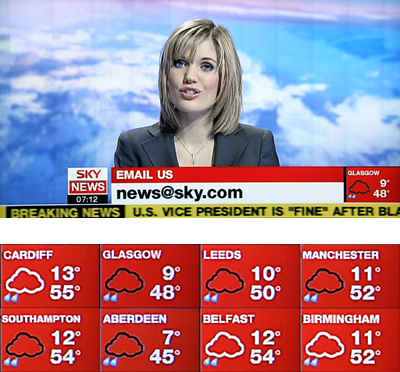
Sky News are currently giving weather forecasts for individual cities on their morning show in the form of icons in the corner of the screen.

On seeing two temperatures for each city, you might expect that they are minimum and maximum temperatures, as is conventional for city forecasts. But these temperatures are more reminiscent of those found in the Middle East.

Even after using the international standard Celsius system for 40 years, it seems that we are expected to realise that the pairs of figures shown are actually both maximum temperatures, but using two different systems.

When will the media make it easier for us all, and stick to one standard temperature scale?

Metric howlers – Times hat-trick

When converting metric units into imperial units, journalists (or more likely sub-editors) are apt to make mistakes, especially if they are dealing with subjects with which they are not very familiar. On the 9th December 2006, The Times managed a hat-trick of blunders. [article contributed by MV]

Page 8 – Airlines should pay full cost of their pollution

The penultimate paragraph contained the text “[Boeing and Airbus] Aircraft use an average of four litres of fuel per 100 km”. This sentence should have raised the alarm bells – a consumption of 4 L/100 km is what one would expect of an economical car such as the Smart Car. (The imperial equivalent is 70 mpg!). If the writer used metric units when driving they would have spotted this howler.

Page 43 – Why the Dead Sea is dying

The fifth paragraph contains the phrase “to suck 1,900 million cubic metres (2.1 million cubic yards) of water”. This phrase contains two howlers. Firstly, a factor of 1000 seems to have gone missing. Secondly, the writer appears to have used a factor of 1.1 to convert cubic metres to cubic yards when the correct factor is 1.1 x 1.1 x 1.1 (which is equal to 1.331).

Page 44 – Spend a penny, but it make you think of a tenor

The third paragraph contains the sentence “The block, in Calcutta, is spread over 3,000 square metres (3,300 square yards) and is “. Here, the writer used a factor of 1.1 to convert square metres to square yards. The correct factor is 1.1 x 1.1 (which is equal to 1.21).

Football going metric?

Viewers of “Match of the Day” on 9 December had the unusual experience of hearing football commentary in metric. Was this an aberration or a straw in the wind? (asks Robin Paice)

There was an interesting exchange on “Match of the Day”
recently.

Three football pundits (Ray Stubbs, Alan Shearer and Mark Lawrenson) are discussing the “goal of the season” scored by Matthew Taylor for Portsmouth against Everton. Lawrenson is describing the volley, voice over an action replay: “straight as an arrow, like a rocket, dipping – here’s the measurement [screen shows 42 metres]. Similar thing at Sunderland last season, like an arrow, goalkeeper on his six yard box [sic] didn’t stand a chance [screen shows 39 metres], not quite so far but still a very good goal. He won’t score many better than that. 42 metres …

AS: By the way, I work in yards.

ML: [slightly condescending] It’s 42 lots of 39 inches.

AS: [to RS] Carry on then.

ML: It’s about 45 and a half yards, give or take.

RS: Have you just worked it out that quickly?

ML: No, I’ve been practising all day.

[All fall about laughing].

Football tends to be militantly imperial despite the fact that as the sport is relatively unknown in the USA, and despite the prominence of foreign players and managers in English and Scottish football, Britain and Ireland are the only countries in the world which still cling to expressions such as the “eighteen yard box” (meaning the penalty area). So it was encouraging, and perhaps we should thank Mark Lawrenson for introducing the footballing masses to the novelty of metric measurements – albeit it was treated somewhat light-heartedly – as though metres are not real measurements.

I would guess that the explanation for this unexpected foray into the world system was that the software used by the BBC in this instance was probably metric. It was easier to use it than try to amend it.

Anyway, thanks to Mark Lawrenson.

“Animals in the womb: Mammals” – pioneering TV from Channel 4

This programme used a combination of computer graphics, physical modelling, and actual ultra-sound images to create stunning pictures of the foetus of a dolphin, an elephant and a golden retriever developing in the womb. There was a commentary, but for much of the time the amazing images spoke for themselves. [Article contributed by Derek Pollard]

Continue reading ““Animals in the womb: Mammals” – pioneering TV from Channel 4″

NHS use of kilograms

Although the NHS uses grams and kilograms, the media often dumb down the information, and politicians do nothing to help. [article by Roz Denny]

Last week I went to see the GP for my elderly father and she was pleasantly surprised when discussing his weight that she didn’t have to “translate” it for me from kg to stones. I am also of the generation of women who gave birth 28 years ago in an NHS hospital and was handed my little bundle at 3.1kg, no conversions. Thereafter my baby’s weights were entered in her clinic record book in kg, albeit with lbs in brackets. Since those heady days we’ve seemed to have gone backwards. Even to the extent that the media think all UK babies are weighed in lbs at birth particularly the babies of prominent politicians – Blair, Brown and Cameron.

Consumer watchdog misses metric opportunity

BBC Radio 4 has missed a golden opportunity to to do some real consumer education and help shoppers to obtain value for money by understanding and using “unit pricing” – i.e. prices per kg, litre, metre, etc.

On Thursday, 14 December, BBC Radio 4’s flagship “You and Yours” programme dealt with a recent report by the National Consumer Council (NCC) on public perceptions of Weights and Measures law, including an interview with its Deputy Chief Executive, Philip Cullum, who was joint author of the report.

The report, “Measuring up”, suggests that fixed sizes for packets and cartons are unnecessary, and consumers would not miss them if they were abolished. For example, jam and honey have to be packaged in the UK in multiples of 57 g (equivalent to 2 imperial ounces), so the more logical 400 g or 500 g sizes are banned from shops (unless they are imported!). The researchers found that most packers and consumers would be happy to see these restrictions abolished (as, incidentally, proposed by the European Commission).

However, what the BBC programme failed to say was that, if fixed sizes (or “prescribed quantities” (PQs) as they are known in the jargon) are abolished, then it is essential that consumers have another method of comparing value for money. For example, if you haven’t got a pocket calculator with you, how would you compare, say, a 454 g jar of honey at £1.78 with a 600 g jar at £2.30? The answer, of course, is “unit pricing” – that is, the obligation to show the price per kg or litre (or 100 g or 100 ml as appropriate) on the shelf label.

Unit pricing not understood and little used

Unfortunately, as the researchers showed, fully two thirds of consumers participating in the discussion groups either did not understand or did not use the unit prices in small print at the bottom of price labels. Moreover, only larger supermarkets and superstores (over 280 m² floorspace) are required to provide this information. The result is that most consumers will have no way of deciding which jar of honey is better value for money (leaving aside questions of quality).

If PQs are to be abolished (which they probably will because the EU will ultimately make the decision), then it will be the responsibility of the Government and consumer organisations to publicise and explain unit pricing so that consumers are better equipped to deal with all the ruses employed by manufacturers, packers and retailers to conceal the true cost of what they are selling. The Government should also reconsider whether the 280 m² floorspace limit is far too high (It may be onerous for a small corner shop – less than 100 m² – to have to unit price every item, but there is no reason why medium sized high street shops belonging to national chains should be exempt).

No mention of the metric/imperial muddle

Of equal concern is the fact that the NCC report carefully avoided raising what is perhaps an even greater problem – the continuing failure of the authorities to enforce the unit pricing of “loose goods” (i.e goods sold to order from bulk and not pre-packed – such as vegetables, meat and fish). Thus, six years after it became compulsory to show the price per kg or litre, many small businesses and market traders still display prices exclusively in obsolete imperial measures such as “lbs”, “st” or “fl oz”, and many local authorities appear to turn a blind eye. This obviously makes it difficult to compare prices and hence value for money as between the street market and the supermarket.

The BBC’s mission statement is “to inform, educate and entertain”. The “You and Yours” programme makers may have thought it entertaining to ridicule the soft target of the current PQ rules, but they failed in their responsibility to inform or educate the consumer.