
Today’s (9/5/2007) news media have widely reported a story that imperial measures may continue to be displayed alongside metric ones in this country for an indefinite period. (http://news.bbc.co.uk/1/hi/uk/6637587.stm) This is being trumpeted by some as a “monumental victory”. It is ironic that in the very year when we are celebrating the bicentenary of the abolition of slavery, clinging on to our imperial past is so widely embraced. However, this news just means ‘business as usual’ in the UK. Weighing machines will not be changed back to imperial. We shall continue to see some unnecessarily complex price labels and, for those who stick to using imperial, a muddle at the supermarket checkout.
What most reports fail to state is that at the greengrocer, butcher and supermarket still legally need to weigh and measure using metric. So if your trader uses imperial scales, they have not been tested recently. But what is the value of labelling in imperial? If you read a price in imperial you cannot check if you have been charged correctly without using a calculator.
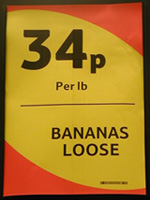
Take this real example of a supermarket advert for bananas above. A customer reading “34p/lb” may have the impression that it is a lower price compared with the shop down the road offering bananas a price of say 69p/kg. The equivalent price is actually 74p/kg.
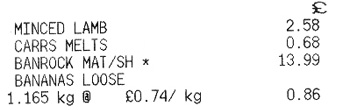
At the checkout, however, the customer cannot check whether he or she has been charged correctly. The weighing machine uses kilograms and the receipt shows the kilogram price 74p/kg.
Common sense would suggest that the most sensible thing would be to display the price using the units of the weighing machine and receipt. Adding the imperial supplementary price adds nothing and can be confusing. Seven years after changing to metric for loose goods, we have all had enough time to change over.
What a pity that some of our politicians and news media despise consumer protection and see a victory in perpetuating an obsolete unit. It is high time that the British Government – without any pressure from the EU – finishes off the metric conversion in the interests of the consumer.

