
Who would believe that the negative influence of the Department for Transport’s measurement muddle would be felt far beyond our shores? Believe it or not, it has an impact in Gibraltar as its Highway Code is based on the UK highway code and always has been. Despite the fact that the Gibraltar Highway Code is reviewed and adapted to meet Gibraltar’s local requirements, it is bizarre that it includes a table of stopping distances for speeds in miles per hour, which is the only place in the Code where miles are used. Gibraltar speed limits are in kilometres per hour and distances are all metric and this is reflected everywhere else in the Gibraltar Highway Code.
Gibraltar is a British Overseas Territory connected to the south coast of Spain and has close historical ties to the UK.
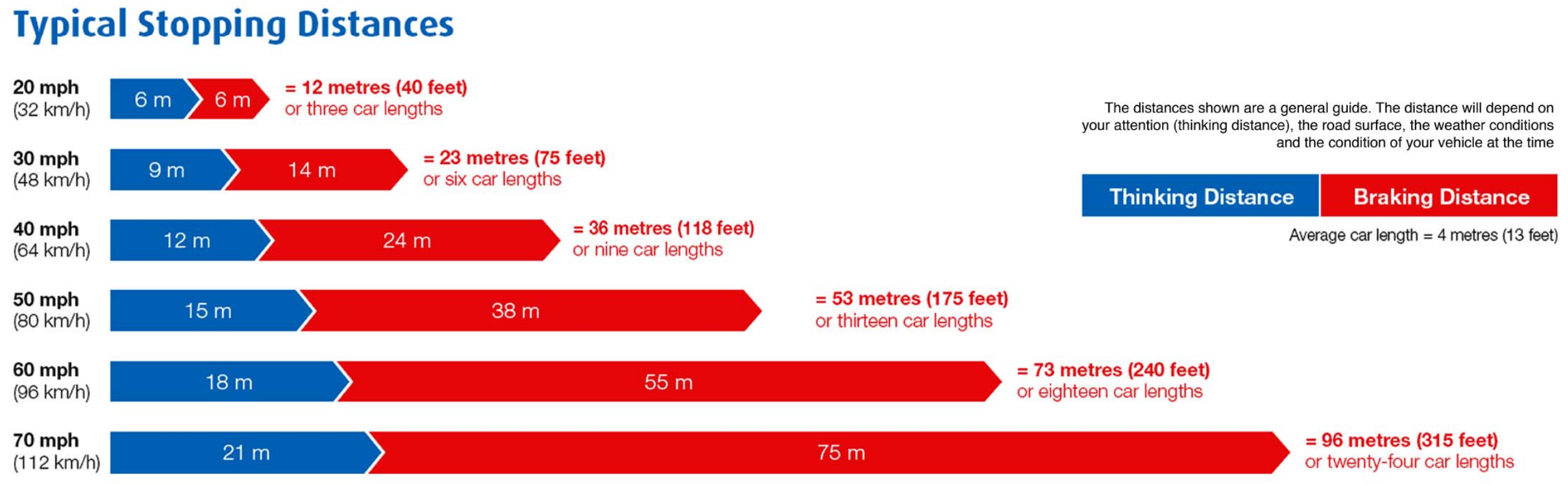
It appears that the Stopping Distances chart has been copied and pasted into the Gibraltar Highway Code without a second thought. One thing that has been overlooked is that Gibraltar uses kilometres per hour but the table gives stopping distances based on miles per hour in multiples of ten. The Stopping Distances charts in the UK and Gibraltar Highway Codes are virtually identical. Spot the difference!
Stopping Distances in the UK Highway Code
Stopping Distances in the Gibraltar Highway Code
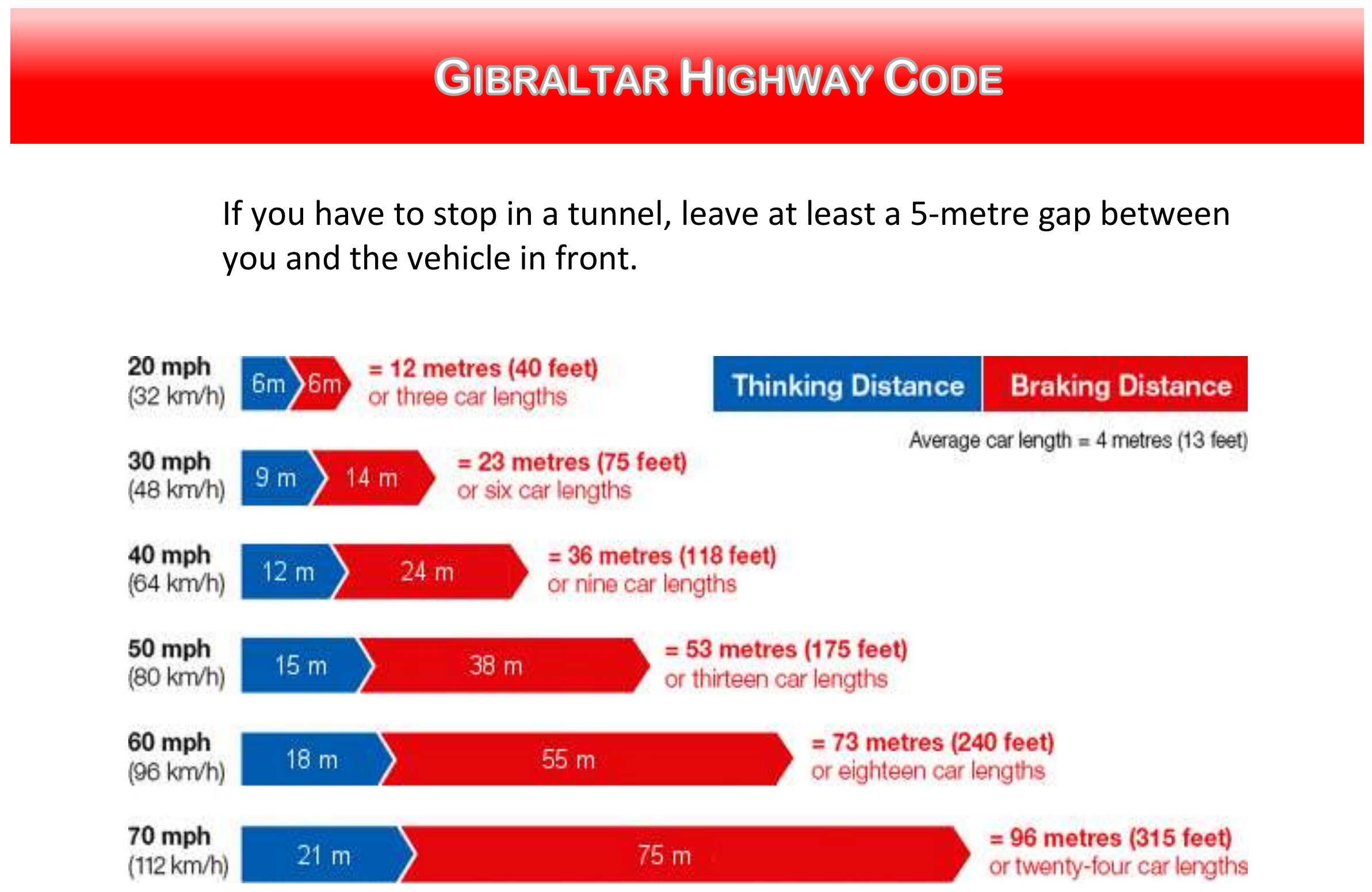
The chart ignores the fact that the maximum national speed limit in Gibraltar is 50 km/h as stated in the Gibraltar Highway Code. The Code states that:
“Where there are no signs indicating the speed limit, the maximum national speed limit in Gibraltar is 50kmph (sic). Buses and all vehicles registered as goods vehicles must observe a maximum national speed limit of 35kmph (sic). Signs indicating a lower speed limit to the maximum speed limit, applies to all classes of vehicles.”
Elsewhere in the Code, it tells you that in some areas a 30 km/h maximum speed limit may be in force.
A chart with stopping distances for speeds in multiples of 5 km/h up to Gibraltar’s maximum national speed limit of 50 km/h would be more appropriate to suit Gibraltar’s local requirements. As distance signs only use metres, conversions to feet and car lengths should be removed. Why does the Gibraltar Highway Code use mph speeds in the Stopping Distances chart which are not used in any other part of the Code or on Gibraltar’s roads? We ought to blame the Department for Transport for exporting our measurement muddle to Gibraltar.
The UK Highway Code can be found at https://www.gov.uk/guidance/the-highway-code.
The Gibraltar Highway Code can be found at https://www.gibraltar.gov.gi/uploads/documents/transport/Gibraltar-Highway-Code-2022.pdf.
HM Government of Gibraltar press releases about the Highway Code:
 Metric Views
It is also truly bizarre that the photographs in the Gibraltar Highway Code show British road scenes reversed to show vehicles driving on the right hand side of the road, but do not take account of the fact that buildings such as those shown in the photographs are not found in Gibraltar. Why did they not take a few local photographs and use them?
The Code also includes a Warning Sign ‘Two-way traffic straight ahead’ with the arrows the wrong way round for driving on the right. While the sign for ‘Priority over vehicles from opposite direction’ is correctly displayed in the list of traffic signs, it is incorrect (using the UK pattern for driving on the left) in paragraph 132 under ‘Traffic-calming measures’. To compound this error, there is a balloon enlargement of that sign with the arrows the wrong way round for Gibraltar. I have no idea why there are ‘Additional rules for the motorway’ as you will be very hard pushed to find a motorway in Gibraltar! Again, another reversed photograph of a British road scene.
And then their use of ‘kmph’ to represent kilometres per hour when describing the general speed limit in Gibraltar. How many times does it have to be repeated that the metric symbol is km/h, the symbol shown on the dashboard of a car? It occurs to me that I wrote to the Gibraltar authorities quite a few years ago to point out that mistake. They replied that it would be corrected at the next update of the Code. Clearly it wasn’t.
LikeLike
Thank you, Metricnow, and I have spotted a few others. Like motorways, you will be hard pushed to find a railway in Gibraltar. On page 117, traffic lights, the green arrow is explained, but the picture represents UK practice. In the UK you can see a green arrow to the left in conjunction with a red main signal. You can see a green arrow to the right only in conjunction with a green main signal. This needs to be reversed in Gibraltar. On page 129 the Bus Stop road marking relates to a keep-left rule.
Overall, less than a professional job of the standard that one ought to expect from a government department. But our own UK Highway Code has similar discrepancies. For example, latest edition, page 7, Rule H2: the picture shows pedestrians keeping right. This is in contravention of page 9, Rule 1.
LikeLiked by 1 person
Metricmac:
Indeed, there are no railways, nor tramways, the other type of crossing referred to in the Gibraltar Highway Code. What they should have included, in my opinion, is a reference to the crossing at the airport where the road crosses the runway just after you pass border control. That would have been a useful piece of information and a reminder of what comes immediately after you enter Gibraltar. But I would imagine it is considered a road junction like any other, though I don’t think there are traffic lights for departing or arriving aircraft!
LikeLike
@metricnow: The road between Gibraltar and Spain no longer crosses the runway. On 31 March this year, a new road around the eastern end of the runway was opened to traffic. Part of it in a tunnel. However pedestrians and cyclists, but not motor-cyclists can still cross the runway.
LikeLiked by 1 person
Martin Vliestra:
Thank you for that update. I wasn’t aware of the changes to the entry points.
LikeLike