
For years, the DfT has given cost and diversion of funds from other parts of the transport budget as arguments against the metrication of UK road signs. While all kinds of arguments have been made for and against the reduction of the speed limit on local roads to 20 mph in London and Wales, I have not heard any opponents of the rollout of 20 mph speed limits say that it costs too much or that it diverts funds from other parts of the transport budget. This shows that the DfT arguments against changing road signs to metric units are bogus.
On Thursday 14 September 2023, the Evening Standard published the following front page telling readers that over half of London’s roads now have a 20 mph speed limit:
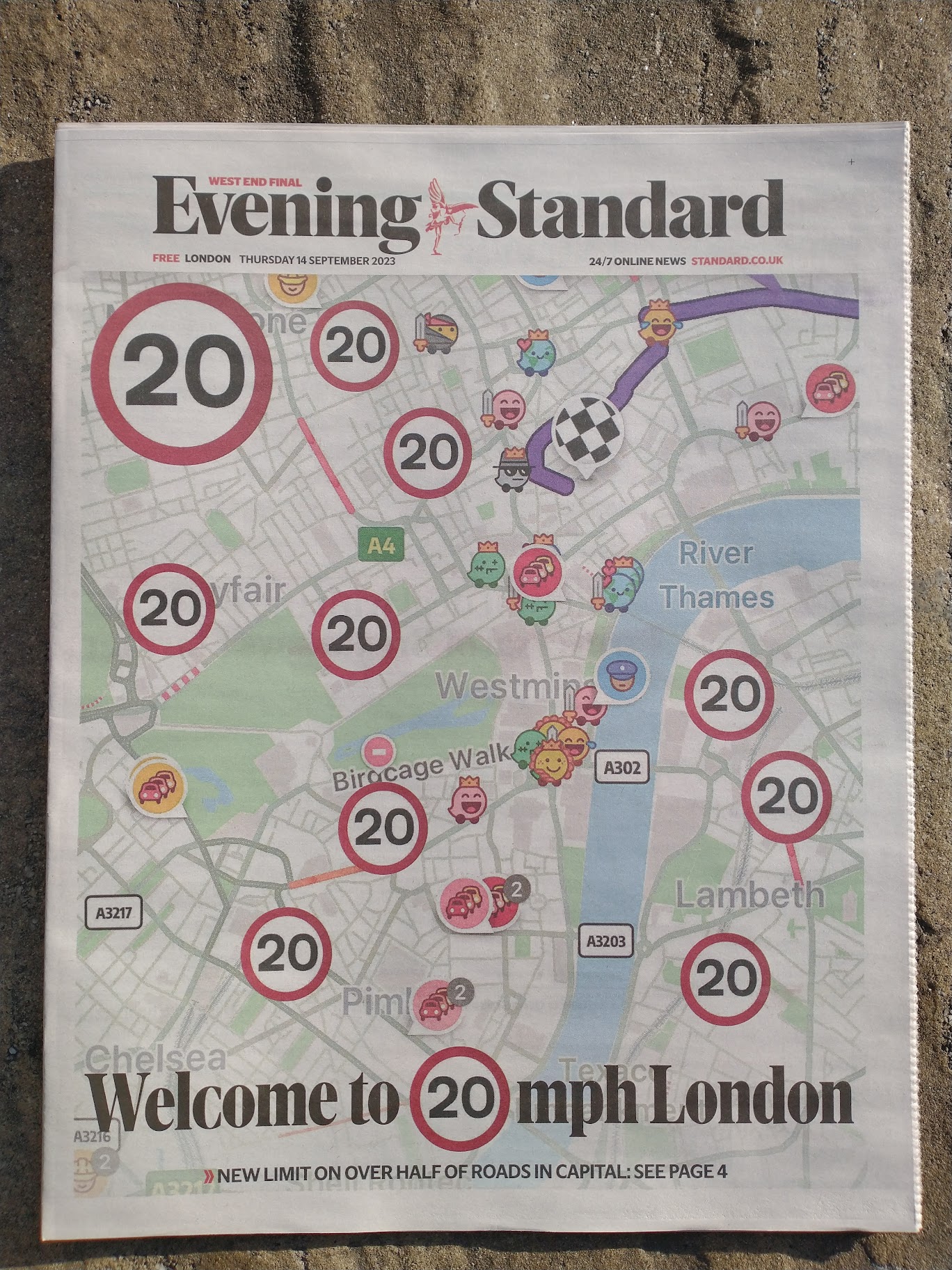
This edition of the Evening Standard reports that this includes 16% of TfL roads and 52% of borough roads.
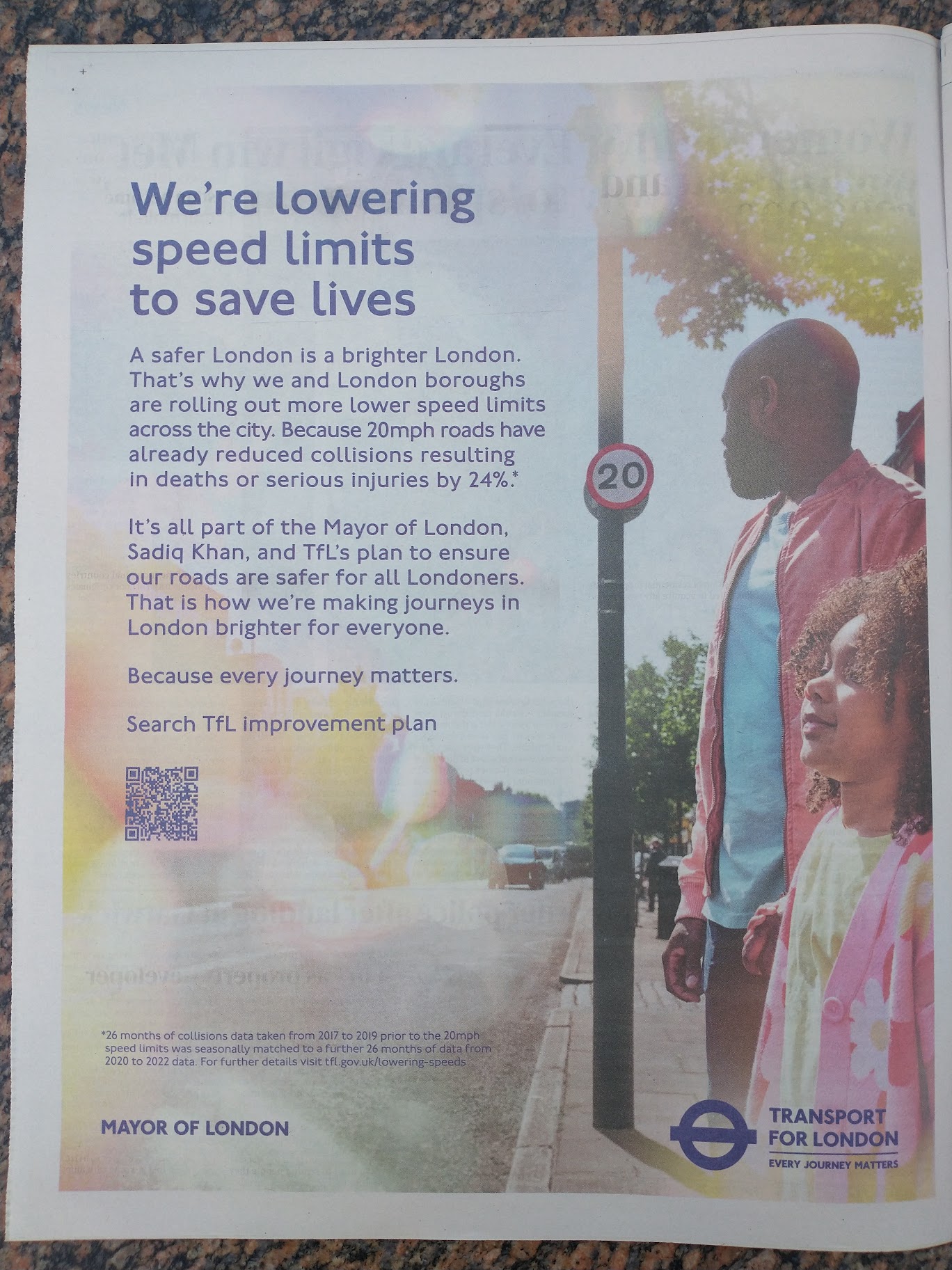
TfL says that it is lowering the speed limit by 10 mph on another 140 km of the roads they manage and expects this to be completed by May 2024. 1 Work is in progress to implement 20 mph speed limits on 28 km of roads in Camden, Islington, Hackney, Haringey and Tower Hamlets. (ibid.) The work to introduce 20 mph speed limits in more areas involves the work on signs, road markings, pedestrian crossings, footways, cycling lanes, traffic lanes, traffic islands and more. (ibid.) TfL has been advertising its plans for the rollout of the 20 mph speed limit. Here is an example of the one full-page TfL advertisement that has appeared in the Evening Standard recently:
There has been a lot of recent coverage of the rollout of the 20 mph speed limit in Wales and London. The BBC reports that:
“The UK’s first 20mph zone was introduced in Tinsley, Sheffield in 1991. Now many UK counties, towns and cities have 20mph limits on some of their residential roads.” 2
In Wales, approximately 30 000 signs are going to be replaced. The BBC says that Scotland is thinking about implementing the 20 mph speed limit and that the Welsh Government has spent about £32.5m on getting roads ready for the default 20mph speed limit. (ibid.)
For many years, the DfT has justified its refusal to metricate UK road signs by arguing that it would cost too much and would divert funding from other parts of the transport budget, saying:
“The significant costs involved for the UK in changing the measurements used on signs, replacing signs, providing safety and publicity material and the consequential costs for businesses and other organisations would far exceed any benefits in terms of meeting the EU’s objectives.”
“We do not consider that diverting funding from high priority areas for the metrication of traffic signs is justified.”
The DfT could make the same arguments against the rollout of the 20 mph speed limit. It doesn’t nor do opponents of these plans. Why is cost seen as a problem for changing speed limits to km/h but not for reducing speed limits? If they were implemented at the same time, it would not have cost a penny more. As a recent MV article on the reduction of speed limits in Wales pointed out, it could save millions of pounds. 3 This is a missed opportunity to start to metricate UK road signs. Apparently, cost and diverted funds are not a problem when reducing speed limits but are a problem when converting speed limits to km/h. This is illogical and makes no sense. It exposes DfT arguments against the metrication of UK road signs as bogus.
Sources:
- https://tfl.gov.uk/corporate/safety-and-security/road-safety/safe-speeds?cid=lowering-speeds
- https://www.bbc.co.uk/news/uk-wales-66774379 (“20mph: Wales first UK nation to drop speed limit from 30mph”, BBC News, 18 September 2023)
- https://metricviews.uk/2023/09/01/opportunity-missed-to-save-millions-on-new-speed-limit-signs-in-wales/
 Metric Views