
On 9 December 1970, the Minister for Transport Industries John Peyton announced that the Government have decided that speed limits will not be made metric in 1973 and have no alternative date in mind. Why did the Government scrap the metrication of speed limits? Historical government documents give various reasons for scrapping the planned conversion. This article will show some of these documents, which reveal the reasons the Government gave for its decision.
The Department of the Environment (DoE), which was responsible for transport at the time, issued the following press notice:
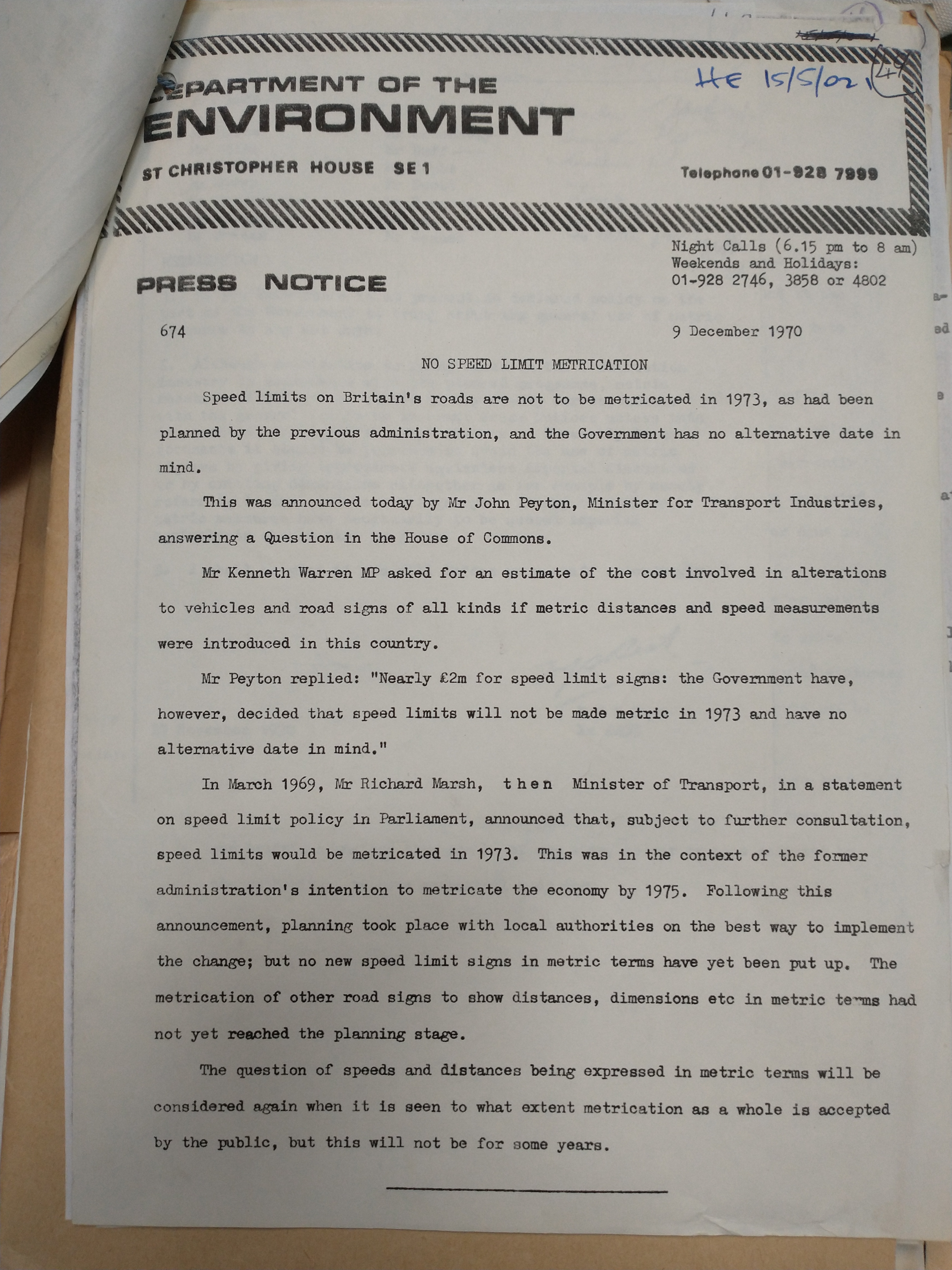
The press noticed ended by saying, “The question of speeds and distances being expressed in metric terms will be considered again when it is seen to what extent metrication as a whole is accepted by the public, but this will not be for some years.”.
One paper examined the arguments for and against the conversion. In this paper, some arguments against the conversion were underlined in blue:

For arguments against, the paper said, “It can be argued that there would be a hostile public reaction to the cost and inconvenience of the proposed change on the grounds that considerable expenditure should not be incurred merely to alter the system which will not benefit motorists generally in this country. Metric traffic signs would not help exports, nor do they relate to a tangible commodity where new measurements would rapidly become familiar by individual experience.” and that “… it can be argued that the conversion of directional and other signs should be delayed for several years in order to allow the public to get more experience of the metric system first.”.
Point number 2 in the Background Notes papers reveal opposition from Conservative MPs and that it was official government policy that metrication should be voluntary.
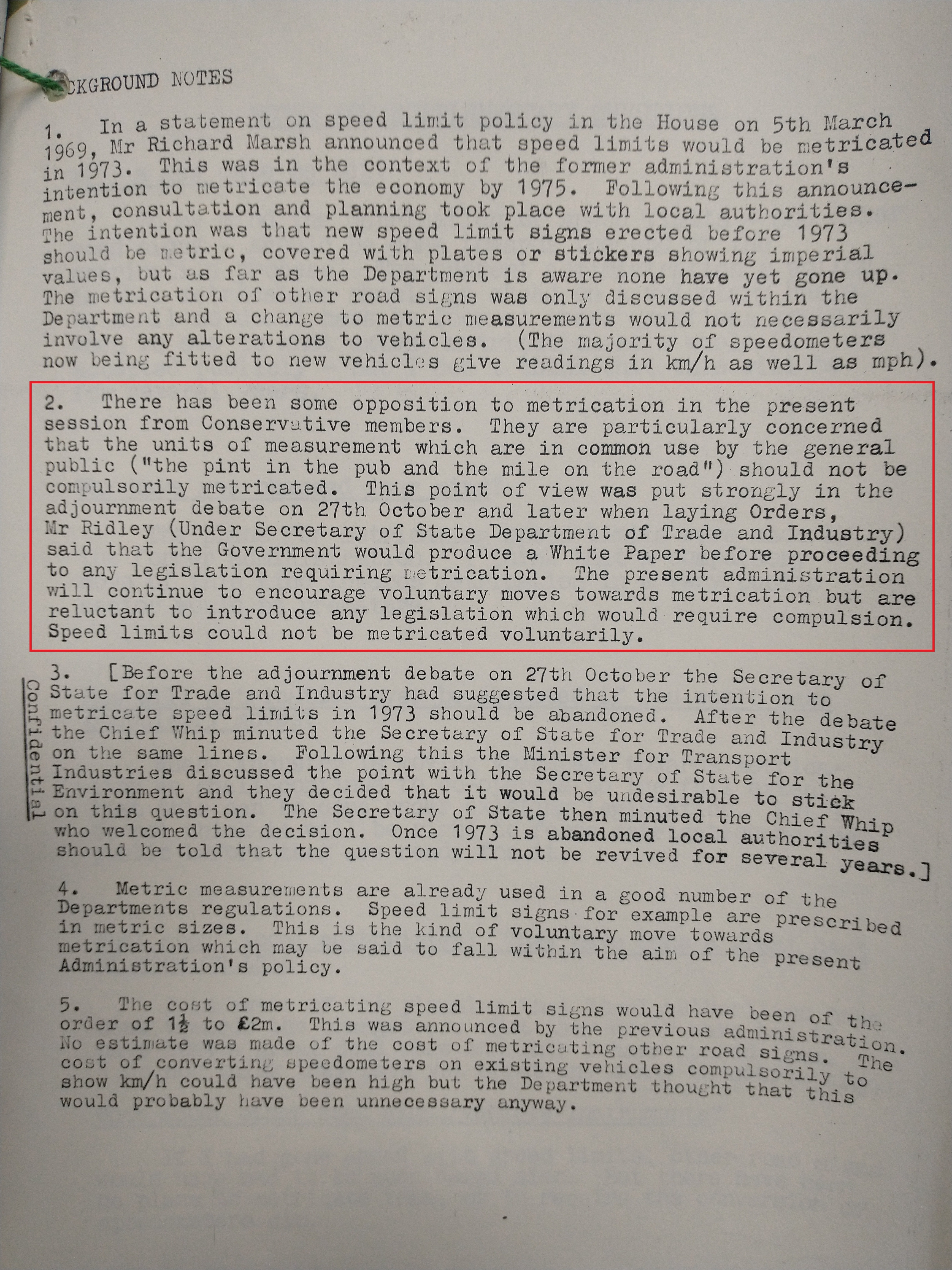
Conservative MPs were concerned that the units of measurement which are in common use by the general public (“the pint in the pub and the mile on the road”) should not be compulsorily metricated. This point of view was expressed strongly in the adjournment debate on 27 October and later when laying Orders.
Changing speed limits would require compulsion and would be contrary to the policy of voluntary metrication. The Government was reluctant to introduce any legislation which would require compulsion, including legislation to change speed limits to km/h.
Another paper reveals that there were 64 Conservative MPs ready to support “the pint in the pub and the mile on the road”.

The Minister for Transport Industries thought that the public had enough on its plate by way of change in other sectors for the time being (see note 2 of Metrication of Speed Limits and Traffic Signs section below).
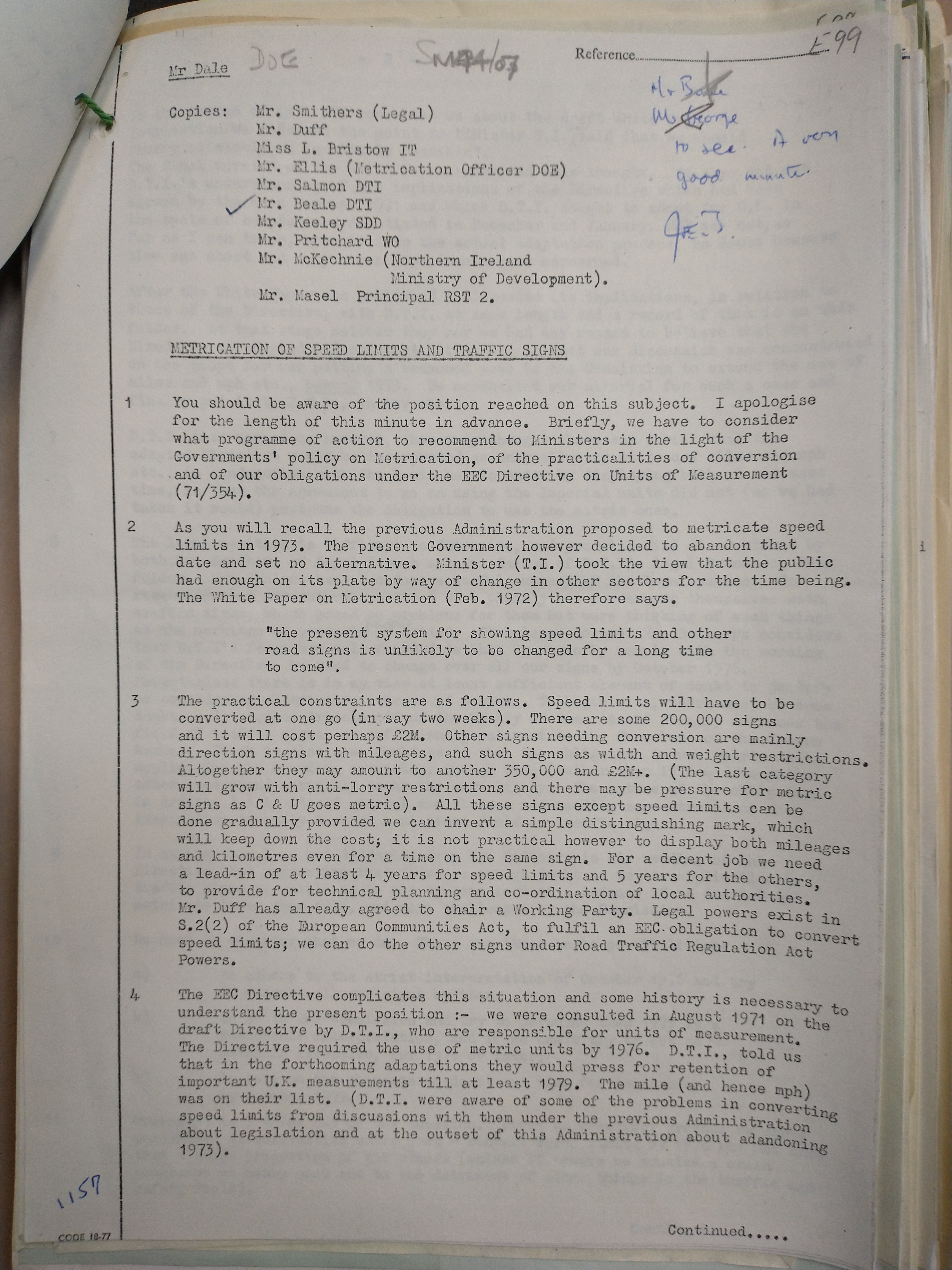
The Minister was probably referring to the change to decimal currency and metrication in other areas. The Minister presumably thought that metricating road signs would be too much for the public to accept.
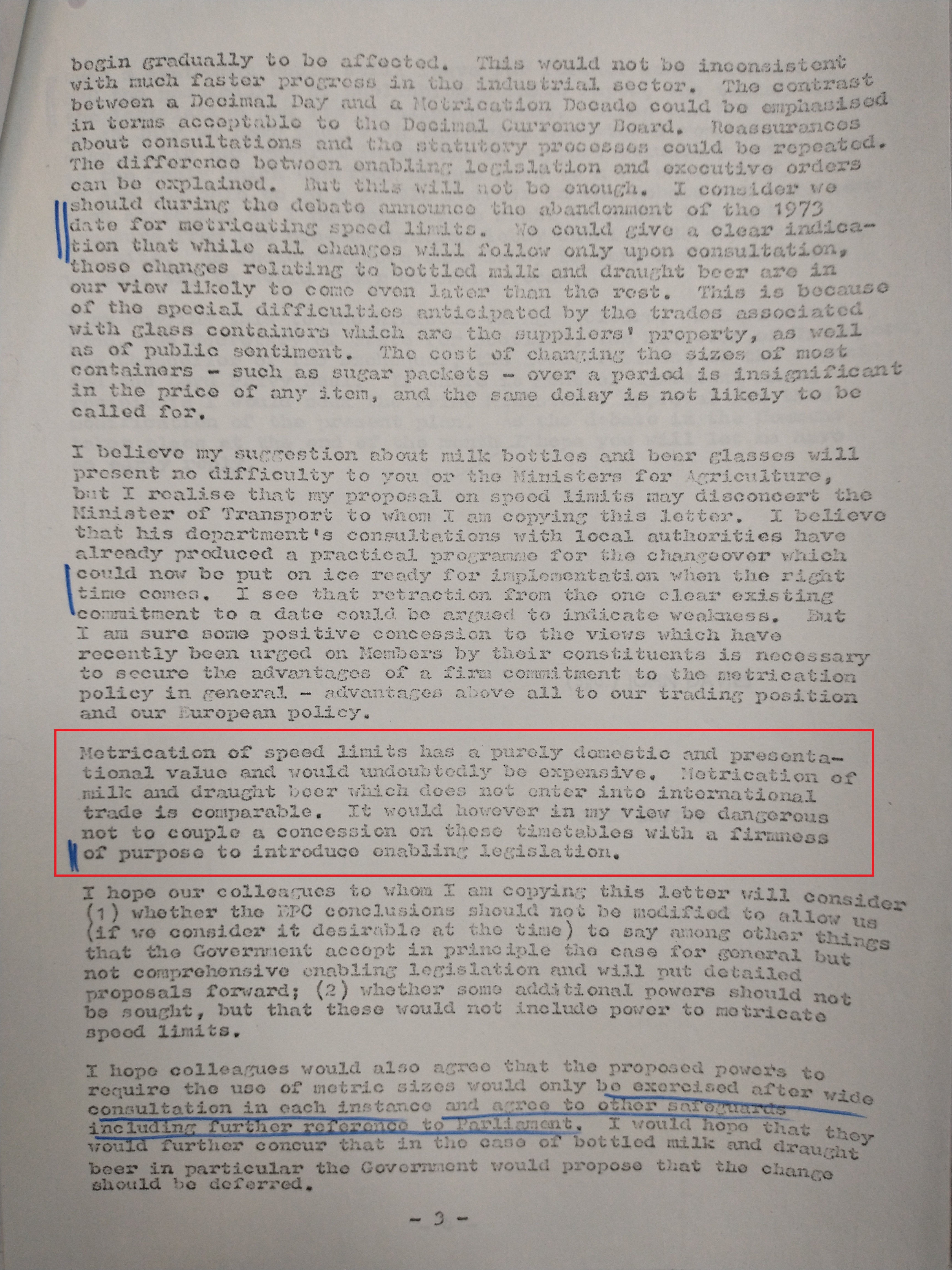
In debates on metrication, one argument made against metrication of speed limits was that it has a purely domestic and presentational value and would be expensive and that metrication of milk and draught beer which does not enter in international trade is comparable.
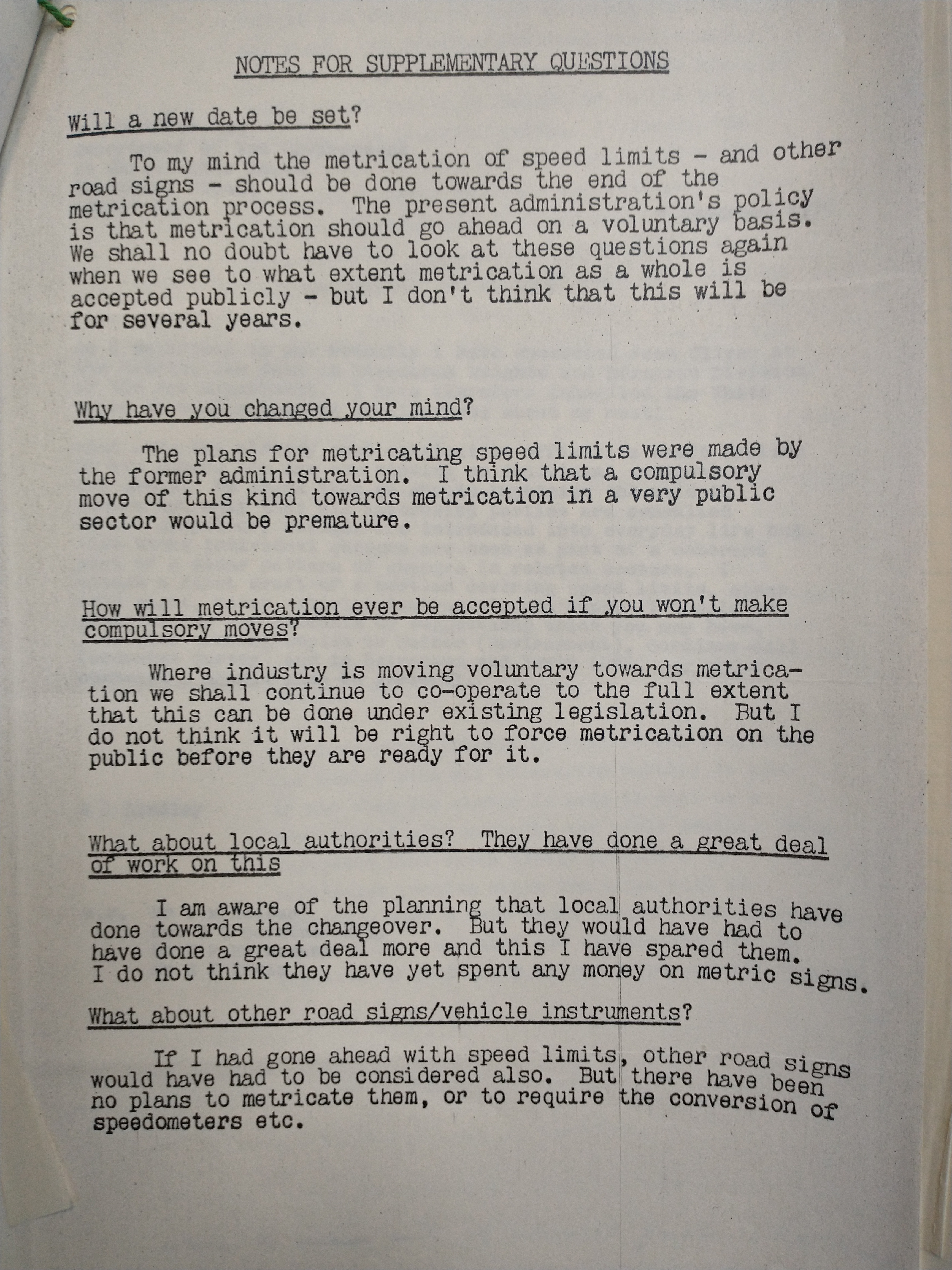
The Notes to Supplementary Questions paper gives us valuable insights into government thinking when the proposed metrication of speed limits was scrapped.
What a shame that the Government failed to learn lessons from other Commonwealth countries that successfully metricated their road signs and never looked back. If they had metricated UK road signs, the change would have been permanent, like the change to decimal currency in 1971. Fifty-three years have passed since the metrication of road signs was abandoned on 9 December 1970 and we are still waiting. Since then, little progress has been made to introduce metric units on UK road signs. Why have successive governments failed to metricate UK road signs in over half a century? What is taking them so long? Since then, they have given endless excuses for their refusal to do so.
The most recent excuse the Department for Transport (DfT) has given for their failure to convert road signs to metric units is that it is too expensive. They have used this excuse ever since they published their grossly inflated cost estimates for conversion of road signs to metric units in 2006. Numerous Metric Views articles have compared the DfT estimates to actual costs incurred for new, replaced and amended road signs and found that the DfT cost estimates bear no relation to reality. The previous Metric Views article revealed that the DfT estimates are at least 17 times higher than the official government cost conversion estimates of 1970 after adjusting the figures for inflation.
 Metric Views
This is such a cop-out. Road signage is forced by its very nature, even more so before the advent of Satnav. The only reason why they would be in common use by the general public is because that is what the road signs are in, and people are forced to cope with them. There is nothing especially British about miles over kilometres, especially given that the signage looks similar to road signage used elsewhere. If the road signage is in kilometres, then people would quickly get used to kilometres.
It is unbelievable that they have needlessly wasted so much time, money, and effort keeping such archaic, inconsistent, and illogical measurement units alive because of such terrible excuses. When they could have gotten this all done and dusted 50 years ago without this fuss.
LikeLiked by 2 people
One of the small (very small I hasten to add) positive sides to the government action in the 1970’s was to require that km/h appear on speedometers as a secondary unit. This requirement has now fallen away.
As of now, there is one action that the government could take which will not cost them anything (either money-wise or politically). They could require that with immediate effect (or starting six months hence) that all new cars sold on the UK market should have fully switchable metric/imperial instrument panels. This can be done using LCD technology – the sort of technology that you see on a smartphone or iPad. This technology was not available in the 1970’s. The motor manufacturers should not complain as such panels can be fitted as standard to all their vehicles world-wide, thereby reducing the size of their manufacturing and their spares inventory. On leaving the UK for France or the Republic of Ireland, a UK driver could switch to metric units while the Irish or French driver entering the UK could do likewise.
The biggest problem might be car manufacturers who have a vested interest in segmenting the Republic of Ireland market from the United Kingdom market and who use the metric/imperial argument to do so.
LikeLiked by 1 person
In fact, the speed limit signs in Hong Kong look identical to those in the UK but the meanings are different.
LikeLike
“Metric traffic signs would not help exports, nor do they relate to a tangible commodity where new measurements would rapidly become familiar by individual experience.”
But they do help not only with exports but with measurements and understanding measurements in general. The metre is the base unit of length and distance and the millimetre and kilometre are prefixed quantities based on the metre. To fully understand the metre one has to be able to relate to all of the prefixed values. By having metres and multiples of metres on signs gives the person a full grasp of the metre.
Thus by not gaining experience and comprehension of kilometres by using them on the roads, a full understanding of the metre, the millimetre, the micrometre, the megametre, etc is not realised.
Maybe this is what the people behind the decision not to metricate road signs and auto instrument panels were hoping for. A failure in this one spot would have a large scale effect on comprehending other SI units and the maybe the population in general will feel they are fighting an uphill battle in learning SI and demand a full return to FFU.
This obviously seems the case since 50 years later, there are still those salivating that the return to FFU is going to happen. With the realisation that in the present or future time a return to FFU will never happen, although as long as road signs remain in FFU, the prospect of hope exists and there will always be an effort to try again.
The only solution to end any future attempts to return to FFU, the road signs issue must be settled now and in favour of full metrication.
LikeLiked by 3 people
Thanks again, Ronnie, for digging further. Points that were made at that time:
– . . . allow the public to get more experience of the metric system first.
– . . . there would be a hostile public reaction . . .
– The Government was reluctant to introduce any legislation which would require compulsion. It should be on a voluntary basis.
So look at what has actually happened since these feeble excuses.
– Tachographs work in kilometres.
– Distance posts alongside motorways show kilometres.
– Fuel is now sold by the litre (making reckoning of economy or fuel costs for journeys more difficult because this does not relate to miles).
– Some Highway Code distances are specified in metres only, e.g. distance at which a number plate can be read, limit of visibility requiring headlights.
– Public notices of road works specify distances in metres.
I would say that all this has happened by a form of compulsion, not voluntary choice. The public has had plenty of time to gain experience of metric. I am not aware of any “hostile reactions”. The difficulty now is the expectation to be able to estimate metric distances, though road signage is in imperial.
This is a job that has been started and needs to be finished.
LikeLiked by 3 people
“On the other hand it is fair to say that if metrication is to be adopted generally for its benefits in trade, commerce and education, it is difficult to justify any long term exception in the field of road traffic. In the long term this could only appear quite anomalous and confusing to a new generation brought up to think metric.”
I thought I’d pull this quote out of the second image, which no one else seems to have highlighted.
Even back in 1970 it was thought that that the halfway house would be untenable in the long run, but sadly ossification and clinging onto the old have seemingly won the battle in Government.
Until there is a visible political cost (meaning the politicians start to lose money or chances of re-election) then nothing will be done about this issue I fear – 53 years of stasis tends to back this hypothesis up.
LikeLiked by 2 people
“Metric traffic signs would not help exports.”
“. . . one argument made against metrication of speed limits was that it has a purely domestic and presentational value . . .”
It would be a dull, dull world indeed, if everything we did had to be justified in terms of helping exports or yielding a return on investment.
I have seen, on our roads, teams clearing litter. The M6 Toll motorway, alias Midland Expressway, is a joy to drive, not just because of the lightness of traffic on this 3-lane road but because of the marvellous landscaping. Neither landscaping nor litter-picking contributes to exports or provides a return on investment. Yet we do this – because it is worthwhile; it improves the quality of life.
Presentation is something that a well-run economy can afford. It creates a happier living environment. It can even attract tourists.
And, in terms of economics, tourism to the UK is classed as export.
LikeLiked by 2 people
We talk and read about the DfT and the Business Department (or whatever it is called these days), but does the Department for Education not have any say in this matter? Surely it is the best interest of teachers and their students that the units of measurement they teach should be what their students see in their everyday lives and in the working world. Surely those same units should also be the units of measurement shown on road signs for transport purposes. Transport is a major part of the working world. Has the Secretary of State for Education been asked for their view on this matter, or do they just do the Government’s bidding? There used to be talk of joined-up government. Perhaps the Department for Education and the DfT need to talk to each other.
LikeLiked by 1 person
@metricnow: When the announcement about metrication was made in 1965, a ten-year window was set. The Department for Education, having a specific target of 1975, ditched imperial units from the curriculum on grounds that when the pupils concerned got to the workplace, everything would be in metric units.
Fast-forward to the 2020’s. A child’s formal education still lasts 12 years (when they take their GCSE exams). During that period the education plan should follow a fixed pattern. I was at primary school in the 1950’s. We were taught vulgar fractions until the equivalent of Year 6 and were only taught decimals from Year 7 onwards. Since metrication and decimalisation children are taught decimals at a much younger age and they only have a rudimentary exposure to fractions. If one is to re-introduce the proper teaching of imperial units, then it will take time for the syllabus to be agreed, textbooks to be rewritten and the work plan phased in over at least three years. During that time there will probably be a change of Minister for Education and possibly a change of Prime Minister, either of which could see things being changed yet again.
LikeLiked by 2 people