
Official government documents from the early 1970’s stated that road signs cannot remain imperial while the rest of the UK goes metric. One of these documents is an official letter from the Ministry of Transport (MOT), as the Department for Transport (DfT) was then called. Would you believe it? Compare that with the current attitude of the DfT today, which directly contradicts the admission in the MOT letter.
A letter from KC Fowler at the MOT to DJ Goodrham Esq at Treasury Chambers on 6 July 1970 explained the breakdown of estimated costs for trunk roads and local authority roads over four financial years in the early 1970’s. It also included some other relevant information about the planned conversion of speed limits to km/h.
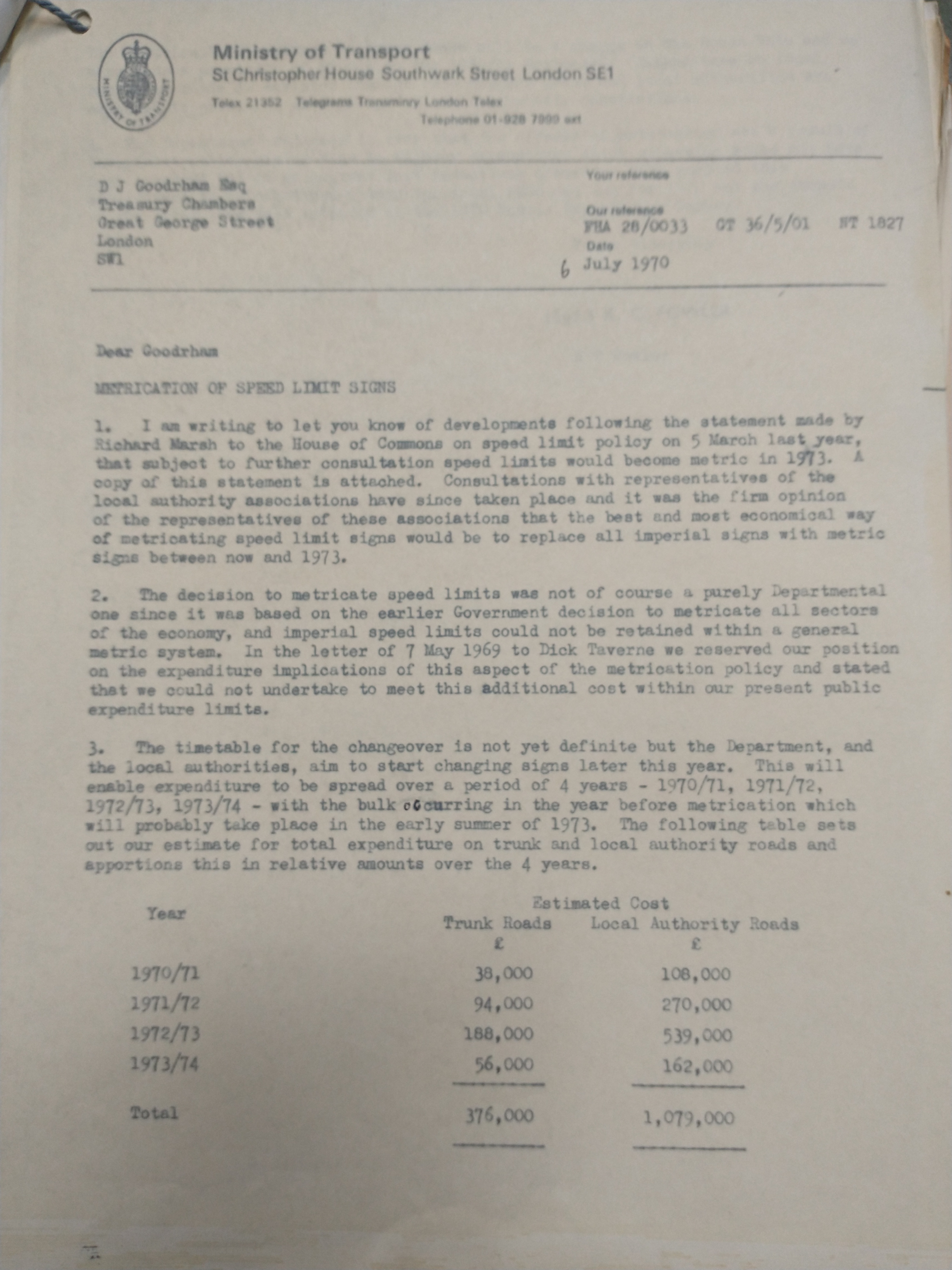
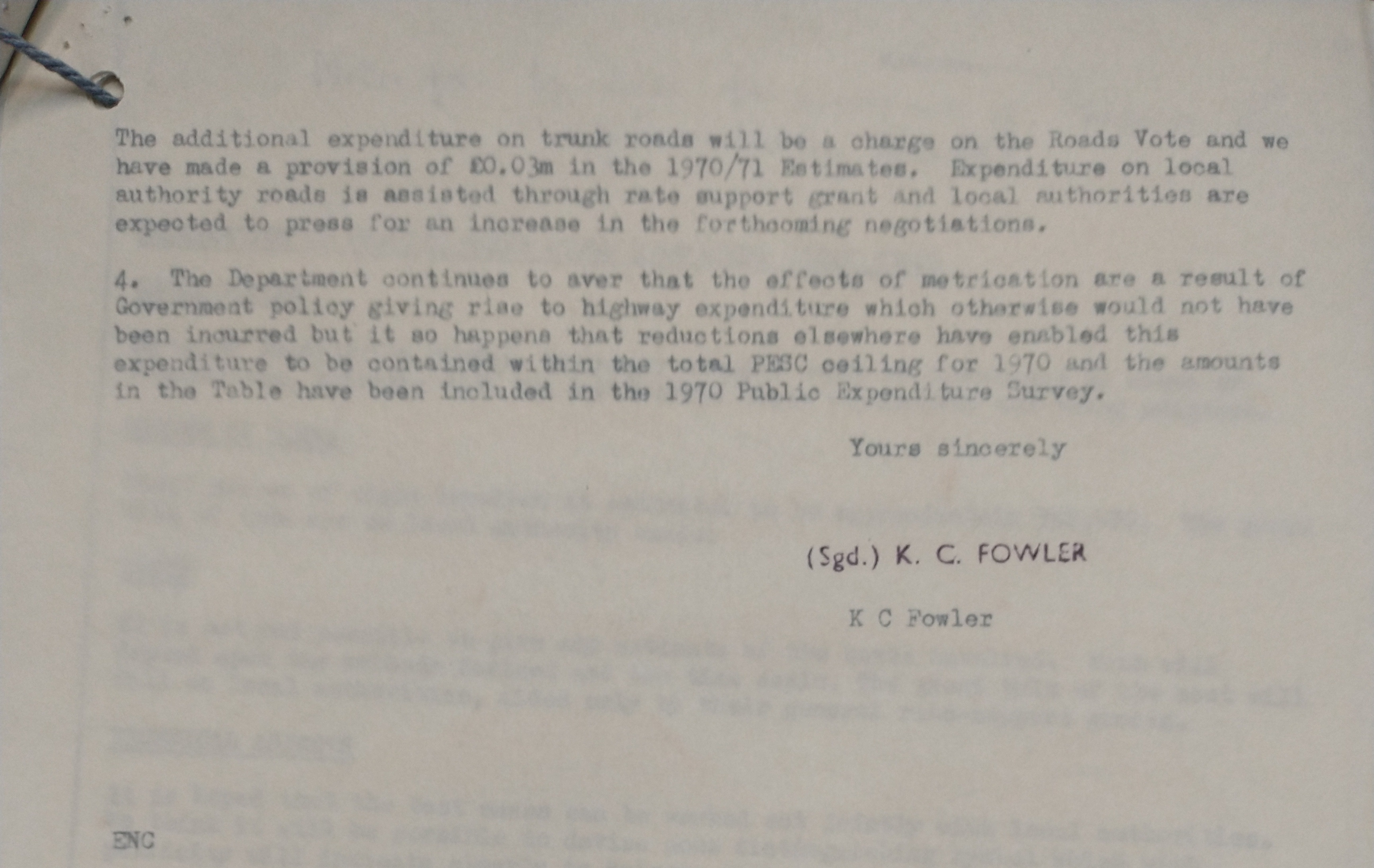
Point 2 of this MOT letter stated that, “The decision to metricate speed limits was not of course a purely Departmental one since it was based on the earlier Government decision to metricate all sectors of the economy, and imperial speed limits could not be retained within a general metric system.” (my emphasis)

Another official paper also made this point, saying:
“On the other hand it is fair to say that if metrication is to be adopted generally for its benefits in trade, commerce and education, it is difficult to justify any long term exemption in the field of road traffic. In the long term this could only appear quite anomalous and confusing to a new generation brought up to think metric.
An announcement has already been made about the intention to introduce metric speed limits and a decision is awaited on the other signs; the conversion of other traffic signs would be a logical development, indeed, it would be illogical to show metric speed limits and retain imperial road distances.” (my emphasis)
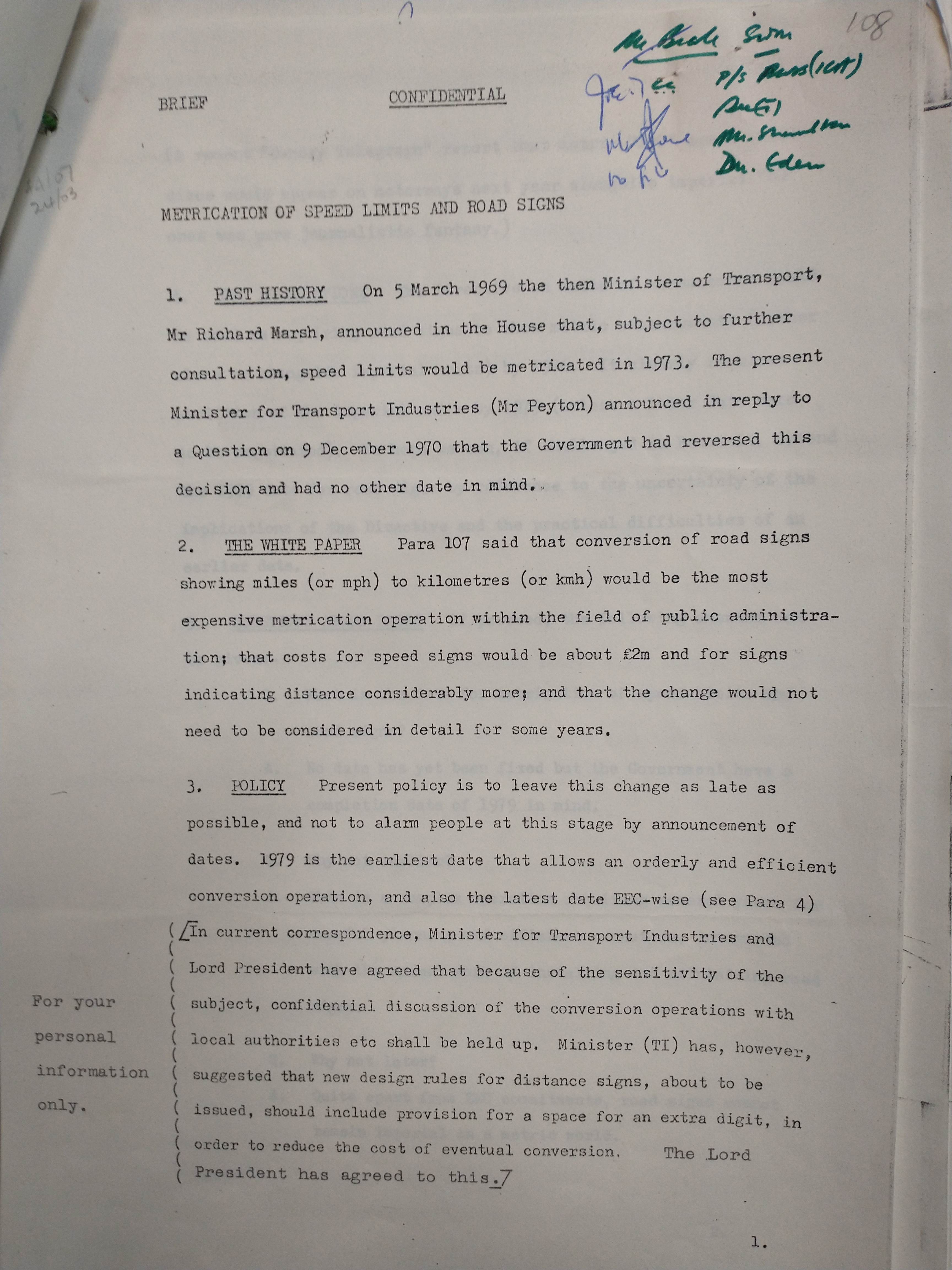
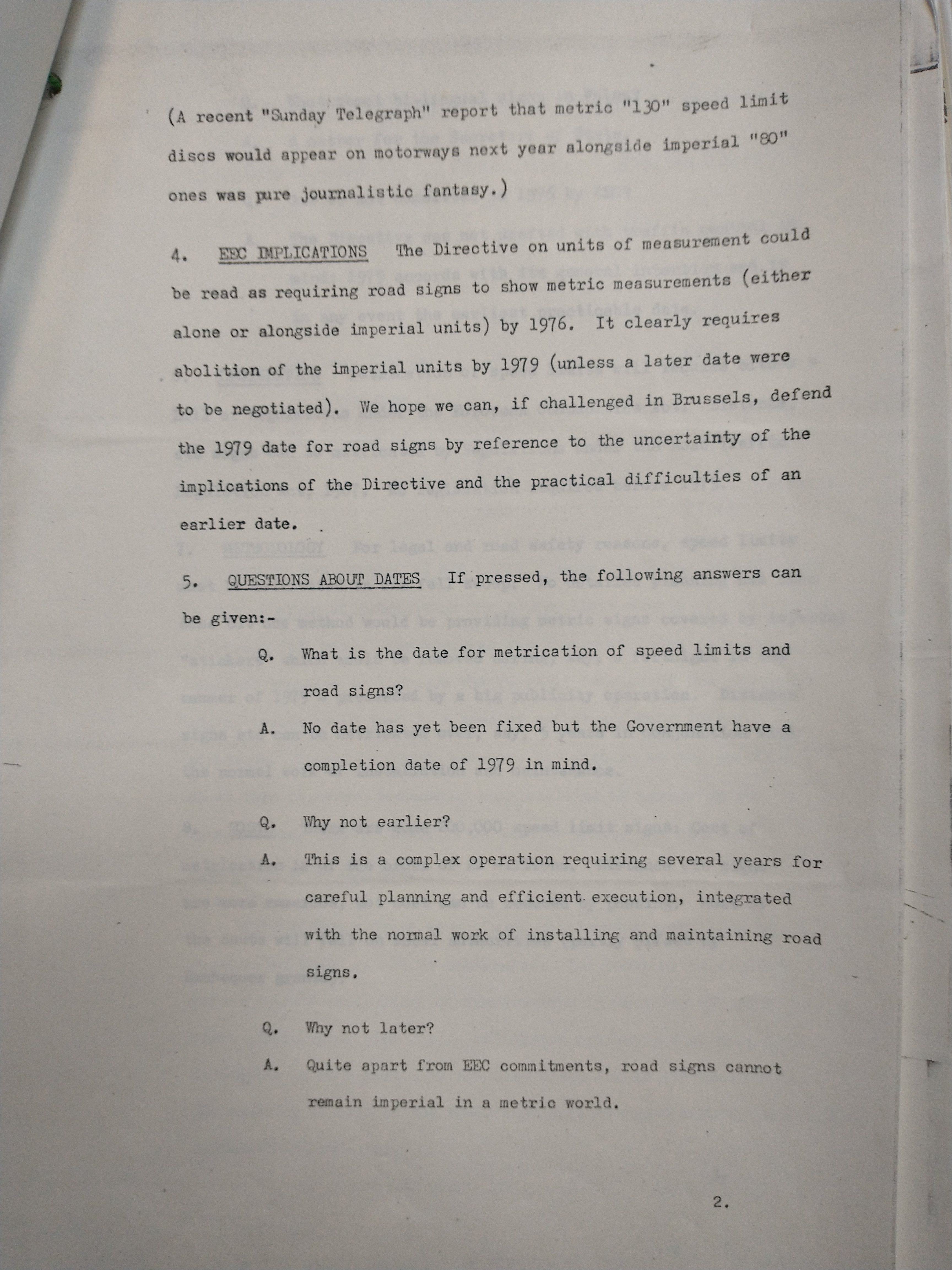
An official briefing paper on the metrication of speed limits and road signs contained a section called QUESTIONS ABOUT DATES. This section contained a list of prepared answers for specific questions. On the question of the date for metrication of speed limits and road signs, the prepared answer was that no date has yet been fixed but the Government have a completion date of 1979 in mind. On the question “Why not earlier?”, the prepared answer was that this is a complex operation that required several years for planning and execution alongside the normal work on road signs. On the question “Why not later?”, the prepared answer was, “Quite apart from EEC commitments, road signs cannot remain imperial in a metric world.” (my emphasis)
The Government, including its own MOT, said that road signs cannot remain imperial in a metric world. Does the Government stand by what they said in the 1970’s? If so, they should draw their own logical conclusion that road signs must be converted to the metric system. If not, we ought to ask the Government when they changed their mind and why.
 Metric Views
“If so, they should draw their own logical conclusion that road signs must be converted to the metric system. If not, we ought to ask the Government when they changed their mind and why.”
I hope UKMA will put this question to the Government. I very much look forward to hearing their reply.
LikeLiked by 1 person
Another excellent article. THANKS.
I, and I’m sure others as well, will wonder how many MPs (of all parties), and members of the House of Lords are aware of this extremely important information.
Is there a simple way to make all those in both the House of Commons, and the House of Lords know about these facts?
LikeLiked by 2 people
Is this a “Yes Minister” script or is it what really happened? I believe that “Yes Minister” was based on fact.
Until we have more people in Government with STEM-based backgrounds rather than Oxford PPE’s we can continue to receive this sort of rubbish. Those of us who watched “Yes Minister” might recall that whenever Jim Hacker made a policy statement, he would turn on the TV to see how his ratings had changed. Have things changed at all?
In the present environment, all that we can do is to educate the public and to press for small changes.
LikeLiked by 1 person
Metricnow,
The government not being a sentient being and capable of making decisions did not change its mind. It doesn’t have a mind to change. One person or group of people felt correctly that metrication can’t be a series of isolated events and possible aware of the parallel changes taking place across the commonwealth felt it made the most sense for road signs to be metricated as well and expressed their sentiments in the report of which is the centre of topic of this particular post.
But the person running the DfT at the time was personally opposed to metrication everywhere in England and interjected his personal preference into national policy where he could and him and his successors continued to resist ever since. Somehow we have to consider ourselves somewhat lucky that their decision did not affect the engineering aspect behind the scenes and the entire DfT is metricated except for signs.
I find it somewhat strange that not one person was ever put in charge of the DfT over the years that would have supported metrication in such a way change could have been brought about at some time in the past. Nor do I understand how the person at the DfT who made this decision to make metric signage illegal was able to trump national policy on metrication. Why did those who planned, scheduled and implemented metrication in those days make sure that no exemptions of exceptions were possible? The only choice the person running the DfT should have been allowed to make was the scheduling and that should have been in harmony with other sectors of the economy, such as manufacturing where there would be a need for synchronising with implementation of the change taking place in the automotive industry. That is to change at the time it was economical for the automotive industry to implement a change in speed and distance displays in the cars.
LikeLiked by 1 person
@Daniel
The DFT is a government agency that ultimately reflects the policy of the government at the time, it is not directly responsible for the decision to keep the signs in imperial. Any government has the power to override the DFT and insist that the signs are put in metric. Your particular point of blame needs to be on the minister for transportation (or whatever equivalent at the time) who is ultimately in charge of the DFT.
“DfT who made this decision to make metric signage illegal was able to trump national policy on metrication”
There was never any policy or intention to make metric road signs illegal but rather the TSRGD works on the basis of not allowed unless specifically permitted. Which there is a good reason for, unrelated to metrication as it ensures road signs are consistent throughout the country. It is just unfortunate that it has it backwards, in the sense that miles, yards and fractions of a mile are the permitted units as opposed to metres and km. All that needs to happen is for a minister of transportation to authorise metres and km for distance then local authorities would be free to phase in those signs.
LikeLike
Alex M,
If road signs laws followed the same laws and requirements as everyone else is required to follow, then shouldn’t they be required to use metric units as primary in larger font on the signs and imperial units may appear on signs only in smaller font as supplemental units? Isn’t that the law? Of course having to sets of units on signs with different fonts is ridiculous, but it is either this or metric only. Isn’t that the law?
So, how do ministers and members of the DfT get away with breaking the law? If it is legal for them to have imperial only signs then why is it illegal for a shop keeper to advertise and sell in imperial? Why are they legally bound to selling in metric only and only allowed to advertise in imperial as supplemental units?
Shouldn’t it be the same sauce for the goose as for the gander? As far as I can see, the minister of the DfT, if he is putting forth laws that allow only for imperial only and metric is forbidden, then he is in breech of the law. So, how is this rectified?
LikeLike
@Daniel The DFT has been given a special exemption that it should have not been to begin with. While they are happy to acknowledge the benefit of metrication when it comes to trade, they are seemingly unable to do so when it comes to transportation. Hence why it has ended up with this inconsistent application, rather than a smooth transition throughout all different departments.
LikeLike
Alex M,
Giving the DfT an exemption was a huge injustice to everyone. Why only them and not everyone else? In a sense this is what the UKMA needs to do, find allies in high places and fight against it. Either within the ranks of government or industry.
Obviously someone at the DfT recognised then and recognises still that metric units has more than an advantage in the trades, it has an advantage in their own organisation, since everything within the DfT is metric except for the signs.
I stand by by assertion that those individuals who have run the DfT over the past 50 years and in the present time, were hoping their little proverbial foot in the door was going to be at some point the catalyst in some master scheme at reverting everything to imperial. It took until the post Brexit period for this to almost happen and I’m sure as long as the road signs remain in FFU, they will continue to try. Much of the pressure is still coming from the fake news media.
https://www.dailymail.co.uk/debate/article-12790919/tax-cuts-tories-brexit-brendan-oneill.html
“The Government ‘watered down’ the timetable for liberating Britain from Brussels-made law. This includes the widely hated EU directive from 2000 which mandated the use of the metric system in most areas – with the notable exceptions of pints in pubs and miles on road signs.”
The Fake News Media is still claiming that pint bottles of Champagne will be back in months.
https://www.thesun.co.uk/news/24899391/major-change-britain-drinking-laws/
The UKMA needs to do its best to fight these attempted reversions. The best way to obtain this victory is to get the road signs changed.
LikeLike
@Daniel says: 2023-12-04 at 19:17
Interestingly banal wailing from the gutter press as always.
I picked out another phrase “We were told we would become a high-seas free-trading nation, in the mould of New Zealand, Australia, Singapore.”
Well, if we trade in the mould of those nations then then we must embrace metric to do so.
As usual the whole of the articles to my mind (not at all biased as in the spirit of the articles) show why the Brexit fiasco was wrong, and that metrication was and still is (wrongly) very much part of the EU issue.
What a shock is coming whey ‘they’ realise the rest of the world, not just EU is metric!
Miles on roads is still the biggest single block to acceptance of full metrication.
The second biggest obstacle is the the media, natural progression seems slowly to be gaining ground, a long road ahead, but they may yet be the only force able to change to this nonsense. Allowing metres is a simple change with big impact, changing speed limits is more of a legal challenge.
LikeLiked by 1 person
@BrianAC
Totally agree that Imperial road signs is the single biggest roadblock to fuller use of metric by everyday folks and even (as a knock-on effect) fuller of metric (only!) in the media. The results in Ireland and even Canada (which is overwhelmed daily with American media using US Customary units) clearly demonstrate that the conversion of road signs to metric moves the population to using “kilometres” instead of “miles” and “metres” instead of “yards” (or even the dreaded “feet”). <:-0
LikeLiked by 1 person
Driverless cars: Tech possible for UK motorways by 2026, transport secretary says
It would be interesting to see how metric driverless cars interact with imperial signage on a national level.
LikeLike
Well Brian, it seems that 81.1 % of the people want the status quo to remain. Fortunately, it means there won’t be any reverting to imperial, but also unfortunately the chances of road sign metrication are close to zero.
Driver-less cars will just be computers talking to each other and they can be programed to do it in metric. Whereas humans struggle with non-rounded numbers, computers don’t. So if the legal speed limit is 60 mph or 96.5606 km/h, a computer will just maintain 96.5 km/h. Unless for some reason once people no longer do the driving the computer speeds are rounded to say 100 km/h or the computers speak to each other in metres per second. Thus 60 mph is 26.8224 m/s or rounded to 27 m/s.
LikeLike
It will be interesting to know how well driverless cars will be able to ‘see’ road signage etc.
Lots of local authorities fail to cut back vegetation etc.
On motorways – road work signage, bollards/cones etc. can often obscure the nornal signage.
LikeLike