
I recently asked the Department for Transport (DfT) when they changed their view about the metrication of road signs. In July 1970, the Ministry of Transport (forerunner of the DfT) wrote in a letter that “imperial speed limits could not be retained within a general metric system”. Since then, almost everything has officially gone metric, but road signs remain one of the few official uses of imperial units. The other official uses of imperial units are pints for draught beer and cider and doorstep milk and troy ounces for precious metals. The DfT now argues that road signs should remain exempt from metrication, contrary to what they said in the letter. I asked the DfT about this inconsistency. They refused to comment on it.
I asked the DfT why they changed their views on the metrication of road signs. In my written correspondence to the DfT, I wrote:
Point 2 of a Ministry of Transport (MOT) letter from 1970 stated that, “The decision to metricate speed limits was not of course a purely Departmental one since it was based on the earlier Government decision to metricate all sectors of the economy, and imperial speed limits could not be retained within a general metric system.”.

I wrote about this issue for Metric Views and you can find my article, including the MOT letter, at:
https://metricviews.uk/2023/11/26/government-once-admitted-that-road-signs-cannot-remain-imperial-in-a-metric-world/

The Ministry of Transport (as the Department for Transport was called at the time) said that road signs cannot remain imperial in a metric world. Does the Department for Transport agree with what the Ministry of Transport said in 1970? If so, what is the logical conclusion the DfT should draw about British road signs? If not, I would like to know when the DfT changed their mind and why.
The DfT refused to explain when or why they appear to have changed their view on the metrication of road signs. I received the following reply from the DfT:
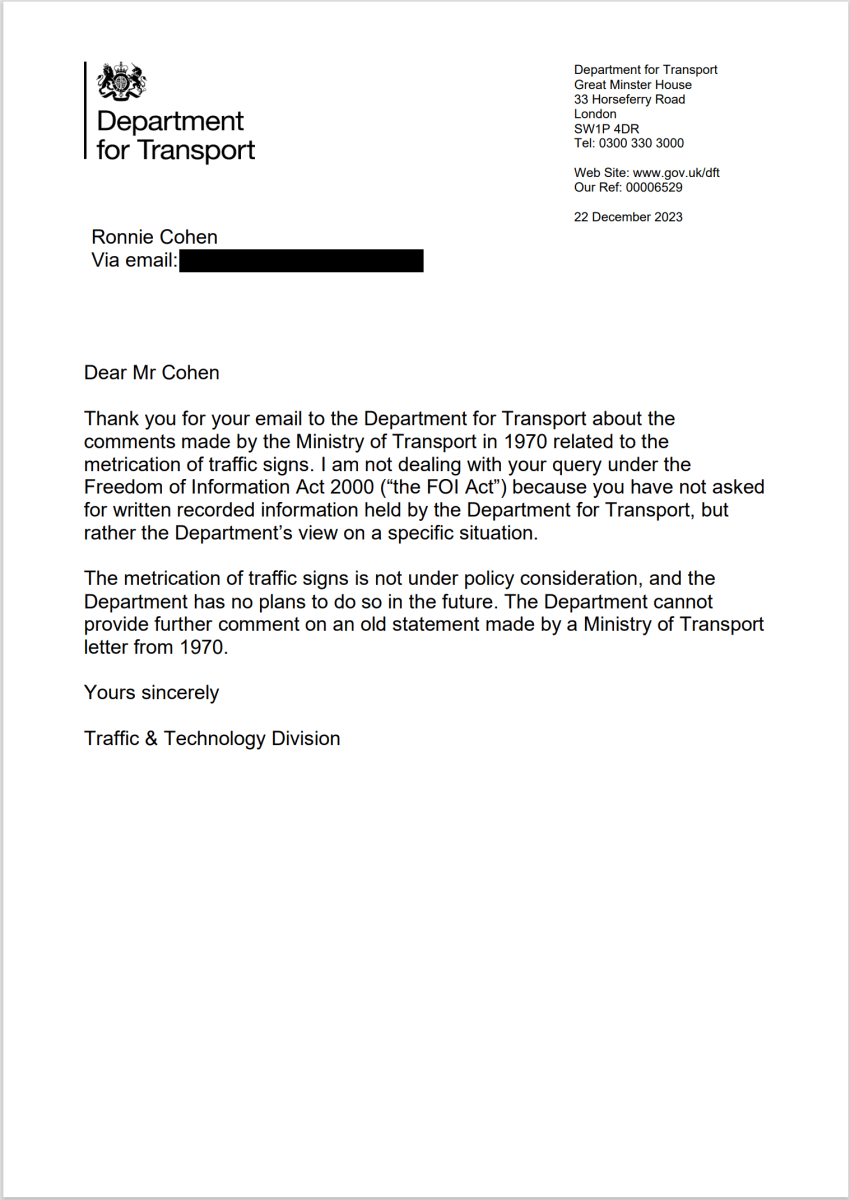
They avoided answering awkward questions about the inconsistency of their current position and what they said in the 1970’s. They cannot possibly hold contradictory positions on the metrication of road signs.


The entire economy operates on the basis of metric units, including the transport sector itself, from the design and construction of motor vehicles to road planning and building and even to the dimensions of the signs above and at the side of the road. It is all metric. The metric system has been taught to generations of children in British schools for half a century. It therefore defies any logic whatsoever to refuse to even contemplate, as the DfT appears to be doing, to bring road speeds and distances into line with this important change in the nation’s life. The Commonwealth countries have all ‘gone metric’ but they have all changed their road speed and distance measurement to metric units too. Why is the DfT refusing to do this? UKMA has shown many times that this can be done on a reasonable cost basis. It would not cost the inflated sums of money the DfT has itself claimed in the past. Our closest neighbour, the Republic of Ireland, has also very successfully changed to metric road signs. (Was that even reported in the UK?) The UK should not be operating dual measurements as an official policy. It flies in the face of logic, safety and security. It undermines and wastes the metric education children receive as everyone, even a pedestrian, is a road user. Has UKMA contacted the Secretary of State for Transport to ask why this situation has still not been resolved, despite the very clear statement back in the early days of the conversion to metric units that imperial speed limits and distance measurements cannot be retained within a general metric environment.
LikeLiked by 2 people
@mertricnow
Spot on comment. I just hope the Labour government can be persuaded to make the change.
LikeLiked by 1 person
I find it perfectly understandable for someone today working for the DfT not knowing why someone from 50 years ago working for the DfT did what they did. But what happened 50 years ago is water over the dam. So isn’t there anyone working for the DfT today that personally supports metrication and sees the advantage of changing road signs? That the population by being exposed to metres and kilometres will understand the metric system that much better and be more useful on the job in a business that needs people who are fully functional in metric.
By not using metres and kilometres on the road, very few people in England have the feel for a kilometre. It is for a full understanding of all metric units, that people in the industries and government in other countries pushed for an across the board approach to metrication, especially in areas where it affected the general public.
LikeLiked by 1 person
punditgi said: ”I just hope the Labour government can be persuaded to make the change.”
Why? What is so special about members of the Labour party that would make them larger or smaller supporters than any other party? What experience do you have with the Labour party that would give you the impression they would support a change in road signs? Have they said something in the past in favour of the metrication of road signs?
LikeLiked by 1 person
Daniel;
I am selectively quoting from your post where you wrote “the population by being exposed to metres and kilometres will understand the metric system that much better and be more useful on the job in a business that needs people who are fully functional in metric”
I’m sure the ‘powers that be’ would reply that people who use metric at work are already fully functional in the units they encounter in their daily activities. Obviously, doctors and nurses will sometimes at least be using different metric units to engineers and builders, for example.
But that misses the wider point that it makes no sense for a government to allow two different systems of measurement to be used at the same time and to believe that that are ‘assisting’ the general public and the consumer by offering a ‘choice’. That completely turns on its head the argument that a country needs a proper system of measurement that everyone is taught and can be expected to know and to use in order to ensure health and safety and consumer protection, amongst other things. It is perfectly obvious that Britain needs to complete the task of using metric for all official purposes. The biggest stumbling block to that at the moment is road signs for speeds and distances.
The DfT should be perfectly capable of providing a proper answer to the question asked if it wanted to. It was official policy 50 years ago to move towards the metrication of measurement in all areas in the UK, not just the view of ‘someone working at the Department of Transport’ (the forerunner of the DfT)’. The answer is surely that the idea was quietly buried and forgotten. Until now.
LikeLiked by 2 people
Ronnie,
I think you are wrong in the claim that the “MOT/DFT” changed its views on metrication. Beside the fact that the “MOT/DFT” doesn’t have a mind to change, we have to look at the people involved.
From the previous post you link to, referring to the letter of 6 Jul 1970, the letter starts off stating that Richard March spoke to the House of Commons on 5 Mar 1969 saying the signs would be metric by 1973. I believe this to be in alignment with the general policy at the time that everything would metricate with no objections and as stated in paragraph 2.
The letter written by K C Fowler, points out that the optimum time frame was for the change to occur in 1971. This must have been for cost reasons. This was further explained in paragraph 2 due to budget restrictions.
The letter in no way indicates a decision had been made to metricate road signs other than it was assumed the road signs would be metricated along the same lines that everything else in the economy was being metricated.
With an understanding that the metrication of road signs was not agreed upon nor already set in stone, it was possible for someone either in the “MOT/DFT”, the government or both to come to a secret decision and agree not to pursue metrication of the road system and to seek an exemption.
There are two failures here, not so much coming from the “MOT/DFT” but (1) from the persons on the Metric Board that permitted this exemption and (2) for the issue not to be address at a future date in order to at some future time to set up the frame work for eventual metrication of roads. Let’s face it, other than pints of beer and milk and gold ounces, there was an exemption with scales in the shops, but eventually, come the year 2000, the laws were changed, forcing finally the metrication of scales. What is the difference between scales and road signs?
Something is wrong where members of the DFT today continue to use the excuse of cost and come up with exaggerated cost estimates based on a total switch-over of signs. It is a standard practice in business to come up with different methods to accomplish the same goal with different costs and to pick the most economical.
So why isn’t the DFT forced to do this? To look at the experience of others who completed the metrication of roads successfully? What about the cost of complete sign replacement versus overlay stickers and replace the signs only after they wear out? What about the slow method the Irish followed until 2005 when speed limits were required to change? There are a lot of inexpensive ways to achieve this goal.
The final comment is why have metric signs been illegal? Metric signs could have been installed over time and many were only to have them defaced. How much would this have saved on the cost? How many signs would be metric by now?
I don’t expect there would ever be a forced metrication of signs, but what we need to fight for at least is the complete removal of all laws that forbid metric signs, the criminalisation of defacing or removing any metric sign and the restoration of all removed or defaced signs at the expence of the defacers.
LikeLiked by 3 people
I’ve always found it absurd that the DfT aren’t required to make sure that anything new is done in such a manner as to avoid any issues converting to metric, such as things like making sure electronic road signs are switchable and capable of displaying multiple units. That said I have noted that on newer roads that signage on the approach to junctions is now often staggered in ⅓ mile distances which equates more closely to 500 m than the ¼ and ½ mile signage of the past.
One possible challenge though is that since the Brexit vote of 2016 I’ve noted in photos of car speedometers that analogue units now often ONLY show imperial units with no secondary metric dial. I realise some may have a separate digital display but this does mean that any changeover immediatly becomes more expensive to the consumer and so likely to be a stumbling block if the general public is to back a change in the future. More so as I seem to recall reading a more recent copy of the rules for new vehicles and recall not being able to find the requirement for dual-unit displays which I’m sure I’d seen not more than a decade earlier.
LikeLike
Free Thinker
Many thanks for your most informative post.
First, if analog speedometers are now being sold in the UK with no km/h indications on the speedometer in addition to the mph indications, that is frankly crazy because anyone who drives such a car into Ireland, France, or elsewhere in the EU will be unable to immediately check if they are observing the local speed limits.
Second, if suppressing km/h indications on speedometers is deliberate on the part of the government, it smacks of Number 10 selling off the lands they had bought for the HS2 right of way just so that the next government (most likely Labour) will have a hard time reviving that project.
Reminds me of how the Romans sewed salt into the earth in and around Carthage after Rome beat the Carthiginians to prevent anyone from being able to grow food in that land so that Carthage could never be revived as a society. What a stupid, short-sighted, and cruel way of looking at the world and one’s so-called “opponents”?
I can only think of what my uncle from Manchester used to say when I think of the Tories and the next general election: “Good riddance to bad rubbish!”
LikeLike
The ETCS (European Train Control System) specification has an interesting feature that handles the situation when trains travel between mph to km/h zones. The control panel (which includes the speedometer) is an LCD display (much like you might have on a laptop, iPad or smartphone). The speedometer is pseudo-analog (ie the screen displays a moving needle) but the units are spaced such that either mph or km/h but not both are displayed. When the train goes from one zone to another, the display changes, but if the train’s speed is the same, the speedometer numbers are spaced such that the needle remains in the same position. This could easily be implemented in cars (Possibly it already has been implemented), but with the driver having the ability to change the display. On one of my wife’s cars, she had a digital display and could only be changed when the car was stationary.
LikeLike
Wow Martin,
All of the extra expense and possible confusion and errors just to accommodate two incompatible measuring units. So, the managers at the DfT think they are saving millions by not metrication road signs, but the cost is still there, it is pushed on to someone else and on top of it, it is a perpetual cost that not only never ends, it grows with inflation.
LikeLiked by 2 people
This short video provides a light-hearted view of why the USA refuses to adopt international road signs. Now, if the USA really wanted to go international with road signs, we would make them metric as well. Maybe someday? I just hope the UK will get around to doing it way before the USA likely does it (after I’m gone, sadly).
Ezra
LikeLike
My car has a digital speedometer and I use km/h all the time. It even converts the speed limit for me, like showing 64 on screen at a 40 MPH road.
I also set my Google Maps to show km instead of mile.
We don’t have to beg DfT to change system. As modern cars mostly have digital dashboards, if anyone wishes they can start using km/h instead of MPH straight away.
It does not matter if road signs still use MPH. People pay more attention to their sat navs nowadays than road signs.
LikeLike
@TellMeInSimplerTerms Converting road signs to metric will have a psychological effect not only on drivers but on passers-by as well. We have seen this in Australia, New Zealand, South Africa, Ireland, and Canada.
But what you say does make a good case for converting distance signs as quickly as possible (no legal effect) and as stated elsewhere make all signs with “yards” say “m” for metres and make all length, height, and width restriction signs metric only.
The issue of speed limit signs can be addressed later but the above will be a good start (as well as making metric only signage completely legal everywhere in the kingdom).
Ezra aka punditgi@
LikeLiked by 1 person
@TellMeInSimpleTerms: Not all cars have the feature to which you are alluding. If your speedo is GPS-linked, great, but if not, you could have trouble travelling between RoI and NI. Also, having your speedo convert between MPH and km/h requires that all vehicles in Europe have such a feature, even if the owners never plan to visit the UK. Furthermore having UK out of synch with the rest of Europe means that if the UK decides to synchronise with the rest of Europe, everybody will have to ensure that their speedos know that they need no longer convert between the two.
LikeLike