
In Part 1 of this article, we saw that one of the basic methods by which a digital measuring device operated was the conversion of an analogue signal (often a voltage or an electric current) into a set of digital bits. The number of bits determined the precision with which the device could take a measurement. The article went on to describe the workings of a digital thermometer and how domestic-quality thermometers are often designed around the use of degrees Celsius with displays in degrees Fahrenheit being an add-on where the Fahrenheit display is calculated from the equivalent Celsius measurement.
In this article we will look at how digital weighing devices work.
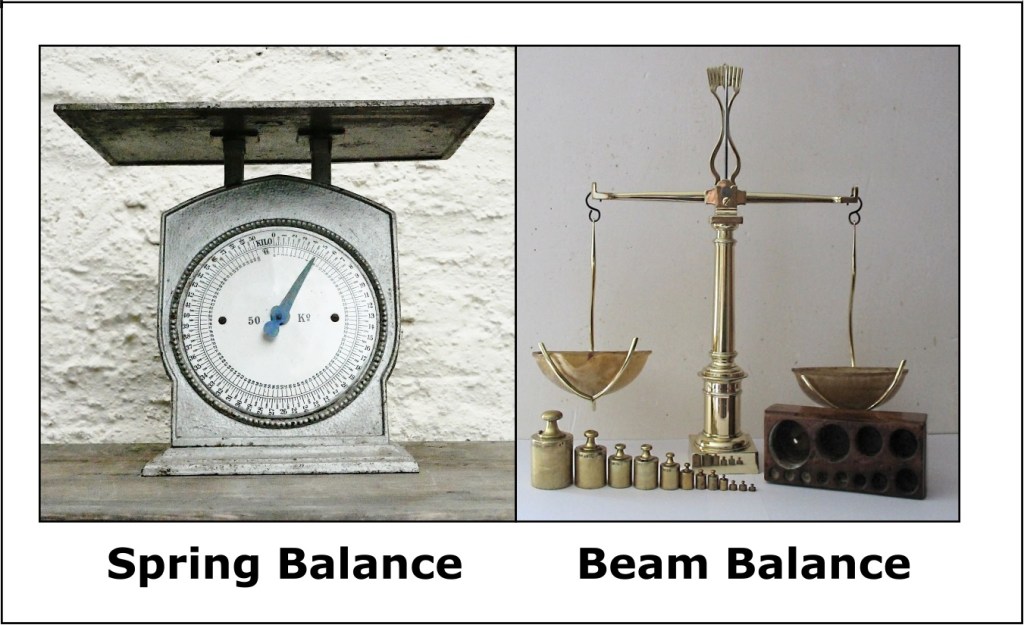
Fundamentals
The above diagram illustrates two different ways in which weighing devices operate. The beam balance on the right weighs an object by balancing its weight to a selection of weights of known mass. The spring balance on the other hand works by measuring the gravitational force exerted on the object. This force is counteracted by a spring which causes the needle to move, thereby indicating the weight of the object. Unlike the beam balance, the spring balance relies on gravity and will therefore give a different reading should it be used in areas where the gravitational force is different – in practice the gravitational field at the poles is 0.45% greater than at the equator. Thus, if two objects that have different densities appear to have the same weight at the equator, their weights will appear to be different at the poles even though their masses have not changed.
Most digital weighting devices operate in a similar manner to the spring balance with the difference being that the spring is replaced by a load cell which produces a voltage that is proportional to the gravitational force exerted on the object. As described in Part 1, this voltage can be converted to a set of digital bits using an analogue-to-digital convertor. These bits are then converted using digital electronics to a reading which can be displayed to the user (or printed out on an appropriate printer).
Certification
No measuring device can ever be 100% accurate so laws exist to clarify what is acceptable and what is not acceptable when a weighing device is used for a commercial, medical or scientific operation that has real-life consequences. In 1988, the International Organisation for Legal Metrology (OIML) published Recommendation R076 which lays out a recommended legal specification of weighing devices. This recommendation was last updated in 2006 and forms part of the basis on which current UK and EU legislation is based.
It is hardly surprising that R076 is entirely metric – §2.1 states that in general four units of mass will be recognised – milligrams, grams, kilograms and tonnes. As an exception carats may be used for weighing precious stones. (1 ct = 0.2 g). No provision is made for the display of other units of mass, thus the NHS Medical Patient Weighing Scales notice (Notice EFA/2010/001 published in 2010) required that weighing devices only display metric units.
Recommendation R076 defines four classes of weighing device:
- Class I devices are of the highest accuracy, often used by standards laboratories.
- Class II devices are high accuracy devices and are typically used for laboratory work.
- Class III devices are typically found in supermarkets and in hospitals where a reasonable degree of accuracy is required.
- Class IIII devices are typically found in mobile medical settings where ruggedness takes priority over accuracy.
Weighing devices that meet the recommendation display one of the symbols shown below (as appropriate).

The standard also lists many other requirements that are to be met including, but not limited to details of the display, default temperature operating range, maximum allowable deviation from the true mass etc. Furthermore, scales that are R076-compliant need to be recertified at regular intervals. The standard makes no provision for any units of measure other than metric units, so under current UK law, all scales that are legal for use in commerce, healthcare etc may only display metric units.
Weighing devices come in all shapes and sizes from jeweller’s scales to industrial traffic weighbridges. Recommendation R076 catalogues three parameters by which weighing devices can be sized:
- Verification scale interval: This is the smallest increment that can be detected by the device. In digital devices this typically corresponds to one bit and is denoted by “e”.
- Number of verification scale intervals: This denotes the number of intervals that correspond to the device’s highest reading. In the case of Class III devices this must lie between 500 and 10 000. If “e” has been defined as 5 grams, then the device capacity must be at least 2.5 kg (5 x 500 grams) and need not exceed 50 kg (5 x 10 000 grams)
- Minimum capacity in scale intervals: This is the lowest number of intervals for which a recorded weight will be valid. In the case of Class III devices, this must be at least 20 intervals. Thus, if “e” is defined as 5 grams, the minimum weight for which the device is certified is at least 100 g (5 x 20 grams).
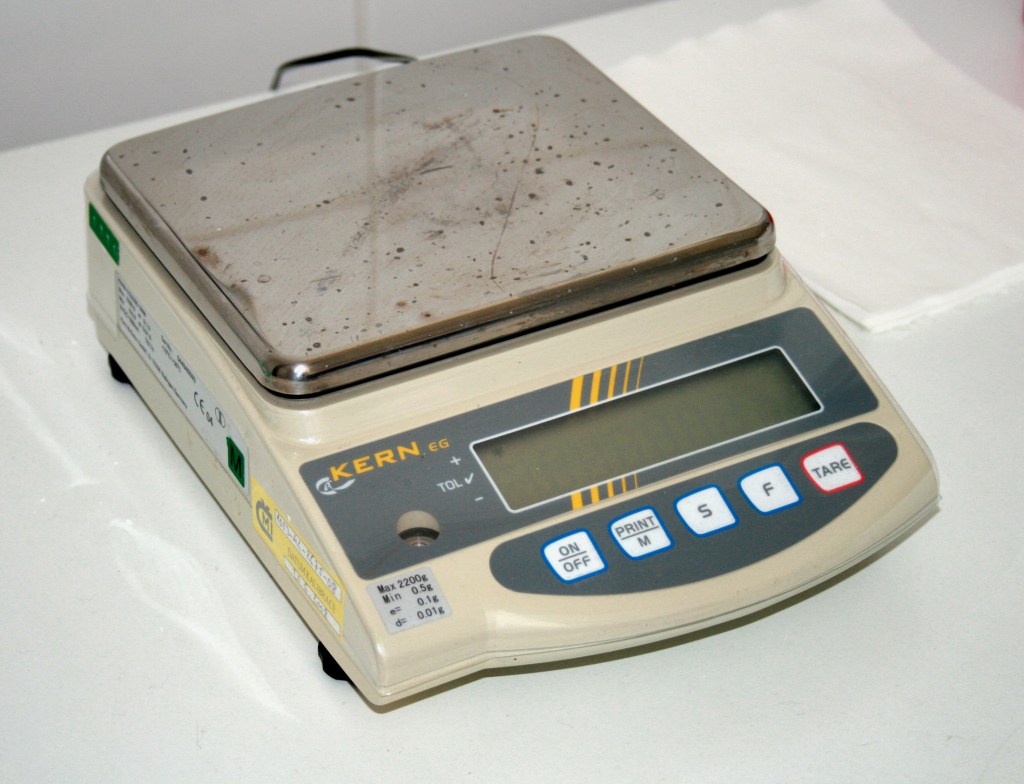
In practice, many weighing devices have multiple scales. For example, my bathroom scale has three separate scales – the lowest is in 0.1 kg increments for weights up to 50 kg, the second is in 0.2 kg increments for weights in the range 50 to 100 kg and 0.5 kg increments for weights above 100 kg. Since there are 500 intervals in each range, these scales could be R079 compliant, but since the paperwork associated with proving compliance is expensive, domestic devices are not usually certified.
Practical Home Devices
I have three digital weighing devices at home, all of which have multiple units and none of which are R076-compliant. (R076-compliant devices are much more expensive and I am not willing to pay for certification of these devices).
These scales are:
- Bathroom scales
The first is the bathroom scale described above which I purchased in 2000. It was built for the UK market and has a kilogram/stone switch. Its maximum capacity is 150 kg or 23 stone. In the range 0 – 50 kg, it weighs in intervals of 0.1 kg, between 50 kg and 100 kg the intervals are 0.2 kg and above 100 kg the intervals are 0.5 kg. The imperial scale has increments of 0.5 lbs up to 10 stone but since it only has four digits in its display, it has to drop the last digit for weights above 9 stone 13.5 lbs (63 kg). Thus, the metric units resolution is twice that of the imperial unit resolution, suggesting that the imperial unit display is calculated from the metric measurement.
- Kitchen scales
The second digital weighing device that I own is a kitchen scale. It can switch between kilograms/grams and pounds/ounces. Its maximum capacity is 5 kg (11 lb) and its increments are one gram or 0.1 ounces depending on the units setting. The astute reader will notice that metric unit resolution is more than twice the imperial unit resolution. This suggests to me that again the imperial units are calculated from the metric units rather than being measured separately.
- Jeweller’s scales
The third digital device that I have is a jeweller’s scale which can weigh up to 200 g in 0.01-gram increments. It can be switched to avoirdupois ounces, troy ounces, grains, carats and pennyweights. I compiled a table of the device’s capability in various units of measure:
| Unit | Eq wt (g) | Max | Δ (unit) | Δ (mg) |
| gram | 1 | 200 | 0.01 | 0.010 |
| ounce | 28.35 | 6.9 | 0.001 | 0.028 |
| troy ounce | 31.1 | 6.01 | 0.001 | 0.031 |
| pennyweight | 1.555 | 128 | 0.01 | 0.016 |
| carat | 0.2 | 1000 | 0.05 | 0.010 |
| grain | 0.0648 | 290 | 0.2 | 0.013 |
where
- Eq wt = Equivalent weight of one unit in grams
- Max = Maximum displayed weight (approx.)
- Δ (unit) = increments in specified units
- Δ (mg) = increments in milligrams
These figures suggest very strongly that the device was designed to optimise the use of metric units. Since there are 24 grains in a pennyweight, one would expect the two units to be coordinated, but they are not – the pennyweight incremental weights and the grain incremental weights are different.
References
Non-automatic weighing instruments: Part 1: Metrological and technical requirements – Tests (OIML): https://www.oiml.org/en/files/pdf_r/r076-1-e06.pdf
EFA/2010/001 – Medical Patient Weighing Scales: https://www.nss.nhs.scot/publications/estates-and-facilities-notice-efa2010001/

