
John Austin reports on the athletics programme for the 2026 Commonwealth Games, which will commence in Glasgow, Scotland on 27 July. National and International Athletics is almost entirely metric. The only imperial measurements in general use are “beneath the surface”: some shot weights are in whole numbers of pounds and hurdle and steeplechase heights are in imperial. Even the marathon is not an official distance in miles but is rather 42 195 m. So it may come as a surprise to most people to find that the 1500 m races have all been replaced by 1 mile [1].
The distance has of course a great deal of historical and cultural significance due to the attempt in the 1950s to be the first athlete under 4 minutes. Many at the time questioned whether it was even physiologically possible. Of course, Roger Bannister achieved that target in 1954 [2] and it has immortalised his name and the distance remains a classic distance on the athletics programme. However, it is not run that often, with the 1500 m race being far more dominant. I always preferred a 1500 m race in my 20s because it is that little bit shorter (by 109.344 m) and you have the complete back straight to slot into position in the field before the first bend. In the mile race, there is just a short distance before the first bend, so if you are not fast enough off the start line, you have an extra distance in lanes 2 or 3 to cover.
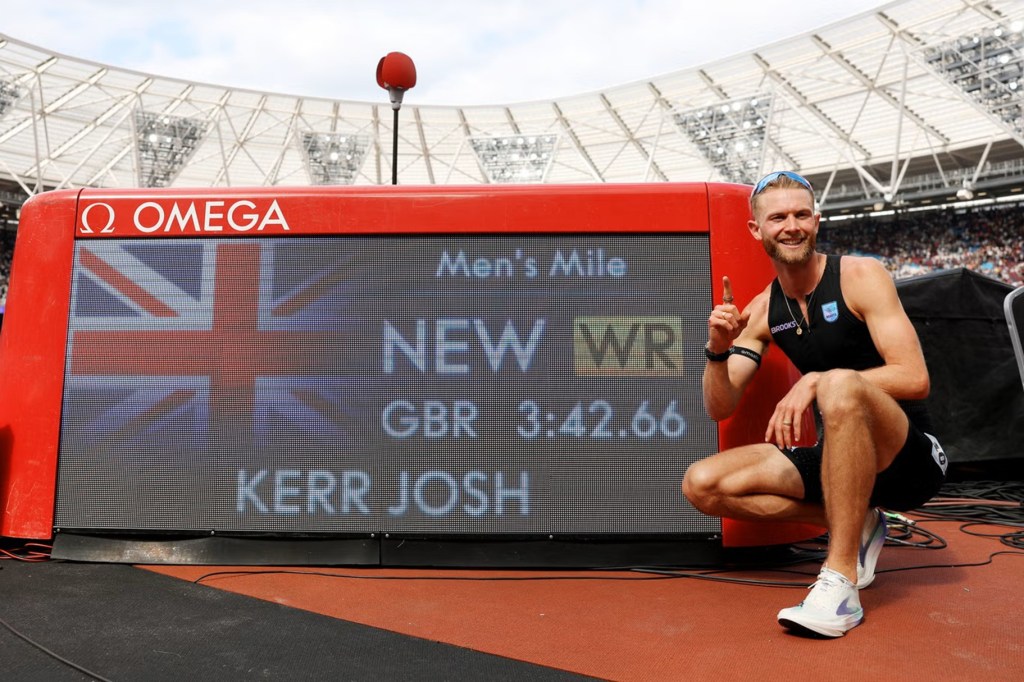
As if on cue, Josh Kerr, who will be running for Scotland in the Commonwealth Games, set a new world record for the distance at the London Diamond League Athletics meeting on 19 July. This was a substantial performance, beating a 27-year-old record, and it brought back the mile record into British ownership once more. The media interviewed Seb Coe and Steve Cram, former holders of the record and both praised Josh’s performance profusely. Cram in particular was part of the BBC commentary team for the event.
The track was remarked for the occasion, and Cram with his usual penchant for humour, said that he hoped that they had measured the distance properly. Like all good humour, there is hidden depth in this remark. If the distance were found to have been just 1 m short, then even though it would take an athlete only a fraction of a second to cover that metre, it would completely invalidate any record. When a track is measured in metric, but an imperial distance is run, extra care is required. Usually a mile race is started from a curved line 9.343 m from the finish line. So you need to run 4 laps plus 9.343 m. The shape of the curve line is computed by projecting a straight line from the curved line to the bend, assuming the runner takes the shortest route. If there are many athletes present this would lead to collisions, as I alluded to in the opening paragraph. The London meeting organisers reduced the chance of collisions or extra distance needed to run by introducing a second curved line further out from the kerb and by splitting the runners between the two start lines. To ensure that everyone ran a mile but no further, the second curved line would have needed to have been measured accurately. This appears to have been an innovation, so Cram would not have experienced this in his racing career. Of course none of this is necessary in a 1500 m race, where runners have almost 100 m to slot into position and a single curved start line suffices for as many as 20 competitors.
The Commonwealth Games Championship record dates back to 1966 (Kip Keino of Kenya in 3:55.34) [3]. In 1970, the games went metric and the 1500 m record is now 3:30.12 by Oliver Hoare (Australia) from 2022 [4]. As Martin Ward has commented, it is certainly ironic that the first metric games in 1970 were in Edinburgh, also in Scotland. With Josh Kerr’s new world record (above) almost 13 s faster than Kip Keino in 1966, a new games record is almost inevitable. It will seem odd for spectators to hear mile times instead of 1500 m times, and the competitors will likely want to try to convert their times to approximate 1500 m times. Many personal bests will be set but they won’t have the same meaning as 1500 m bests, especially for the women knocking on the door of 4 minutes. I pity the top class women who have to endure the 4 min mile hyperbole.
Changes in the World Athletics programme have been small and subtle over the last few years. They have been stimulated by Seb Coe (former world record holder over the 1500 m and, yes, mile and numerous other achievements too many to note) as head of the International Association of Athletics Federation. Some of the innovations have not gone down well, others have flourished. I disagree, though, with Coe’s contention that the sport needs to change in order to attract more public interest. Personally, I think the powers that be should leave the sport to evolve naturally. I believe that the public only has a limited capacity for sport at the highest level and trying to pull spectators from other sports endangers losing the interest of more devoted fans. To my mind, it is the performances of the competitors on the world stage that will determine the ebb and flow of spectator interest. I certainly wouldn’t want to see the mile race at other championship events and I hope this experiment is reversed for the next Commonwealth Games.
Acknowledgement: The topic of this article was suggested by Martin Ward.
References
[1] Commonwealth Games 2026: Mile Race Returns and Mixed 4x400m Relay Introduced – Running News Daily by My BEST Runs – My BEST Runs – Worlds Best Road Races
[2] roger bannister 4 min mile – Search
[3] Athletics at the 1966 British Empire and Commonwealth Games – Men’s 1 mile – Wikipedia
[4] List of Commonwealth Games medallists in athletics (men) – Wikipedia

 Metric Views
There has never been a women’s mile race at the Commonwealth Games before, so the Games organisers can’t pretend that this is some sort of tribute to the past. It seems that the para athletic 1500-metre races remain unaffected by this stunt.
As there is no internationally accepted symbol for mile, it will be interesting to see if they will be using the same abbreviation that the Department for Transport uses for mile on UK motorways?
If so, the new events will be the “Men’s 1 m” and “Women’s 1 m”.
LikeLiked by 2 people
There is a symbol for the mile: mi Not sure if it is internationally accepted though.
On this particular subject, I think it’s a retrograde step to be re-introducing imperial distances in any sport. It only really appeals to US (and older UK) competitors and spectators.
If we are going down that route, we should be changing the Marathon back to it’s original distance of 40 km, not the ridiculous distance it is now (set due to the whim of Princess Mary over 100 years ago).
Marathon – Wikipedia
LikeLiked by 2 people
The biggest ratio between any track events is the difference between the 1500 metre and 5000 metre events where the ratio is 3.33. If they are looking for new events, why not the 500 metres, 1000 metres and 2000 metres (to replace the 400 metres, 800 metres and 1500 metres). This would make the ratios between any two events 2.0 or 2.5 (or 2.12 in the case of the ratio between the 10,000 metre and half-marathon events). In addition, the half-marathon (not an Olympic event) could be added as a filler between to 10,000 metres and the marathon
LikeLiked by 1 person
To “m”, I agree that there is no historical significance of the women’s mile. In fact there will be an inaugural championship record. On this aspect, the organisers can’t win. If they have a women’s mile, there is no historical precedence. If they keep to 1500 m for the women, they can be accused of treating women differently to men. I suppose para athletics has a different organisational chain and may not have agreed to the change from 1500 m to a mile. It will be interesting to see what symbol the CG organisers use for the mile. Perhaps they’ll spell it out each time, as it’s only 4 letters. When I was competing the symbol M was used to avoid confusion.
I agree with “modernman” and, as I mentioned in my article, I don’t like the idea of mile races. The mile is a great race for events like the Diamond Leagues and so on, where the outcome of the race doesn’t matter and is soon forgotten. Records are still important, though, for historical and cultural reasons. I would disagree about changing the marathon distance. There have been good physiological reasons for holding it at around 42 km rather than 40 km. Most well-trained athletes have enough fuel to last about 2 hours, but at the elite level, until recently this has not been long enough to enable the athlete to last to the finish line. As a result, the leading positions can change significantly in the last 2 or 3 km, depending critically on fuel management by the athlete. so I don’t support a shortening of the event. Whether the distance is 42 km or 42.195 km makes no practical difference. As the event is run on public roads, the course has to be surveyed each time it is used. So for record purposes and so on, we should maintain the event distance.
To Martin Vlietstra, I would point out that the CG organisers are not looking for new events per se! Current track events have been established over many decades as metric equivalents of old imperial measurements. Hence, the there is a 400 m event (the old quarter mile) not 500 m. There won’t be any support for many changes as athletes need to be fine-tuned to their distance. Martin is right that in the current programme there is a big gap between 1500 m and 5000 m. It makes it very difficult for any 1500 m runner who is pressed for speed to move up a distance. There is, then, an argument for adding a 3000 m to the programme. This is a commonly run race on the international circuit, and it brings together the endurance (5000 m) athletes and the faster (1500 m) athletes. Of course at international level, the women used to run 3000 m but this was scrapped in championships in favour of equality. I also agree that championship half marathons would be appropriate. In fact the events do exist in principle, but are held away from the main championships. So they tend to be out of the public gaze. One proposal, then, would be to move the half-marathon to the main championships and move the marathon to another event, such as one of the spring “City” marathons. Both events would maintain their status. The problem with the championship marathon nowadays is that the event is held in the middle of summer, usually in a hot climate and that is simply not healthy even for the best of athletes.
LikeLike
I don’t think too many people realise that the 1500 m race is in fact the old Roman mile as the Roman mile is/was about 1480 m. The 1500 m was just a round of up this value. In reality, the 1500 m race should be the replaced by the 1600 m, not because it is close to the English modified mile, but because it is a whole number increment of 400 m. It would be exactly 4 time around the track. If one wants change, they can introduce a 2 km race which would be 5 times the base 400 m race.
As for the Marathon, it was originally 40 km and should have remained that way. It should be returned to it. All Marathon races time the 40 km point so every runner who has run this race has his/her 40 km time to compare to all other 40 km times. 40 km is ideal as it is also an exact increment of 400 m, that being 100 times. A half Marathon of 20 km would be 50 times the 400 m base distance.
In reference to the decision to by the Commonwealth Games organisers to reintroduce the mile, it makes no sense since in every other event world-wide it will be 1500 m that will be run and comparisons will be difficult. Plus those who will be running in the event will have difficulties running the extra 110 m as they have trained themselves to run 1500 m. This stunt has to originate among English Luddites still pushing for a return to imperial. I would hope the next time the Commonwealth Games are held in a different country, one that is metric, with no attachment to ignorance, the 1500 m will return.
LikeLiked by 2 people
This year Birmingham is hosting the European Athletics Championships and, here too, races that have hitherto been in round metric distances, have been changed for no apparent reason to non-round metric distances:
https://en.wikipedia.org/wiki/Category:Race_walking_at_the_European_Athletics_Championships
The walk race distances were shown on screen as 42.2 KM and 21.1 KM.
Half marathon race walk report | Pérez establishes inaugural world record with 1:30:06 in Birmingham
https://www.european-athletics.com/home/news/half-marathon-race-walk-report-perez-establishes-inaugural-world-record-with-1-30-06-in-birmingham
LikeLike
Further to my previous comment, it seems that the decision to change the race walk distances was made by the Council of World Athletics, chaired by President Sebastian Coe, at a meeting held on 3 and 4 December 2024 in Monaco.
https://worldathletics.org/download/download?filename=4428b6a0-ab13-429e-8a71-cf85d53976e0.pdf&urlslug=Decisions
“The Council of World Athletics, chaired by President Sebastian Coe, met on 3 and 4 December 2024 in Monaco.”
“2.1.5 Race Walk Distances
Council also approved the introduction of new official senior road distances for race walking events to help put the remarkable achievements by athletes into context, make the events more relatable for fans, and encourage mass participation.
The standard senior distances for race walking will therefore change from:
• 20km race walk to half marathon race walk (21.0975km)
• 35km race walk to marathon race walk (42.195km)
These changes will be implemented starting 1 January 2026 in senior World Athletics Series events.”
Lord Coe’s comments were reported in the Lancashire Walking Club’s blog:
“As for the status of these new distances in the Olympic Games, Coe noted:
“I think that is a question that is best directed at the [IOC] Program Commission and the Sports Department. What we’ve said is race walk is secure in our World Championships.””
https://lancswalkingclub.com/2024/12/06/major-changes-to-race-walking/
LikeLike
m,
Why do I get this sneaky suspicion that this is all being brought on by those people who just a few years ago tried to sneak in an attempt to revert England back to full imperial? They failed, but I’m sure that isn’t stopping them from looking for places to make it happen, such as in public sporting events. None of these changes are being introduced by anyone outside of England. But, I’m sure the ones who brought about these changes are hoping they can continue the momentum.
Even though the marathon is not an imperial distance, the fact that the English changed it from a round 40 km, to a somewhat rounded imperial value, those outside the metric world don’t think of it in metric terms. I wonder if Sebastian Coe is an honourary member of the BWMA. I’m also somewhat perplexed that when these changes are pushed through, voting members of these organisations from outside of England are resisting. What next?
LikeLike
I share your suspicions Daniel. The changes to race lengths in the Commonwealth Games and the European Championships both seem to have been championed by Sebatian Coe. It will be interesting to see if the changes are duplicated in the next Olympic Games.
https://www.glasgow2026.com/news/4211918/the-enduring-magic-of-the-mile-a-distance-with-global-appeal
“So why the change?
The reintroduction of a discipline referred to as the ‘Commonwealth Mile’ into the Games programme was the brainchild of World Athletics President Sebastian Coe.
President Coe said, “… The Mile is easy to understand; it is four laps of the track and remains a standard everyday measurement across the Commonwealth.“”
LikeLike
m,
Sounds like something a member of the BWMA would say. But, he is wrong. The mile is not 4 laps of the track. The track length is 400 m exactly and 4 times is 1600 m, not a mile. American High School track races don’t do the mile nor the 1500 m, they do the 1600 m.
Now I’m wondering if the mile races of the recent Commonwealth games was in fact 1600 m and not a mile. But, I’m sure we will never know.
LikeLike
I asked Google about DfT in the new government and this is the response (which does not seem to be good news for metricating road signs in the UK):
Heidi Alexander remains the Secretary of State for Transport, keeping her position at the Department for Transport during Prime Minister Andy Burnham’s cabinet reshuffle.
Transport Leadership Details
LikeLike