
The signposting of the clearance of bridges and other overhead obstructions in the United Kingdom is a mess. Clearances on service station canopies, access to buildings and car parks, motorway construction sites and airside at airports are given in metric units while until 2002 imperial units were used exclusively on road signs. In 2002, the use of metric units alongside imperial units was permitted on height, width and length restriction signs and in 2016 it became mandatory to use both metric and imperial units. It appears that the 2016 requirement to use both units is not properly enforced, possibly to placate voters who are opposed to metrication.
Legal Requirements for Road Signs
On the roads, there are two classes of road sign relating to height restrictions – prohibition signs and warning signs.
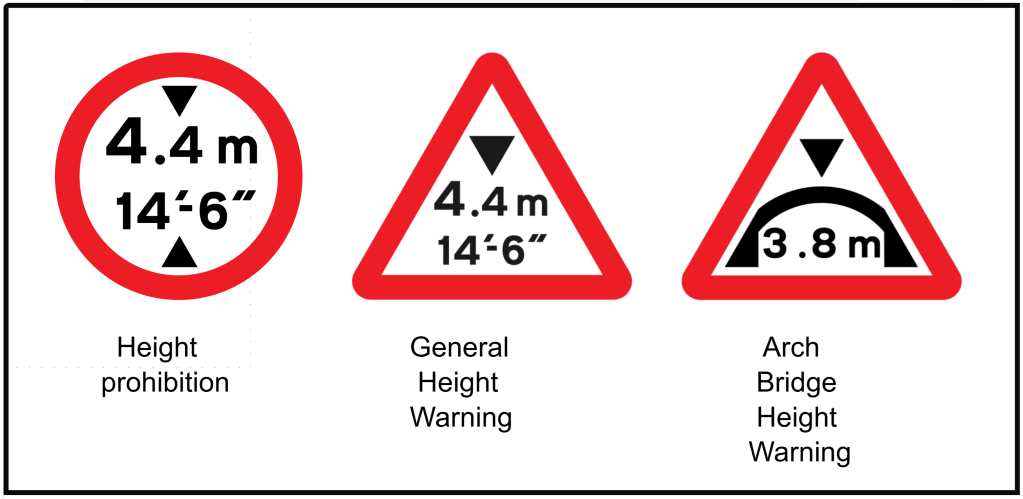
Prohibition signs are often found on bridges and other obstructions (see picture below) while warning signs give advance notice of such an obstruction. A driver of a high vehicle can always drive past a warning sign, especially if his destination is before the actual obstruction itself.
At the turn of the millennium, all height warning signs were in imperial units only, but since the turn of the millennium, metric units were first permitted (alongside imperial units) and are now mandatory whenever a sign is replaced. However, it is still mandatory to display imperial units. The author has noticed a number of cases where the metric unts are not displayed, especially on warning signs.
The stated bridge heights that are less than the true bridge height to give a safety margin. This allows for, amongst other things, irregularities in the road surface, changes after resurfacing and driver error. The resultant safety margin is between 8 and 18 centimetres when using metric units and between 3 and 6 inches when using imperial units. It should be noted that because of rounding the two safety margins are not identical. (Ref 11)
The main purpose of height warning and prohibition signs is to reduce the number of bridge strikes, especially where HGVs collide with low railway bridges. On average, there are five lorry strikes of railway bridges per day. Network Rail states “We are aware that bridge strikes can involve drivers from other countries who may be unfamiliar with our roads or are driving left-hand-drive vehicles”, and Network Rail prepared leaflets aimed at foreign drivers. (Ref 1)
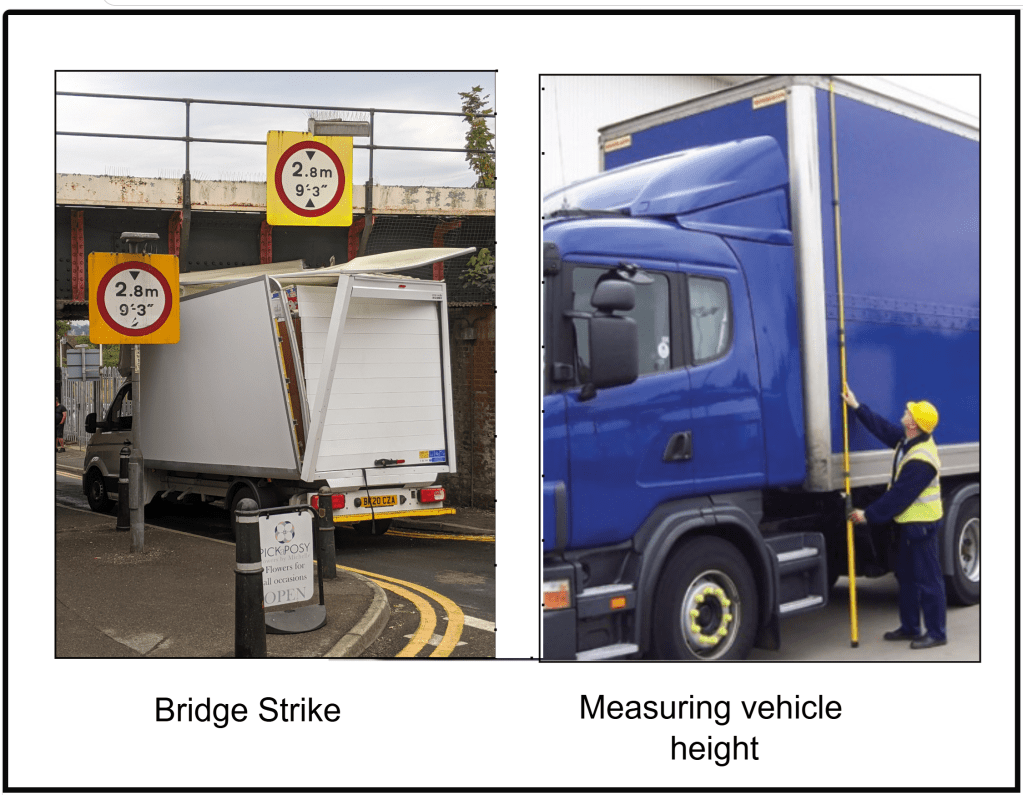
How effective is this program? Under the “The Road Vehicles (Construction and Use) Regulations 1986”, users of UK-registered vehicles that are over 3 metres in height are required to display the vehicle’s height in feet and inches in the cab using characters that are at least 40 mm high and which are positioned in such a way that the driver can read them. Metres [sic] may also be used an optional extra. These details are summarised in the Department for Transport document “Prevention of Strikes on Bridges over Highways”. (Ref 3) The regulations are silent as to the precision required in the displays, but there is an implication that when using imperial units, a precision of one inch is sufficient. The document goes on to recommend that in view of the number of foreign drivers in the UK, that dual units be used. The document is silent as to the precision required for metric units and it is common for the displayed height of busses to be quoted in millimetres. (Ref 2). Measuring sticks as shown in the diagram cost between £50 and £100 and adjustable stick-on in-cab display can be bought for £10.
The requirement that vehicle heights must be clearly visible to the driver does not apply to foreign vehicles that are under 4 metres in height. (Ref 2) The figure of 4 metres probably derives from the 1996 EU Directive 96/53/EC which states that no EU member state may prohibit the entry into its territory of a vehicle that is less than 4 metres in height on grounds that it is too high. In practice, all EU member states apart from Norway, Sweden, France and Ireland use a 4-metre height limit on their own vehicles so are unaffected by this UK rule. The directive is however silent about the means whereby the driver should know his vehicle’s height, though it does require that the vehicle’s width and length be displayed on a maker’s plate.
While the British literature aimed at HGV drivers highlight the need to ensure that drivers know the heights of their vehicle and give guidance on how to conduct the measurements, the Irish documents such as the “Collite Drivers Handbook” (ref 8) and the Quarry delivery handbook (ref 9) make little or no reference to checking vehicle height. The Irish Concrete Code of Practice (ref 10) does suggest that drivers should check the heights of bridges that they might encounter along their route but says little more. This suggests that Irish HGV vehicles are not required to have their vehicle heights displayed inside the vehicle cabs.
Foreign Drivers
Are foreign drivers more at risk of bridge strikes than British drivers? Although the author cannot find any statistics to prove this, there is a considerable amount of anecdotal evidence on the internet suggesting that this is the case. Why then are foreign drivers more likely to be involved in bridge strikes than British drivers? Reasons include:
- Driving on the left-hand side of the road diverts attention from other road matters such as awareness of low bridges.
- Not understanding feet and inches.
- Unfamiliarity with the notation «12’6” ». (Note 1) According to the EU directive 80/181/EEC and the now deprecated international standard ISO 31-1 the symbols “ft” and “in” are used to denote feet and inches respectively. According to these documents and to ISO 80000-3:2019 (which superseded ISO 31-1), single and double apostrophe are symbols that denote minutes and seconds of arc. When ISO-31 was replaced by ISO 80000, references to feet and inches were dropped.
- Not knowing their vehicle’s height. There are many devices on the market to enable drivers to measure their vehicles. This is especially necessary for articulated vehicles where the tractor does not necessarily pull the same trailer or semi-trailer.
Looking at each of these in turn:
- There is little that can be done about driving on the left as opposed to the right. (The only countries in Europe traffic drives on the left are the island nations of the UK, Ireland, Malta and Cyprus). The cost of changing over would be enormous. This of course means that more effort should be put into mitigating other problem areas.
- During the last decade Britain has been in the process of displaying bridge clearances in both metric and imperial units. Dual units have been permitted since 2002 and have been mandatory on all new signs since 2016, but this does not appear to be fully enforced.
- Both the Vienna Convention on Road Traffic and EU Directive 96/53/EC) are silent about in-cab height indicators. (Ref 4) Imposing an obligation on incoming height vehicles to comply with the same regulations as British vehicles could cause problems as UK regulations require feet and inches.
Proposal
British politicians of all parties are always sensitive to public opinion when introducing changes as the opposition will often seize on any proposed change to whip up public opinion against the government of the day. This has particularly been the case with metrication, though it seems now that the younger generation do not have the same hang-ups concerning metrication as did the older generation. Bearing this in mind, the following low-cost program to ensure harmony in all height clearance information with minimal compulsion is proposed:
- Phase 1 – Ensure that all height warning and restriction signs appear in both metric and imperial units throughout the country. This could be managed via a minor change to the TSRGD.
- Phase 2 – Permit the use of either or both imperial and metric units for in-cab indicators. The underlying legislation should specify the exact format of the metric units used. In my view, the use of millimetres as seen in many busses is inappropriate – displaying the height rounded up to two decimals of a metre is probably more appropriate. This is unlikely to cause any problems provided that Phase 1 has been properly managed as the choice of units will be up to the owner or driver concerned.
- Phase 3 – Require foreign drivers to have UK-complaint height indicators in their cabs located such that they are visible to the driver. Since such indicators can be in metric units, there should be little resistance, and many drivers will agree that while, in the short term, it might be an irritant, in the long term it is a “good idea” (in much the same way that many UK drivers now carry easily accessible yellow vests in their cars in a manner required by French Law). This phase is likely to have little opposition in the UK. From a political point of view, it might be expedient to merge Phase 2 and Phase 3 into a single phase.
- Phase 4 – Phasing out imperial signs. In keeping with government policy of “gradual implementation of metric units, this phase need only be conducted when it is politically expedient to do so or when it becomes apparent that the clutter caused by dual units is a hinderance.
Notes
- The French guillemets are used as quotation marks because the single and double apostrophe appear in the quoted text.
- Legislation mentioned in this article applies only to public roads. Height limits for vehicles on construction and industrial sites in the UK are often quoted only in metric units.
References
- https://www.networkrail.co.uk/our-work/looking-after-the-railway/bridges-tunnels-and-viaducts/the-risk-of-bridge-strikes/
- https://www.legislation.gov.uk/uksi/1986/1078/regulation/10
- https://assets.publishing.service.gov.uk/media/5a7ef17ced915d74e33f366e/network-rail-bridge-strike-protocol.pdf
- https://unece.org/DAM/trans/conventn/Conv_road_traffic_EN.pdf
- https://www.tralert.com/en/blog/what-is-the-maximum-width-of-a-truck/
- European Directive 96/53/EC – https://eur-lex.europa.eu/eli/dir/1996/53/oj/eng
- https://app.croneri.co.uk/topics/vehicle-dimensions-preparing-international-operations/employer-factsheet-maximum-permitted
- Colite Handbook: https://www.coillte.ie/media/2017/09/Coillte-Drivers-Handbook.pdf
- Quarry delivery handbook https://www.hsa.ie/media/yhid4kxg/cop_quarry_deliveryv_ehicles.pdf
- https://irishconcrete.ie/wp-content/uploads/2017/01/Code-of-Practice-for-Transport-Operations.pdf
- https://adamtownsend.com/heighthunt/about.php
 Metric Views
Anyone have any clue who will run the Department for Transport in the Burnham government? Could a new person be persuaded to make sensible changes?
If I were in the UK I would “vote” for replacing all restriction and warning signs with metric-only signs (including replacing warning signs that use “yds” with “m”, which is likely close enough for all practical purposes, yes?) No need to muck about with dual units, I say.
Then the government can move on to replacing distance signs with metric only units, followed eventually by an Irish-style changeover of speed limits. (Come to think of it, could the fact that foreign drivers have to contend with Imperial speed limits also contribute to bridge strikes? Driving too fast could contribute to not having enough time to react to the upcoming obstacle or mentally calculate if your lorry height is less than the stated restriction.)
Ezra aka punditgi
LikeLike
The use of metric units alongside imperial units on height, width and length restriction signs has actually been permitted since long before the turn of the millennium.
Ever since the Traffic Signs Regulations and General Directions 1981 came into operation (45 years ago today), highway authorities have been able to sign restrictions in dual units.
Initially, signing restrictions in dual units required two separate signs – metric and imperial. This paved the way for the imperial sign to be removed later, at a time of the Department for Transport’s choosing, thus making for a simple cost-effective changeover to metric-only signs.
In 1994, this metrication route was scuppered though, with the introduction of the current dual unit height restriction roundel (metric and imperial on one sign), and the de-authorisation of the metric-only roundel.
Alas, even though imperial-only height restriction signs have not been included in the TSRGD since 2016, all existing imperial-only signs still remain legal.
LikeLike
@Isaac
Imperial-only signs still remain legal??? What a mess.
Let’s hope Burnham picks someone for Department for Transport that will see the light about metricating road signs.
Ezra aka punditgi
LikeLike
punditgi said:
(including replacing warning signs that use “yds” with “m”, which is likely close enough for all practical purposes, yes?)
If you are implying that signs that say “yards” are actually yards, you’d be wrong. The DfT measures all of the distances as metres and just uses the word yards, so all of the “yards” are already metres, although hidden. All that would need to be done is overlay the word “yards” with the word “metres” or the symbol “m” and the job is done.
LikeLike
Isn’t it time for DfT to convert to metric only restriction signs, height stickers in every lorry cab, education efforts, etc etc? More ‘hidden’ costs of the metric muddle!
https://www.bbc.com/news/articles/c1j14p3w255o
Ezra aka punditgi
LikeLike
A smart way to prevent bridge strikes is to place a metal beam across the road about 50 m before the bridge on both sides. The beam would be the number of metres stated on the sign above the road surface. So, instead of striking the bridge, the vehicle would strike the beam. There would be plenty of damage to the vehicle, but no damage to the bridge.
LikeLike
Daniel wrote: “The DfT measures all of the distances as metres and just uses the word yards, so all of the “yards” are already metres, although hidden.”
This sounds quite plausible given that thirds-of-a mile markers at motorway exits are measured at intervals of 500 m, but can you provide any evidence to support your argument? If this is the case, there must surely be instructions somewhere for the highways department to follow, stating that distances should be measured in metres and signposted as the same number of yards.
LikeLike
Daniel wrote: “A smart way to prevent bridge strikes is to place a metal beam across the road about 50 m before the bridge on both sides.”
I’ve seen this practice in mainland Europe at the Channel Tunnel in Calais where vehicles have to pass under a beam to ensure they are not overheight for the shuttle train they are going to board (there are single storey carriages on the shuttle trains for high-sided vehicles), but that is on private property with a single file of vehicles slowing approaching it.
I’ve also seen similar at a viaduct in Belgium (Vilvoorde, near Brussels) which is undergoing extensive renovation. Vehicles over a certain size and weight will strike the bar if they have not already observed the warning signs and left the main road.
But would it work in the UK? If the bar across the road were struck by a high vehicle and fell, or were left partly fallen, it could well pose a hazard to other vehicles and road users as well as to pedestrians.
LikeLike
There is an example of a heavy bar a metre or so in front of a bridge at Farnham (Surrey). It can be seen at https://www.google.co.uk/maps/@51.201685,-0.8175374,3a,37.5y,20.96h,88.03t/data=!3m7!1e1!3m5!1sIBV7o9v-zw67sBT1YeMIQA!2e0!6shttps:%2F%2Fstreetviewpixels-pa.googleapis.com%2Fv1%2Fthumbnail%3Fcb_client%3Dmaps_sv.tactile%26w%3D900%26h%3D600%26pitch%3D1.9730478056831942%26panoid%3DIBV7o9v-zw67sBT1YeMIQA%26yaw%3D20.962056156561754!7i16384!8i8192?entry=ttu&g_ep=EgoyMDI2MDgxMi4wIKXMDSoASAFQAw%3D%3D. In this particular case, the bar could not be more than a metre in front of the bridge as it would foul up the road to the right.
The main gist of my article was a strategy to safely phase out the use of feet and inches in the way that gallons were phased out during the Thatcher years.
LikeLiked by 1 person
metricnow,
It is in the DfT manual, but I don’t know where. It is done this way because the measured distance and stated distance can be off by 10 %. So measuring metres and calling them yards falls within the allowed 10 % limit.
LikeLike
@Daniel
The reference that you are probably thinking of is on page 83 of the Traffic Signs Manual Chapter 8 (part 1). It refers specifically to signs at road works and temporary situations. See e.g. diagram on page 79.
https://assets.publishing.service.gov.uk/media/5a74adeaed915d7ab83b5ab2/traffic-signs-manual-chapter-08-part-01.pdf
D4.4.8 In this Chapter, siting distances are specified in metres and miles. However the Regulations require that all distances and speed limits are displayed in imperial units and accordingly these are shown as “yds” (yards), “miles” and “mph” (miles per hour). In siting signs it will not always be possible to adhere precisely to the required dimensions and variations in distance of up to 10% are generally permissible. The siting of certain signs shown on the plans have been rationalised within the permitted 10% variation, e.g. the 400 yards wicket signs being placed at 400 m. Any further required adjustment in siting of these signs should take this into account in order that the placed signs remain within the permitted 10% tolerance.
LikeLiked by 1 person
Just been reading a thread in a UK focused trucking subreddit, where the denizens of said sub have been discussing bridge strikes, prompted by a strike on a – according to them – well signposted bridge on the A5 at Hinckley.
The consensus on the sub is that the most common causes o bridge strikes are people being overly reliant on their satnavs and disregarding the signs – yes really – and the use of agency staff. The latter is due to those employees being in and out of multiple vehicles per day, so forgetting how tall their vehicle is and failing to set in cab height signs.
https://www.reddit.com/r/uktrucking/comments/1vpugbt/infamous_a5_bridge_strike_again_at_hinckley/
LikeLiked by 1 person
@Martin Vlietstra “It appears that the 2016 requirement to use both units is not properly enforced, possibly to placate voters who are opposed to metrication.” I am not sure there is need to placate voters.
The subject of metrication does not arise in political debates. The public is concerned about much more pressing issues. In any case, metrication of height and width signs appears to be progressing well – around where I live at any rate. We have reached the stage where a height sigh in imperial only is beginning to look odd and dated. I have also noted a couple of signs in metric only. I am not sure that this is legal – but I won’t report them!
I think that the main problem facing foreign drivers is unfamiliarity with imperial units and how their vehicle height relates to them. I don’t see driving on the left as a significant factor. @punditgi Andy Burnham re-appointed Heidi Alexander to continue as Minister for Transport. I presume that Simon Lightfoot continues as Under Secretary for roads and local transport, the section most concerned with metrication.
LikeLike
Metricmac wrote: “I think that the main problem facing foreign drivers is unfamiliarity with imperial units and how their vehicle height relates to them”
I’m sure you’re absolutely right where drivers are faced with an imperial-only sign. I understand that the Department’s authority was initially to erect metric signs on routes heavily frequented by foreign lorries. That doesn’t help drivers of coaches from abroad who are faced with the same problem and who are not following conventional routes for deliveries. I was on a Belgian coach once myself in the depths of rural Sussex when we had to pass under a bridge with an imperial-only sign. The driver cursed, pulled over and proceeded to get out some kind of a booklet which must have contained a conversion table. Fortunately, the coach did pass under the bridge.
Obviously, foreign drivers do not understand imperial units on road signs. I wonder how younger British bus and lorry drivers relate to these units which they do not learn in school.
LikeLiked by 1 person
“in 2016 it became mandatory to use both metric and imperial units. It appears that the 2016 requirement to use both units is not properly enforced”
There was a Metric Views article, in 2024, about the DfT’s Traffic Signs Manual not being fully updated to take account of the DfT’s withdrawal of imperial restriction signs in 2016.
https://metricviews.uk/2024/12/05/does-the-traffic-signs-manual-promote-the-illegal-use-of-imperial-only-vehicle-restriction-signs/
I’ve just checked, and the relevant chapter has still not been updated. The latest available version is still from 2009.
https://www.gov.uk/government/publications/traffic-signs-manual
LikeLike