
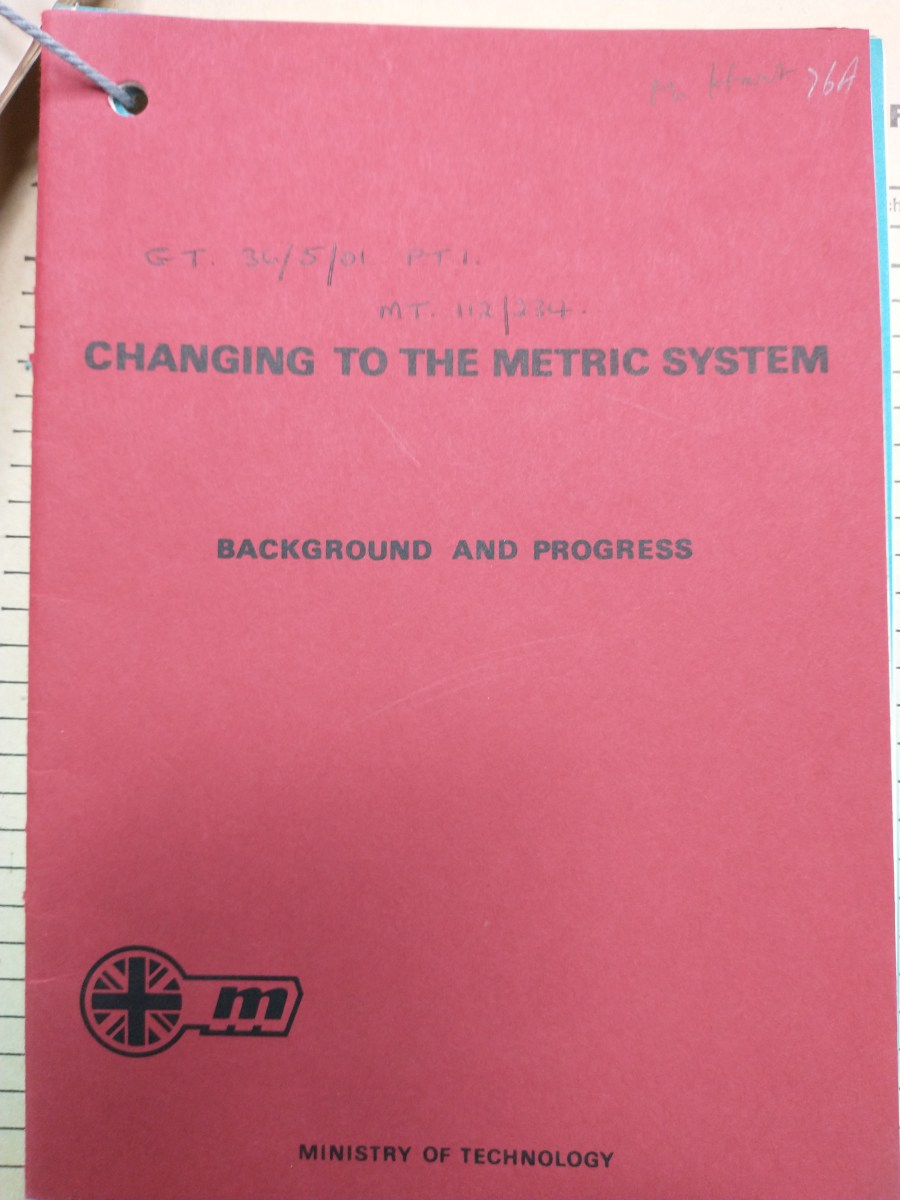
In late 1968, the Ministry of Technology published Changing to the Metric System: Background and Progress, a comprehensive explanation of why the United Kingdom needed to adopt the metric system and how the transition should unfold. More than half a century later, the document reads like a snapshot of a moment when Britain was poised to modernise its measurement system in line with global practice.
This report revisits that publication, summarises its key arguments and reflects on its relevance to today’s stalled metrication programme.
Historical Background
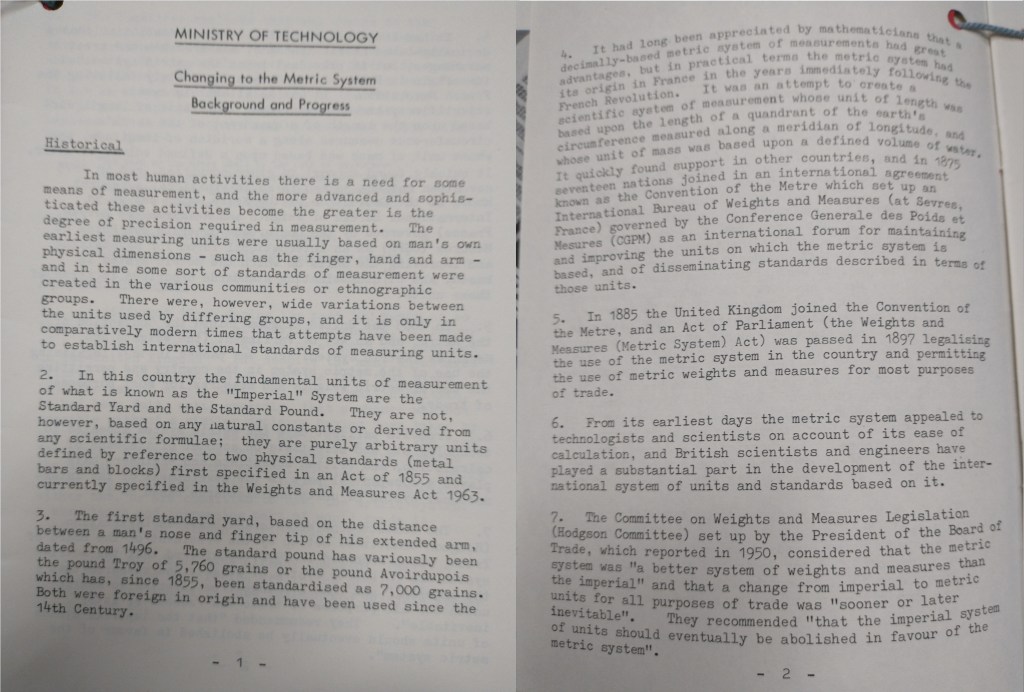
The report begins by tracing the origins of measurement systems. It highlights how early units were based on human anatomy and varied widely between communities. The Imperial system, formalised in the 19th century, relied on arbitrary physical artefacts rather than natural constants.
The metric system, by contrast, emerged from the scientific ambitions of post‑Revolutionary France. Its units were tied to physical realities — the Earth’s meridian, the mass of water — and later refined through international cooperation under the Convention of the Metre (1875). Britain joined the Convention in 1885 and legalised metric units in 1897, though widespread adoption remained elusive.
The Case for Change
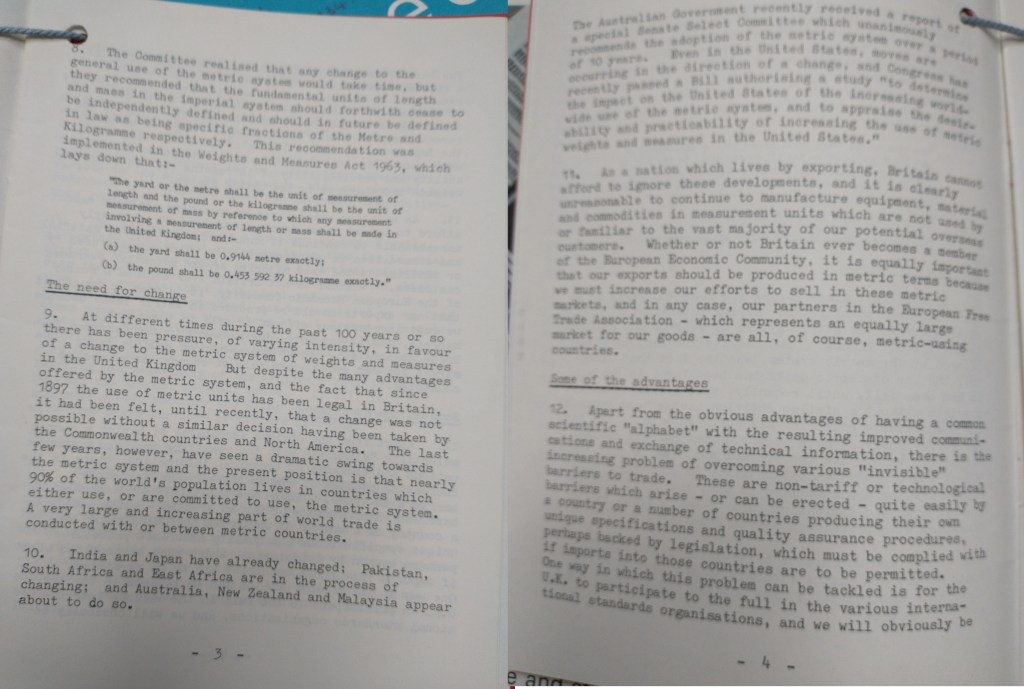
By the mid‑20th century, pressure for metrication grew. The Hodgson Committee (1950) concluded that the metric system was superior and that Imperial units should eventually be abolished. The Weights and Measures Act 1963 redefined the yard and pound in terms of the metre and kilogram, signalling a shift toward international standards.
The report emphasises global trends: by the late 1960s, nearly 90% of the world’s population lived in countries using or committed to metric units. Commonwealth nations were converting and the United States was beginning to study the issue. For an export‑dependent nation, Britain could not afford to remain out of step.
Advantages of Metrication
The document outlines several advantages:
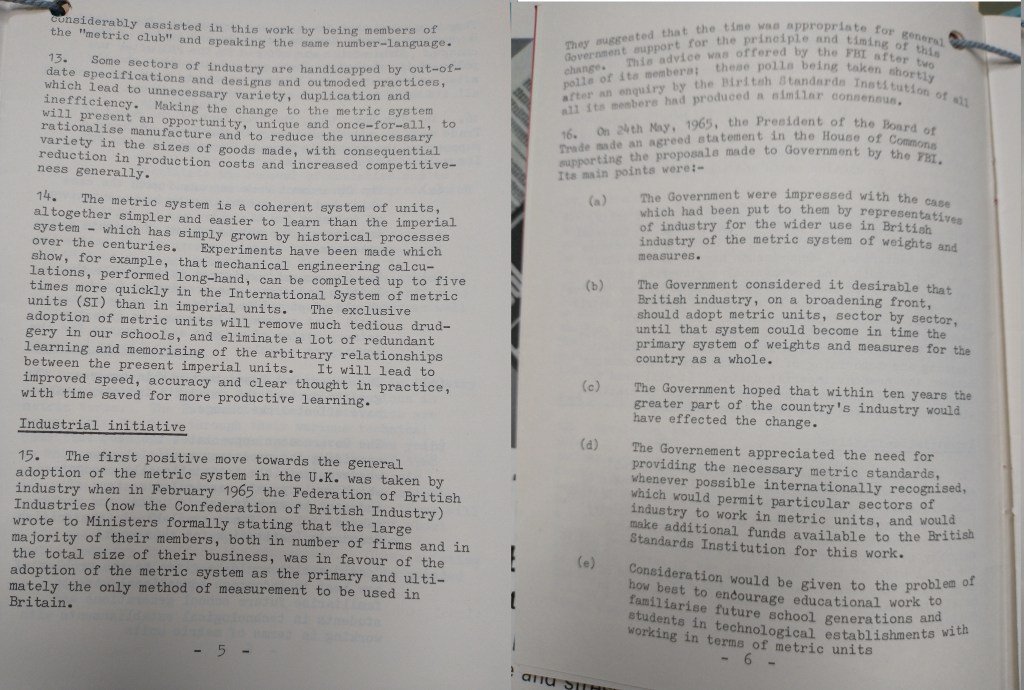
- Industrial efficiency: Metrication offered a chance to rationalise outdated specifications and reduce unnecessary variety in manufactured goods.
- Educational clarity: The metric system’s coherence would simplify teaching and eliminate the drudgery of memorising arbitrary Imperial relationships.
- Scientific alignment: British scientists already used metric units; full adoption would harmonise industry with scientific practice.
Experiments showed that engineering calculations could be completed up to five times faster using SI units.
Industrial Initiative and Government Support
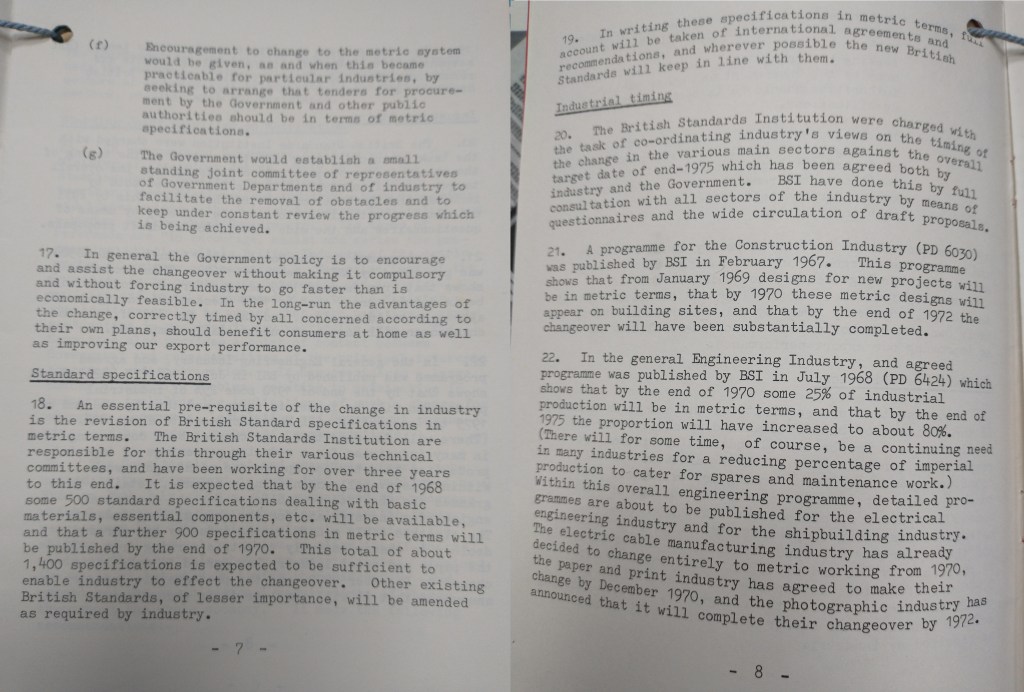
The Federation of British Industries (now CBI) took the first major step in 1965, urging government support for metrication. The Board of Trade responded positively, outlining a ten‑year transition plan and committing to provide metric standards.
Government procurement would gradually shift to metric specifications, encouraging industry to follow suit. A joint committee was established to monitor progress and remove obstacles.
Standard Specifications and Sector Programmes
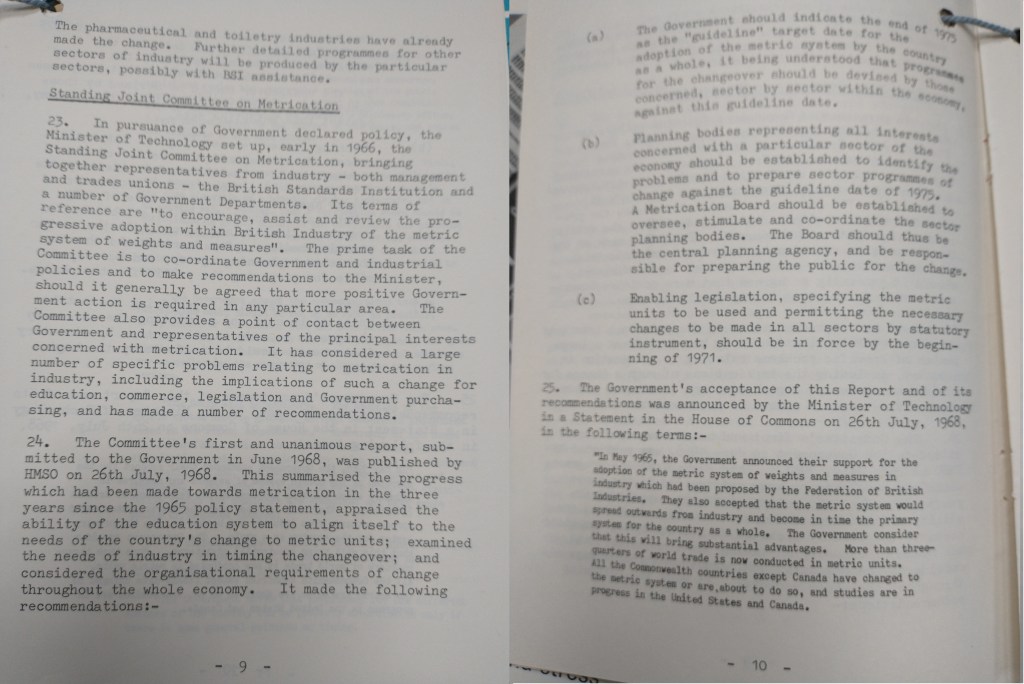
The British Standards Institution (BSI) played a central role, revising hundreds of standards into metric terms. By 1970, around 1400 specifications were expected to be ready — enough to support a broad industrial transition.
Sector‑specific programmes were developed:
- Construction: Designs in metric from 1969; changeover largely complete by 1972.
- Engineering: 25% metric production by 1970; 80% by 1975.
- Electrical, shipbuilding, cable manufacturing, paper, printing, photography: Each sector produced its own timetable.
Standing Joint Committee on Metrication

Established in 1966, the Committee coordinated government and industrial policy. Its 1968 report recommended:
- A national target date of end‑1975.
- Sector planning bodies.
- A central Metrication Board.
- Enabling legislation by 1971.
The government accepted all recommendations, emphasising voluntary adoption but coordinated planning.
Non‑Industrial Sectors, Legislation and Finance
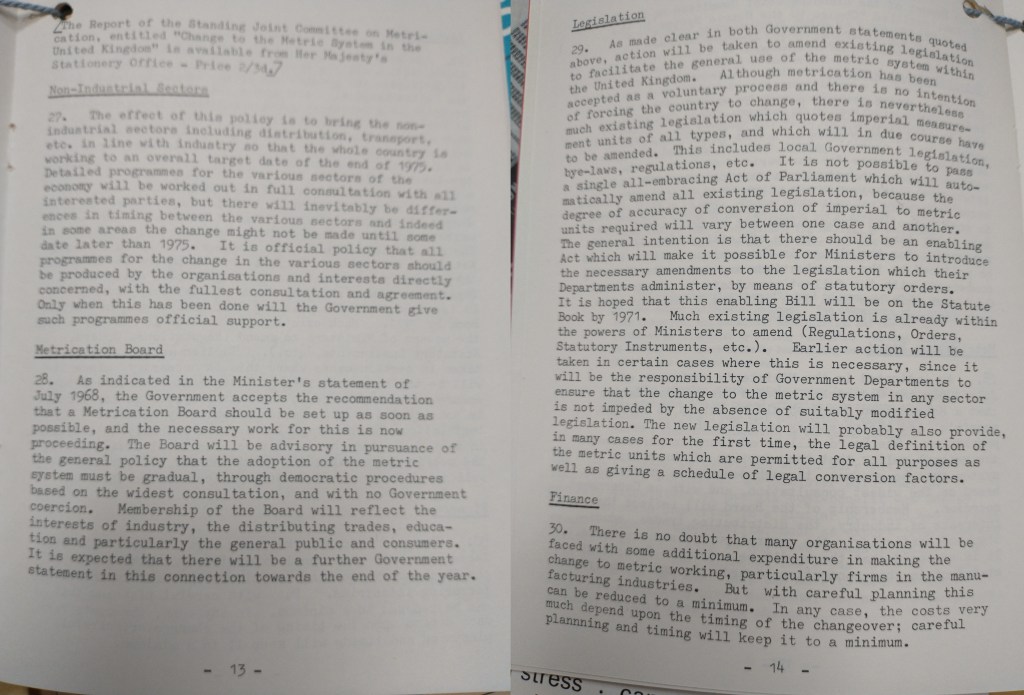
Metrication was to extend beyond industry into distribution, services and education. Programmes would be developed collaboratively, with government support once consensus was reached.
Legislation would be required to amend Imperial references across statutes and regulations. A single sweeping Act was impractical; instead, ministers would use statutory instruments to update laws sector by sector.
Costs would “lie where they fall,” with no special compensation — but benefits would be permanent.
Education and Retraining
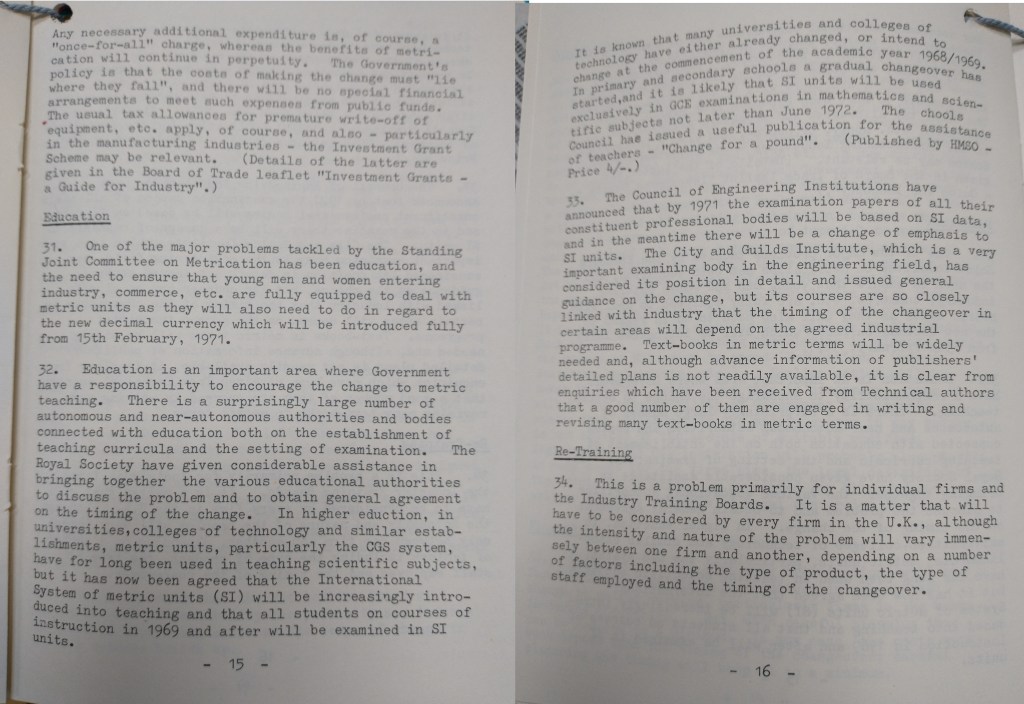
Education was recognised as a critical component. Universities and colleges were already using metric units in science and SI would be adopted across higher education from 1969. Secondary schools would follow, with SI used in GCE exams by 1972.
Professional bodies and vocational training organisations prepared to shift examinations and course materials to SI. Retraining within industry would vary by sector but was considered manageable with proper planning.
Publicity, SI Units and Government Procurement
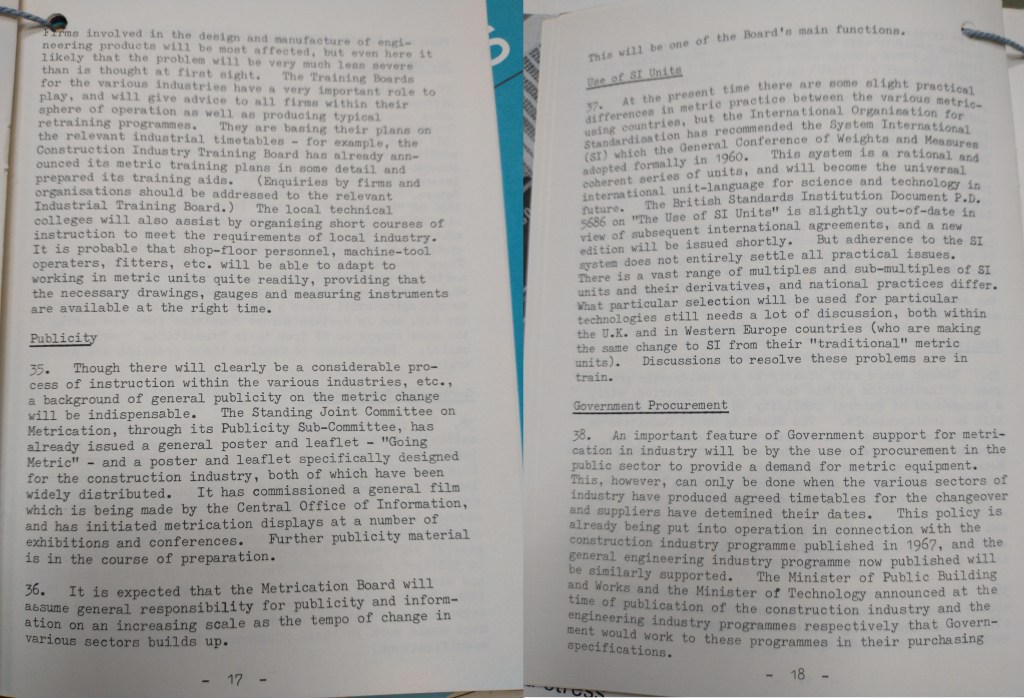
Public awareness was essential. Posters, leaflets, films and exhibitions were produced to explain the change. The Metrication Board would later assume responsibility for nationwide publicity.
The report stresses the importance of adopting SI units consistently and resolving practical differences between countries. Government procurement would support the transition once industries were ready.
Conclusion
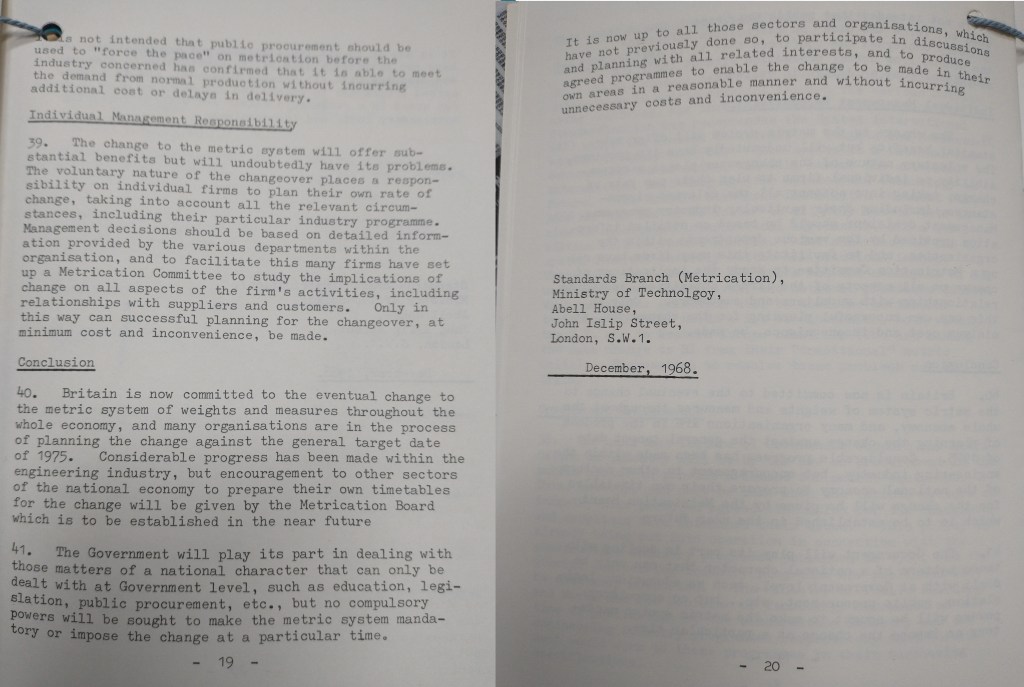
By 1968, Britain was formally committed to full metrication. The government emphasised voluntary adoption, coordinated planning and sector‑specific timetables. The Metrication Board would guide the process and many industries were already well advanced.
The report ends with a clear message: metrication was a major national change requiring cooperation, planning and public engagement — but the benefits were substantial and enduring.
Reference Publications
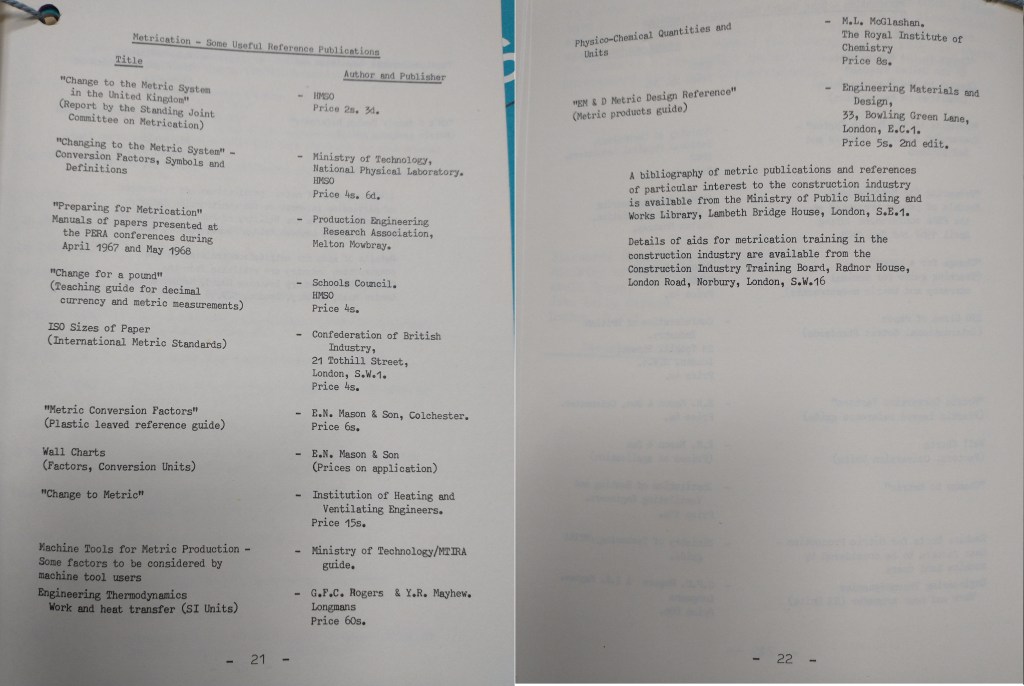
The final pages list reference materials available at the time, including BSI standards, teaching guides, conversion charts and technical manuals.
BSI Publications
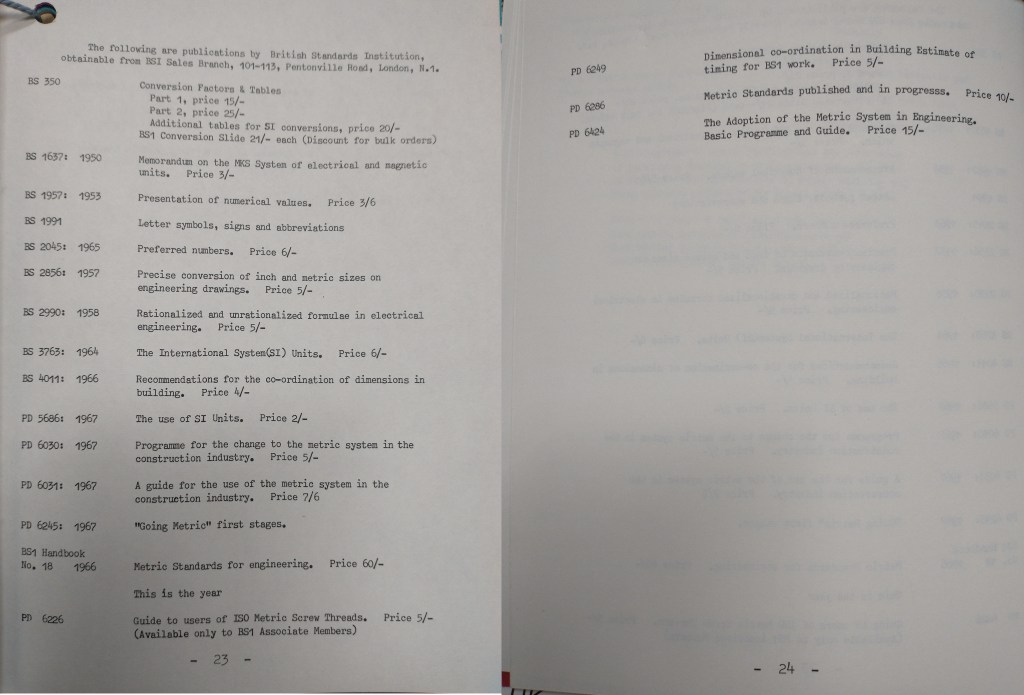
A catalogue of BSI documents relevant to metrication, including conversion tables, SI guidance, sector programmes and engineering standards.
Final Thoughts for Metric Views Readers
This 1968 publication captures a moment when Britain was ready to modernise its measurement system in line with global practice. The clarity of the arguments, the thoroughness of the planning and the cross‑sector coordination stand in stark contrast to today’s fragmented and incomplete metrication programme.
Revisiting this document reminds us that the UK once had a coherent national strategy — and that completing the job remains both possible and desirable.


Ronnie,
Excellent article and a timely reminder of how the UK could still extricate itself from the metric muddle and get the job done.
Ezra aka punditgi
LikeLike
The report states that, “The Government will play its part in dealing with those matters of a national character that can only be dealt with at Government level”, but conspicuous by its absence, is any mention of speed limits and road signs.
Changing all road signs to metric at the earliest opportunity would have demonstrated the Government’s commitment to metrication at an early stage, and provided the publicity that it said it was seeking – far more effectively than any poster or leaflet campaign.
Alas, the Government’s stance that, “No compulsory powers will be sought. There can be no question of compensation; the costs of adopting metric weight must lie where they fall.” also guaranteed resistance from the start. In particular, the Department for Transport (or Ministry of Transport as it was then) was never going to want to initiate a metrication programme for road signs within its normal budget.
LikeLiked by 1 person
In my view, there were three fundamental failings of the British metrication process:
Firstly, control of the metrication process was given to the Board of Trade. Since the metrication process spanned many departments, there was a good case for tit to come under the prime minister’s direct control (as was the case in South Africa). As such, the prime minister could have over-rules ministers who were seeking “exemptions” from the process. In this way, they Department of Transport would have found it more difficult to renege on their responsibilities.
Secondly, the way in which it was financed – “Costs will be borne where they fell”. As “m” rightly points out, such a situation was bound to cause conflict. The stationery industry for example welcomed metrication – rather than having to have two ranges of similar products – quarto-oriented range of stationery and foolscap-oriented range of stationery, they only needed one range – a4-oriented range of stationery. As a result they could reduce their number of production limes and also inventories that they held. On the other hand, greengrocers saw no benefit in metrication whatsoever – they had to pay for new sets of scales and saw no return. In the short term, all their process suddenly looked more expensive; rather than paying 35p for a pound of bananas, they now had to be priced at 77 p per kilogram.
Thirdly, the failure to pick the “low-lying fruit” first. In Australia, horse-racing was one of the first “industries” to be metricated. Instead, in the United Kingdom the first area to be metricated was British Standards. AS a result, when it came to metricating those areas of life in which the general public had considerable influence, considerable resistance had built up. Thus we see that rugby was metricated but football was not while a half-baked job was done in cricket.
LikeLiked by 1 person
Another light-hearted look at how the USA misunderstands metric vs Imperial:
LikeLike
Before the 1959 redefinition of the pound and foot, all the USC and imperial units were different, not just the volume units. There are also differences still not restricted to volumes, such as hundredweights and tonnes. There may be even more.
LikeLike
Another bit of backward sliding as the BBC report on rainy weather includes inches in parentheses in every spot in the article where the rain amount in mm is given. I checked the Met web site for Herstmonceux in Essex and their info was only in metric. I can’t figure out what’s going on at the BBC.
https://www.bbc.com/weather/articles/cvgydkpdn99o
LikeLike