
Between 1968 and 1970, Britain’s transition toward the metric system generated a remarkable volume of correspondence between county surveyors, borough engineers, police constabularies, education advisers and the Ministry of Transport. These letters—practical, candid, sometimes frustrated—capture a moment when local authorities were grappling with the implications of metrication for road signs, speed limits, education and engineering standards.
What emerges is a vivid administrative snapshot: uncertainty about timelines, concerns over cost, debates about sign placement and the recurring question of how to prepare for a metric future while still operating in an imperial present. This article brings together these voices, showing how the metrication debate unfolded on the ground.
1. Early Concerns: Direction Signs and Distance Conversions (1968–1969)
The earliest letters reveal anxiety about how quickly metrication would arrive—and how costly it might be if authorities were forced to replace signs twice.
Gloucestershire County Council (3 October 1968)
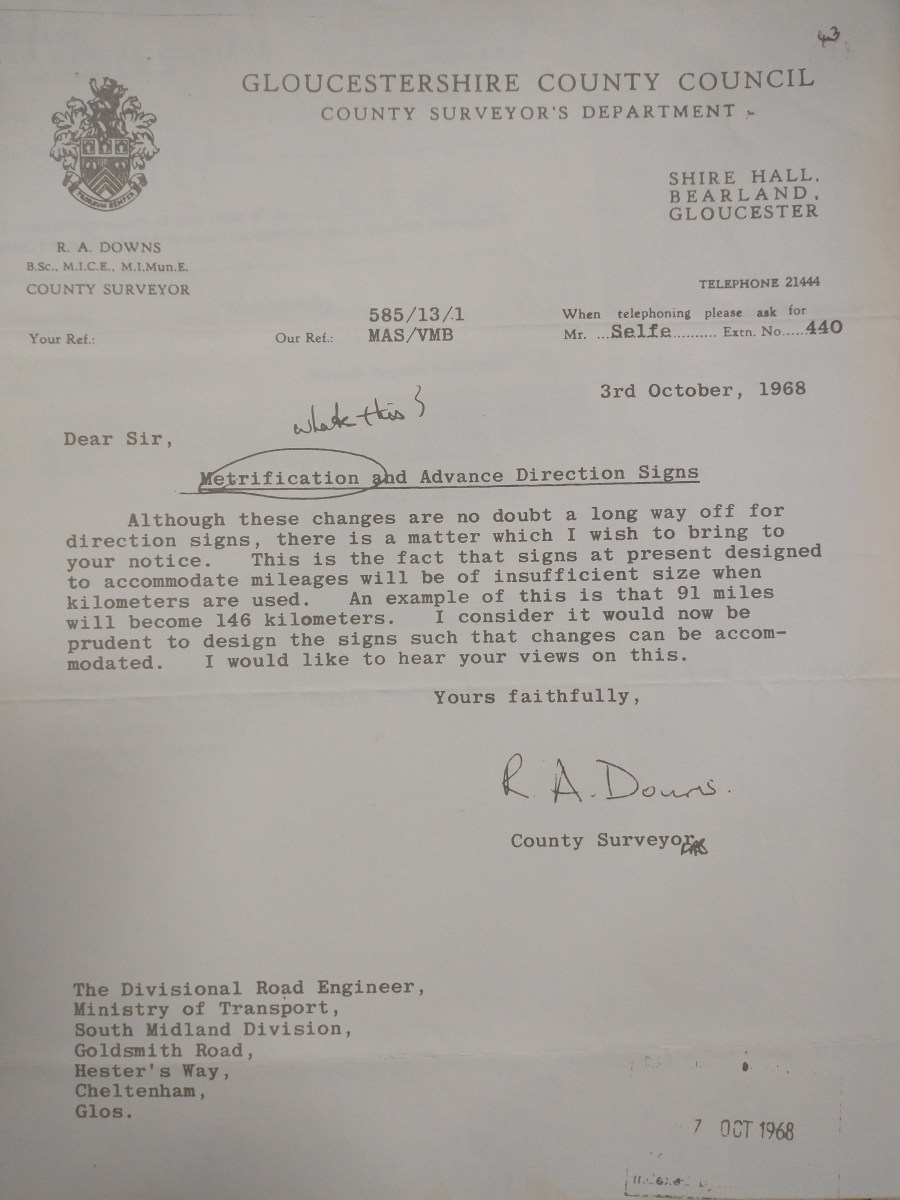
The County Surveyor of Gloucestershire County Council urged that new advance direction signs be designed with future kilometre distances in mind, even if imperial units were still required on the face of the sign. This was a pragmatic attempt to avoid waste: build the sign once, update only the plate later.
London Borough of Lambeth (25 July 1968)
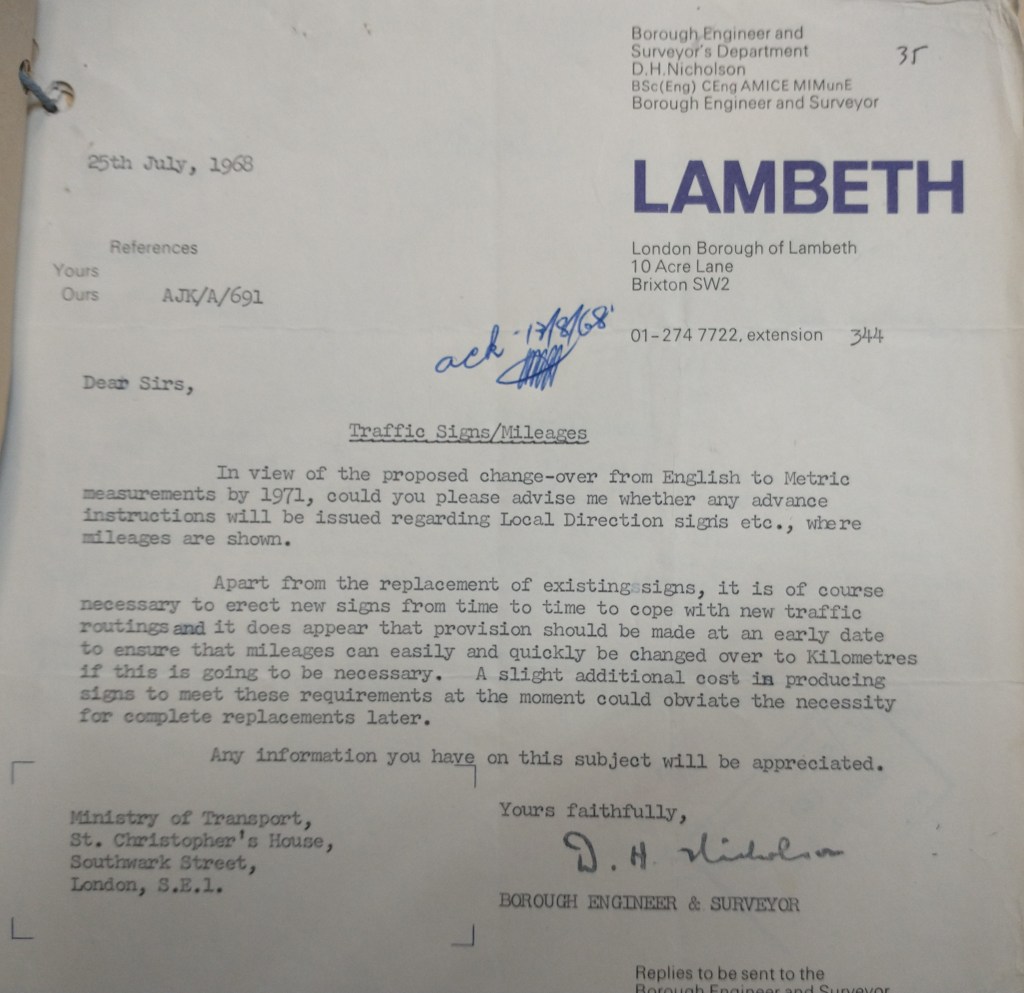
The London Borough of Lambeth echoed the same concern. With new signs being erected regularly due to changing traffic patterns, the Borough Engineer asked whether advance instructions would be issued so that mileages could be converted easily to kilometres. The fear of “complete replacements later” loomed large.
Kent County Council (22 January 1969)
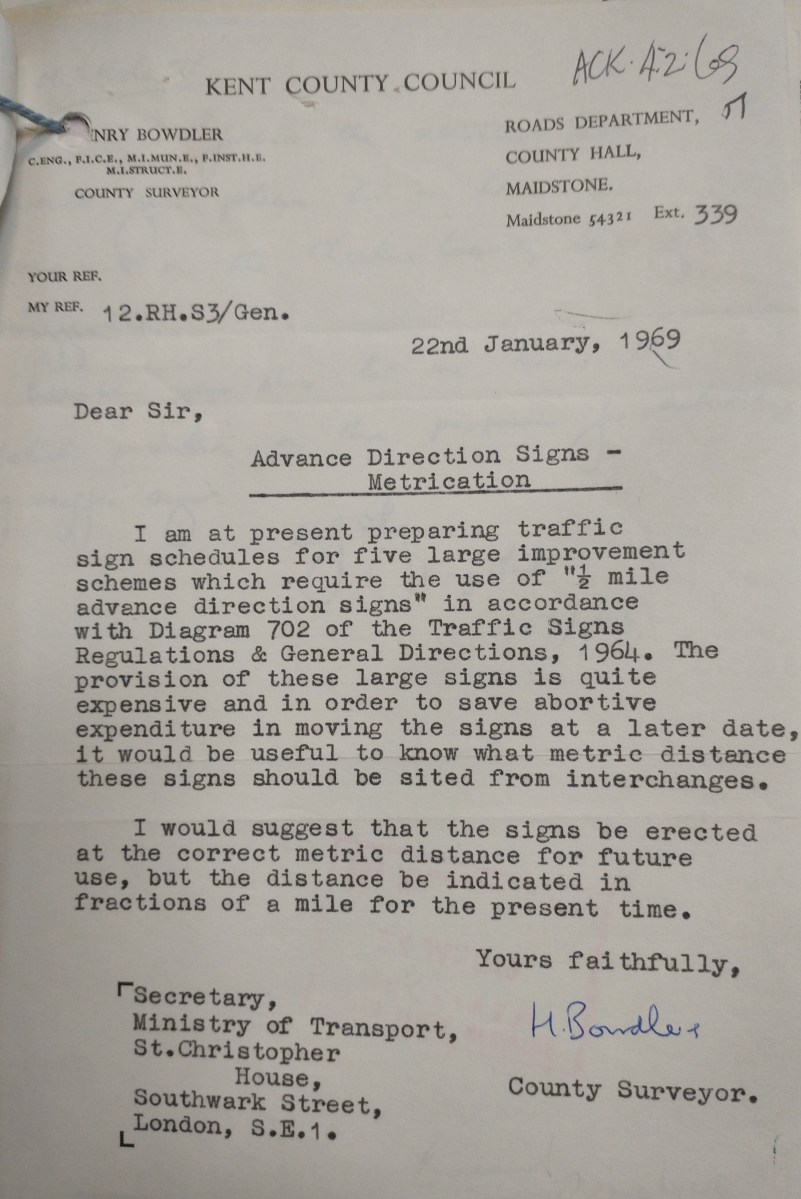
Kent County Council proposed a hybrid approach: erect signs at the correct metric distances but display imperial fractions until the official changeover. This shows how local authorities were already thinking in metric even before national policy was finalised.
2. Schools Go Metric—But Road Signs Don’t (February 1969)
Worcestershire County Council Education Committee (25 February 1969)
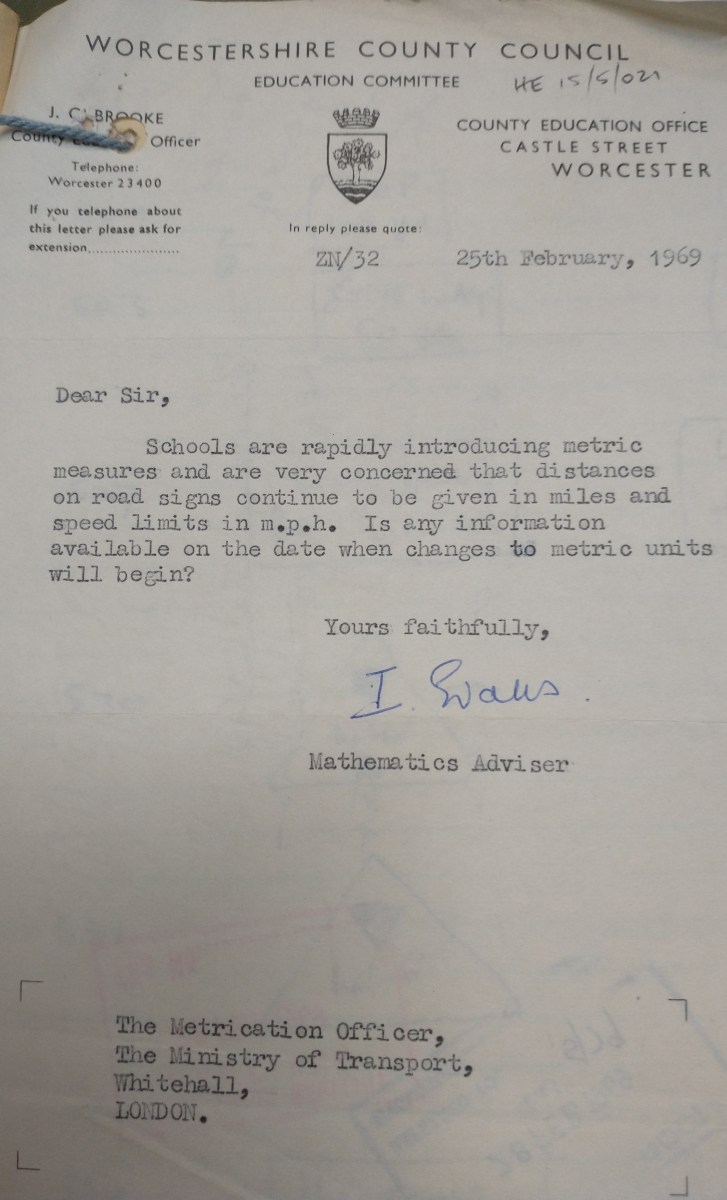
A mathematics adviser wrote to the Ministry of Transport expressing concern that schools were teaching metric units while road signs remained stubbornly imperial. The mismatch, he argued, risked confusing pupils and undermining education policy. This letter is one of the clearest examples of cross-sector tension caused by the slow pace of metrication.
3. The Speed Limit Question: Panels, Representation and Funding (1970)
By 1970, attention shifted from distance signs to speed limits—particularly how to convert them and who should pay.
County Council of Clackmannan (16 April 1970)
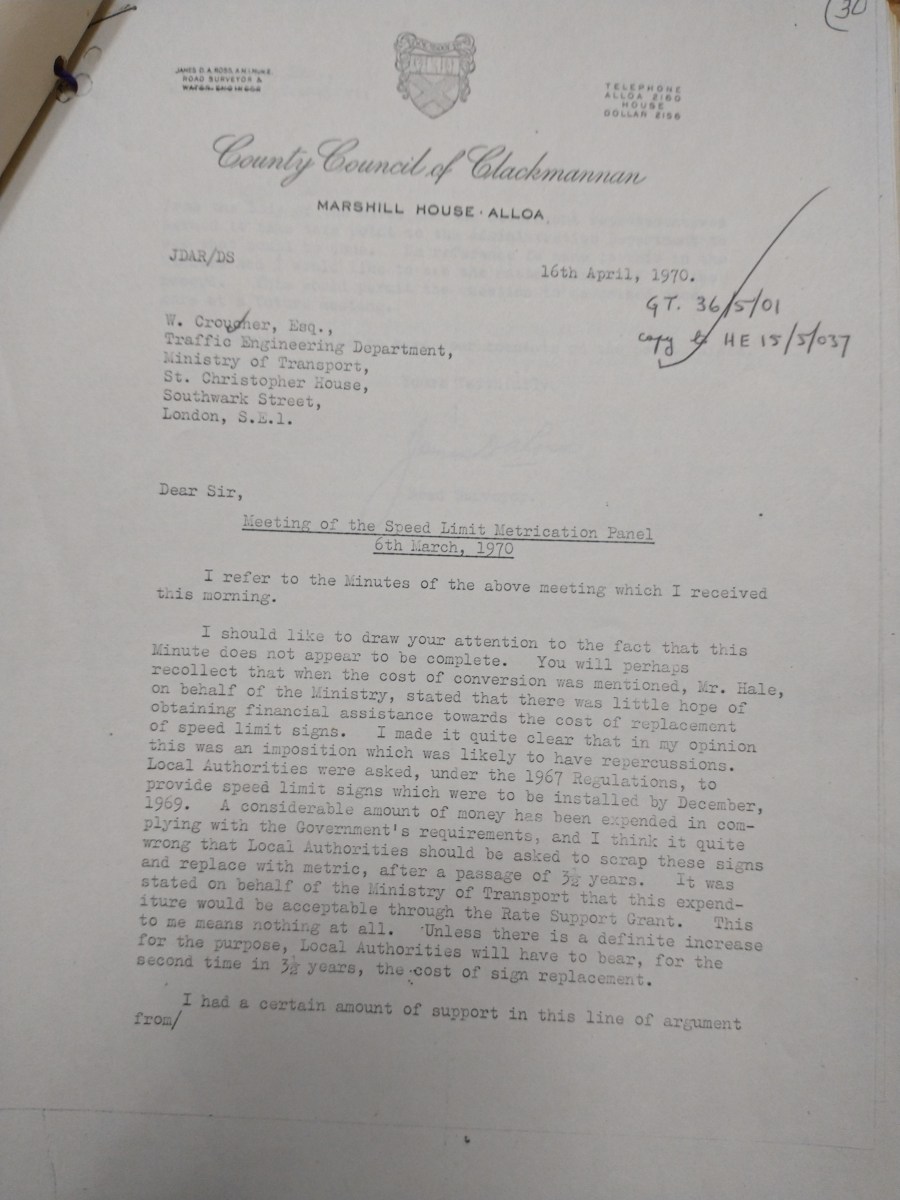
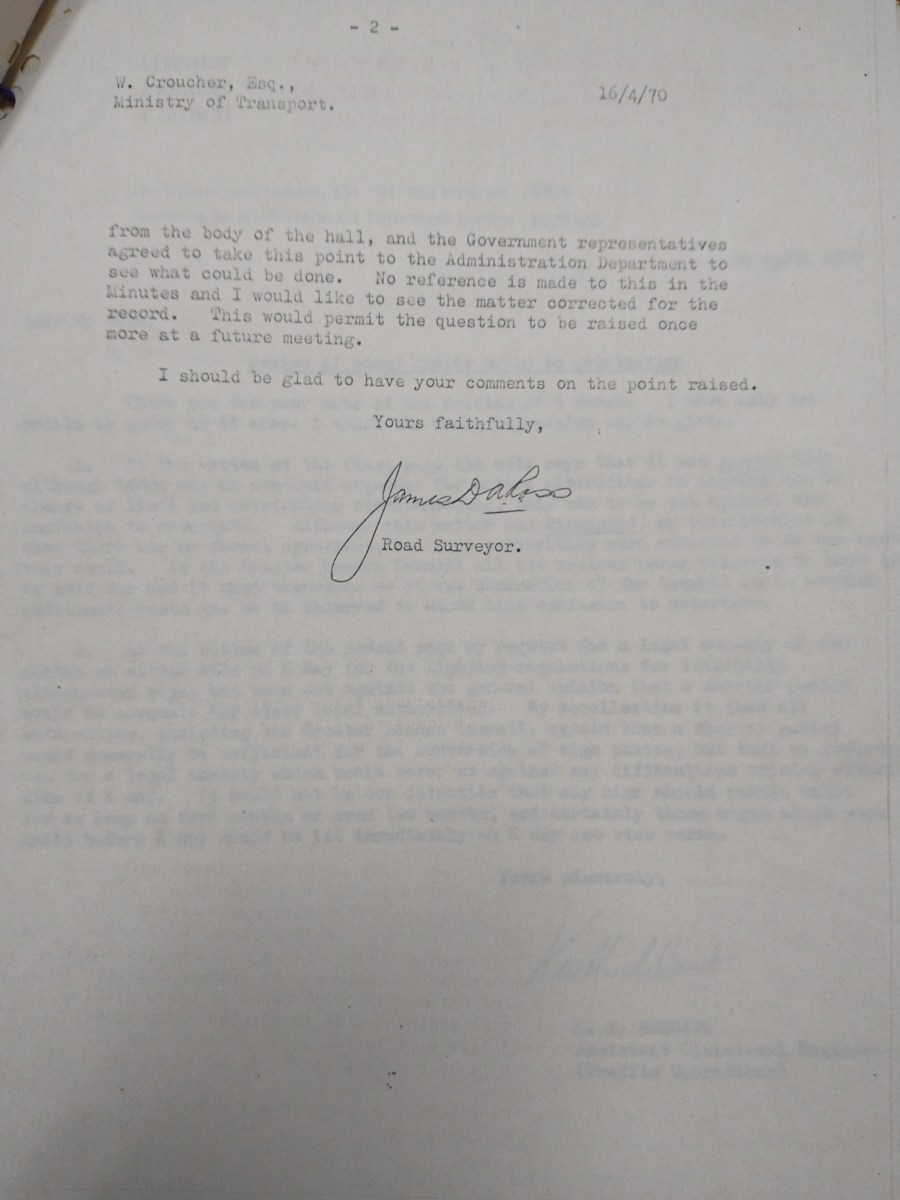
The County Council of Clackmannan complained that despite agreeing to nominate a representative to the Speed Limits Interaction Panel, the Council was not listed as represented in the minutes. The letter also raised a subtle but important financial issue: replacement of warning signs was reimbursable by the Ministry, but other signs were not. Metrication, therefore, had budgetary consequences.
Derby County and Borough Constabulary (4 September 1970)
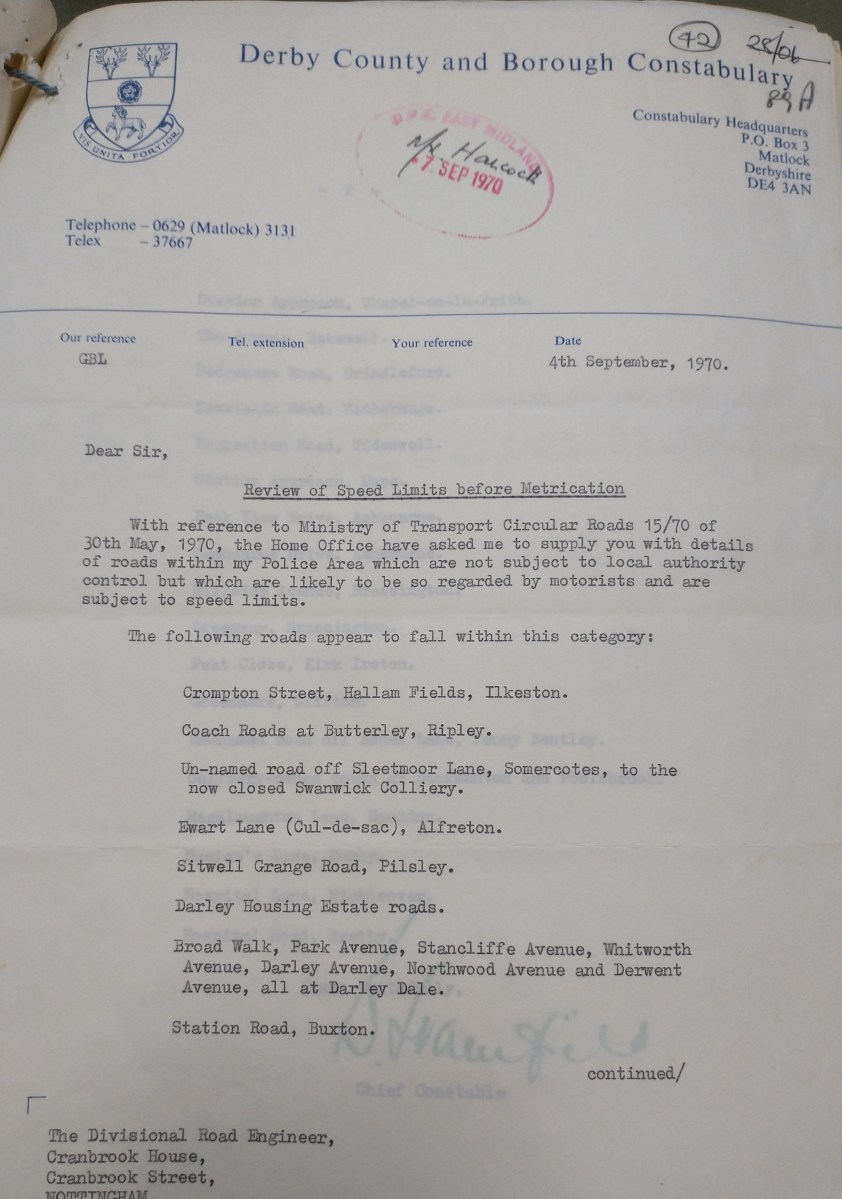
Police forces were also drawn into the process. The Chief Constable of Derby County and Borough Constabulary listed roads requiring review before metrication, demonstrating how speed limit changes were not merely administrative—they required detailed local knowledge of road conditions.
4. Guard Rails, Motorways and Engineering Standards (1970)
Metrication intersected with broader engineering debates about safety, mounting heights and motorway signage.
Greater London Council (29 April 1970)
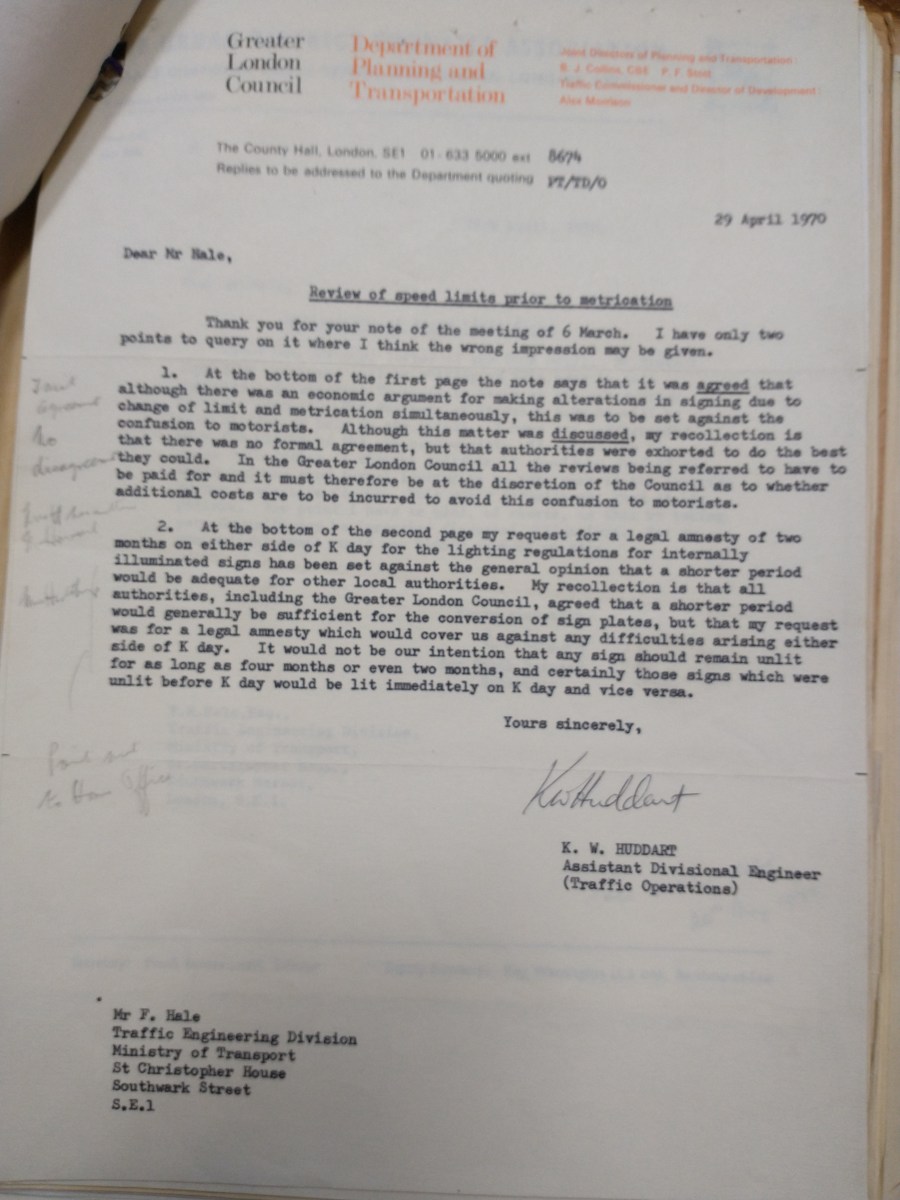
The Greater London Council (GLC) clarified that guard rails should only be removed where safe and that boroughs should bear the cost of removing certain roadside manifolds. Although not strictly metrication-related, this letter shows how the shift to metric units was entangled with wider traffic engineering reforms.
Oxfordshire County Council (6 August & 18 September 1970)
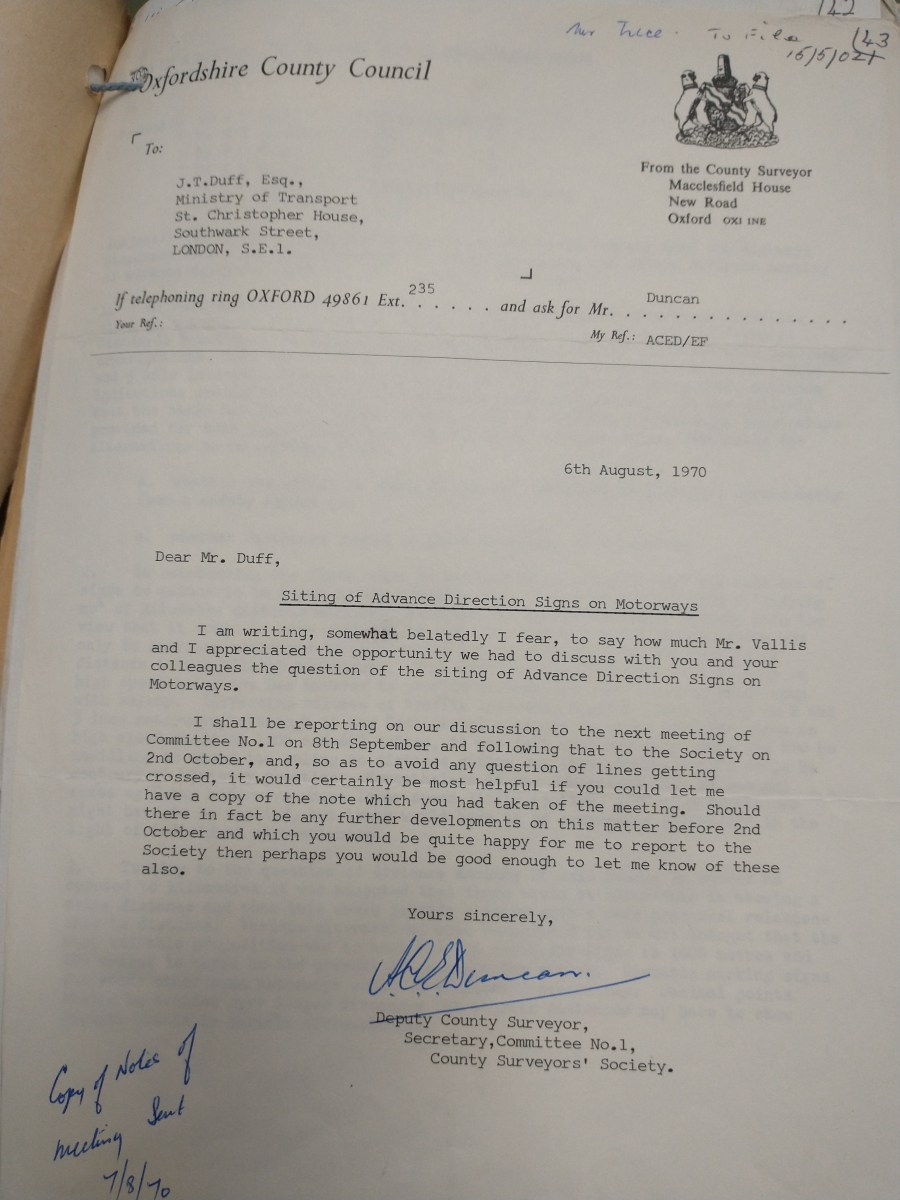
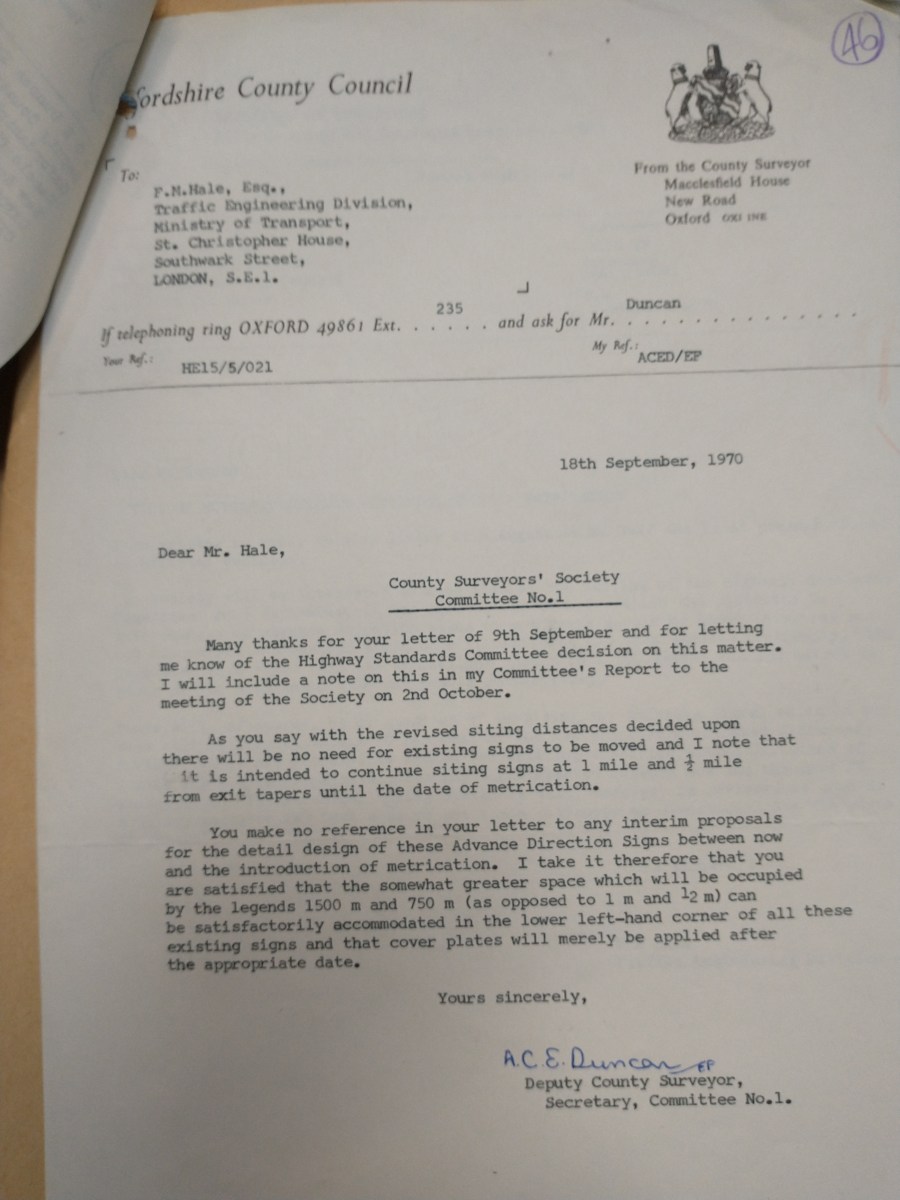
Oxfordshire County Council’s letters reveal ongoing discussions about motorway advance direction signs and the need to avoid duplication of effort between the Ministry and the County Surveyors’ Society. By September, attention had turned to the design of metric plates and the timing of their introduction.
5. Urban District Councils: Seeking Clarity and Cooperation (1970)
Urban District Councils Association (17 April & 29 April 1970)
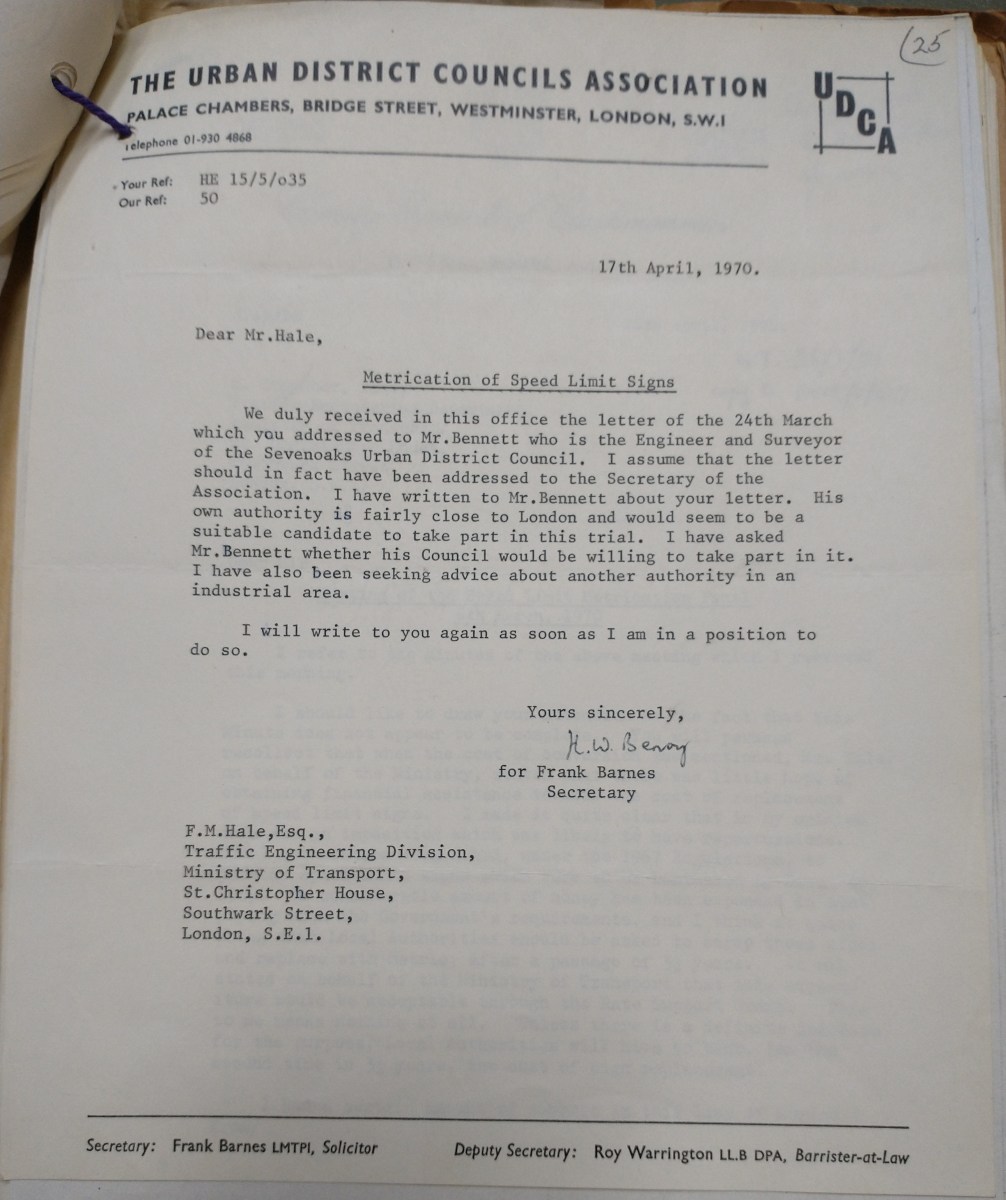
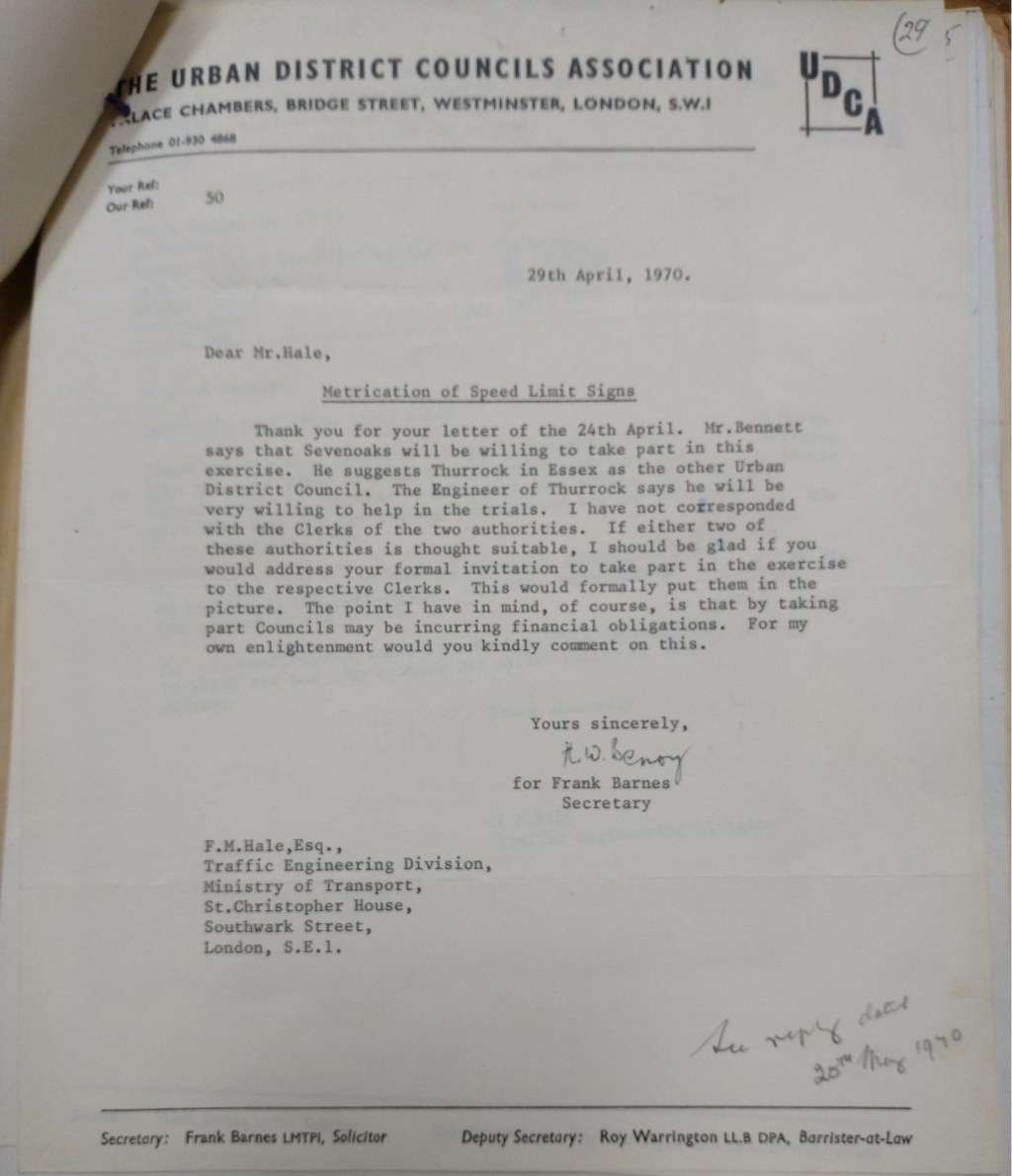
These letters show the Urban District Councils Association (UDCA) acting as a conduit between local engineers and the Ministry. They sought clarification on the metrication of speed limit signs and coordinated feedback from boroughs and districts.
Sevenoaks Urban District Council (29 May 1970)
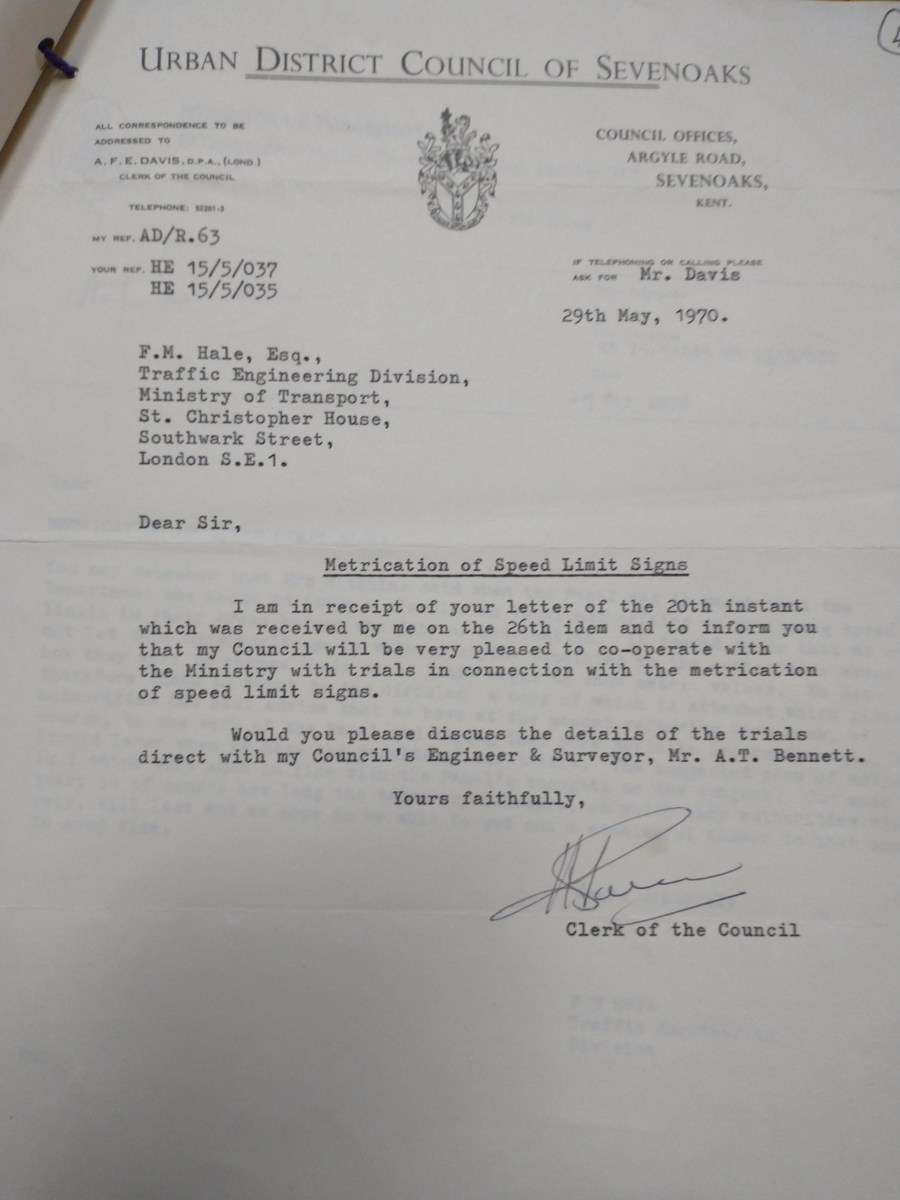
Sevenoaks Urban District Council expressed willingness to cooperate with the Ministry’s metrication trials and directed officials to liaise with its Engineer & Surveyor. This is one of the few letters showing enthusiastic participation rather than concern.
Conclusion: A Nation Preparing—Slowly—for Metrication
The letters from 1968–1970 reveal a Britain preparing for metrication in fits and starts. Local authorities were eager for guidance, worried about costs and often forced to make interim decisions without clear national timelines. Engineers debated mounting heights, police reviewed speed limits, educators worried about mixed messages and councils tried to future-proof signs before the metric system formally arrived.
Metrication was not simply a technical change—it was an administrative, financial and educational challenge. These letters show the human side of that transition: thoughtful, practical, occasionally exasperated, but always striving to make Britain’s roads ready for a new era.


Thank you. This is a most informative and frustrating article. Congratulations on the research which it must have necessitated.
LikeLiked by 1 person
As a point of comparison this Metric Views article from 2012 about road sign conversion to metric in Ireland is instructive:
https://metricviews.uk/2012/06/22/irelands-road-signs-revisited/
LikeLike
A very effective letter, it would seem, from the Mathematics Adviser at Worcestershire County Council Education Committee:
Dear Sir,
Schools are rapidly introducing metric measures and are very concerned that distances on road signs continue to be given in miles and speed limits in m.p.h. Is any information available on the date when changes to metric units will begin?
Yours faithfully
I Evans
Mathematics Adviser
Within 8 days, the Minister of Transport announced in Parliament that speed limits would go metric in 1973.
https://api.parliament.uk/historic-hansard/commons/1969/mar/05/roads-speed-limits
Are education authorities continuing to pressure the Department for Transport about the disconnect between measurement units on road signs and those taught in schools (and used everywhere else outside schools). Nearly 60 years on, the situation is considerably more urgent, as practically all working-age drivers, on UK roads now, have received no formal education in the units used on road signs.
LikeLiked by 1 person
Does anyone know where this all ran into the sand? As I’ve seen references to a statement in the HoC re the postponement of the metrication effort, with respect to roads, but overall it seems as to the actual process has been lost to backroom discussions and / or unminuted meetings in smoke filled Clubs / subsidised bars in the HoC.
But overall, here seems to be neither the means nor the will to complete the process – if anything it seems further down the political agenda than ever and it is of no import to the general public either – are we saddled with the “Metric Muddle” for a century or two?
LikeLiked by 1 person
One of the drivers for the concerns amongst county engineers was the release of the Report of the Traffic Signs Committee (https://archive.org/details/op1265802-1001) under the chairmanship of Sir Walter Warboys. That report recommended a total overhaul of British road signs which was under way from the late 1960’s onwards.
The principal recommendations were firstly that the UK change the “look and feel” of her road signs to conform to the designs contained in the Vienna Convention on Road Signs and secondly that the upper-case lettering used on road signs be replaced by a new mixed-case font known as “Transport Font”. The road signs that we see today in the UK are essentially those recommended by the Warboys Committee.
I believe that many County Engineers were aware of the disruption caused by having to replace old-stye road signs with new-stye road signs (albeit often on an “end-of-life” trigger) and having another big change on the horizon filled them with foreboding.
The issue of metrication fell outside the scope of the Warboys Committee so the Committee can be forgiven for not commenting on the consequences of the UK adopting metric units. One solution that I saw in Mauritius in 1978 was to place a red lie across the speed limit sign from top right to bottom left. The top left-hand semi-circle would have the speed limit in mph and the lower right-hand semi-circle would have the speed limit in km/h. This approach removed the need for an expensive “big-bang” approach such as was used in Ireland, but requires either than the sign be larger or that the country will have to live with the actual speed limit being less legible.
LikeLiked by 1 person
It certainly would be a good sign (forgive the pun) if the government engaged in a program to replace distance signs with metric equivalents and replace restriction signs with metric-only signs. At least that would avoid a big bang conversion of such signs.
LikeLiked by 1 person