
A recent incident caused me to wonder whether our schools, far from helping to resolve the UK’s two systems muddle, are actually consolidating and perpetuating it.
Continue reading “Are our schools entrenching the very British mess?”
Category: General
Britain from Above
A fascinating new series from the BBC comes up to expectations. (Article contributed by Derek Pollard). Continue reading “Britain from Above”
Metric campaigners unimpressed by poll findings
The UK Metric Association dismissed as “unrepresentative and old hat” the findings of an AA/Populus panel, showing that a large majority of AA members are opposed to metric road signs in the UK. (This press release was issued for use after 00:01 on Saturday, 2 August 2008).
Continue reading “Metric campaigners unimpressed by poll findings”
Acre not to be abolished – unfortunately
The media just can’t get it right. Nor can they miss any opportunity, however unfounded, to knock both the metric system and the European Union. The latest non-story is to be found in the Daily Telegraph and Daily Mail of 21 July.
With a headline “EU abolishes British acre” the Telegraph declares that “The acre, one of Britain’s historic imperial measurements, is to be banned from use under a new European directive.” Similarly, the Daily Mail’s headline announced: “Selling land by the acre to be banned under new EU ruling.” See these links:
http://www.dailymail.co.uk/news/article-1036895/Selling-land-acre-banned-new-EU-ruling.html
http://www.telegraph.co.uk/news/uknews/2310257/European-Union-abolishes-the-British-acre.html
Both papers then go on to print verbatim the misinformed comments of a Conservative spokesman – from which it is obvious that the story emanates from a Conservative Party press release.
In fact the acre is not to be abolished. All that has happened is that, since the UK’s Land Registries have for many years used hectares rather than acres for land registration, it has been agreed that the exemption for acres for this purpose (and this purpose only) is redundant. So the decision is a tidying up measure that makes no practical difference to this or any other uses of the acre.
In any case, land is not bought and sold by unit of area (that is, priced per acre or hectare). Each site is unique and is sold as a single lot. You can’t stroll into the estate agent and order “10 acres/hectares of land, please”. Where acres and hectares are used, they are simply descriptions of the size of a site.
However, when it comes to paying of EU subsidies under the Common Agricultural Policy, hectares are of course mandatory. This is because a consistent means of calculating subsidies is necessary, and since every other country uses hectares, it is only sensible that the UK should fall into line.
UKMA believes that it would be better if acres WERE abolished for all remaining legal, trade and official purposes. Once it is understood that a hectare is equivalent to a square 100 m by 100 m, it is very easy to work with. (The Mail and Telegraph articles illustrate the dysfunctional nature of acres by including the helpful information that an acre is 4840 square yards!) It is also highly inconvenient to have to work in hectares for some purposes and acres for others, with all the problems of conversion errors and incomprehension that result.
So the Mail and the Telegraph got it wrong. The EU has not abolished the acre. If only the UK Government would.
Metric, a truly natural system
At the time of writing NASA scientists are eagerly awaiting the results of soil sampling from their latest Martian probe Phoenix. Crucial to that experiment is confirmation of the presence of water. That precious substance essential to all life both here on Earth and maybe elsewhere. It also plays a big part in shaping the world geologically and meteorologically both here and possibly on Mars. What more natural a substance to choose for defining a unit of mass as was the case originally with the metric system.
Are Imperial units based on 12s?
It is often claimed that imperial is based on 12s (duodecimal) and that this has advantages over decimal. But is this truth or myth?
Of course it makes more sense to use the same number system for measurement, money and other practical uses. But let’s look at whether imperial is duodecimal.
Consider length:
One foot = 12 inches
One yard = 3 feet
One rod = 5.5 yards
One chain = 4 rods
One furlong = 10 chains
One mile = 8 furlongs
Only the foot uses a base of 12.
Consider volume:
One pint = 20 fluid ounces
One gallon = 8 pints
No duodecimal units
Consider avoirdupois weight:
One pound = 16 ounces
One stone = 14 pounds
One hundredweight = 8 stones
One imperial ton = 20 hundredweight
Again no duodecimal units
A disadvantage of imperial is that it does not have any consistent number system but uses a hodgepodge of bases.
First Emperor showed the way – 2000 years ago
I recently had the pleasure of visiting the splendid (Chinese) First Emperor exhibition at the British Museum. Apart from the terracotta warriors, what impressed me the most was the way that Qin Shihuangdi imposed standardisation on his vast empire – including, of course, weights and measures.
Qin Shihuangdi unified China by conquest in 221 BC. One of his first acts was to decree that only standard weights and measures were to be used throughout the empire. The bronze weight illustrated below is inscribed as follows: “In the 26th year [of his reign the king of Qin] united the princes of the [individual] states; the people enjoyed peace, and he was proclaimed emperor [huangdi]. He issued an edict that all weights are to be standardised. Where they are not uniform, or where there are any doubts, let them be standardised and classified.”
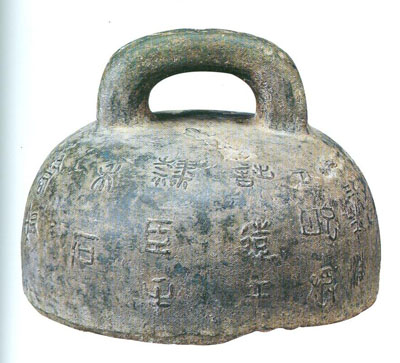
(Acknowledgements to the Trustees of the British Museum)
Also of interest is the measuring cup illustrated below. Its capacity is a “half dou”, which was the most popular size in use. Strangely enough, it is almost exactly equivalent to one litre. Obviously, this must be sheer coincidence, but it does give the lie to the British imperialists’ claim that the pint is “natural”, whereas the litre is not.
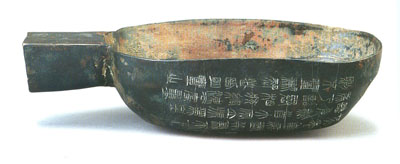
(Acknowledgements to the Trustees of the British Museum)
Here in Britain the first recorded attempt to standardise weights and measures can be found in Magna Carta (1215), but it was not until 1824 that imperial measures were standardised by the first Weights and Measures Act. Unfortunately, our current crop of politicians lack the perception or the political courage (or both) to acknowledge that a single system of weights and measures is a basic requirement of a modern society. Hence we have, to quote another Chinese leader*, “one country, two systems”.
————————————————————————–
*the late Deng Xiaoping, referring to the Hong Kong Special Administrative Region
The London Marathon
This weekend thousands of runners will test themselves to the full in the annual Flora London Marathon. At 42.195 km, it is a race of endurance. But why 42.195 km? That is tied up in the history of the 1908 London Olympic Games. But why does the United Kingdom press call it a 26 mile 385 yard race and does it matter? For the record, two measurements differ by 1 cm. (Article contributed by Martin Vlietstra)
Decimal measures to oust inches and miles
But seriously folks. The article below was an April fool joke but the decimal tape measure is real. In Britain surveyors did use the decimalised foot before going metric. Clearly they recognised the advantages of a decimal system but realised that the metric system proper had much more to offer. The tape featured in the article is in fact American where they still use old fashioned units of measurement. They too clearly see the advantages of decimal in measurement, so the next step is …
Continue reading “Decimal measures to oust inches and miles”
Visionary sci-fi writer uses metric
The late Arthur C Clarke who died this month (March 2008) wrote what may be regarded as his most memorable non-fiction article in 1945. He was the first person to propose the use of satellites in geostationary orbit to form part of a global communications network.
http://lakdiva.org/clarke/1945ww/1945ww_oct_305-308.html
It was quite fitting that his orbital calculations and other details were entirely in metric in recognition of the future as seen from early post-war England.
 Metric Views