
The British Government once developed and examined proposals to change all UK speed limit signs from miles per hour to kilometres per hour in the 1960’s and in 1970. On 9 December 1970, the Minister for Transport Industries John Peyton announced that the proposed metrication of speed limit signs would not go ahead and was postponed indefinitely. The proposed change to metric speed limits was due to be implemented in 1973. Fifty years have now passed since then. Half a century later, UK speed limit signs are still in imperial units. The Department for Transport (DfT) now claims that metricating UK road signs costs too much. However, it would have cost little to convert all UK road signs to metric units according to cost estimates by the Department of the Environment (DoE), which had responsibility for transport at the time, according to historical government documents held at the National Archives.

On the date that the proposal to metricate speed limits was dropped (9 December 1970), John Peyton was asked “to state the estimated cost involved in alterations to vehicles, and road signs of all kinds if metric distances and speed measurements are introduced into this country”. Peyton replied, “Nearly £2 million” (£26.2 million at October 2023 prices), followed by saying that the Government has decided that speed limits will not be made metric in 1973. Peyton’s answer was clarified by a handwritten note (see image above) saying that the £2 million figure referred to the DoE cost estimate of replacing road speed limit signs, not all road signs and refers the reader to background note no. 5.
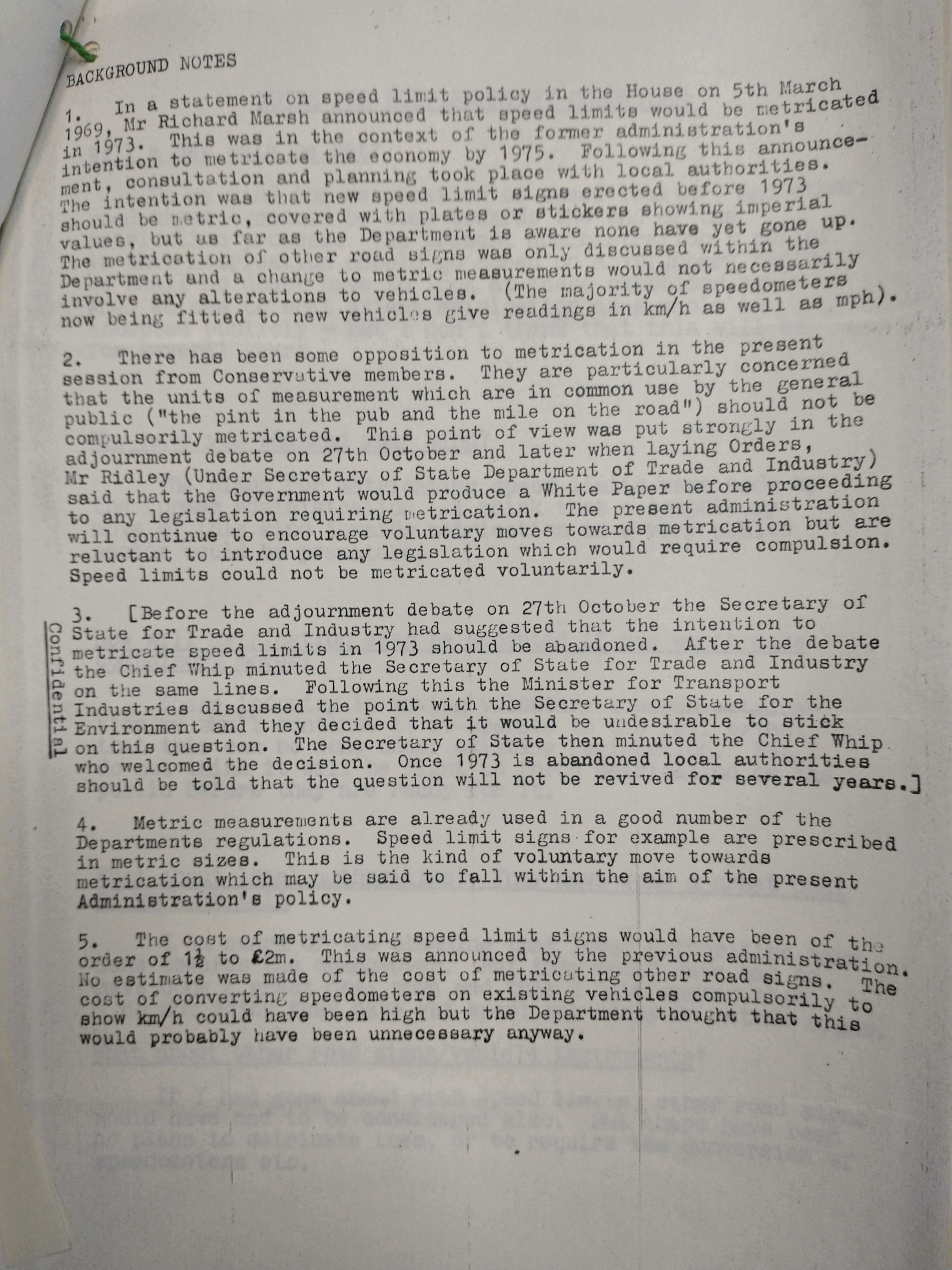
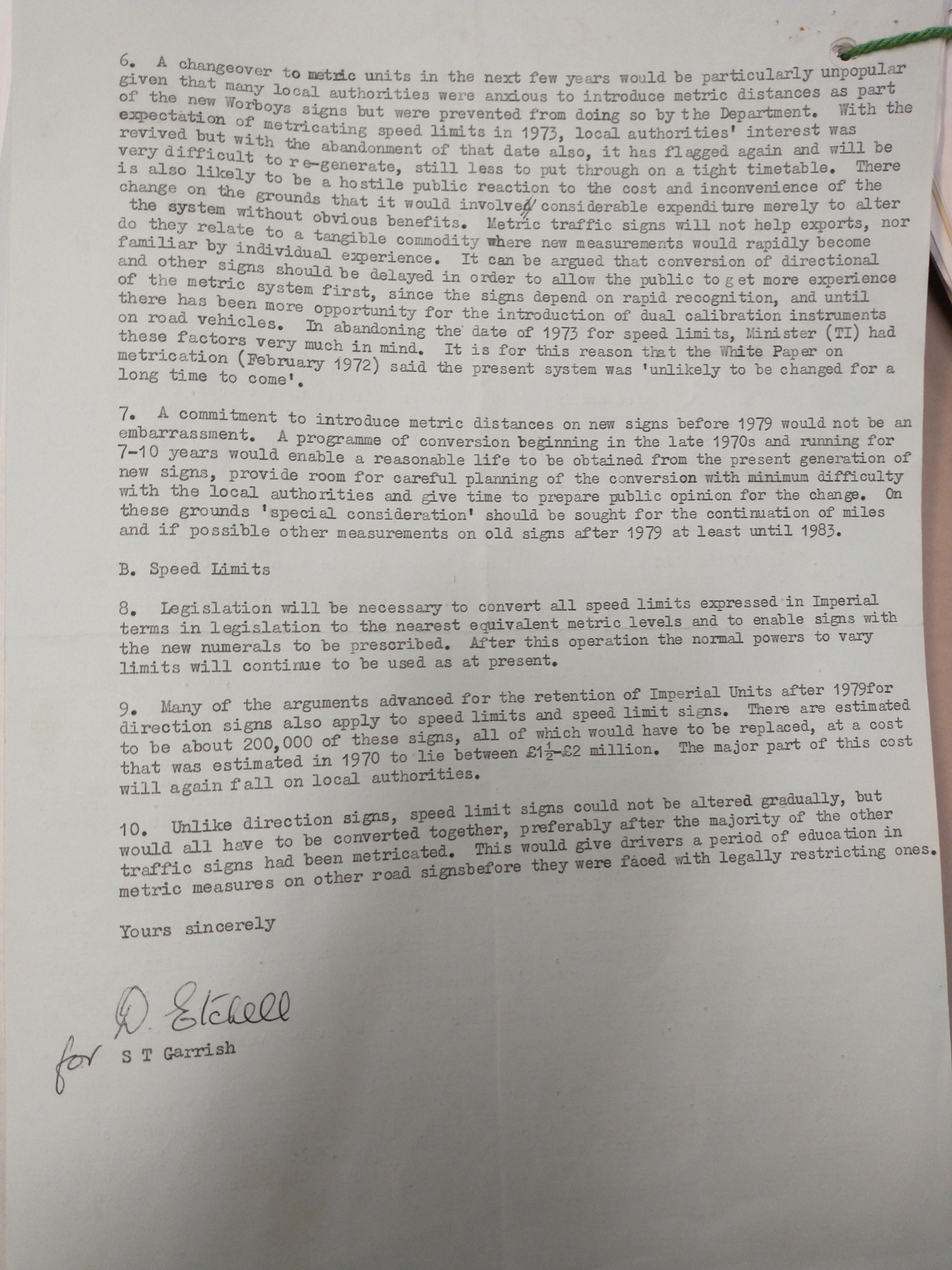
Background note no. 5 gives a range for the cost estimates between £1½ million and £2 million (£19.7 million to £26.2 million at October 2023 prices). Background note no. 9 also mentions these cost estimates and that there are estimated to be about 200 000 speed limit signs.
The papers also estimated the cost and number of other road signs with mileages on them:

Note 3 of the Metrication of Speed Limits and Traffic Signs paper says:
“There are some 200,000 [speed limit] signs and it will cost perhaps £2M. Other signs needing conversion are mainly direction signs with mileages, and such signs as width and weight restrictions. Altogether they may amount to another 350,000 and £2M+.”
The cost range for converting speed limits has already been estimated to be between £1½ million and £2 million in 1970. The paper did not give a maximum limit above the estimated £2 million cost of replacing the other imperial signs. If we use an upper limit of £3 million for argument’s sake, the total estimated cost would be between £3.5 million and £5 million (£45.9 million to £65.5 million at October 2023 prices).
Let’s compare these inflation-adjusted cost estimates with the UKMA and DfT cost estimates published in 2006. There were approximately 550 000 signs to replace in 1970. A cost range of £3.5 million and £5 million (£27.8 million to £39.7 million at 2006 prices) would be equivalent to £6.36 to £9.09 per sign (£50 to £72 per sign at 2006 prices). Changing 200 000 speed limit signs at a cost of £2 million would be equivalent to £10 per sign (£79 per sign at 2006 prices).
In 2006, the UK Metric Association published the “Metric Signs Ahead” report on the metrication of British road signs. (Source: UKMA, https://ukmetric.files.wordpress.com/2017/07/msa.pdf) This report estimated that the cost of amending or replacing half a million road signs would be in the range £41 – 160 million, with a “most probable” figure of £80 million, some of which would be absorbed within annual revenue budgets. This is equivalent to £82 – £320 per sign with a “most probable” figure of £160 per sign.
In response to the UKMA report, the DfT published its own report, “Estimating the cost of conversion of road traffic signs to metric units”, on the cost of replacing around half a million signs. (Source: The National Archives, http://tinyurl.com/7bqczxa) It was estimated that the cost of amending or replacing around half a million signs would be in the range £680 – 760 million. This is equivalent to £1360 – £1520 per sign.
The DfT’s estimated cost per sign in 2006 is 17 to 19 times the original government estimates in 1970 (no more than £80 per sign at 2006 prices) after adjusting the original figures for inflation. They appear to be grossly inflated compared to the government’s own original estimates.
For many years, the DfT has given cost as the reason for its refusal to metricate British road signs. After its previous excuses lost all credibility, it had to come up with a new excuse. Hence, the DfT produced grossly inflated cost estimates for conversion to justify its refusal. One thing is clear about conversion costs. Future conversion costs rise as an ever-increasing number of road signs and markings are added. They will also have to be converted. The more it is put off, the more the eventual cost will be. If cost is an issue now, why didn’t the Government proceed with the conversion in 1973 when the cost was cheap? The next Metric Views article will tell you the reasons given for scrapping the planned conversion. Most of these reasons had nothing to do with costs.
The Bank of England Inflation Calculator was used to adjust figures for inflation and can be found at https://www.bankofengland.co.uk/monetary-policy/inflation/inflation-calculator.
 Metric Views
How many times have you been behind a vehicle and it says “This vehicle is limited to 58 MPH or this vehicle is limited to 62 MPH and so forth, we know that this is soft metrication, now 20+ years ago the Republic of Ireland went from MPH to km/h on their road signs, they simply replaced old warn out MPH signs with new km/h ones, currently in parts of the country (UK) we have local authorities reducing the speed limit from 30 MPH to 20 MPH, and what is 20 MPH in km/h? Well it’s about 32 km/h, which means no single sign needed changing because all the local authorities have to do is put a km/h sign (a large readable label) under the 30 MPH limit that now say 30 km/h, also since reducing the speed limit is such a big political issue now I have a simple solution, make changing to km/h a road safety issue. You can reduce the speed limit in km/h and nobody would notice because people see a bigger number in km/h compared with MPH. For example 30 MPH to 20 MPH people don’t like, but 30 MPH to 30 km/h is still 20 MPH but people see 30. It’s psychological.
LikeLiked by 1 person
Thank you Ronnie, this is a very well researched article.
LikeLiked by 1 person
In the 50 years since then, we the tax payers, have had to bear the daily cost of duplicity of pointless signage with all the added confusion and retrograde education.
LikeLiked by 2 people
Thanks, Ronnie, for the digging you have done to reveal this. This confirms my view that decisions are based on political will rather than cost. Everything costs something, so cost is a handy pretext for opposing something, rather than to present a less-plausible reason – especially when figures are presented without context. The figures from the DFT’s estimate circa 2006 appear to apply to changing ALL signs, not just speed limiting one. This is not really an honest appraisal; we all know that disance signs could be updated on an opportunity and piecemeal basis.
LikeLiked by 3 people
There are a number of reasons why the inflation-adjusted cost of metrication of road signs in 1970 would have been a lot cheaper than today. First of all there were probably far fewer road signs to change: no 20 mph zones, no 50 mph signs and far fewer 40 mph zones, all of which need repeater signs. The other reason is possibly far less attention was paid to health and safety.
LikeLiked by 3 people
What a waste when this could have all been done and dusted 50 years ago. In my local town, there are a couple of footpath signs in km, and a few “give cyclists space” signs that are in metres, but all the road signs for vehicles are in miles and some in “yards” (whatever that is).
LikeLiked by 3 people
Thanks, Ronnie, for a very information article. In its articles over the years UKMA has shown how this changeover could made be efficiently and in a cost-effective manner. It is absurd to leave imperial units on road signs when the economy operates in modern units of measurement. This will be a one-off, long term change that will benefit everyone, and imperial units will become (an interesting part of) history. Once it’s been done, we will all wonder what the fuss was. The question is when will it happen.
LikeLiked by 2 people
The above only covers speed limit signs. The “how far away” signs will need to be changed too. There will also be knock-on effects. And how often does something government does come in on budget? You cannot change all the signs at the same time which means that the new signs will have to have the figure followed by “K” or “KM” which takes up space which is at a premium on road signs. For the record I am all in favour of metrication, but I think that successive governments have rightly decided that no real benefit will come from making a change.
LikeLike
@Martin I do recall seeing an example of a sign which merely had km (not KM) above the numbers rather than beside each one which seemed like a good use of currently unused space and would avoid needing a larger sign to carry all the information.
This would also make it easier to plate existing distance signs instead of having to replace the whole thing to allow for the extra space.
LikeLiked by 1 person
@Free Thinker
Indeed. This is demonstrated in our leaflet “Traffic Signs 2.0”, in the section titled “7. Replace miles with kilometres”.
https://ukma.org.uk/publications/traffic-signs-leaflet/
LikeLiked by 2 people