
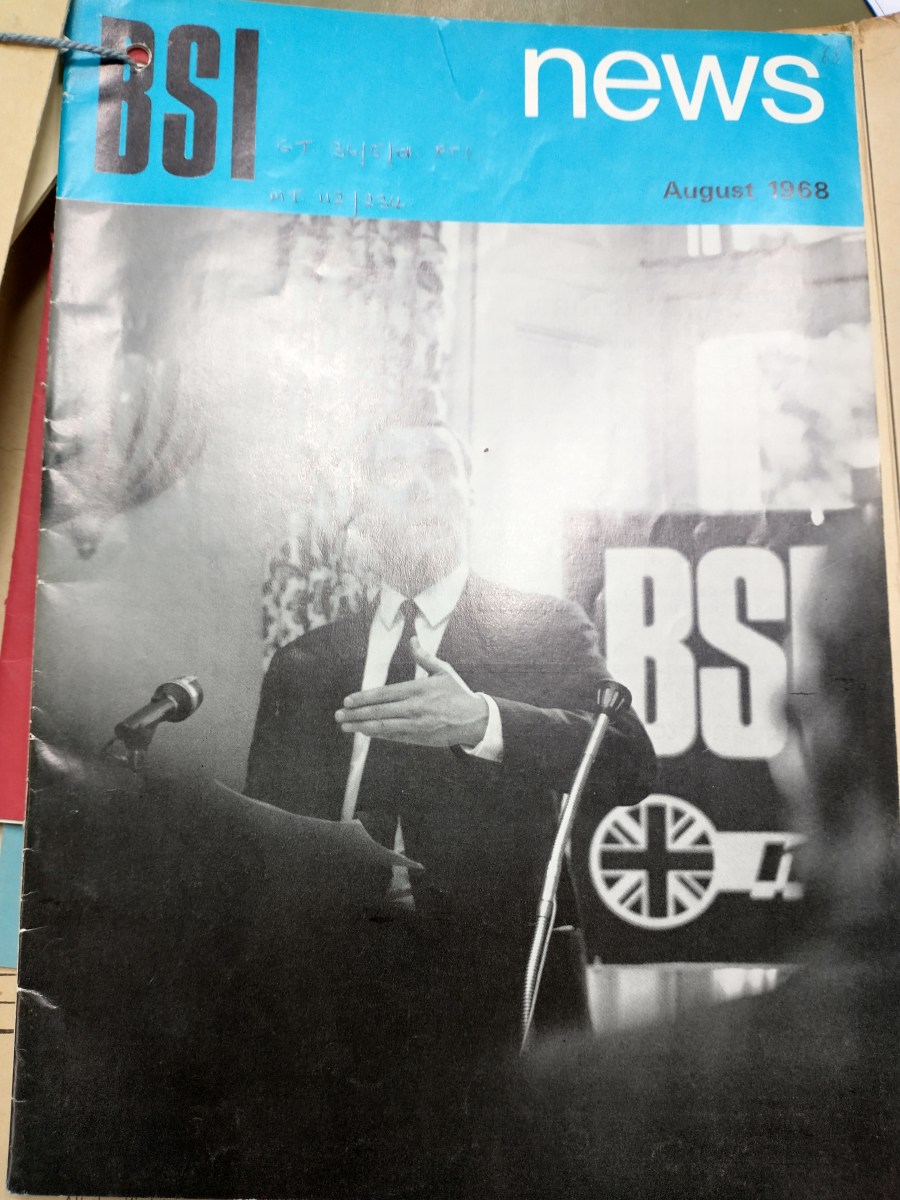
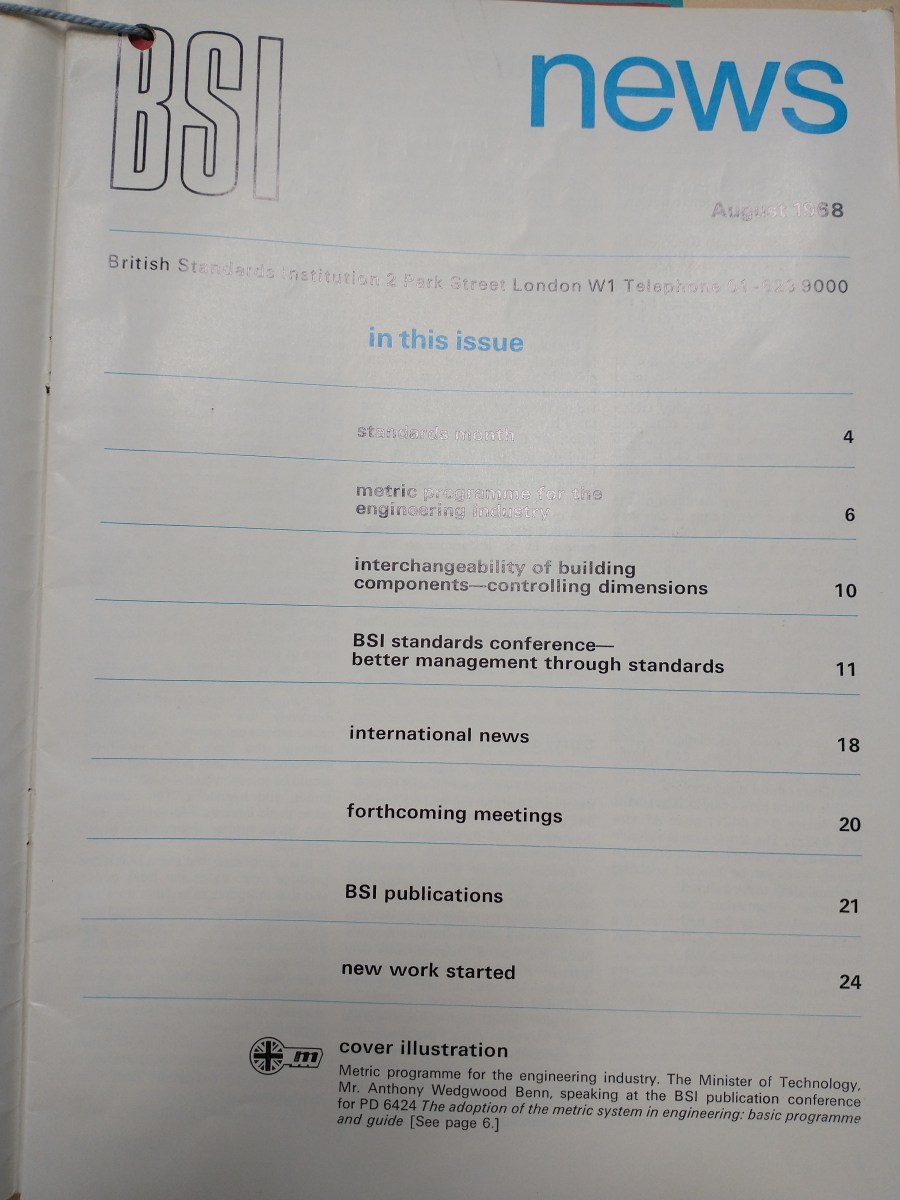
In August 1968, the British Standards Institution (BSI) published one of its most consequential issues of BSI News: a comprehensive, sector‑by‑sector roadmap for Britain’s transition to the metric system. At a time when engineering, manufacturing, construction and public administration were still deeply rooted in imperial units, BSI’s programme represented a decisive shift toward international alignment, industrial efficiency and long‑term economic competitiveness.
The original pages from that 1968 issue offer a rare, detailed snapshot of the UK’s metrication strategy at the moment it was being built. This article synthesises those pages into a coherent narrative, showing how BSI planned the transition, how industry responded and how the government positioned metrication as a national priority.
1. Setting the Scene: A Nation at a Measurement Crossroads
The late 1960s were a period of rapid global standardisation. Across Europe and beyond, engineering industries were converging on SI units, driven by international trade, scientific collaboration and the need for interoperable components. Britain—still using inches, pounds and gallons—risked falling behind.
BSI’s August 1968 issue opens with a clear message: metrication is not optional. It is a strategic necessity.
2. The Engineering Metric Programme: A Structured National Plan
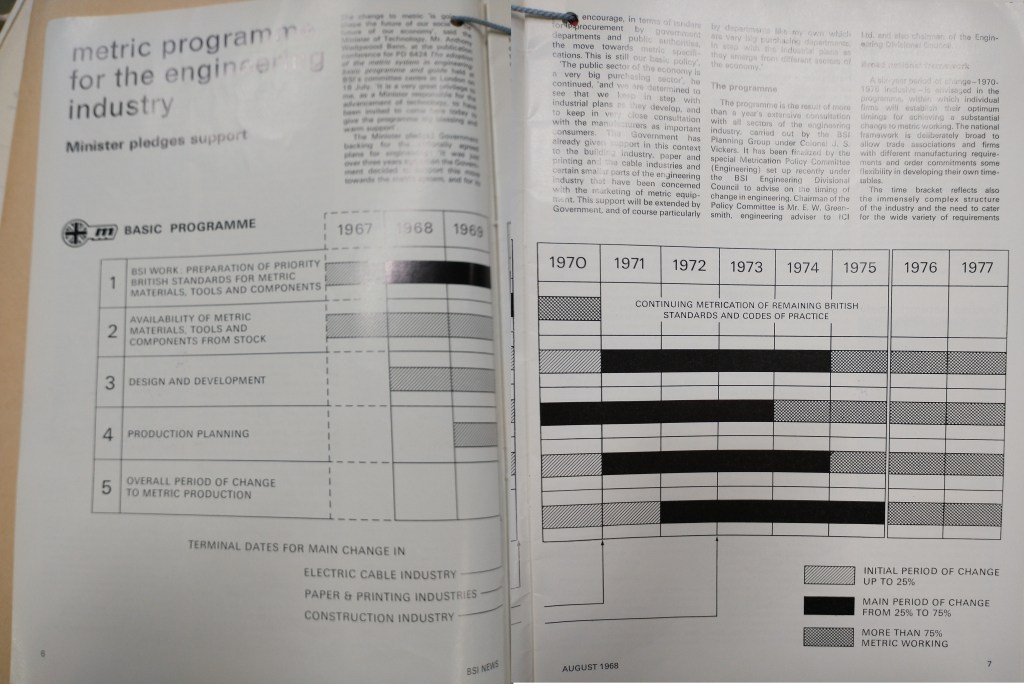
At the heart of the publication is the Metric Programme for the Engineering Industry, a multi‑year timeline mapping the transition from imperial to metric standards.
The Basic Programme (1967–1969)
BSI laid out five foundational tasks:
- Preparation of priority British Standards for metric materials, tools and components
- Ensuring availability of metric stock
- Design and development of metric products
- Production planning
- Full transition to metric production
The timeline uses shading to show progress—from initial change (up to 25%) to main change (25–75%) and finally to full metric working.
Terminal Dates for Key Industries
BSI identified industries that needed early conversion:
- Electric cable
- Paper and printing
- Construction
These sectors were foundational to broader industrial supply chains, making their early metrication essential.
3. Industry Response: Support, Coordination and Practical Guidance
The pages show strong backing from the Confederation of British Industry (CBI) and active coordination across engineering sectors.
Network Analysis of Metric Product Introduction
One standout feature is a flowchart showing how a company should introduce a metric product—from policy development to design, manufacturing drawings and classification of parts.
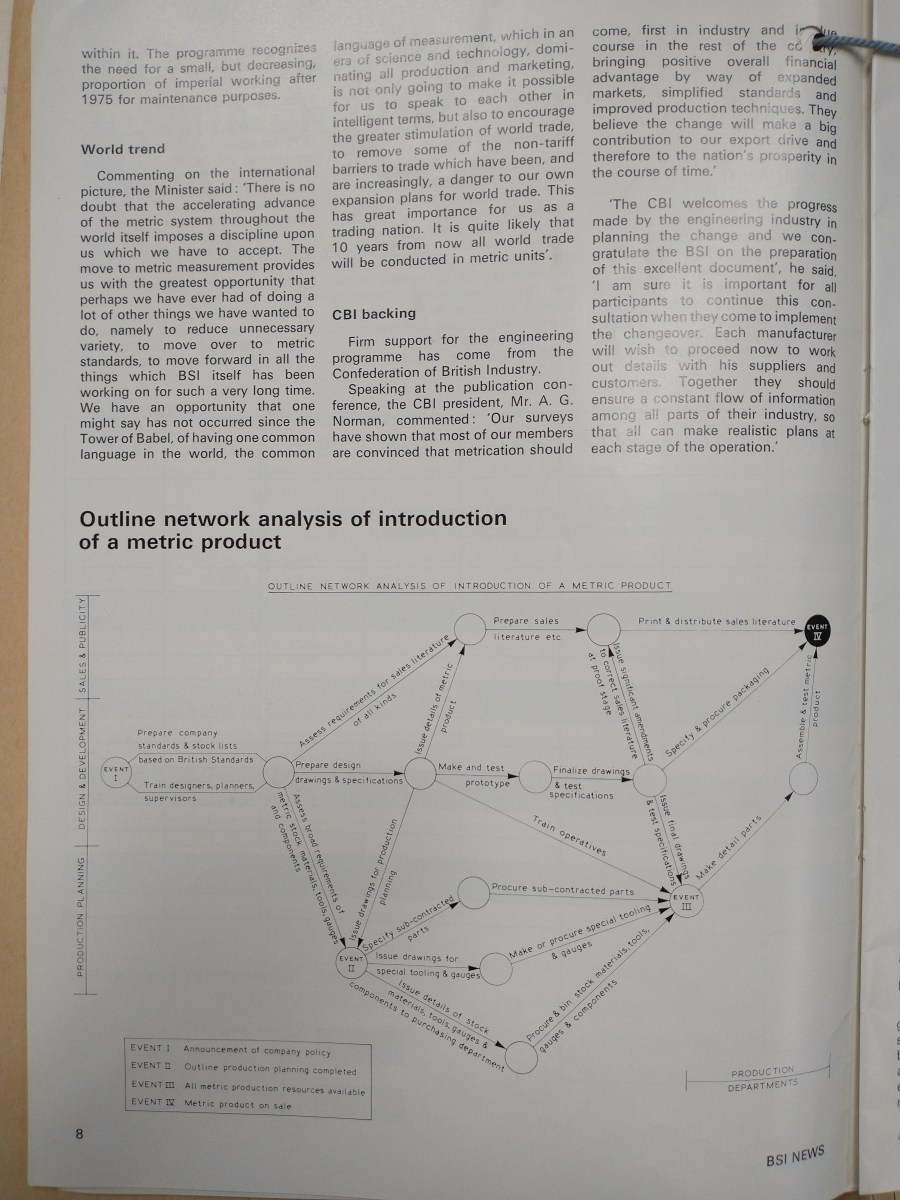
This is early systems engineering applied to metrication—a sign of how seriously industry took the transition.
Practical Guidance
BSI provided:
- Sector‑specific programmes
- Advice on dimensional coordination
- Updates to standards for washers, tubes, cranes, office furniture and more
- Revised specifications for steel, tolerances and quality control
Metrication was not just about units—it was about rebuilding industrial consistency.
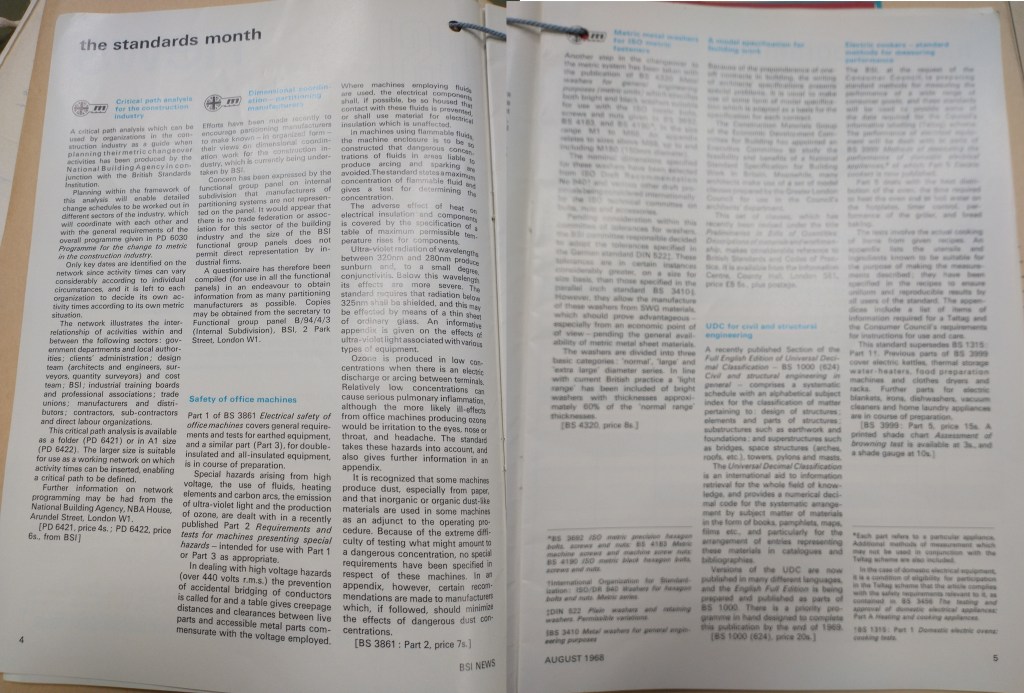
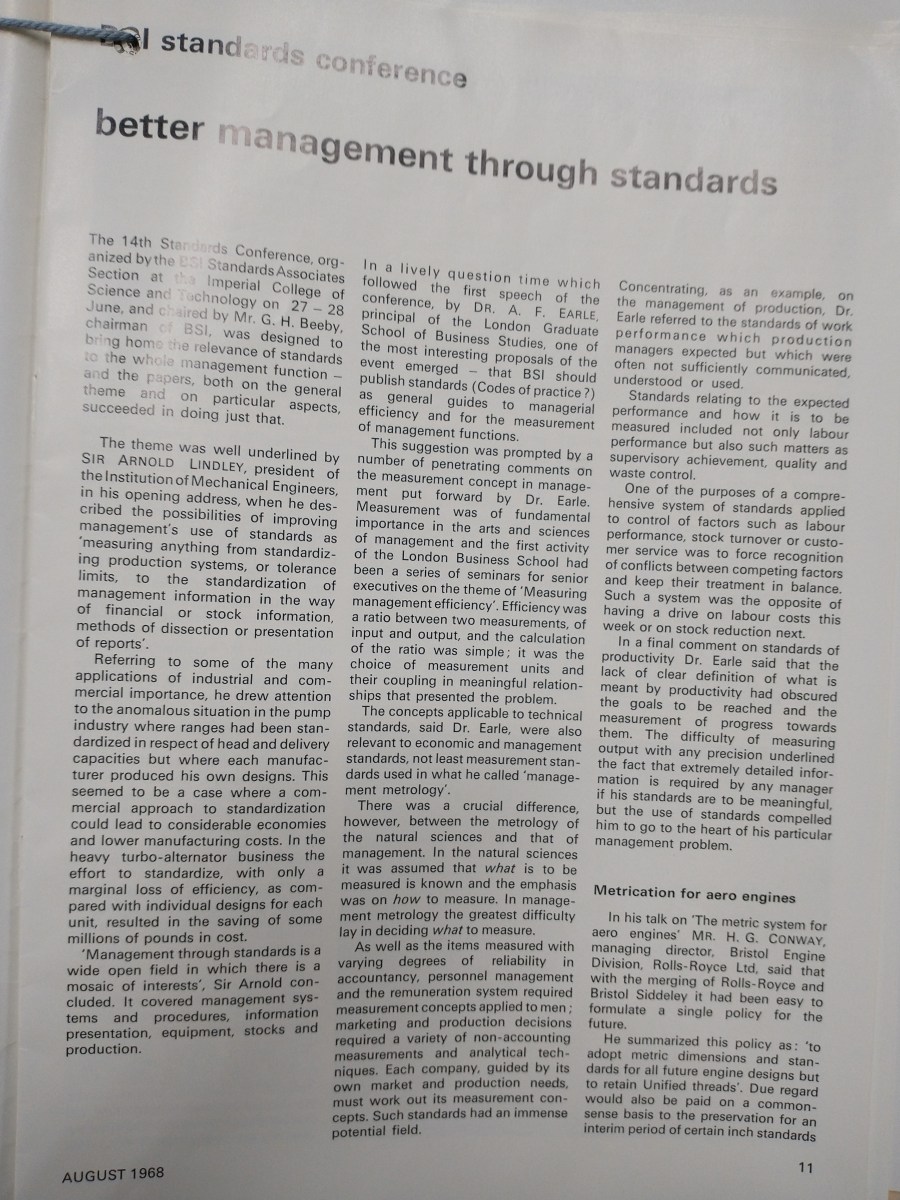
4. Management Through Standards: A New Professional Mindset
Several pages focus on the role of standards in improving management efficiency. Conferences held by BSI emphasised:
- Better decision‑making through standardisation
- The importance of metrology
- The need for uniformity in design and production
- The role of standards in aero‑engine metrication
Speakers from academia, industry and government reinforced that metrication was part of a broader movement toward professionalised management.
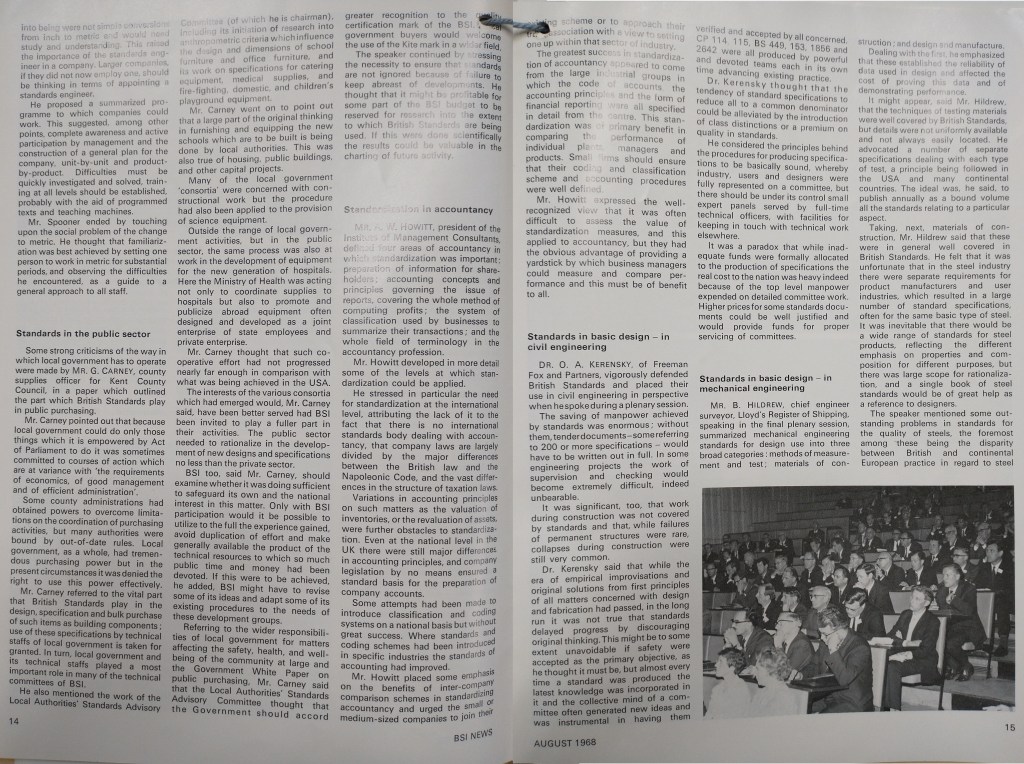
5. Sector Case Studies: Public Sector, Accountancy, Civil & Mechanical Engineering
The publication includes detailed discussions of how metrication and standardisation would affect:
- Local government procurement
- Accountancy practices
- Civil engineering design
- Mechanical engineering fundamentals
Each sector faced unique challenges, but all shared a common need: consistent, internationally aligned measurement systems.
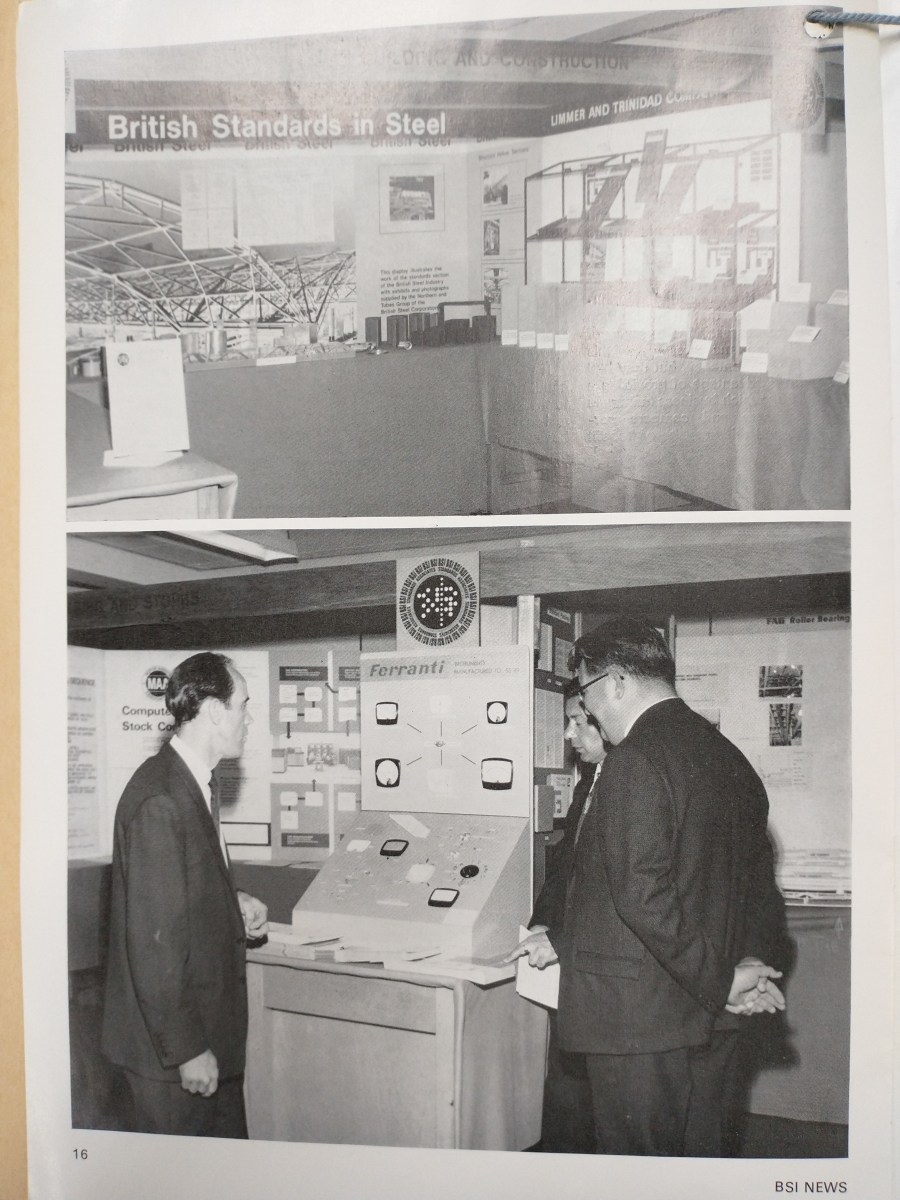
6. Exhibitions, Regional Engagement and Public Communication
BSI’s regional exhibitions showcased:
- Standardisation in steel
- Computerised stock control systems
- Ferranti’s engineering displays
- Construction and production standardisation
These exhibitions were crucial for persuading industry and the public that metrication was practical, modern and beneficial.
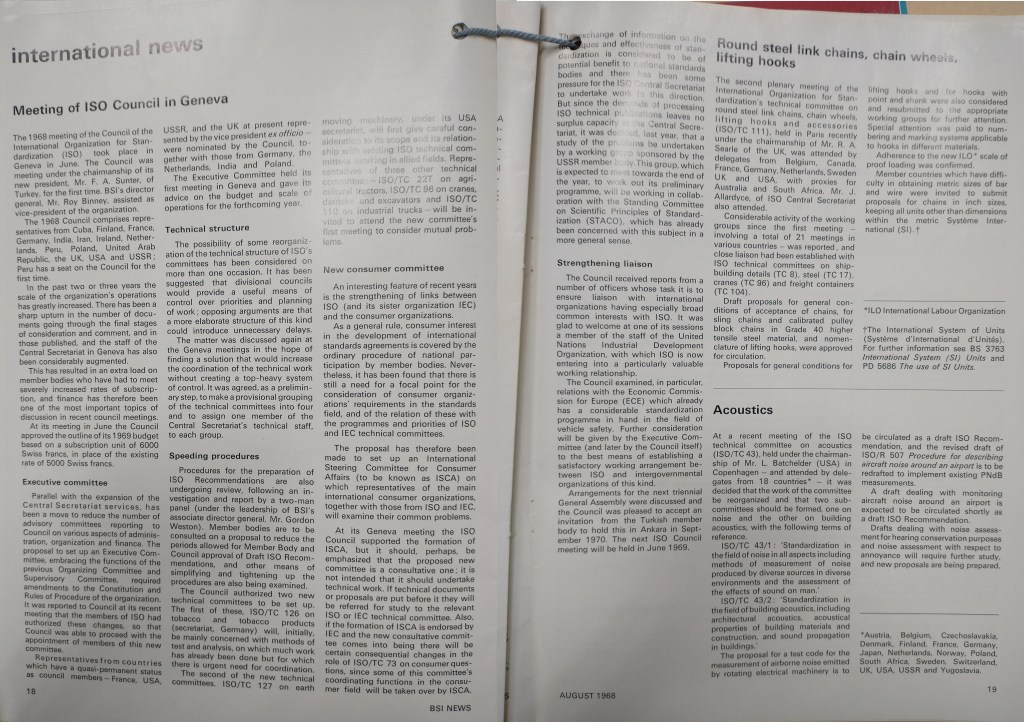
7. International Standardisation: ISO and IEC Developments
The August 1968 issue also reports on:
- ISO Council meetings in Geneva
- Strengthened liaison with international bodies
- New ISO and IEC recommendations
- Acoustics, chain wheels, lifting hooks and other technical areas
Metrication was part of Britain’s integration into a global standards ecosystem.
8. New Standards, Withdrawals and Drafts: The Machinery of Change
The publication ends with extensive listings of:
- New British Standards
- Revised standards
- Withdrawals
- Drafts circulated for comment
- Proposed pesticide common names
- Updates to BS 9000 (electronic components)
These lists show the sheer administrative scale of metrication—hundreds of standards updated, replaced or created.
Conclusion: A Moment of National Modernisation
The August 1968 BSI News captures Britain at a pivotal moment. Metrication was not a simple unit conversion—it was a national modernisation project impacting every sector, every factory, every design office and every public authority.
This edition of BSI News shows the seriousness, structure and ambition behind the programme. It also reveals how much progress was made—and how much remains unfinished today.
For readers of Metric Views, these pages are more than historical artefacts. They are reminders that measurement reform requires planning, leadership and persistence. In 1968, Britain had all three. The challenge now is to rediscover that momentum.
 Metric Views
One key point that was missed in the document was education of the public. In Australia and South Africa, the sale of measuring devices that were calibrated in imperial units was prohibited. In the UK, not only were dual units were permitted so that the public could “get used to metric units”, but on tape measures, measuring jugs etc imperial units continued to be the easier to use while at garages, psi is the default for measuring tyre pressure.
In the current situation in the UK, one way to overcome this problem without too much customer resistance would be to remove VAT on domestic-quality measuring devices that displayed only metric units. If the average household spends £24 per year on such devices, the cost to government would be £4 per household – an amount that would be “lost in the noise”, but which would remove the “compulsion” element from the British mindset. (Due to EU constraints, special conditions or an EU exemption might have to apply to Northern Ireland).
LikeLike