
Yesterday, the National Audit Office (NAO) criticised the UK Department for Transport (DfT) for its unfounded claims about the benefits of the proposed high speed rail project HS2. In this article, Ronnie Cohen identifies another unfounded claim by the DfT – one that relates to the change to metric units on road signs.
Category: Myths
A statement from UKIP
UKIP’s recent electoral successes have resulted, quite rightly, in increased scrutiny of its policies. Here, we take a look at a recent statement by the Party’s Trade spokesman on the subject of measurement units.
Myths, misinformation and fallacies (1) – Are imperial units “natural”?
The claim is often made by last-ditch defenders of miles, feet, pints and acres that “Imperial units are natural whereas metric units are artificial”. In the first of an occasional series of articles on “myths, misinformation and fallacies” used by opponents of completing metrication, we examine this claim.
A list of such myths is summarised in a webpage on UKMA’s main website at this link entitled “Briefing note for UKMA representatives”. This note arose from a discussion at UKMA’s 2012 annual conference about the abysmal standard of debate heard on local radio phone-in programmes. The original intention was (and remains) to help UKMA members and supporters to make the case in radio and television interviews, in newspaper correspondence and online.
In the coming months we shall be discussing particular arguments from this list and opening them up to readers of MetricViews. This week we look at the claim that:
“Imperial units are natural whereas metric units are artificial”
Continue reading “Myths, misinformation and fallacies (1) – Are imperial units “natural”?”
UK metric myths tumble during the Games
Metric Views revisits some of the myths around the metric system, and asks readers to suggest how many of these might have lost credibility as a result of the welcome given in the UK to the Olympic Games of 2012.
DfT cost claims busted
The UK Department for Transport (DfT) now puts forward cost as the principal reason for the failure to convert road traffic signs to metric. Ronnie Cohen reports on a major study he has recently carried out, using the Freedom of Information Act, to find out the actual costs of replacing and installing traffic signs. He finds that the DfT estimate of cost, published in 2006, bears little relation to reality.
Marathon myth
With the London Marathon being run today, it is timely to remember the metric origins of the marathon, and to puncture the myth that it is a race measured in imperial units.
Linked by a common system of measures
There is a widely held view in the UK that we share our measurement system with the USA. True – but not in the way many believe. Continue reading “Linked by a common system of measures”
Are Imperial units based on 12s?
It is often claimed that imperial is based on 12s (duodecimal) and that this has advantages over decimal. But is this truth or myth?
Of course it makes more sense to use the same number system for measurement, money and other practical uses. But let’s look at whether imperial is duodecimal.
Consider length:
One foot = 12 inches
One yard = 3 feet
One rod = 5.5 yards
One chain = 4 rods
One furlong = 10 chains
One mile = 8 furlongs
Only the foot uses a base of 12.
Consider volume:
One pint = 20 fluid ounces
One gallon = 8 pints
No duodecimal units
Consider avoirdupois weight:
One pound = 16 ounces
One stone = 14 pounds
One hundredweight = 8 stones
One imperial ton = 20 hundredweight
Again no duodecimal units
A disadvantage of imperial is that it does not have any consistent number system but uses a hodgepodge of bases.
First Emperor showed the way – 2000 years ago
I recently had the pleasure of visiting the splendid (Chinese) First Emperor exhibition at the British Museum. Apart from the terracotta warriors, what impressed me the most was the way that Qin Shihuangdi imposed standardisation on his vast empire – including, of course, weights and measures.
Qin Shihuangdi unified China by conquest in 221 BC. One of his first acts was to decree that only standard weights and measures were to be used throughout the empire. The bronze weight illustrated below is inscribed as follows: “In the 26th year [of his reign the king of Qin] united the princes of the [individual] states; the people enjoyed peace, and he was proclaimed emperor [huangdi]. He issued an edict that all weights are to be standardised. Where they are not uniform, or where there are any doubts, let them be standardised and classified.”
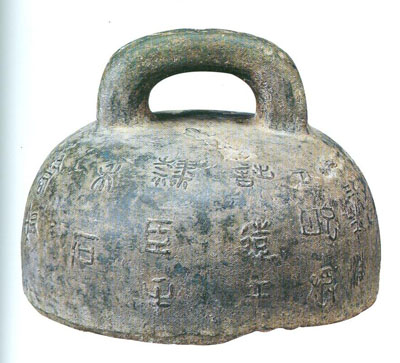
(Acknowledgements to the Trustees of the British Museum)
Also of interest is the measuring cup illustrated below. Its capacity is a “half dou”, which was the most popular size in use. Strangely enough, it is almost exactly equivalent to one litre. Obviously, this must be sheer coincidence, but it does give the lie to the British imperialists’ claim that the pint is “natural”, whereas the litre is not.
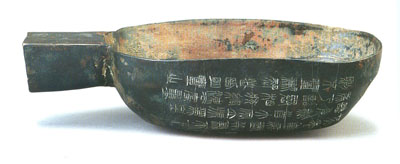
(Acknowledgements to the Trustees of the British Museum)
Here in Britain the first recorded attempt to standardise weights and measures can be found in Magna Carta (1215), but it was not until 1824 that imperial measures were standardised by the first Weights and Measures Act. Unfortunately, our current crop of politicians lack the perception or the political courage (or both) to acknowledge that a single system of weights and measures is a basic requirement of a modern society. Hence we have, to quote another Chinese leader*, “one country, two systems”.
————————————————————————–
*the late Deng Xiaoping, referring to the Hong Kong Special Administrative Region
Language and measurement – an enduring relationship
One objection to metrication that I often hear is that the imperial system is embedded in the English language. If we were to lose the old measurement system, we would lose a lot of our language with it, they say. Just how true is that? (Article contributed by David Brown)
Continue reading “Language and measurement – an enduring relationship”
 Metric Views